

See more of our articles in your search results.
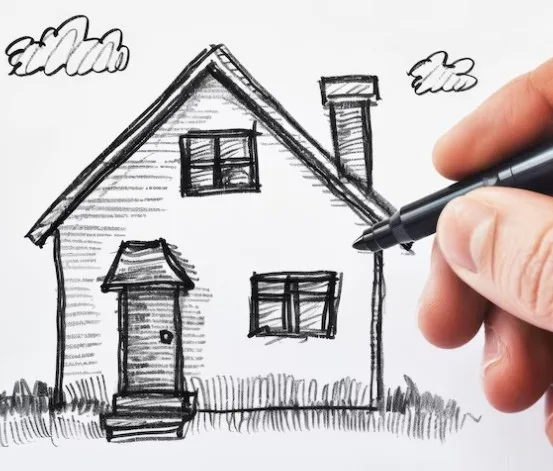
A psychologist hands someone a blank sheet of paper and a pencil, and asks for something that sounds almost too simple: draw a house. No instructions on style, no time pressure, no right answer. And yet what comes back on that page — the size of the door, whether there’s a chimney, how close the windows sit to the ground — can reveal something the person never intended to say out loud.
That’s the strange power behind the House Test, more formally known as part of the House-Tree-Person technique in clinical psychology. It works on the premise that when the conscious mind isn’t being asked a direct question, it sometimes lets something quieter slip through — feelings about home, safety, family, or self that a person might struggle to name in a straightforward interview. This matters because not every emotional truth arrives neatly packaged in words. Some of it only shows up sideways, through a drawn roofline or a door with no handle.</p
But how exactly does a simple drawing turn into clinical insight?
This guide explains what the House Test is, its defining characteristics, how it’s administered, and how psychologists actually go about interpreting it.
What Is the House Test in Psychology?
The House Test is a projective psychological assessment in which a person is asked to draw a house, with the resulting image analyzed for symbolic content related to their emotional state, self-perception, and family relationships. It’s most commonly used as one component of the broader House-Tree-Person (HTP) test, developed to explore personality traits that standard questionnaires might miss.
How many of these have you been "meaning to read" for months?
- 1
 TarcherThe Artist's Way30th Anniversary EditionListen Free On Audible
- 2
 Undercover Publishing HouseStop Letting Everything Affect YouHow to break free from overthinking, emotional chaos, and self-sabotage.Listen Free On Audible
- 3
 MajostaDon't Believe Everything You ThinkWhy Your Thinking Is The Beginning & End Of Suffering (Beyond Suffering)Listen Free On Audible
Projective tests, as a category, operate on a specific theoretical assumption: when given an ambiguous task, people unconsciously project their own psychological content onto it. A house, in this framework, often symbolizes the self, one’s family of origin, or one’s sense of security. That’s a big claim to rest on a doodle, and clinicians who use the test tend to treat it as one data point among several, not a standalone diagnosis.
A few things distinguish this specific test from other assessment tools:
- It requires no verbal fluency, making it usable across age groups and language barriers.
- It draws on unconscious symbolism rather than direct self-report.
- It’s typically followed by a structured interview asking the person to describe their own drawing.
Psychologist John N. Buck, who developed the technique in the 1940s, envisioned it as a way to access personality dimensions that resisted more direct questioning — the sort of material people either couldn’t articulate or weren’t fully aware of themselves.
Where Did the House Test Come From? Origins and History
The House Test emerged directly from earlier work in projective assessment, particularly efforts to use drawing as a window into personality rather than intelligence alone. Its roots trace back to research on children’s drawings from the early twentieth century.
Psychologist Florence Goodenough created the Draw-a-Man test in 1926, originally intended to measure cognitive development in children rather than emotional content. That instrument planted the seed for a much bigger idea: drawings could reveal something systematic about the person holding the pencil. Buck built on this foundation, formally introducing the House-Tree-Person technique in 1948, expanding beyond a single human figure into three separate symbolic subjects.
The technique gained substantial traction through the later contributions of psychologist Emanuel Hammer, whose 1958 book on clinical applications of projective drawings became a standard reference for interpreting HTP results in therapeutic settings. Hammer’s work pushed the House Test from a research curiosity into something regularly used in clinical practice, particularly with children and adolescents who struggled to articulate feelings verbally.
A rough timeline looks like this:
- 1926 — Florence Goodenough introduces drawing-based assessment with the Draw-a-Man test.
- 1948 — John Buck formally develops the House-Tree-Person test as a projective personality measure.
- 1958 — Emanuel Hammer publishes influential clinical guidance expanding interpretive frameworks.
- 1960s–present — The test becomes a staple in child clinical assessment, though scrutiny over its scientific rigor grows steadily alongside its use.

What Are the Key Characteristics of the House Test?
Several defining features separate the House Test from more standardized psychological measures, and understanding them clarifies both its appeal and its limitations. It isn’t scored the way a multiple-choice personality inventory is.
The most central characteristic is its open-ended, ambiguous prompt. There’s no template, no example shown beforehand, and minimal instruction beyond “draw a house.” That openness is intentional — the fewer constraints given, the theory goes, the more personal material surfaces in the choices someone makes.
- It relies on symbolic interpretation rather than objective scoring criteria.
- Results are typically evaluated alongside a follow-up interview about the drawing’s meaning to the person.
- It’s frequently used in combination with drawings of a tree and a person, forming the complete HTP battery.
- Interpretation depends heavily on the clinician’s training and theoretical orientation.
That last point is worth sitting with for a moment. Two clinicians looking at the exact same drawing might reach somewhat different conclusions, depending on their interpretive framework. This subjectivity is precisely where much of the test’s controversy originates, a topic worth returning to later.
How Is the House Test Administered Step by Step?
Administration follows a fairly consistent structure across clinical settings, even though interpretation varies more widely afterward. The process is short. Usually under fifteen minutes for the drawing itself.
- The clinician provides plain paper and a pencil, without rulers, erasers, or reference images.
- The person is asked to draw a house, with minimal further guidance beyond that single instruction.
- Once finished, the clinician conducts a structured interview, asking questions like who lives there or what’s happening inside.
- The clinician documents both the visual elements and the person’s verbal responses about the drawing.
- Results are considered alongside other assessment data, never interpreted in complete isolation.
The interview stage matters more than people often assume. A closed door might mean something entirely different if the person explains it as “that’s just where the mail slot goes” versus “no one’s allowed in there.” Context reshapes meaning constantly, and a skilled clinician treats the drawing as a conversation starter, not a verdict rendered on sight.

How to Interpret a House Drawing: Key Elements to Analyze
Interpretation generally focuses on specific structural elements within the drawing, each carrying loosely established symbolic associations within projective testing tradition. None of these associations function as fixed rules; they’re starting points for further exploration, not conclusions.
| Drawing Element | Common Interpretive Focus |
|---|---|
| Door | Represents accessibility to the self or willingness to let others in emotionally |
| Windows | Suggest openness to the outside world and social contact |
| Chimney | Often linked to emotional warmth or family atmosphere within the home |
| Roof | Associated with fantasy life or intellectual and imaginative functioning |
| Overall size | May reflect self-esteem or perceived personal significance |
Clinicians also pay attention to line pressure, placement on the page, and how much detail the person adds without prompting. A house drawn tiny in the corner of a large page carries a very different feel than one that fills the entire sheet confidently. Still, no single feature should be read in isolation. A missing chimney doesn’t automatically signal a cold home life. It might just mean the person forgot, or ran out of time, or never thought chimneys mattered to their concept of “house” in the first place.
What Different House Features May Symbolically Represent
Beyond individual architectural elements, broader patterns in how a house is drawn can carry additional symbolic weight within the interpretive tradition established by Hammer and later clinicians. These patterns tend to focus on the relationship between the house and its surrounding context.
- A house drawn with heavy fencing or barriers may suggest a felt need for protection or emotional guardedness.
- A house floating without ground contact can point toward feelings of instability or lack of grounding.
- Multiple structures or additions might reflect a sense of a complicated family system rather than a single cohesive unit.
- Excessive erasing or reworking of one section often draws clinical attention toward specific areas of conflict the person is unconsciously revisiting.
It’s tempting to treat this like a decoder ring, matching each detail to a fixed meaning. Resist that urge. The same “isolated house” pattern might reflect healthy independence in one person and painful loneliness in another — the surrounding interview and broader clinical picture are what actually differentiate those two very different realities.
House Test vs Other Projective Drawing Tests
The House Test rarely stands entirely alone; it’s usually one piece of a larger projective drawing battery, and understanding its relationship to sibling techniques clarifies its specific role. Comparing it against related tests highlights what makes house imagery distinct from other symbolic subjects.
Psychologist Karen Machover developed the Draw-A-Person Test in 1949, focusing specifically on figure drawings as a window into self-concept and body image, distinct from Buck’s broader HTP framework. Where Machover’s test zeroes in tightly on identity and self-image through a human figure, the House Test within HTP tends to surface material related to family environment and sense of security instead.
Some useful distinctions:
- The Draw-A-Person Test focuses heavily on self-image and body-related concerns.
- The tree drawing within HTP is often interpreted as reflecting unconscious growth patterns and resilience.
- The house drawing specifically tends toward themes of family, home life, and felt security.
- The Rorschach inkblot test, though also projective, relies on abstract shapes rather than a specific concrete object, drawing on a different interpretive tradition entirely.
Combining all three HTP drawings tends to give clinicians a fuller picture than any single drawing could offer on its own — the house, tree, and person together, cross-referenced, rather than any one image carrying the full interpretive weight.
Is the House Test Scientifically Valid? Criticisms and Limitations
This is where the conversation gets genuinely complicated, and any honest discussion of the House Test has to sit with that discomfort rather than glossing over it. Projective drawing tests, broadly, face persistent questions about reliability and validity within the research community.
Critics point out that interpretation varies significantly between clinicians, undermining the kind of consistency that scientific measurement generally requires. Psychologist John Exner, whose work on standardizing the Rorschach through the Comprehensive System aimed to address similar criticisms in that test, illustrates just how much effort is required to bring rigor to projective methods — effort the House Test has never received to the same degree.
Key limitations worth naming directly:
- There’s no universally standardized scoring system comparable to structured personality inventories.
- Cultural background heavily influences house imagery and architectural norms, complicating cross-cultural interpretation.
- Research support for specific symbolic claims remains inconsistent across studies, with some findings failing to replicate.
None of this means the test is useless. It just means it works best as a supplementary, exploratory tool, not a diagnostic instrument capable of standing alone. Responsible clinicians treat it that way. Not all of them do, and that gap is exactly where the criticism has teeth.

When and How Psychologists Use the House Test Today
Despite the ongoing debate over scientific rigor, the House Test still shows up regularly in specific clinical contexts, particularly where verbal assessment falls short. It hasn’t disappeared. It’s just been repositioned within a more cautious, supplementary role.
Common current uses include:
- Working with young children who lack the verbal vocabulary to describe complex emotional states directly.
- Building initial therapeutic rapport through a low-pressure, non-confrontational task early in treatment.
- Supplementing broader assessment batteries in forensic or custody evaluations, always alongside more rigorously validated instruments.
- Exploring themes in trauma-informed care, where indirect expression sometimes feels safer than direct disclosure.
Most contemporary training programs emphasize using the House Test as a conversational bridge rather than a scored diagnostic tool. If a clinician leans on it as the sole basis for a major clinical decision, that’s generally considered outside best practice. Used thoughtfully, though, it can open doors — sometimes literally, given the imagery involved — that a direct question never quite manages to.
FAQs about the House Test
Is the House Test the same as the House-Tree-Person test?
Not exactly, though they’re closely related. The House Test typically refers to just the house-drawing component, while the House-Tree-Person test, developed by John Buck, includes three separate drawings: a house, a tree, and a person, each interpreted individually and then together. In clinical practice, the house drawing is rarely used entirely on its own; it’s usually part of the full HTP battery, since combining all three drawings gives a broader and more balanced picture than any single image alone.
Can the House Test diagnose a mental health condition?
No, it isn’t designed or validated to diagnose any specific condition on its own. It functions as a supplementary, exploratory tool that may highlight themes worth discussing further, not as a standalone diagnostic instrument. Responsible clinicians use it alongside structured interviews, standardized questionnaires, and clinical observation, treating any single drawing as one piece of information among several rather than conclusive evidence of anything specific.
What age group is the House Test typically used with?
It’s used across a wide age range, but it’s particularly common with children and adolescents who may struggle to articulate complex feelings verbally. Younger children especially benefit from a task that doesn’t require sophisticated language skills. That said, clinicians also use it with adults in certain therapeutic contexts, particularly when verbal defenses seem to be blocking deeper exploration, or when someone finds direct emotional questions overwhelming to answer head-on.
Does a scary or unusual house drawing always mean something is wrong?
Not necessarily, and that’s an important point often missed in casual discussions of the test. A single unusual feature, like a house with no door or heavy shading, isn’t automatically evidence of distress. Interpretation depends heavily on context, the accompanying interview, and the overall pattern across multiple elements, not one detail in isolation. Clinicians are trained to avoid jumping to conclusions based on a single striking image without further exploration.
How long does administering the House Test usually take?
The drawing portion itself typically takes somewhere between five and fifteen minutes, depending on the person’s pace and level of detail added. The follow-up interview, where the clinician asks questions about the drawing’s meaning, generally adds another ten to twenty minutes. Altogether, the full process is relatively brief compared to lengthier standardized assessments, which is part of why it remains a practical option for initial evaluations or rapport-building sessions.
Why do some psychologists avoid using the House Test at all?
Some clinicians avoid it primarily due to concerns about scientific reliability and validity, since interpretation can vary considerably between practitioners and lacks a universally standardized scoring system. Given that psychology as a field increasingly favors evidence-based, empirically validated tools, some practitioners consider projective drawing tests too subjective for rigorous clinical use. Others still find value in it as a supplementary or rapport-building exercise, provided it’s never treated as a definitive diagnostic measure on its own.
Bibliography
- Buck, J. N. (1948). The H-T-P Test. Journal of Clinical Psychology.
- Hammer, E. F. (1958). The Clinical Application of Projective Drawings. Charles C. Thomas Publisher.
- Goodenough, F. L. (1926). Measurement of Intelligence by Drawings. World Book Company.
- Machover, K. (1949). Personality Projection in the Drawing of the Human Figure. Charles C. Thomas Publisher.
- Exner, J. E. (2003). The Rorschach: A Comprehensive System. John Wiley & Sons.
- American Psychological Association. Guidance on projective testing and psychological assessment standards.
- Lilienfeld, S. O., Wood, J. M., & Garb, H. N. (2000). The Scientific Status of Projective Techniques. Psychological Science in the Public Interest.
Use this citation format to reference the article clearly and help readers find the original source.
PsychologyFor. (2026). House Test: What it Is, Characteristics and How to Interpret it. PsychologyFor. https://psychologyfor.com/house-test-what-it-is-characteristics-and-how-to-interpret-it/