


See more of our articles in your search results.
You’ve just wiped down the counter for the third time in an hour, and yet your mind is already whispering that it isn’t clean enough. This is what an obsession with cleanliness feels like from the inside — not a preference for tidiness, but a relentless internal alarm that never seems to switch off. People around you might call it “neat freak” behavior or even admire your spotless home, but you know the truth: the cleaning isn’t optional, and the relief it brings never lasts long enough. What looks like discipline from the outside often feels, from the inside, like being held hostage by your own hands.
This experience carries real emotional weight because it quietly consumes hours, relationships, and peace of mind. Many people with compulsive cleaning habits describe canceling plans because the house “isn’t ready,” feeling intense anxiety when someone touches a freshly cleaned surface, or lying awake mentally rehearsing tomorrow’s cleaning routine. It matters because this pattern often overlaps with obsessive-compulsive disorder or perfectionism rooted in anxiety, and without intervention, the compulsive loop tends to expand rather than resolve on its own. The exhaustion isn’t just physical — it’s the cognitive toll of never being allowed to feel “done.”
Is there a way to actually loosen this grip without your home falling into total chaos?
This guide explains what drives an obsession with cleanliness, how to tell it apart from ordinary tidiness, and evidence-based strategies to regain control of your time and mind.
How many of these have you been "meaning to read" for months?
- 1
 TarcherThe Artist's Way30th Anniversary EditionListen Free On Audible
 - 2
 Spiegel & GrauCodependent No MoreHow to Stop Controlling Others and Start Caring for Yourself (Revised and Updated)Listen Free On Audible
 - 3
 TarcherperigeeSet Boundaries, Find PeaceA Guide to Reclaiming YourselfListen Free On Audible

What Is an Obsession with Cleanliness, Exactly?
An obsession with cleanliness is a pattern in which cleaning stops being a practical task and becomes a compulsive response to intrusive anxiety, disgust, or fear of contamination. Unlike simply enjoying a tidy space, this pattern is driven by distress that temporarily eases only through repeated, ritualized cleaning behavior.
Psychiatrist Judith Rapoport, author of the landmark book on OCD titled “The Boy Who Couldn’t Stop Washing,” documented how cleaning and washing rituals often emerge from an overactive threat-detection response in the brain, rather than any genuine increase in dirt or danger. The person isn’t choosing to clean excessively out of preference; their nervous system is signaling danger that the cleaning temporarily silences.
This distinction matters clinically. In many cases, this pattern falls under contamination-focused obsessive-compulsive disorder, one of the most common OCD subtypes, though it can also appear as a milder, non-clinical perfectionistic tendency. Both versions share a common thread: cleaning is used to manage internal anxiety rather than external mess.
- Contamination OCD involves intrusive fears about germs, illness, or “wrongness” tied to dirt.
- Perfectionistic cleaning is driven by a need for control rather than fear of contamination itself.
- Situational over-cleaning can appear temporarily during high-stress life periods without becoming chronic.

Is This OCD or Just High Standards? Key Differences
The core difference lies in whether cleaning is a choice or a compulsion driven by unbearable anxiety. If skipping a cleaning ritual triggers intense distress, intrusive thoughts, or a sense of impending doom, this points toward a genuine obsessive-compulsive pattern rather than simple preference.
Clinical psychologist Jonathan Abramowitz, a leading OCD researcher, notes that the defining feature of clinical obsession isn’t the behavior itself but the function it serves — compulsions exist specifically to neutralize anxiety generated by intrusive thoughts. Someone with high standards can tolerate an unfinished task; someone with cleanliness OCD often cannot, even when they logically know the fear is exaggerated.
| High Standards | Obsessive Cleaning Pattern |
|---|---|
| Cleaning is flexible and optional | Cleaning feels mandatory and urgent |
| Skipping it causes mild annoyance | Skipping it triggers intense anxiety |
| Doesn’t interfere with daily life | Consumes hours and disrupts relationships or work |
Recognizing this line honestly, without shame, is the first step toward change. It also clarifies whether self-help strategies are enough or whether structured treatment, such as cognitive behavioral therapy, is warranted.
What Causes an Obsession with Cleanliness?
This pattern typically develops from a mix of genetic predisposition, learned anxiety responses, and life circumstances that reinforce control-seeking behavior. No single cause explains it fully, but several contributing factors show up consistently in research and clinical practice.
Anxiety specialist Reid Wilson explains that obsessive patterns often form when a person’s brain misreads an ordinary sensation — like touching a doorknob — as a genuine threat, prompting an exaggerated protective response. Over time, the brain “learns” that cleaning relieves this false alarm, reinforcing the cycle through negative reinforcement.
Life experiences also shape this pattern significantly. Growing up in a highly critical household, experiencing a traumatic illness, or living through a period of genuine chaos can all prime someone toward using cleanliness as a coping mechanism for underlying control and uncertainty.
- Genetic vulnerability to anxiety disorders increases susceptibility to obsessive-compulsive patterns.
- Learned associations between mess and danger, often formed in childhood or after trauma.
- Chronic uncertainty in life circumstances that gets displaced onto controllable domestic tasks.
Signs Your Cleaning Habits Have Become Compulsive
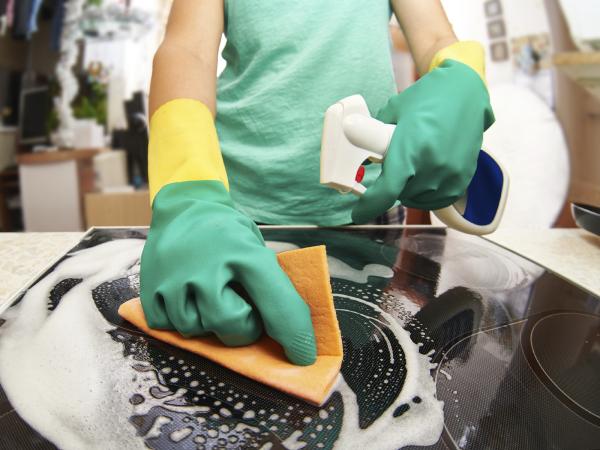
Recognizing the shift from habit to compulsion is essential before change can happen. The clearest indicator is that cleaning no longer feels like a choice but an urgent, anxiety-driven necessity that overrides other priorities.
Many people notice they’ve begun rearranging their entire schedule around cleaning rituals, avoiding social invitations because their home “isn’t ready,” or feeling disproportionate distress when someone else cleans a surface “incorrectly.” These behaviors often coexist with intrusive thoughts about contamination, illness, or moral “wrongness” tied to mess.
- Notice if you re-clean already-clean surfaces multiple times daily out of anxiety rather than necessity.
- Track whether you avoid social situations because of contamination fears or an unfinished cleaning task.
- Check whether loved ones have expressed concern about your cleaning-related distress or time spent.
- Ask whether you feel physical relief only temporarily after cleaning, with anxiety quickly returning.
Honest self-observation here isn’t about self-judgment; it’s diagnostic information that clarifies the next step, whether that’s self-guided strategies or professional exposure-based treatment.
How Exposure and Response Prevention Helps Break the Cycle
Exposure and Response Prevention (ERP) is the gold-standard, evidence-based treatment for obsessive cleaning patterns, working by gradually exposing a person to feared triggers while resisting the urge to perform the cleaning ritual. Over repeated practice, the brain learns the feared outcome doesn’t occur, and the anxiety naturally diminishes.
Psychologist Edna Foa, a pioneer of ERP research, demonstrated that avoidance and ritual behavior actually maintain anxiety rather than reduce it long-term, even though compulsions provide short-term relief. Her research established that the anxiety curve peaks and then naturally falls if the ritual is delayed or skipped, a concept known as habituation.
A practical starting point involves delaying a cleaning urge by a small, manageable increment — five minutes, for example — and gradually extending that delay over several weeks. This is not about eliminating cleaning altogether, but retraining the brain to tolerate uncertainty and discomfort without immediately neutralizing it through ritual behavior.

Practical Daily Strategies to Loosen Cleaning Compulsions
Small, structured changes to daily routine can meaningfully reduce the grip of compulsive cleaning without requiring a complete lifestyle overhaul. The goal is to interrupt the automatic loop between anxiety and ritual response.
Setting a firm time limit for cleaning tasks — twenty minutes for the kitchen, for instance — and stepping away once the timer ends, even if anxiety remains, helps rebuild tolerance for imperfection. This structured boundary prevents the open-ended, never-satisfied quality that fuels obsessive cleaning.
- Establish a realistic cleaning schedule instead of responding impulsively whenever anxiety spikes.
- Practice mindfulness techniques to observe the urge to clean without immediately acting on it.
- Deliberately leave one small task intentionally imperfect to build tolerance for incompleteness.
- Redirect freed-up time toward enriching leisure activities that rebuild identity beyond cleaning.
Consistency matters more than intensity here. Small, repeated practice in tolerating a slightly messy drawer builds far more lasting change than one dramatic attempt to quit cleaning altogether.
The Role of Perfectionism and Control in Cleaning Obsessions
Perfectionism frequently underlies obsessive cleaning, functioning as a way to manage anxiety about judgment, failure, or unpredictability elsewhere in life. Understanding this connection reframes the behavior as an emotional coping mechanism rather than a character flaw.
Researcher Brené Brown, known for her work on shame and vulnerability, describes perfectionism as a shield against the fear of being seen as inadequate — a dynamic that can easily attach itself to something as controllable as household cleanliness. A spotless home becomes proof of worth, competence, or safety, even when that connection is entirely unconscious.
Loosening this grip requires gently challenging the belief that imperfection equals danger or inadequacy. Journaling about the specific fear behind an urge to clean — “what am I afraid will happen if I don’t?” — often reveals the deeper anxiety driving the behavior, which is rarely actually about dirt itself.
How Loved Ones Can Support Someone Struggling
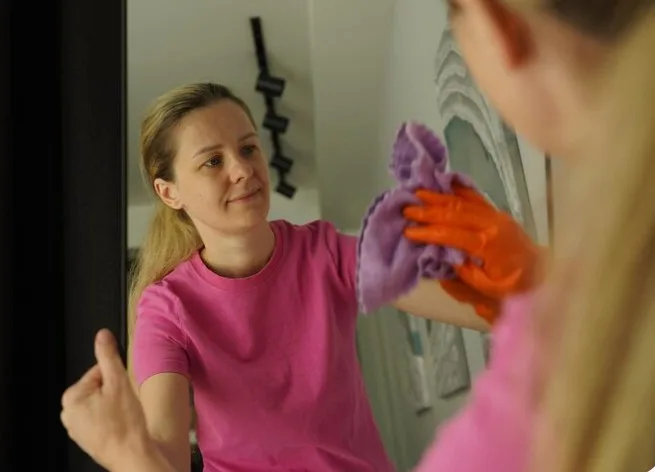
Family and partners play a significant role in either reinforcing or reducing compulsive cleaning patterns, often without realizing it. The most helpful support avoids both harsh criticism and constant accommodation of the compulsion’s demands.
Repeatedly reassuring someone that a surface is “clean enough,” or performing cleaning rituals on their behalf to ease their distress, can unintentionally strengthen the obsessive-compulsive cycle rather than easing it. This pattern, known clinically as family accommodation, is common and well-documented in OCD treatment literature.
Instead, loved ones can offer steady encouragement toward tolerating discomfort, gently naming the pattern without shame, and supporting professional treatment when needed. Patience matters enormously here — compassionate accountability, rather than either enabling or confrontation, tends to produce the most sustainable progress.
When to Seek Professional Help for Cleanliness OCD
Professional support becomes essential when cleaning compulsions consume significant time, damage relationships, or resist self-directed change despite genuine effort. This is not a sign of weakness — it reflects the same medical logic as seeking treatment for any anxiety-based condition.
Psychiatrist Jeffrey Schwartz, developer of the widely used Four Steps method for OCD, emphasizes relabeling intrusive urges as brain-based false alarms rather than accurate signals, which helps patients create psychological distance from the compulsion. Combined with structured ERP therapy and, in some cases, SSRIs prescribed by a psychiatrist, this approach has strong evidence supporting long-term symptom reduction.
A licensed mental health professional can assess whether the pattern meets criteria for OCD or reflects a milder anxiety-driven habit, then tailor treatment accordingly. Reaching out for this kind of support is an act of self-respect, not failure, and it often produces meaningfully faster relief than self-help alone.
FAQs about Overcoming Obsession with Cleanliness
Is an obsession with cleanliness always a sign of OCD?
Not always. Some people develop intense cleaning habits due to perfectionism, past trauma, or high anxiety without meeting the full clinical criteria for obsessive-compulsive disorder. The key distinguishing factor is whether the behavior is driven by uncontrollable anxiety and intrusive thoughts, and whether it significantly disrupts daily functioning, relationships, or wellbeing. A mental health professional can conduct a proper assessment to clarify whether the pattern reflects diagnosable OCD, a related anxiety condition, or a non-clinical perfectionistic tendency that can still benefit from support.
How long does it take to reduce compulsive cleaning behaviors?
Progress varies widely depending on severity, consistency of practice, and whether professional treatment like exposure and response prevention is involved. Some people notice meaningful reductions in anxiety within a few weeks of consistent practice delaying cleaning urges, while more entrenched patterns may take several months of structured therapy. Patience is essential, since setbacks are a normal part of the process rather than a sign of failure. Gradual, consistent effort tends to produce more durable change than attempting to stop all cleaning behavior abruptly.
Can medication help with obsessive cleaning?
Yes, selective serotonin reuptake inhibitors, commonly known as SSRIs, are frequently prescribed alongside therapy for obsessive-compulsive patterns, including compulsive cleaning. Medication can help reduce the intensity of intrusive anxiety, making it easier to engage in behavioral treatments like exposure and response prevention. Medication decisions should always be made with a licensed psychiatrist who can evaluate individual symptoms, medical history, and severity, since it is not universally necessary and works best combined with structured therapeutic support rather than as a standalone solution.
What should I do if my partner’s cleaning habits are affecting our relationship?
Start by having an honest, compassionate conversation about how the behavior is affecting you, without framing it as a character flaw. Avoid either constantly accommodating every cleaning demand or dismissing their distress, since both extremes tend to reinforce the underlying pattern rather than help it. Encouraging your partner to speak with a mental health professional, and offering to support that process, is often more effective than trying to resolve the issue through arguments alone. Couples or family therapy can also help address how the household has adapted around the compulsion.
Why does cleaning provide only temporary relief from anxiety?
Cleaning rituals interrupt anxiety in the short term because they provide immediate action against a perceived threat, triggering a quick sense of relief. However, this relief reinforces the underlying fear rather than resolving it, since the brain never learns that the feared outcome wouldn’t have happened anyway. This is why compulsions tend to escalate over time, requiring more frequent or intense rituals to achieve the same temporary calm. Breaking this cycle requires tolerating the anxiety without immediately acting on it, which gradually retrains the brain’s threat response.
Can children develop an obsession with cleanliness too?
Yes, contamination-related obsessive-compulsive patterns can appear in children and adolescents, sometimes triggered by illness, family stress, or learned behavior from an anxious caregiver. Signs may include excessive handwashing, refusal to touch certain objects, or extreme distress over mess or perceived dirtiness. Early intervention with a child psychologist trained in cognitive behavioral therapy tends to produce strong outcomes, since children are often highly responsive to structured, gradual exposure techniques when guided by a supportive, patient caregiver and clinician team.
Bibliography
- Rapoport, J. (1989). The Boy Who Couldn’t Stop Washing. Dutton.
- Abramowitz, J. S. (2018). Getting Over OCD: A 10-Step Workbook for Taking Back Your Life. Guilford Press.
- Foa, E. B., & Kozak, M. J. (1986). Emotional Processing of Fear: Exposure to Corrective Information. Psychological Bulletin.
- Schwartz, J. M. (1996). Brain Lock: Free Yourself from Obsessive-Compulsive Behavior. HarperCollins.
- Wilson, R. (2016). Stopping the Noise in Your Head: The New Way to Overcome Anxiety and Worry. Health Communications Inc.
- Brown, B. (2010). The Gifts of Imperfection. Hazelden Publishing.
- American Psychological Association. (2022). Obsessive-Compulsive Disorder. APA.org.
- National Institute of Mental Health. Obsessive-Compulsive Disorder Overview. NIMH.gov.
Use this citation format to reference the article clearly and help readers find the original source.
PsychologyFor. (2026). How to Overcome the Obsession with Cleanliness. PsychologyFor. https://psychologyfor.com/how-to-overcome-the-obsession-with-cleanliness/