

See more of our articles in your search results.
The Roman world was an eminently urban world. However, we cannot ignore the importance of the rural area, which guaranteed the production and distribution of raw materials and food that allowed the cities and the army to survive. In this agricultural world we find the villaerural centers that represented a complete microcosm and often highly specialized.
How did you live in a Roman Villa?
Although it is true that these villae were constant throughout the history of Rome, it is also true that the intense social changes that occurred from the 2nd and 3rd centuries AD modified their characteristics, and the towns went from being small centers of production, highly involved in the trade network. imperial, to luxurious self-sufficient houses in which the dominus The lord took shelter from political upheavals and warlike actions. The Roman villa constitutes, therefore, a key element in the transition from late antiquity to the medieval period.
What was it like to live in one of these production centers? Who lived in them, and what was their lifestyle like? In today’s article we tell you what daily life was like in these rural centers of the Roman world, the villae or villas.
The Roman villa: enclaves of a large production and trade network
Although villas were already common at the beginning of Roman history, their presence proliferated shortly before the great crisis of the Roman Republic. These were then modest agricultural centers that rested in the hands of small farmers. However, after the fall of the Republic, with the subsequent crisis and the subsequent rise of the empire, these villae They began to fall into the hands of the great Roman patricians, as well as the wealthy plebeians, and went from being modest buildings in the countryside to constituting true latifundia governed by luxurious mansions that imitated the comfort of urban villas.
Squeeze the countryside to maintain an empire
Roman villas are a product of the countryside: they were located far from the cities, although we find some located, as we have already said, in the heart of the cities. Of course, one of the main differences is that the rural villas had parts dedicated to agricultural tasks, while the city villas constituted only luxury housing.
How many of these have you been "meaning to read" for months?


The workforce in these rural towns was made up of slaves and servants, who were in charge of all the tasks of production, maintenance of the house and care of their masters. Although in the early period these tasks were usually carried out by slaves, a basic pillar of the Roman economy and society, as the empire advanced (and with the expansion of Christianity and its rejection of slavery) we observed a preference for colonists. , that is, free men and women who decide to put themselves in charge of a dominus and enjoy his protection in exchange for working his lands. As we see, This is the germ of what later became the medieval serfs of the people.
In any case, the importance of these towns is crucial, since the supply of products to the empire’s trade network depended on them and, therefore, the feeding of its colonies and the numerous Roman army. Over time, many of these towns came to specialize in specific products: in Hispania, where this type of construction was very common, the area of current Catalonia specialized in vineyards, while Bética and Lusitania were the largest producers of oil.
Private life and work
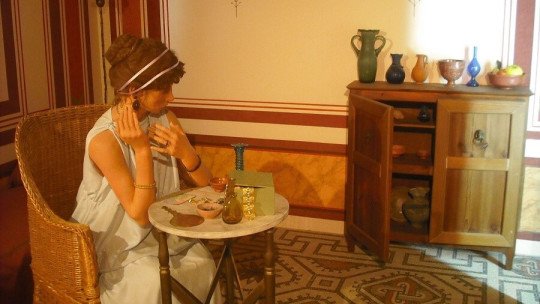
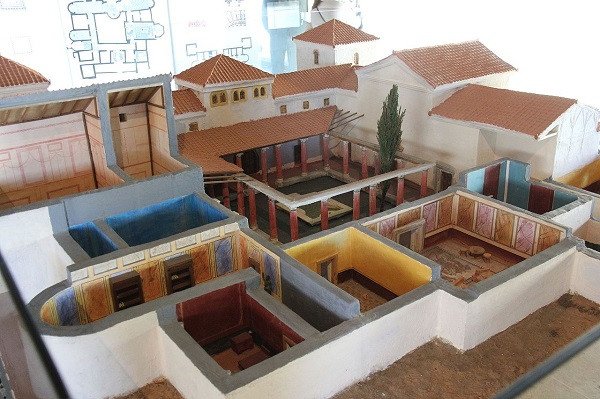
Thus, in Roman villas it is normal to find two blocks duly differentiated and separated: the first, called pars dominicawas the area reserved for dominus or lord and his family, where the rooms for rest and personal leisure were located. Also in this block the lord received his guests, to entertain them and surprise them with his riches, which were usually reflected in the luxurious mosaics and exquisite paintings on the walls.
On the other hand there was the pars massariciawhich represented the production core and the economic base of the hacienda. This part was in turn divided between the pars rusticawhere the workers slept and ate, and the pars fructuaria or production, which was where the areas intended for work were concentrated.
The pars dominica or rooms of the lord
The pars dominica or part of the lord tried to emulate the luxuries and comforts of city homes. In reality, nothing was usually missing in a villa; Of course, the thermal baths were an important space for family leisure and hygiene, as well as the rooms for rest and meals, which were decorated with magnificent mosaics. We have numerous testimonies of villa mosaics that denote the economic power of their owners.; Some of the most spectacular are found in La Olmeda, in Palencia (Spain), a Roman villa that had no less than 3,000 m2 of luxurious mosaic.
In the Roman world, cleansing the body and the social act that this entailed was essential. The villae They had the three rooms that no Roman bath could ignore. First, the caldarium or hot water area, the heat of which was achieved through the Roman hypocaust system, which served both to heat the water in the thermal baths and to heat the various rooms in winter.
The hypocaust consisted of a series of ovens that ran beneath the pavement, raised by brick pillars, whose cavities allowed the flow of hot air. This heating resource was highly appreciated by both Greeks and Romans, and made it possible to make habitable houses that would otherwise have been impassable in winter. Let us remember that Roman villas were not only found in the Mediterranean area, but were also spread throughout the most northern parts of the empire, including Gaul and Britain.
Behind him caldariumthe bather could access the tepidarium or warm water pool and, finally, the frigidariumwhich contained cold water. Not only that; in the villa’s hot springs, the guests of the dominusIn addition to sharing a bathroom with him, they could relax with a massage while talking about politics or culture. The perfect complement was the gymnasium or lecture, common in rich towns, where the lord exercised.
We cannot leave this short tour of the private rooms of a Roman villa without mentioning the large banquet room, usually the most ostentatious room in the house, where the dominus He received his guests with artificial meals. In general, it was an isolated space configured around the peristyle or central patio, where, little by little, the most intimate evenings (the conviviuma relaxed gathering of friends) to more showy expressions of ceremony, where the dominus It was contemplated and revered by the attendees in a replica of the customs of the imperial court.
Towards the figure of the feudal lord
The importance of Roman villas in the configuration of the transitional society between the late ancient and medieval periods is undeniable. We have already commented how, little by little, and As the crisis worsened, the lords of the towns locked themselves in their properties and abstracted themselves from the world of the court and the empire.
These towns, once connected to the production and trade networks of the globalized Roman world, were, therefore, becoming self-sufficient centers that even had small garrisons for their own security. The inhabitants of the countryside were increasingly disconnected from the state and the nuclei that, later, would give rise to medieval fiefdoms were formed.
In this line, the role of dominus of the 4th century AD also changed. In late ancient times, the owner of the town had become a kind of “feudal lord” (we put it in quotes because of the anachronism of this expression), who settled matters not only related to matters of production, but also of justice in his tablinum or office (located in the center of the town, between the atrium and the peristyle). Roman society was moving towards an inevitable fragmentation that will be the main characteristic of the medieval era.
Use this citation format to reference the article clearly and help readers find the original source.
PsychologyFor. (2024). How Did You Live in a Roman Villa?. PsychologyFor. https://psychologyfor.com/how-did-you-live-in-a-roman-villa/