

See more of our articles in your search results.
The Medici marked a definitive stage in the history of their native Florence. Symbols of the almost absolute power of a city that, however, still sold itself as a republic, their wealth and network of contacts allowed them to quickly climb the echelons of power.
Join us in the story of the most powerful family of the Florentine Renaissance
The Florence of the Medici and humanism
At the end of the Middle Ages, a new ideological current began to emerge in the cities of the Italian Peninsula, which would culminate in the Florence of the Quattrocento. This current, which has been called humanism, had its roots in medieval cathedral schools, such as the famous school of Chartres. However, It was not until the end of the 14th century and the beginning of the 15th century that humanism began to gain strength hand in hand with new philosophical currents.
Before the artistic field, the Renaissance occurred in the literary and philosophical field. Thinkers such as Marsilio Ficino (who translated Plato’s work in 1484), Bruni and Pico della Mirandola gave impetus to Neoplatonism, which they tried to assimilate with Christian theory. But, above all, what mainly characterizes Renaissance humanism is the fact of placing the human being at the center of everything.
Unlike medieval theocentrism, in which everything revolved around God, The Renaissance humanist understood that the human being, as created in the image and likeness of God, was the most important thing in divine creation and the center of the universe. Hand in hand with this new conception of reality, art becomes on a “human scale.” The very tall Gothic cathedrals give way, then, to Renaissance buildings, where horizontality predominates and whose proportions are more appropriate to human measurements.
How many of these have you been "meaning to read" for months?
- 1
 TarcherThe Artist's Way30th Anniversary EditionListen Free On Audible
- 2
 Undercover Publishing HouseStop Letting Everything Affect YouHow to break free from overthinking, emotional chaos, and self-sabotage.Listen Free On Audible
- 3
 MajostaDon't Believe Everything You ThinkWhy Your Thinking Is The Beginning & End Of Suffering (Beyond Suffering)Listen Free On Audible
Florence at the beginning of the Renaissance
At the end of the 14th century, Florence was at a time of clear economic and artistic prosperity. Its importance was great among the numerous city states that dotted the not yet unified Italy. However, in the 1390s, The troops of Gian Galeazzo Visconti, Duke of Milan, began to insistently harass the Florentine Republic
Faced with the Milanese threat, which had already taken cities such as Siena and Bologna under its power, Florence closed its doors, with the harm that this self-isolation entailed for a state that based its wealth on trade. However, this situation only strengthened their republican values, compared to the princely system of government that the Visconti represented.
The incursion of Milanese troops was repeated in the 1420s, when Filippo Maria Visconti repeated his father’s attempt to subjugate the Florentine territories. The defeat of the Florentines was avoided through the city’s alliance with Venice, which was satisfactorily settled in 1425.
The Republic of Florence was one of the most careful governments in Europe, since, To guarantee republican benefits, the balances of power were scrupulously monitored We have already commented that the republican values of Florence were very clear in the population, who did not in any way wish to become a principality, like that of their neighbors in Milan.
However, as we will see in the following sections, the reality was very different. The Medici began to climb the ranks of power and, although, nominally, Florence remained a Republic, the family relied on its extraordinary wealth to do and undo as it pleased, which turned the Republic into a covert principality.
Bankers to the Pope and patrons of artists
Although the Medici genealogy dates back to the 11th century, the first notable member is Giovanni di Bicci de Medici, who founded the famous Banca Medici and went from being a simple moneylender to being the official banker of the papacy
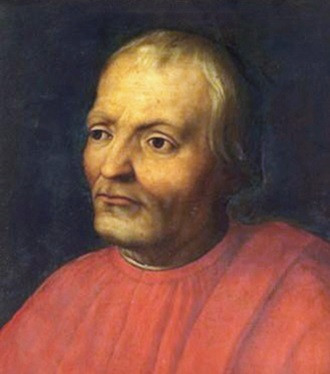
This lucrative business brought Giovanni a considerable fortune that, following the humanist trend of the time, he knew how to invest wisely in the creation of fabulous works of art and, above all, in the patronage of artists of the stature of Masaccio, Brunelleschi and Donatello.
It was not only the love of art that motivated this interest. Giovanni knew, like all powerful people, that art could be one of the fastest vehicles for promotion and propaganda, so he did not hesitate to immerse himself fully in Florentine artistic life.
The artistic patronage of the Medici in Florence, as well as the beginning of their rise to power in the city, began in 1418, when Giovanni led the initiative of several citizens of the San Lorenzo neighborhood who wanted to contribute funds to build a parish. Each of the families would build their own chapel in the church and, obviously, Giovanni was not going to be any less. With Medici funds, the sacristy was built, which was also planned from the beginning as a family mausoleum.
The location of the mausoleum in the new parish of San Lorenzo was not coincidental. An early Christian church from the 4th century had been built on the site, consecrated by none other than Saint Ambrose. The religious symbolism of San Lorenzo was, therefore, greater than that of the Duomo, later consecrated. With this action, the Medici made their intentions very clear.
The year the construction of San Lorenzo began coincides with the moment when Giovanni di Bicci de Medici became papal banker, which, obviously, constituted an important source of wealth for the family. It was this wealth that allowed them to hold, de facto, the power of the city; and although, nominally, Florence remained a republic, the Medici practically served as princes. Precisely, what the Florentines had been fighting against since the end of the 14th century.
Symbols of power
The Medici soon launched a propaganda campaign through new artistic productions, starting with their own residence. It was Giovanni’s son, Cosimo, who led this unstoppable rise that, since 1434, the family was involved in. He never held government positions, but he did direct the political life of the Republic from the shadows. Such power required adequate symbology, and Cosme found it in the main artists of the moment.
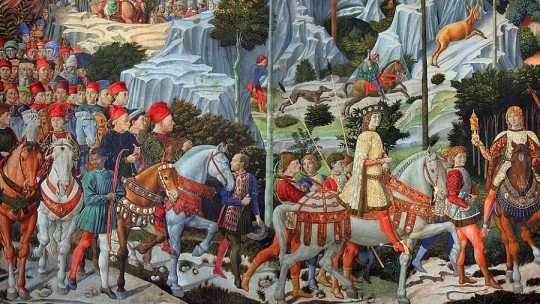
In 1446, Cosimo commissioned Michelozzo to build the family residence, the Medici Palace The palace, which absorbed the old parish of San Lorenzo within its walls, was characterized by being openly inspired, and for the first time in Florentine art, by classical models. On the other hand, the palatine chapel shows the magnificent frescoes of the Procession of the Magiexecuted by Benozzo Gozzoli and which represent an authentic apotheosis of Medicean power, since the family was photographed among the members of the entourage.
The frescoes were executed in 1449 and are preserved in the Medici-Riccardi palace. Among the Medici represented in the procession, the portraits of Cosimo, Piero ‘El Gotoso’ and a very young Lorenzo, who would later be acclaimed as ‘The Magnificent’, stand out.
The appearance of the family’s effigies in the chapel was a very clear allusion to the power that the Medici held in the city Not only that: he placed them in a religious framework that “demonstrated” their devotion and magnificence. Let us not forget that the men of the family paraded in the procession with the brotherhood of the Three Wise Men, which left, every January 6, from the church of the convent of San Marcos, where, supposedly, the relics of the kings were kept. The procession passed through the Medicean palace, making clear with this fact the privileged situation of the family.
Rival families
As expected, not everyone in Florence loved and admired the Medici. Such power always arouses suspicion and envy, and there were many families that disputed this position of power.
Cosimo’s leadership ran into the interests of another of the Florentine families, the Albizzi In 1433, and due to an accusation of embezzlement of public funds, Cosimo was forced to flee Florence. However, a year later, it was the Albizzis who fell from grace and were banished from Florence. Cosimo’s power in his city had redoubled. No one doubted that, although they still technically lived in a republic, the Medici, with Cosimo at their head, were the undisputed lords of the place.
Upon Cosme’s death, his grandson, Lorenzo, came to power. At this time the enemy had changed: the Albizzis were no longer the threat of Medici power, but another family, the Pazzis. It is in this context that the well-known Pazzi conspiracy, a plot orchestrated by the rival family and by the Pope himself, Sixtus IV The plan was to assassinate the Magnificent when he was leaving to hear mass in the Cathedral of Santa Maria in Florence. And although Lorenzo was saved, his brother Giuliano died in the attack. Lorenzo took long revenge on his enemies; After killing them, he had their corpses hung in the Palazzo della Signoria, in addition to allying himself with Naples against the pope.
The Florentine Academy
Cosimo de Medici had sponsored the Careggi Academy, an unofficial circle where humanists who followed the Neoplatonism promoted by Marsilio Ficino met. The Florence of the Medici thus stands as a model to follow for the rest of Italian cities, not only in the philosophical-literary field, but also in the artistic field.
Cosme’s grandson, Lorenzo, was the protagonist of an authentic cultural revolution A great patron and protector of artists and thinkers, he continued to promote the Florentine academy, in addition to acquiring a vast library of classics, supplied by humanists such as the traveling salesman Giovanni Aurispa.
With Lorenzo, art was imbued with Neoplatonic philosophy, and the works of the artists of the moment, such as Botticelli or Michelangelo, followed the precepts developed by the Academy, which dealt with topics such as Platonic love or the immortality of the soul. Not even the harangues of the Dominican Savonarola against these “banalities”, which sowed terror in the Republic, could withstand that universe of beauty and philosophy that supposedly Medici Florence.
Use this citation format to reference the article clearly and help readers find the original source.
PsychologyFor. (2024). What Was Medici Florence Like?. PsychologyFor. https://psychologyfor.com/what-was-medici-florence-like/