

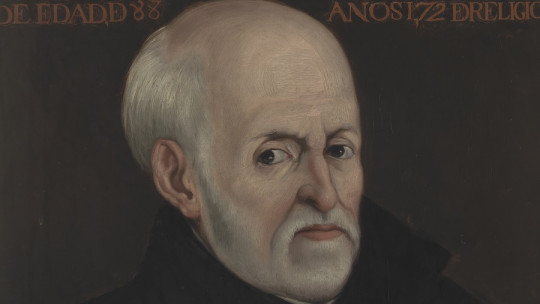
Among the many personalities who represent the period of splendor of Spain in the 16th century, Juan de Mariana is one of them.
We will go through the most important moments in the life of this author through a biography of Juan de Mariana in order to be aware of the importance of his legacy and the height of his critical thinking, which even caused him problems with the ecclesiastical establishment, as we will see later.
Brief biography of Juan de Mariana
Juan de Mariana was born in the Toledo town of Talavera de la Reina, in the year 1536 From his birth, he had a certain stigma, since his father, Juan Martínez de Mariana, was a religious position, known as a dean. Therefore, his relationship with Bernardina Rodríguez was not decent under the morality of that time.
Early years and youth
After spending his entire childhood in Talavera de la Reina and receiving his education in said municipality, he reached the necessary age to continue his higher studies. He decided, to do so, to go to Alcalá de Henares, where the university He was able to train in arts and theology
This was the turning point in his life, as this place allowed him to fully immerse himself in the humanist atmosphere that reigned there. Not only that, but on the same day he registered for university studies, Juan de Mariana also became a member of the Society of Jesus, that is, a Jesuit. One of his most famous companions was Luis de Molina, who would become another of the personalities of the time.
Both were under the orders of Francisco de Borja, who would later be sanctified by the Church. Training in this religious order made Juan de Mariana move, first to Simancas, in Valladolid, and later to Rome, where he completed his instruction. In fact, in the years to come, he himself would be a professor at this Jesuit school.
Today's Top Picks
Updated Daily- 1
 St. Martin's PressLet That Sh*t Go: A Journal for Leaving Your Bullsh*t Behind and Creating a Happy LifeListen Free On Audible
 - 2
 GOSSIP FOXThe Gratitude Journal for More Happiness, Optimism, Affirmation & Reflection - An Effective Manifestation Guide Journal, Undated Daily Journals for Women & Men (Beige)Listen Free On Audible
 - 3
 aspenbookcoThe Mindfulness Journal: Daily Practices, Writing Prompts, and Reflections for Living in the Present MomentListen Free On Audible
After his stay in Rome, he continued moving to other Italian towns, such as Loreto and Palermo, where he transmitted the teachings of the Society of Jesus. When the year 1569 arrived, Juan de Mariana undertook a new journey, this time to the French capital, Paris, to achieve the degree of doctor in theology.
In Paris he lived for five years teaching at the Sorbonne University. But he also witnessed dramatic events, such as the Massacre of Saint Bartholomew, an episode of the French Wars of Religion, in which he murdered a multitude of Huguenot faithful. In 1574, Juan de Mariana left the prestigious Parisian institution to return to Spain.
I return to spain
Back to his homeland, Juan de Mariana returned to teaching, in this case in one of the Jesuit schools, located precisely in Toledo It was from this time that he wrote some of his main works. The renown that his training and experience had brought him earned him the Church entrusting him with important tasks, such as supervising religious texts to make a judgment about their appropriateness or not.
These tasks were delicate, since they required in-depth study in order to reach a valid conclusion, and for this extensive knowledge of theology was needed, precisely like those that Juan de Mariana had. He supervised, for example, the Antwerp Royal or Polyglot Bible, or the Manual for the Administration of the Sacraments.
He was also entrusted with other tasks, such as the creation of the “Expurgatory Index”, or rewriting works that already existed, such as the “Acts of the diocesan councils of Toledo”, in the year 1582. But Juan de Mariana was also interested in publishing your own creations. One of his great projects was nothing less than a thirty-volume collection on the history of Spain
These books were published in Latin as Historiae de rebus Hispaniae Libri XXX, and later in Spanish, as “General History of Spain”. In reality, it did not cover history until its own time, since it closed with the death of Ferdinand II of Aragon, the Catholic. The reason was nothing less than not addressing more recent issues, whose point of view would have been controversial for certain groups.
Conflicts with the Church and power
Throughout his career, Juan de Mariana had several disagreements with the civil authorities Among them, two were especially serious. Let’s get to know them in depth.
One of them had its origin in the publication of a work entitled De rege et regis institutione (Of the king and the royal institution). This book was a mandate from García Loaysa, tutor of none other than King Philip III of Spain.
The French authorities, however, were not satisfied with the publication of this volume, since Henry IV of France had been assassinated, and they considered that among the ideas that Juan de Mariana’s book emanated, a certain legitimacy could be sensed for that regicide. , or rather, tyrannicide. The decision of the French parliament was to burn all copies of the work.
Juan de Mariana had written this book with the intention of criticizing Machiavellianism. The Jesuit, in this work, describes how a king should act and makes it clear that, before morality and before the State itself, he should be considered like any other citizen so you would have the same obligations as any person.
He speaks of prudence as the maximum rule that every king should follow. He even dares to talk about taxes and how the monarch must ensure that they are not excessive so that workers can continue producing without being hindered by the State. In short, he would be anticipating some of the principles that economic liberalism would later include.
What Juan de Mariana intended with this work was warn about the risks of excessive power on the part of state leaders as well as the possibility that a king ends up becoming a tyrant, which is why the book was banned in France, as we have already mentioned before.
We have said that there were two most important conflicts that Juan de Mariana experienced with the powers as a result of his works. The second of them was generated following the publication of the volume De monetae mutationebelonging to a larger collection, titled Tractatus septem. One of the topics discussed in the book in question is inflation.
And more specifically, the fact that posed a serious problem for Juan de Mariana were the descriptions he made about certain strategies carried out by some leaders to modify the value of the currency, with the aim of being able to meet certain State expenses. , but having as an immediate consequence inflation, that is, the loss of value of the currency.
King Philip III considered that this volume was making a veiled reference to some Spanish ministers, so he ordered that he be arrested and imprisoned Juan de Mariana was imprisoned for almost a year and a half for this issue.
Although these were the two biggest conflicts that the author faced because of his writings, they were not the only ones. His own religious order, the Society of Jesus, was also the subject of one of his books, Discourse on the Things of the Society. As a result of this volume, the high command of the Jesuits fell out with Juan de Mariana.
Last years
Installed in Toledo since his return to Spain, although with a visit to Madrid due to his stay in prison ordered by Philip III in 1607, Juan de Mariana spent the rest of his life in that Castilian province.
He lived to be 87 years old, continuing to publish new works even when he was already so advanced in age The last volume he wrote was “Scholias to the Old and New Testament.”
Finally, Juan de Mariana died, in the year 1624, in the same province where he was born.
Juan de Mariana Institute
Juan de Mariana’s ideas are still valid today. So much so that, in 2005, a think tank named after him was founded, the Juan de Mariana Institute. This institution advocates totally liberal economic policies, such as those that could be glimpsed in some of this author’s works, several centuries ago.
Renowned economists have collaborated with the Juan de Mariana Institute, such as Jesús Huerta de Soto or Juan Ramón Rallo, great exponents of economic liberalism in Spain.
Use this citation format to reference the article clearly and help readers find the original source.
PsychologyFor. (2024). Juan De Mariana: Biography of This Jesuit and Intellectual of the Golden Age. PsychologyFor. https://psychologyfor.com/juan-de-mariana-biography-of-this-jesuit-and-intellectual-of-the-golden-age/