

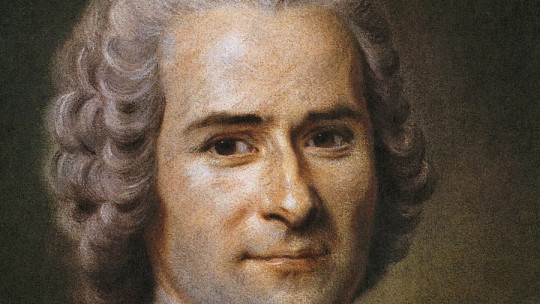
Jean-Jacques Rousseau is one of the most important minds of the Enlightenment and, although he did not live it, of Romanticism. Although he had disagreements with certain properly enlightened points of view, there is no doubt that this Swiss philosopher contributed significantly during the Age of Enlightenment.
He gave his opinion on practically everything that was a concern in his time: politics, education, progress, equality between men… perhaps his way of exposing his vision was somewhat controversial and caused him a few problems with the authorities of his time but, without a doubt, doubts, his way of thinking would lay the foundations of a new society.
Next we will discover the life and work of this thinker through a biography of Jean-Jacques Rousseau in which we will see his points that coincide and diverge with the Enlightenment, his thought and the impact he had on the years he lived.
Brief biography of Jean-Jacques Rousseau
Jean-Jacques Rousseau, also known as Jean-Jacques Rousseau, was a French-speaking Swiss polymath, and thanks to this he was able to establish direct contact with the most prominent figures of the Enlightenment of his time. As a good cultured character of his time He did practically everything: he was a writer, educator, philosopher, musician, naturalist and botanist Although he is considered enlightened, his opinions go against the grain of many assumptions of this movement.
Childhood
Jean-Jacques Rousseau was born in Geneva, Switzerland on June 28, 1712. At an early age his mother died and his father, a modest watchmaker, and his maternal aunt were in charge of his education. Without having barely received the appropriate training, he worked as an apprentice with a notary and with an engraver who subjected him to such cruel and brutal treatment that the young man ended up leaving his hometown in 1728 at the age of sixteen.
In his modest exile he ended up in Annecy, France, obtaining the protection of the Baroness de Warens, a woman who convinced him to convert to Catholicism, abandoning his family’s Calvinist doctrine. Already her lover, Jean-Jacques Rousseau settled in the baroness’s residence in Chambéry, beginning an intense period of intense self-taught training there.
How many of these have you been "meaning to read" for months?
- 1
 THOUGHT CATALOGThe Mountain Is YouTransforming Self-Sabotage Into Self-MasteryListen Free On Audible
 - 2
 Worthy BooksThe Biblio DietLive Long, Master Metabolism, Reduce Pain, Fight Depression, and Conquer Cancer with Healing Secr...Listen Free On Audible
 - 3
 HarvestTo Die ForA Cookbook of Gravestone RecipesListen Free On Audible
Contact with the encyclopedists
The year 1742 marked the end of a period that Rousseau himself would recognize years later as the happiest of his life, and truly the only one. It was then that he left for Paris, a place where he would have the opportunity to frequent various noble salons and made friends with great minds of his time. He went to the Academy of Sciences in that city presenting a new and original musical notation system which he himself had devised although he did not achieve much fame.
He spent between 1743 and 1744 working as secretary to the French ambassador in Venice, with whom he would end up having a strong argument and would have to return to Paris shortly after. Upon his return to the French capital, Jean-Jacques Rousseau would begin a relationship with an uneducated dressmaker named Thérèse Levasseur, whom he would end up marrying in a civil manner in 1768 after having had five bastard children with her, whom he would end up giving up in hospice.
While in Paris he achieved a certain fame and became friends with several enlightened men, being invited to contribute to the Encyclopedia of Jean le Rond D’Alembert and Denis Diderot with his articles on music. In fact, Diderot himself motivated Rousseau to participate in a competition organized by the Dijon Academy in 1750.
In this call Rousseau would be the winner, being awarded first prize for his text “Discourse on science and the arts” In the writing he answered the question of whether the reestablishment of sciences and arts was contributing to the purification of customs, something that he believed was not the case and that they contributed, in fact, to cultural decline.
In 1754 he returned to his native Geneva and returned to Protestantism to reacquire his civil rights as a citizen. For him, more than a reconversion to the faith of his family or renunciation of Catholicism, it was rather a mere legislative procedure. It will be around this time that he will publish his “Discourse on the Origin of Inequality among Men”, which he wrote to present at the Dijon Academy competition in 1755.
Rousseau here exposes his opposition to the Enlightenment conception of progress considering that men, in their most natural state, are by definition innocent and happy However, as culture and civilization assimilate them, inequalities are imposed between them. It is especially because of the emergence of property and the increase in inequalities that human beings are unhappy.
Residence in Montmorency
In 1756 he settled in the residence of his friend Madame d’Épinay in Montmorency. There she would write some of her most important works, including her “Letter to D’Alembert on spectacles” (1758), a text in which she condemned the theater as a source of immorality. She would also write “Julia or the new Heloise” (1761), a sentimental novel inspired by his unrequited love with his hostess’s sister-in-law In fact, it would be this passion that would cause him to end up arguing with Madame d’Épinay.
One of the most important works of this time and, surely, the one considered the most important of his entire life is “The Social Contract” of 1762, a text that is considered the inspiration for the Declaration of the Rights of Man and of the Citizen. Basically in this text he maintains that human beings must be heard regarding their desires for how they want to be governed and treated and that the State must guarantee their rights and obligations through laws that emanate from the popular will.
Finally, at this time a work of special pedagogical importance “Emilio o De la Educación” (1762) would also come to light. Is about a pedagogical novel that, although very revealing, its religious part aroused much controversy In fact, the Parisian authorities strongly condemned it, causing Rousseau to go to Neuchâtel and even then he was not spared the criticism of the local authorities.
Last years and death
Pressured by all this, Rousseau accepted in 1766 the invitation of his supposed friend David Hume to take refuge in England. He would return the following year, convinced that his host had taken him in simply to defame him. It is from then on that Rousseau changed his residence incessantly, harassed by a persecution mania that finally led him to return to the French capital in 1770, where he would spend the last years of his life and where he would write his autobiographical writings, “Confessions” (1765-1770).
Death surprised him meditating in the solitude of the gardens of Ermenonville, where he had been invited by the Marquis de Girardin. He died on July 2, 1778 due to cardiac arrest, after having spent his last decade in constant tension with his former colleagues the Encyclopedists and being quite unpopular, although with the passage of time he would become a crucial figure for the dawn of the New Regime.
The work of Jean-Jacques Rousseau as a philosopher
You cannot talk about Jean-Jacques Rousseau without mentioning his work, philosophical position and how important he is for the Enlightenment. In fact, Along with Voltaire, Diderot, Montesquieu and Locke, the figure of Rousseau cannot be omitted when talking about the Age of Enlightenment Among his main works we can mention the following:
Judging by all these works and the topics they address, there is no doubt that Rousseau was involved in the great Enlightenment philosophical discussions, leaving aside the sentimental issue exposed in his novel “Julia or the New Heloise.” It is especially his opinions on education, absolutism and inequality between men that marked a before and after within the Enlightenment itself, arousing the hostility of some philosophers who saw his opinions as too revolutionary.
This is not surprising since The figure of Rousseau would become an ideological reference during the French Revolution, which would appear just over a decade after the death of the Swiss philosopher. Defender of tolerance, freedom, nature and with a markedly anti-absolutist in his writings, his thought was the one that would end up making the revolutionary flames reach such a profound impact that it would shake the regime that had reigned in Europe for centuries.
Rousseau questioned the radical optimism that was displayed in the Age of Enlightenment Unlike what many thinkers of his time thought, Rousseau believed that nature represented perfection and that society was corrupt. The Enlightenment had great confidence that progress and civilization were synonymous with greater perfection, peace and order in society, while Rousseau was rather pessimistic.
Thus, Rousseau exposes his idealization of the “noble savage,” confronting it with the idea defended by many enlightened economists of the “ignoble savage.” While the idea of the “noble savage” was that of a man who, although uneducated, was happy and lived in peace and harmony with his fellow men, the “ignoble savage” of economists and the majority of enlightened people was a being who, due to lack of possessing social norms behaved like the most aggressive, bloodthirsty and dangerous of animals, only this one was on two legs.
Jean-Jacques Rousseau’s visions and political proposals were quite disruptive compared to the thinking of the majority of the enlightened. His vision not only destroyed the illusions placed in the benevolent reformism of many monarchs of his time, that is, enlightened despotism (“everything for the people, but without the people”). The Genevan philosopher offered an alternative way of organizing the society and launched a slogan clearly contrary to absolutism, caring little if he was enlightened or uneducated.
Absolutism defended the idea that power fell to a single person, usually the king and, at most, his ministers and advisors. Most people maintained that the king held this title because God had willed it that way (sovereignty by divine grace). Rousseau does not think the same, maintaining that The head of state and the form of government must arise from national sovereignty and the general will of the community of citizens, ideas that would be key during the French Revolution and the appearance of nationalism in times of Romanticism.
Thus, with his thought Rousseau was situated in a somewhat unorthodox current of the Enlightenment. Although the way in which he presented his ideas was not the most solid or sophisticated, his first important text “Discourse on the Sciences and the Arts” (1750) is fundamental to understand his reluctance towards the rationalist optimism that firmly believed in the progress of civilization.
Rousseau did not share this vision of the majority of the enlightened. He attributed little importance to the perfection of science and granted greater value to the volitional faculties than to reason. For him, the technical and material progress of society was not synonymous with greater humanity, and in fact it could even harm it to the detriment of moral and cultural progress. More technology does not mean a better society, but can even make it worse and further accentuate inequalities if it is not managed well.
In his “Discourse on the origin and foundation of inequality among men” (1755) he tries to elucidate and expose the effects that social organization had had on human nature. In this specific text he focused on describing his conception of the noble savage, which, as we have mentioned, is a being who, despite living in a primitive state in nature, did not suffer any inequality and lived in peace and equality with the rest of his peers, having only differences derived from biology.
According to Rousseau, in the state of nature men were neither good nor bad by nature, simply “amoral.” He also explains that Due to a series of external causes, human beings had to group together and provide mutual aid in order to survive which caused societies, cultures and civilizations to be forged over time as complex exponents of that human social life.
These societies must have emerged at some point, going beyond the most primitive and idyllic associative stage: the family. The families would begin to associate in communities of nomadic settlers who shared everything hunted and gathered. Later, these societies would become more complex with the discovery of agriculture, at which time private property and inequalities would appear. Whoever had more possessions had more influence in the community and could exercise more power.
The process continued with the appearance of servitude and slavery. Those who owned nothing offered their labor in exchange for the protection of the powerful, or if they had nothing or no way to defend themselves, the most powerful turned them into their property. The abuses perpetrated by those who had the most led to mutual distrust and the need to prevent crime, which is why governments were created, the application of their laws and the protection of the private property and privileges of those who had the most.
Rousseau saw in private property an element that clearly marked inequalities but this did not mean that he advocated the abolition of private property. Material goods and their possession were an irreversible fact and were already part of society as an inherent feature; however, Rousseau himself defended that the situation should be improved through the improvement of political organization and guaranteeing that those who had The less they could have something to be able to live in a dignified way.
In his “The Social Contract” (1762) he diagnoses the origin of social injustice and human unhappiness, proposing the bases and organization of a new society founded on a pact freely agreed upon and accepted by all individuals, a general will. made law and that reconciled individual freedom with a just social order and broad social acceptance.
The Enlightenment was largely in favor of reason, a point on which Rousseau disagreed. In this sense, he collaborated by spreading an aesthetic of feeling with the publication of his novel “The New Heloise” (1761), although it must be said that he was neither the only writer of sentimental novels of the time nor the one responsible for the melodramas that would appear. partially in the Enlightenment and especially in Romanticism.
In his book “Emilio o De la Educación” (1762) he exposes his ideas about education, promoting that educational work should be carried out outside of society and its institutions Educating does not consist of imposing rules or directing learning, but rather promoting the development of the individual by taking advantage of the child’s spontaneous inclinations or interests, facilitating their contact with nature, an entity that is truly wise and educational according to Rousseau’s vision.
Finally we have his “Confessions”, an autobiographical work that was published posthumously between 1782 and 1789. This text is an exceptional example of the depths of Rousseau’s soul and mind, an extreme display of personal introspection that would only be fully achieved a century later. with the arrival of Romanticism and its authors, who would perfect this genre.
All of them, and especially this last work, are considered a “warning” of what would come later with Romanticism, although it must be said that Rousseau was not the only one who contributed to the appearance of this current. Even so, his exacerbation of the sentimentalism that he had displayed in his novel and the rise of nationalism and the revaluation of the Middle Ages, which, more than a dark era, was the origin of modern European peoples, would be aspects that Rousseau’s thought would nourish.
Use this citation format to reference the article clearly and help readers find the original source.
PsychologyFor. (2024). Jean-Jacques Rousseau: Biography of This Genevan Philosopher. PsychologyFor. https://psychologyfor.com/jean-jacques-rousseau-biography-of-this-genevan-philosopher/