

See more of our articles in your search results.
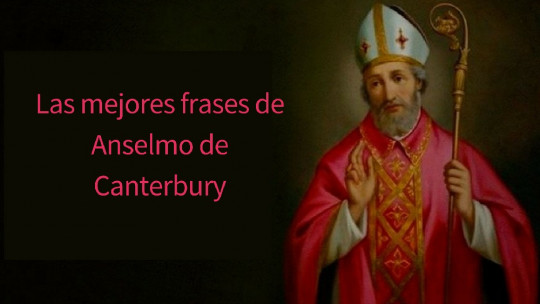
Anselm of Canterbury (1033 – 1109), also known as Anselm of Aosta, was a famous Benedictine monk who served as Archbishop of Canterbury.
He stood out as one of the most brilliant theologians and philosophers of scholasticism.
Famous quotes and phrases from Anselm of Canterbury
In today’s article Let’s learn more about the ideas and thoughts of this monk through the most famous phrases of Anselm of Canterbury.
1. In fact, I do not seek to understand in order to believe, but I believe in order to understand. Well, I believe this, because if I didn’t believe, I wouldn’t understand.
The basis of his thinking was based on a belief.
2. In often re-examining the work, I have not been able to find anything that I have said in it, which does not agree with the writings of the Catholic Fathers and especially with those of the blessed Augustine.
A veneration of their intellectual references within the Church.
How many of these have you been "meaning to read" for months?
- 1
 S&S/Simon ElementProtocolsAn Operating Manual for the Human BodyListen Free On Audible
- 2
 Undercover Publishing HouseStop Letting Everything Affect YouHow to break free from overthinking, emotional chaos, and self-sabotage.Listen Free On Audible
- 3
 Grand Central PublishingIn the Shadow of EightSurviving the Reality of My ChildhoodListen Free On Audible
3. Even if I don’t want to believe in you, I can’t help but understand that you exist.
Phrase by Anselm of Canterbury that invites us to reflect.
4. Come on, little man! Escape for a while from your tasks, hide for a small space from the agitation of your thoughts.
A channel to become oneself again.
5. Come, lay aside your painful cares and lay aside your labors.
In line with the famous quote above.
6. For a moment, dedicate your time to God and rest for a moment in Him.
Mystical reflection cures all evils, according to Saint Anselm of Canterbury.
7. Go into the inner chamber of your mind, close out all things except God and everything that can help you seek God; and having blocked the door of your chamber, seek him.
Only when we are alone can we come into contact with God.
8. Speak now, O my heart, O my entire heart, speak now and say to your God: My face has sought you: Your face, O Lord, will I seek.
An ode to the Supreme Being.
9. Teach me to seek You and reveal You when I seek You, for I cannot seek You except You teach me, nor find You unless You reveal Yourself.
Only oneself is capable of finding one’s way.
10. Let me look for you in longing, let me long for you in looking for you; let me find you in love and love you in finding.
A great poetic phrase from the Archbishop of Canterbury.
11. Lord, I thank you and thank you that you have created me in this your image, so that I can be aware of you, conceive you and love you.
An explicit thanks to God.
12. But that image has been consumed by vices, and darkened by the smoke of evil that cannot accomplish that for which it was created, except that You renew it and create it anew.
About the atonement necessary every Sunday.
13. I do not strive, Lord, to penetrate Your heights, because in no way do I compare my understanding with Yours; but I long to understand to some degree Your truth that my heart believes and loves.
An ode to knowledge and the figure of God.
14. I long, O God, to know You, to love You, so that I may rejoice in You.
Another praise to the figure of almighty God.
15. And if I cannot attain complete joy in this life, at least I can advance from day to day until that joy comes to me completely.
About final redemption, in a mythical phrase by Saint Anselm of Canterbury.
16. Where true heavenly joys are, there must always be the desires of our heart.
Nothing mundane should make us lose our minds.
17. Please, Lord, make me feel with my heart what I touch with my intelligence.
The link between emotions and reason, summarized in this phrase from Anselm of Canterbury.
18. God was conceived as a very pure Virgin…it was fitting that the virgin should be radiant with such great purity that no greater purity can be conceived.
About the purity of the son of God, Jesus Christ.
19. God often works more for the lives of the illiterate who seek the things that are God’s, than for the skill of the learned who seek the things that are theirs.
The goodness of God, according to Anselm, knows no limits.
20. Take away grace, and you have nothing by which to be saved. Eliminate free will and you have nothing that can be saved.
Reflection in a metaphysical tone.
21. For vengeance belongs to no one but to Him who is Lord of all; for when the powers of the world accomplished this end, God Himself did so to design it.
The only owner of the ability to take revenge is God.
22. Therefore, Lord, not only are you the one who cannot be thought of as greater, but you are also something greater than what can be thought of.
Inconceivably huge.
23. In you I move, and in you I have my being; and I can’t come to you. You are inside me and of me, and I don’t feel you.
About the omnipresence of the Supreme Being.
24. God is not slow to listen to our prayers because he does not have the courage to give; but that, by increasing our desires, can give us more amply.
A beautiful reflection on divine compassion.
25. God is that, the greatest of what cannot be conceived.
Unimaginable and exaggeratedly kind.
26. Do not let worldly prosperity lead you astray, nor let any worldly adversity hinder you from its praise.
A reflection to apply to our daily lives.
27. A single Mass offered by oneself during life can be worth more than a thousand celebrated for the same intention after death.
About his work and the importance of being a perfectionist.
28. And if I cannot do it completely in this life, let me continue until the day I reach that fullness.
After death, it is assumed.
29. Let me receive what you promised through your truth, so that my joy may be full.
A plea to God.
30. Oh supreme and inaccessible light! Oh, complete and blessed truth, how far you are from me, who am so close to you! How far you are from my vision, though I am so near you! Everywhere you are completely present, and I don’t see you.
Another phrase in relation to the majesty of God.
31. Idleness is the enemy of the soul.
The more fun, the less purity, according to Anselm of Canterbury.
32. God has promised forgiveness to the one who repents, but has not promised repentance to the one who sins.
This is the moral code of the Supreme Being.
33. Deliver me by your mercy, do not punish me with your justice.
A plea to God, in reference to his goodness.
34. Disasters teach us humility.
When we lose everything we have the opportunity to feel like mere mortals again.
35. It is impossible to save the soul without devotion to Mary and without her protection.
About the virgin.
36. There is no inconsistency in God commanding us not to take upon ourselves what belongs to him alone.
What belongs to God is His and nothing more.
37. Because that from which something is made is a cause of what is made from it; and, necessarily, each cause contributes some help to the existence of the effect.
Philosophical phrase.
38. Lust does not desire procreation, but only pleasure.
About the sexual act and its ultimate motive.
39. I have written the following short work… in the role of someone who strives to raise his mind to the contemplation of God and someone who seeks to understand what he believes.
Another sentence about the virtues of believing people.
40. Therefore, Lord God, you are most truly omnipotent, for you have no power through powerlessness and nothing can be against you.
A reflection on the omnipotence of the Supreme Being.
41. Therefore, it is not appropriate for God to pass over sin without punishment.
All behavior must have its divine punishment if it is not morally acceptable.
42. Because I do not seek to understand in order to believe, but I believe in order to understand. Because I believe this: unless I believe, I will not understand.
Faith brings knowledge.
43. This booklet wants to explain in usual language what there is about the divine essence and other points related to this meditation.
To reflect.
44. Eminent Nature is the first and only cause. She alone produced everything by herself and for nothing.
The way God speaks: through the natural environment.
45. To know oneself will then be to ascend to the knowledge of the eminent essence.
About self-discovery and the divine.
46. Know that there is always a similarity-dissimilarity.
The inconsistencies, in the eyes of God.
47. How is the finite related to the infinite, the One to the many?
A philosophical question in the air, of great interest.
48. It is evident that eminent Nature gives life, gives vigor. She creates and maintains preserves with her presence. This means that she is everywhere: through things and within them.
The vitality of nature is practically incomparable.
49. To express God we have to take all the possible attributes and the best and at the best level.
To a superlative degree, always.
50. The artist “says” the things he thinks to himself before executing them. In the same way God has a speaking.
A metaphor to understand the function of thought.
51. The Word is the image and likeness of the thing in the mind.
Do you know what the difference is between signified and signifier?
52. The eminent Essence is defined because it lives, feels and reasons. Then all nature will become closer to it in that it lives, feels and reasons because all good is similar to the greatest good.
Everything is tailored to the divine essence.
53. God is reality: it is important to understand him even when we know that this science surpasses our intelligence.
A disquisition about what exists.
54. Our language is weak, even inefficient: God is greater than everything that can be thought.
Another musing about the limitations of human thought.
55. God has created us in his image: let us then seek this image and we will see God.
Only if we find it will we be close to its essence.
56. The more the reasonable spirit tries to know itself with great care, the more effectively it will know the eminent Essence.
Along the lines of the previous sentence.
57. The most admirable thing you have ever received is the printed image of the Creator: you can remember, understand and love. Memory is the image of the Father, intelligence is the image of the Son, and love is the image of the Holy Spirit.
One of those deep religious phrases.
58. To tend means to believe.
Reflecting on faith.
59. Certainly This is not only God (noetic level), but the only God ineffably triune and one.
The characteristics of the Christian God, according to Anselm.
60. Faith makes us reach God in his reality, in his real essence: we know that he is the only one who really is. that we cannot understand him, we can only rationally understand that he is incomprehensible; that we reach out towards Him to reach Him and enjoy His presence.
About the importance of having faith.
61. The analogy is important if we do not forget to start from the real thing and not from our language.
A language trap can be relying too much on metaphors and similes.
62. The human mind must rationally understand what is incomprehensible.
Not imaginable does not mean not knowable.
63. We can understand with the saints what is the width and length, height and depth, also know the surpassing love of the knowledge of Christ so that we may be filled in all the fullness of God.
To reflect on the love of Christ.
64. Creation was nothing and at the same time it was something.
Interesting thought by Anselm of Canterbury.
65. To believe means to be in contact with something or to have experience of something, and this experience is essential to know.
Apprehension that results in divine knowledge.
66. This does not lead to recognizing that God is not simple, but compound. He is composite in the attributes of him, but at the same time he is simple in that each attribute is in the others.
God and his defining characteristics.
67. Other natures are not, they receive the being of God and therefore must glorify Him.
Every natural being emanates from the wisdom of God.
68. Only God is real because he is the only one who is simply, perfectly and absolutely; The other natures – human nature too – are not real because they are not simply, perfectly and absolutely, they barely exist.
About the concept of reality.
69. By accepting that “he cannot know anything or almost nothing” man unites the two levels, noetic and ontic, the level of thought and the level of reality.
A metaphysical reflection to take into account.
70. God is my defense.
It never fails.
Use this citation format to reference the article clearly and help readers find the original source.
PsychologyFor. (2024). The 70 Best Phrases of Anselm of Canterbury. PsychologyFor. https://psychologyfor.com/the-70-best-phrases-of-anselm-of-canterbury/