

Scrolling through an endless feed of memes and hot takes while your reading list for developmental psychology sits untouched is a familiar kind of guilt for anyone studying the mind. It’s easy to feel like social media and serious academic growth live in two completely separate worlds, one built for distraction and the other for discipline. But here’s the thing many students overlook: psychology Twitter accounts, now largely hosted on X, have quietly become one of the richest, most current sources of research summaries, expert commentary, and field debates available anywhere, often faster than journals or textbooks can keep up.
This tension between wanting to stay informed and feeling like social media is “wasted time” is completely understandable, especially when so much of the platform’s content is genuinely low-value. What most students don’t realize is that curating a focused, high-quality feed of researchers, clinicians, and institutions transforms the platform into something closer to a live academic conference than a distraction machine. Following the right psychology experts online means you see new studies discussed within hours of publication, watch established theories get challenged in real time, and absorb the kind of professional communication style you’ll eventually need yourself.
So which accounts actually deserve a spot in a student’s feed, and how do you find essential Twitter profiles for psychology students that truly enrich your education?
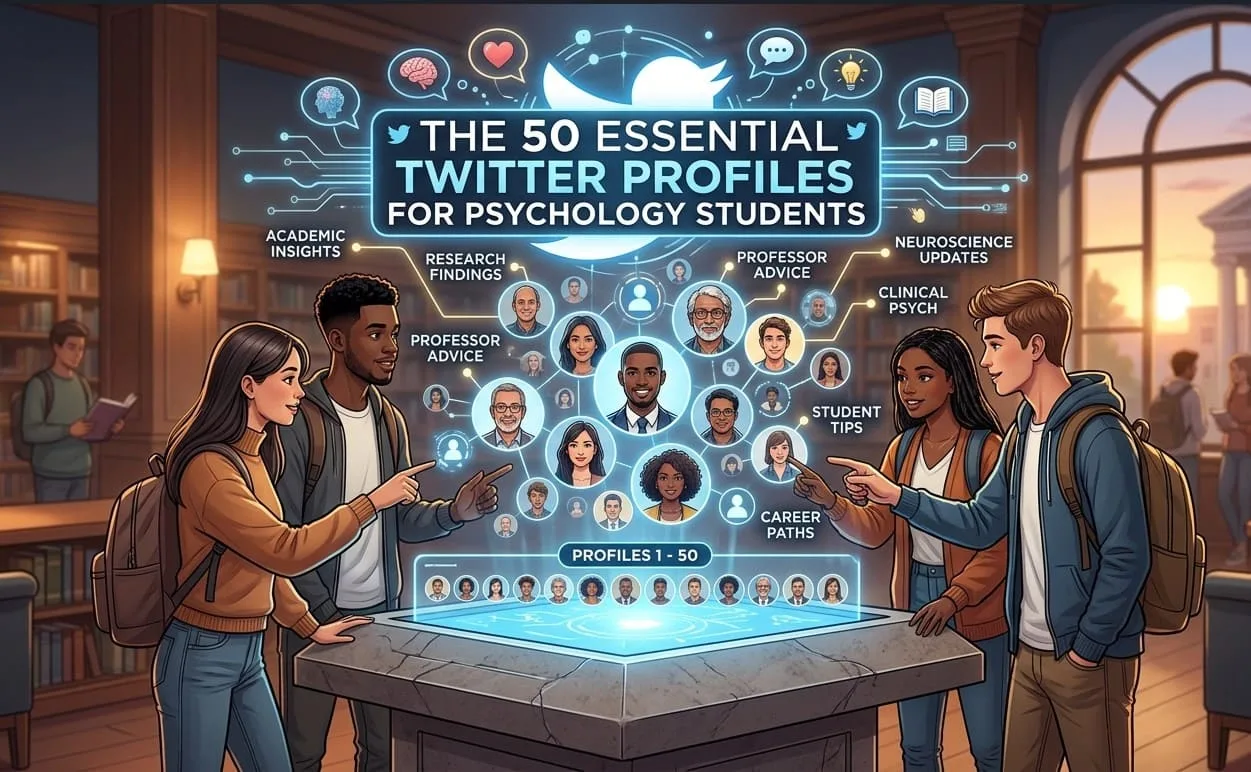
This comprehensive guide breaks down the categories, verification criteria, and standout accounts that constitute the 50 essential Twitter profiles for psychology students, helping you transform everyday digital scrolling into a genuine academic advantage.
Why Should Psychology Students Curate a Twitter Feed at All?
A well-curated feed exposes students to real-time scientific discourse that textbooks simply cannot offer, since academic publishing moves slowly while social platforms surface debate, replication concerns, and new findings almost immediately. This immediacy is genuinely valuable for anyone trying to understand psychology as a living, evolving field rather than a fixed body of settled facts.
Beyond speed, following established researchers gives students a front-row seat to how professional psychologists actually communicate their work publicly, which is a skill rarely taught explicitly in coursework. Watching how someone like cognitive psychologist Steven Pinker (@sapinker) defends or clarifies a claim in a public thread teaches something a lecture on scientific writing never quite captures: how nuance survives contact with a skeptical public audience.
There’s also a networking dimension that shouldn’t be underestimated. Many graduate programs, research assistantships, and conference opportunities get shared first on social platforms, meaning an active, well-curated feed can function as an informal professional development tool long before a student ever attends their first conference.
Students also gain direct visibility into open-science practices, pre-registration discussions, and raw data sharing trends that are currently revolutionizing contemporary methodological standards across psychological laboratories worldwide.
- Following credible accounts helps students distinguish peer-reviewed findings from pop-psychology myths circulating online.
- It builds familiarity with ongoing debates, such as the replication crisis, that shape how modern psychological research gets evaluated.
- It exposes students early to diverse subfields, from clinical work to neuroscience, helping clarify future career specialization choices.
Which Research Psychologists Should Every Student Follow?
Following prominent researchers gives students direct access to empirical psychological science as influential theories get discussed, defended, and refined outside the classroom. These accounts consistently rank among the most substantive voices in the academic community.
Harvard psychologist Steven Pinker (@sapinker), known for his research on language, cognition, and human nature detailed in books like “How the Mind Works,” regularly shares commentary connecting cognitive science to broader social debates, making his feed valuable for students interested in the intersection of psychology and public discourse.
Organizational psychologist Adam Grant (@AdamMGrant), a professor at the Wharton School and author of “Give and Take,” frequently posts accessible breakdowns of workplace and motivational psychology research, which makes his account especially useful for students drawn toward industrial-organizational psychology.
Social psychologist Jonathan Haidt (@JonHaidt), known for his research on moral psychology detailed in “The Righteous Mind,” uses his platform to discuss political polarization, moral reasoning, and more recently the psychological effects of smartphone use on adolescents, a topic increasingly relevant to developmental psychology coursework.
Behavioral economist Dan Ariely (@danariely), author of “Predictably Irrational,” offers a steady stream of content exploring cognitive biases and decision-making, bridging psychology with economics in ways that are especially useful for students studying judgment and behavioral science.
Which Clinical Psychologists Offer the Most Practical Insight?
Clinical accounts translate research into the language of actual therapy practice, demonstrating how clinical intervention models operate with real people facing genuine emotional distress. These voices show how theoretical frameworks get applied beyond textbook summaries.
Researcher and author Brené Brown (@BreneBrown), whose work on vulnerability and shame resilience is detailed in “Daring Greatly,” maintains an active social presence discussing emotional courage and authentic connection, offering students a clinically grounded perspective on topics often glossed over in purely academic coursework.
Psychologist Angela Duckworth (@angeladuckw), known for her research on grit and self-control summarized in her book “Grit,” shares findings relevant to educational and developmental psychology, particularly useful for students interested in resilience-building interventions used in schools and clinical settings alike.
Following clinicians alongside researchers helps students avoid a common pitfall: treating psychology purely as an abstract science rather than a discipline meant to genuinely reduce human suffering, which is ultimately the field’s core practical purpose.
- Clinical accounts frequently discuss evidence-based interventions, giving students a preview of treatment approaches before they encounter them formally.
- They often model appropriate professional boundaries around discussing client work publicly, an important lesson for future practitioners.
- Many clinicians openly discuss their own mental health, helping normalize help-seeking behavior among students who may be struggling themselves.
Which Institutional and Organizational Accounts Are Essential?
Institutional accounts provide the most reliable, vetted updates available on the platform, establishing baseline evidence-based guidelines that represent collective professional standards rather than individual opinions. Following them anchors a student’s feed in verified, consensus-based science.
The American Psychological Association (@APA), the largest professional organization representing psychologists in the United States, regularly shares research summaries, ethical guidelines, and career resources directly relevant to students at every stage of training. Their account functions almost like a daily digest of what’s happening across the entire discipline.
The British Psychological Society’s Research Digest (@ResearchDigest), edited for years by science writer Christian Jarrett (@Psych_Writer), offers consistently well-sourced summaries of new psychological studies written specifically for a general but informed audience, making it one of the most reliably rigorous accounts a student can follow.
The National Institutes of Health (@NIH) and the World Health Organization (@WHO) maintain active verified accounts sharing updates on large-scale behavioral health studies, global psychiatric guidelines, and epidemiological data, which is particularly useful for students exploring public health applications of psychology.
| Individual Researcher Accounts | Offer personal commentary, opinion, and direct engagement with followers |
| Institutional Accounts | Offer vetted, consensus-based updates without individual personality or opinion |
Which Science Communicators Make Research Accessible?
Science communicators exist specifically to bridge the gap between dense academic writing and public understanding, fostering essential public science communication skills that every psychology student eventually needs regardless of their chosen career path. Following strong communicators trains students to recognize clear, honest science writing.
Psychologist Scott Barry Kaufman (@sbkaufman), known for his research on intelligence, creativity, and human potential, regularly shares accessible explanations of complex psychological constructs, often linking directly to the original studies for students who want to dig deeper into the primary literature.
Good science communication accounts share a few consistent traits worth learning to recognize, establishing clear benchmarks for critical appraisal when evaluating popular psychology content online.
- Link to original research rather than simply summarizing secondhand reporting without a traceable source.
- Acknowledge uncertainty honestly instead of overstating preliminary or small-sample findings as definitive proof.
- Avoid sensationalized headlines that misrepresent modest effect sizes as sweeping behavioral discoveries.
Learning to evaluate communicators by these standards is itself a valuable exercise in scientific literacy, one that will serve students well beyond their time in school, particularly when evaluating psychology content across any media platform.
Which Neuroscience and Cognitive Science Voices Round Out a Feed?
Psychology and neuroscience overlap heavily, and engaging with dedicated cognitive neuroscience perspectives gives students a fuller picture of how biological brain mechanisms and psychological states inform each other. This cross-disciplinary exposure is increasingly essential as the fields continue converging.
Persuasion researcher Robert Cialdini (@RobertCialdini), whose foundational work “Influence: The Psychology of Persuasion” remains a cornerstone text in social psychology, occasionally shares updated commentary connecting his classic principles to modern digital manipulation tactics, a genuinely timely application of decades-old research.
Emotion researcher Paul Ekman (@PaulEkman), recognized for his pioneering work on facial expressions and universal emotions, continues to share insights relevant to affective science, deception detection, and emotional regulation, topics that consistently appear across clinical, developmental, and forensic psychology coursework alike.
Rounding out a feed with cognitive and affective neuroscience voices helps students avoid a narrow, siloed view of psychology, reinforcing that behavioral science genuinely requires understanding both mind and underlying brain mechanisms together.
How Can Students Build a Balanced, Non-Overwhelming Feed?
The goal isn’t following as many accounts as possible; it’s cultivating deliberate digital curation habits that reliably surface quality content without generating information overload. A handful of well-chosen accounts consistently outperforms dozens of low-signal follows.
Start by identifying your specific subfield interest, whether that’s clinical practice, cognitive research, or organizational psychology, and prioritize establishing a foundational core feed directly relevant to that focus before expanding outward. This targeted approach prevents the feed from becoming an undifferentiated wall of unrelated content.
Using list features, available on most platforms including X, lets students organize accounts into separate categories, such as “researchers,” “clinicians,” and “institutions,” making it easier to check specific types of content without scrolling through an unsorted main timeline. This small organizational habit meaningfully improves information retention over time.
Engaging thoughtfully with posted content transforms passive consumption into active learning, turning social feeds into genuine academic networking channels where students can ask clarifying questions directly to study authors. Leaving polite, methodologically grounded questions on research threads often elicits detailed responses from principal investigators.
Periodically auditing your follows matters too; implementing regular account audit routines ensures that accounts which have drifted toward engagement bait or commercial promotion get replaced with higher-signal educational voices.
What Mistakes Do Students Commonly Make Building a Psychology Feed?
Even well-intentioned students often build feeds that end up reinforcing bad habits, falling into common social media traps rather than achieving genuine academic learning. Recognizing these frequent missteps helps avoid wasted study time and misinformation exposure.
- Following only accounts that confirm existing beliefs creates a confirmation bias problem, narrowing exposure to genuinely diverse psychological perspectives.
- Treating viral psychology content as automatically credible ignores the reality that engagement metrics reward oversimplification, not accuracy.
- Neglecting to verify academic credentials before trusting self-proclaimed experts can expose students to pseudoscientific claims dressed up in professional-sounding language.
- Overloading the feed with dozens of accounts leads to information fatigue, where nothing gets read closely because everything competes for attention simultaneously.
Avoiding these pitfalls comes down to intentional curation rather than passive following, treating your feed as an active academic tool rather than a casual entertainment stream, which ultimately determines whether social media becomes a genuine asset to your psychology education or simply another distraction disguised as productivity.
The Complete List of 50 Essential Twitter Profiles for Psychology Students
Here is the full, categorized directory of verified profiles referenced across this guide. Every single entry links directly to an active account offering genuine educational value for psychology students seeking reliable research, professional networking, and clinical perspectives.
- Steven Pinker (@sapinker) — Cognitive scientist at Harvard studying language, cognition, and human nature.
- Adam Grant (@AdamMGrant) — Organizational psychologist at Wharton researching workplace motivation and team dynamics.
- Jonathan Haidt (@JonHaidt) — Social psychologist at NYU-Stern investigating moral psychology and youth mental health.
- Dan Ariely (@danariely) — Behavioral economist exploring cognitive biases and irrational decision-making.
- Angela Duckworth (@angeladuckw) — UPenn psychologist and founder of Character Lab studying grit and perseverance.
- Robert Cialdini (@RobertCialdini) — Social psychologist known for foundational research on influence and persuasion.
- Paul Ekman (@PaulEkman) — Pioneer researcher on universal facial expressions and emotion regulation.
- Scott Barry Kaufman (@sbkaufman) — Cognitive scientist and humanistic psychologist exploring intelligence and creativity.
- Richard Wiseman (@RichardWiseman) — Psychologist and author studying the psychology of luck, deception, and belief.
- Amy Cuddy (@amyjccuddy) — Social psychologist known for research on body language, presence, and nonverbal behavior.
- Kelly McGonigal (@kellymcgonigal) — Stanford health psychologist examining willpower, stress resilience, and movement.
- Lisa Feldman Barrett (@LFeldmanBarrett) — Neuroscientist and psychologist exploring the theory of constructed emotion.
- David Eagleman (@davideagleman) — Stanford neuroscientist studying brain plasticity, perception, and neurolaw.
- Daniel Levitin (@danlevitin) — Cognitive psychologist and neuroscientist researching music cognition and executive function.
- Daniel Gilbert (@DanTGilbert) — Harvard psychologist studying affective forecasting and happiness.
- David Buss (@ProfDavidBuss) — Evolutionary psychologist at UT Austin researching human mating strategies.
- Daniel J. Siegel (@DrDanSiegel) — Neuropsychiatrist and author pioneering interpersonal neurobiology and mindfulness.
- Andrew Huberman (@hubermanlab) — Stanford neuroscientist translating neural mechanism research into daily protocols.
- Brené Brown (@BreneBrown) — Research professor investigating vulnerability, shame resilience, and leadership.
- Susan Cain (@susancain) — Author and researcher exploring the psychology of introversion and quiet leadership.
- Sam Harris (@SamHarrisOrg) — Neuroscientist and philosopher analyzing consciousness, ethics, and meditation.
- Richard Thaler (@R_Thaler) — Nobel laureate behavioral economist on nudge theory and decision-making.
- Peter Kinderman (@peterkinderman) — Clinical psychologist and former BPS president discussing mental health reform.
- Christian Jarrett (@Psych_Writer) — Cognitive neuroscientist, author, and science editor covering empirical psychology.
- Daniël Lakens (@lakens) — Psychological scientist at TU Eindhoven researching meta-science and statistics.
- Brian Nosek (@BrianNosek) — Executive Director of the Center for Open Science promoting research reproducibility.
- Simine Vazire (@siminevazire) — Psychologist at UniMelb researching research credibility and personality assessment.
- Eiko Fried (@EikoFried) — Clinical psychologist at Leiden University studying mental health and network theory.
- Laurie Santos (@lauriesantos) — Yale cognitive scientist and host of The Happiness Lab podcast.
- Vaughan Bell (@vaughanbell) — Clinical neuropsychologist and science writer covering neuropsychiatry.
- American Psychological Association (@APA) — Official voice of the APA sharing psychology news, policy, and research.
- Association for Psychological Science (@PsychScience) — Premier international organization dedicated to advancing scientific psychology.
- Society for Personality and Social Psychology (@SPSPnews) — Leading international scientific society for personality and social psychology.
- BPS Research Digest (@ResearchDigest) — British Psychological Society’s feed providing summaries of newly published studies.
- APA Style (@APA_Style) — Official APA resource for scholarly citation standards and manuscript writing.
- APA Journals (@APA_Journals) — Latest calls for papers and research updates from APA scholarly journals.
- APAGS (APA Grad Students) (@apagradstudents) — APA channel advocating for psychology graduate trainees with funding and career tools.
- APA Help Center (@APAHelpCenter) — Public education resource from APA translating psychological science into coping strategies.
- National Alliance on Mental Illness (@NAMICommunicate) — Grassroots mental health advocacy group supporting individuals and families.
- SAMHSA (@samhsagov) — Federal agency leading public health efforts in behavioral health and substance use.
- Active Minds (@Active_Minds) — Nonprofit mobilizing students around mental health education and stigma reduction.
- American Foundation for Suicide Prevention (@afspnational) — Scientific foundation dedicated to understanding and preventing suicide.
- World Health Organization (@WHO) — Global public health agency sharing international mental health guidelines and reports.
- National Institutes of Health (@NIH) — Primary agency of the US government responsible for biomedical and behavioral research.
- Neuroscience News (@NeuroscienceNew) — Independent science news service covering neuroscience, neurology, and psychology.
- Psychology Today (@PsychToday) — Widely read publication featuring articles by credentialed psychologists and therapists.
- Psych Central (@PsychCentral) — Evidence-based mental health platform sharing condition overviews and coping tools.
- PsyBlog (Jeremy Dean) (@PsyBlog) — Scientific blog founded by psychologist Jeremy Dean summarizing peer-reviewed research.
- Mike Anestis (@PsychBrownBag) — Clinical psychologist and researcher focusing on firearm suicide prevention and clinical science.
- Dr. Kathleen Young (@DrKathleenYoung) — Licensed clinical psychologist sharing insights on complex trauma recovery.
FAQs about Twitter Profiles for Psychology Students
Is Twitter, now X, still relevant for psychology students given how much the platform has changed?
Yes, despite significant changes in ownership, algorithm behavior, and overall platform culture, X remains one of the fastest channels for researchers and institutions to share new findings and professional commentary. Many academics maintain active accounts specifically because it still functions as a quick way to reach both peers and the public. That said, some researchers have migrated partially to alternative platforms, so a well-rounded student might supplement their X list with academic newsletters or other platforms where certain voices have relocated, while still recognizing X’s continued relevance for real-time psychological discourse.
How do I verify that a psychology account is actually credible?
Check whether the account holder has a verifiable academic or clinical credential, such as a listed university affiliation, published research, or licensure information that can be cross-referenced outside the platform itself. Credible accounts typically link to original studies rather than making unsupported claims, and they generally acknowledge nuance or uncertainty rather than presenting every finding as definitive. Be especially cautious of accounts that primarily share dramatic, emotionally charged claims without citations, since this pattern often signals engagement-driven content rather than genuine scientific communication.
Should I follow accounts outside my specific psychology specialization?
Yes, following a few accounts outside your immediate interest area is genuinely valuable, since psychology is a highly interconnected field where developments in neuroscience, social psychology, or clinical research often inform each other in unexpected ways. A student focused on clinical practice, for example, benefits from occasional exposure to cognitive or developmental research that deepens their understanding of underlying mechanisms behind the disorders they’ll eventually treat. The key is balance, keeping a strong core of specialization-specific accounts while allowing a smaller number of adjacent-field voices to broaden your overall perspective.
How many psychology accounts should a student realistically follow?
There’s no fixed number, but quality consistently matters more than quantity when building an academically useful feed. A focused list of twenty to thirty carefully chosen accounts, spanning researchers, clinicians, institutions, and science communicators, typically provides more genuine educational value than passively following hundreds of accounts without any curation. Students often find that organizing chosen accounts into topic-based lists helps manage volume without needing to reduce the overall number of follows, since lists allow selective checking rather than an overwhelming single timeline.
Can following psychology experts on social media replace reading academic journals?
No, social media should supplement, not replace, direct engagement with peer-reviewed academic literature. Social platforms are excellent for discovering new studies, following ongoing debates, and understanding how findings get discussed publicly, but they inevitably compress complex research into simplified summaries that cannot substitute for reading full methodology and results sections. The most effective approach uses social media as a discovery and awareness tool, then follows up by reading the original studies directly whenever a topic proves relevant to your coursework or research interests.
What should I do if I notice a followed account spreading inaccurate psychology information?
It’s reasonable to fact-check the specific claim against a credible source, such as a peer-reviewed study or a reputable institutional account, before deciding whether to continue following. Occasionally, even generally credible accounts share information that turns out to be outdated or overstated, and this is a normal part of engaging with an evolving scientific field rather than a reason for alarm. If a pattern of consistently inaccurate or misleading content emerges, unfollowing and replacing that account with a more rigorous alternative protects the overall quality and reliability of your curated feed.
Bibliography
- Pinker, S. (1997). How the Mind Works. W. W. Norton & Company.
- Grant, A. (2013). Give and Take: A Revolutionary Approach to Success. Viking.
- Haidt, J. (2012). The Righteous Mind: Why Good People Are Divided by Politics and Religion. Pantheon Books.
- Ariely, D. (2008). Predictably Irrational: The Hidden Forces That Shape Our Decisions. Harper.
- Brown, B. (2012). Daring Greatly: How the Courage to Be Vulnerable Transforms the Way We Live, Love, Parent, and Lead. Gotham Books.
- Duckworth, A. (2016). Grit: The Power of Passion and Perseverance. Scribner.
- Cialdini, R. B. (1984). Influence: The Psychology of Persuasion. Harper Business.
- Ekman, P. (2003). Emotions Revealed: Recognizing Faces and Feelings to Improve Communication and Emotional Life. Times Books.
- American Psychological Association. Careers and Resources for Psychology Students. APA Publications.
- British Psychological Society. Research Digest, edited by Christian Jarrett. BPS Publications.
Use this citation format to reference the article clearly and help readers find the original source.
PsychologyFor. (2026). The 50 Essential Twitter Profiles for Psychology Students. PsychologyFor. https://psychologyfor.com/the-50-essential-twitter-profiles-for-psychology-students/