

See more of our articles in your search results.
The Iowa Gambling Task (IGT) is a widely used psychological tool designed to assess decision-making skills and risk-taking behavior. Developed by Antoine Bechara and his colleagues in the late 20th century, the task simulates a real-world scenario in which individuals must make decisions that involve both immediate rewards and long-term consequences. It is often used in clinical psychology, neuroscience, and behavioral science to evaluate cognitive functions such as impulsivity, risk assessment, and emotional regulation.
This article will explore what the Iowa Gambling Task is, how it works, and how it is used in various fields of psychology and research.
What is the Iowa Gambling Task?
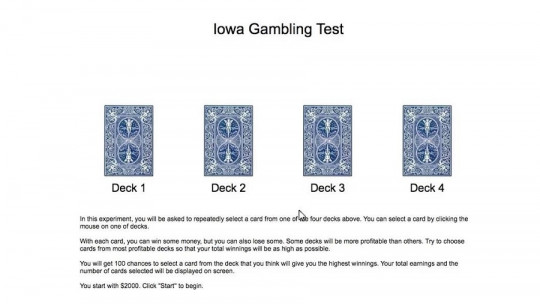
The Iowa Gambling Task is an experimental decision-making task that mimics real-life situations in which individuals are required to make choices under uncertainty. It involves a set of four decks of cards—two “good” decks and two “bad” decks. Participants are instructed to choose cards from the decks, each card providing either a reward or a penalty.
The goal of the task is to simulate decision-making processes where immediate rewards must be balanced with the possibility of future losses. The task is designed to assess how individuals weigh these two factors and how their decisions evolve over time, especially when faced with risk and uncertainty.
How the Task Works:
The participant is given a starting amount of money (usually around $2000).
Real Readers Started These TodayHow many of these have you been "meaning to read" for months?
- 1
 Undercover Publishing HouseStop Letting Everything Affect YouHow to break free from overthinking, emotional chaos, and self-sabotage.Listen Free On Audible
- 2
 Penguin Random HouseAtomic HabitsAn Easy & Proven Way to Build Good Habits & Break Bad OnesListen Free On Audible
- 3
 Harriman HouseThe Psychology of MoneyTimeless lessons on wealth, greed, and happinessListen Free On Audible
As an Amazon Associate we earn from qualifying purchases.They are instructed to pick cards from the four decks.
Each card provides either a small gain or a large gain (reward) or a small loss or a large loss (penalty).
The “good” decks are designed to offer smaller immediate rewards but lower penalties, while the “bad” decks offer larger rewards initially but much higher penalties, resulting in greater net losses over time.
The goal is to maximize earnings by selecting cards from the good decks, avoiding the bad decks.
Types of Decisions Assessed by the Iowa Gambling Task
The Iowa Gambling Task tests a variety of cognitive functions and emotional regulation strategies. Some of the key areas of decision-making it evaluates include:
1. Risk-Taking Behavior
Participants’ tendencies to take risks are central to the IGT. The task challenges them to weigh the benefits of an immediate reward against the potential long-term consequences. A person who consistently chooses from the “bad” decks may be considered more prone to impulsive decision-making or less able to anticipate future consequences.
2. Emotional Regulation and Impulsivity
The Iowa Gambling Task also measures impulsivity—the tendency to make decisions without thinking of future consequences. Those with difficulties in emotional regulation may choose poorly and experience immediate rewards without considering the long-term losses.
3. Strategic Decision-Making
The task assesses a participant’s ability to form a strategy over time. Resilient decision-makers recognize patterns in the rewards and penalties and adjust their choices to optimize long-term outcomes. Successful players gradually favor the “good” decks after learning to avoid the “bad” ones.
4. Decision-Making Under Uncertainty
The task is also useful for studying decision-making under conditions of uncertainty. Participants have limited information about the consequences of their choices, forcing them to adapt their strategies based on experience and feedback.
How the Iowa Gambling Task Is Used
The Iowa Gambling Task is used in various settings, including clinical psychology, neuroscience, behavioral science, and neuropsychology. It has applications in research as well as clinical assessments for disorders related to impaired decision-making.
1. Assessing Executive Functioning
The task is commonly used in research on executive functions, which refer to cognitive processes that help individuals plan, make decisions, and solve problems. These functions include working memory, attention, and inhibition. Deficits in executive functioning are often seen in brain injuries, neurodegenerative diseases, and psychiatric conditions.
2. Neuropsychological Disorders
The Iowa Gambling Task is valuable in assessing individuals with neurological disorders or psychiatric conditions that impair decision-making. It has been used to study individuals with:
Frontotemporal dementia: A neurodegenerative disorder that often involves poor decision-making and impulsive behavior.
Addiction: Impulsivity and poor decision-making are central to addiction, and the IGT helps assess how addiction influences risk-taking.
Psychopathy and Antisocial Personality Disorder: These conditions often involve poor risk assessment, which can be evaluated using the IGT.
3. Investigating the Role of Emotions in Decision-Making
Emotions play a significant role in decision-making, and the IGT helps explore how individuals manage emotional feedback. Participants are given emotional cues in the form of rewards and penalties that influence their decisions. The task is useful in understanding how emotional dysregulation impacts decision-making in conditions like anxiety, depression, and borderline personality disorder.
4. Studying Brain Function
Neuroscientists and psychologists use the Iowa Gambling Task in neuroimaging studies to better understand the brain regions involved in decision-making. The task has been shown to engage the ventromedial prefrontal cortex, a key area responsible for evaluating risks and rewards, making it useful for studying the brain’s role in complex decision processes.
5. Cognitive Training and Rehabilitation
In clinical settings, the Iowa Gambling Task can be used for cognitive training and rehabilitation. Individuals with decision-making difficulties can be trained to improve their cognitive functions through repeated practice with the IGT. By learning to select the “good” decks and avoid the “bad” ones, individuals can strengthen their ability to make better choices in real-world scenarios.
Limitations of the Iowa Gambling Task
While the Iowa Gambling Task is a valuable tool for assessing decision-making, it has certain limitations:
1. Limited Ecological Validity
Although the task simulates real-life decision-making, the artificial nature of the task may not perfectly capture the complexity of real-world situations. In daily life, decisions involve more variables and uncertainty than a card-based task can replicate.
2. Individual Differences
People differ in their approach to risk and decision-making, and the task may not fully account for individual variations in strategies or preferences. For instance, some individuals may prefer taking more risks, while others may avoid risks entirely.
3. Emotional Bias
The Iowa Gambling Task relies heavily on emotional responses to wins and losses, and it is not clear how much emotional biases influence the results. Some participants may be influenced more by emotion than logic, which could affect their performance on the task.
The somatic marker hypothesis
The Iowa Game of Chance was proposed and designed mainly based on a specific hypothesis, explaining decision making. Is about Damasio’s somatic marker hypothesis.
In it, it is proposed that the decision-making process is fundamentally guided and modulated by the emotional and somatic responses that anticipate the consequences of our decisions, in this way we classify possible choices in search of the most favorable ones for us. Emotional responses are interpreted by a neural network or pathway in which the amygdala, in contact with the hypothalamus and the brainstem, generates impulses that are subsequently regulated by said nuclei in order to generate a somatic response.
This is why a response is “marked” on a somatic level as pleasant or unpleasant, something that results in the behavior that provoked it being replicated or avoided. Likewise, through the orbitofrontal we generate a replication of this sensation every time we carry out a similar task, something that explains why response tendencies arise and are maintained.
In what situations or disorders is this task usually used?
Although technically it could be used in any area in which an attempt is made to analyze what a person’s decision-making process is like (since there are interpersonal or even intrapersonal differences depending on the moment and state of the subject), as a general rule the use of the Game Iowa Gambling Task or “Iowa Gambling Task” is usually limited to the clinical or research field.
In both cases is usually used to assess the existence of dysfunctions or alterations in the orbitofrontal cortex, especially in cases of disorders or injuries associated with problems in these areas. While those with an uninjured orbitofrontal tend to experience stress responses when faced with decks considered “bad” after a while, in anticipation of a possible punishment, in the case of subjects with problems in this area this reaction does not occur. is observed to the same extent.
While it does not have a specific target audience, the Iowa Gambling Task is usually used in cases of patients with head injuries, epilepsy, strokes or dementia (as long as damage is observed in the orbitofrontal or the symptoms indicate some type of dysfunction in decision-making), as well as in disorders such as obsessive-compulsive disorder (in which doubt and difficulty making decisions are common) or schizophrenia.
The Iowa Gambling Task is an important tool for understanding how people make decisions involving uncertainty, risk, and reward. By mimicking real-life choices that involve both immediate and long-term consequences, it provides valuable insights into cognitive and emotional processes involved in decision-making. It is widely used in clinical and research settings to assess impulsivity, emotional regulation, and neuropsychological functioning. Understanding how individuals approach risk and manage uncertainty can help identify decision-making deficits and develop strategies for improving these cognitive functions.
FAQs About the Iowa Gambling Task
1. What is the Iowa Gambling Task used for?
The Iowa Gambling Task (IGT) is primarily used to assess decision-making skills, risk-taking behavior, and emotional regulation. It is often employed in clinical settings and research to evaluate how individuals make decisions under uncertainty and how they manage immediate rewards versus long-term consequences.
2. How do you play the Iowa Gambling Task?
In the Iowa Gambling Task, participants are presented with four decks of cards, with two “good” decks and two “bad” decks. The goal is to draw cards from the decks to maximize earnings. The “good” decks offer smaller immediate rewards and lower penalties, while the “bad” decks offer larger rewards initially but result in much higher penalties. Over time, participants learn to favor the “good” decks to increase their overall earnings.
3. What does the Iowa Gambling Task measure?
The Iowa Gambling Task measures several cognitive and emotional processes involved in decision-making, including:
Risk-taking behavior
Impulsivity
Emotional regulation
Executive functions such as working memory and inhibition It also evaluates how individuals respond to uncertainty and make decisions when faced with rewards and penalties.
4. Can the Iowa Gambling Task be used to assess addiction?
Yes, the Iowa Gambling Task is commonly used to assess impulsivity and poor decision-making in individuals with addiction. People with substance use disorders, for example, may show a preference for choosing from the “bad” decks, indicating a tendency to make impulsive choices without considering the long-term consequences.
5. What brain regions are involved in the Iowa Gambling Task?
The Iowa Gambling Task primarily engages the ventromedial prefrontal cortex, a brain region crucial for evaluating risks, rewards, and decision-making. It is also associated with the amygdala, which plays a role in emotional responses, and the striatum, which is involved in reward processing.
6. Is the Iowa Gambling Task reliable for assessing decision-making?
The Iowa Gambling Task is considered a reliable tool for assessing decision-making under conditions of uncertainty and risk. However, its ecological validity—how well it replicates real-world decision-making—is limited, as the task simplifies real-life scenarios. Additionally, individual differences may influence performance, as some people may have different risk preferences.
7. How can the Iowa Gambling Task be used in therapy or rehabilitation?
In clinical settings, the Iowa Gambling Task can be used for cognitive rehabilitation. By repeatedly practicing the task, individuals can improve their ability to make better decisions by learning to avoid risky behaviors and make more rational choices. This is particularly useful for individuals recovering from brain injuries or those with decision-making deficits.
8. Can the Iowa Gambling Task be used for children?
While the Iowa Gambling Task is typically used with adults, researchers have adapted versions of the task for children to study their decision-making processes. The task’s principles remain the same, though modifications are made to accommodate age-specific cognitive abilities and to ensure the task is engaging and understandable for younger participants.
Use this citation format to reference the article clearly and help readers find the original source.
PsychologyFor. (2025). Iowa Gambling Task: What it is and How to Use it. PsychologyFor. https://psychologyfor.com/iowa-gambling-task-iowa-gambling-task-what-it-is-and-how-to-use-it/