

The Argaric culture It is one of many that have passed through the territory of what is currently Spain.
We are going to immerse ourselves in a tour of the history of this town and thus learn what its way of life was, what characterized it and also what is the legacy that endures to this day, in order to better understand a part of our own history.
What was the Argaric culture and what was it like?
The Argaric culture is a group of towns that settled in the southeastern area of the Iberian Peninsula between 2300 BC and 1500 BC, occupying lands that today make up the provinces of Alicante (Valencian Community), Murcia (Region of Murcia), Jaén and Granada (Andalusia).
It is one of the best representations of the European populations of the Bronze Age, and archaeological sites have been found that have allowed us to obtain a lot of information about these people.
We owe the discovery of the Argaric culture to the brothers Luis and Enrique Siret, who in the last decades of the 19th century dedicated their careers to carrying out excavations throughout the southeast of the peninsula, discovering the archaeological treasures that these lands hid and making them known to the world the characteristics of the inhabitants of this territory, four millennia ago One of the most important sites is located in Antas (Almería), and is called El Argar, a name that baptizes the Argaric culture.
The settlement of El Argar is located in the Sierra Almagrera, and in it, the Siret brothers found more than a thousand tombs belonging to the Argaric culture. But in addition to that site, they also explored other tremendously important sites, such as Ifre, Fuente Álamo, Gatas or El Oficio. Currently these places belong to the provinces of Murcia and Almería. The importance of these sites is given by all the material and structures that were found, in a magnificent state of conservation.
This way, They found countless burials, many of them preserving the grave goods of the deceased, which allowed the extraction of objects as diverse as knives, swords, spears, clay, bone or stone objects, clothing and even plant remains. With all this material, archaeologists have been able to carry out well-founded studies that allow us to know today the main characteristics and way of life of the inhabitants of the Argaric towns.
Origin of this ancient civilization
There is some debate around the origin of the Argaric culture. Some historians and archaeologists believe that these people came from Greco-Mycenaean cultures and that they settled in these coastal peninsular areas due to the wealth of metals such as tin, which allowed mining to be exploited.
However Other studies affirm that the Argaric culture is an evolution of pre-existing peoples in this territory so they would not fulfill the hypothesis of colonization from other Mediterranean peoples.
Although the bulk of the Argaric populations are concentrated in Almería and Murcia, always in enclaves protected by geographical features such as elevations of the terrain, other more distant settlements have subsequently been discovered, which even reach the area of Ciudad Real, and already in more distant areas. flat. It is believed that the military culture of the Argarics allowed them to expand in search of more metal mines and more land where they could develop agriculture and livestock.
It is believed that the Argaric culture could have coexisted with other peoples of the Bronze Age, also called chalcolithics. In some sites the possibility is observed that the settlements were built on top of existing ones, while in others it seems quite clear that they were built from scratch, without using the constructions or the previous distribution of other societies that had abandoned the place or had been conquered by the Argarics.
Characteristics of the Argaric peoples
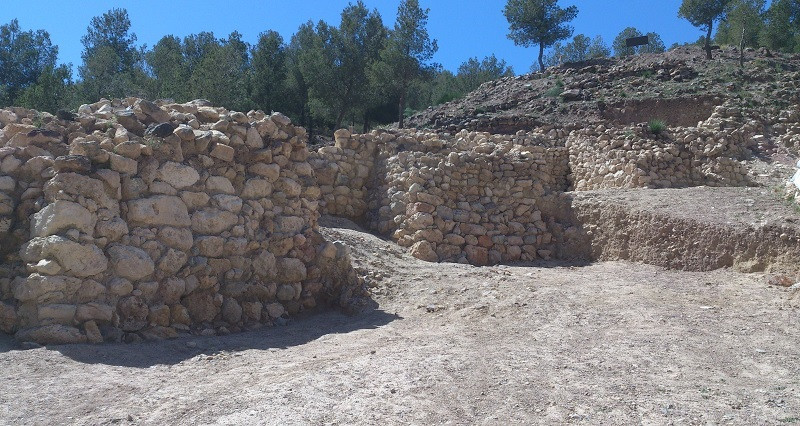
Investigations of the Argaric culture sites allow us to know their main characteristics. For example, we know that they used to establish themselves in high places, as already mentioned, and in these locations they created their buildings, usually rectangular in plan and sometimes trapezoid-shaped. The materials used were stone, adobe and rammed earth creations, walls made with clay and wooden formwork, very typical in Mediterranean cultures such as the Argaric.
In addition to the homes themselves, constructions dedicated to social activities are observed, such as warehouses, workshops and places to develop various professions. Some sites have walls for defense against possible attacks by invaders, but many of them lack these fortifications, since the strategic locations in well-protected places were naturally enough defense, as they made any external attack very difficult.
It is believed that about 400 people lived in each town although the largest could house even 600. These population centers had a series of services such as channeled drains, cisterns to store water that they collected from a nearby place, since they always settled next to a river, stables for animals, granaries for being able to store food, and various elements to facilitate transit between different parts of the town, such as stairs or ramps to bridge differences in level.
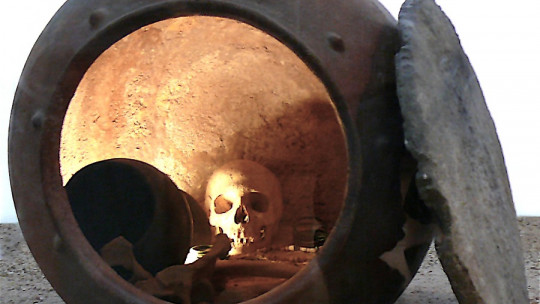
One of the main characteristics of the Argaric culture is that they buried their dead on the grounds of their homes. To do this, they made pits or even used pithoi, large jars made of ceramic. Besides It was common to make offerings that were buried next to the deceased, and the elements found have been tremendously useful in getting an idea of the social hierarchy existing in Argaric societies.
Although most graves house a single body, there are some cases of couples and even family groups sharing a niche. Likewise, tombs have been found with offerings but without a body, which indicates that they could not bury their mortal remains, perhaps because these individuals had died in a battle from which they did not return. The fact of perform a funeral ritual even without a body It is an indicator of certain religious thoughts that could indicate beliefs in a life after death.
Social structure
In the Argaric culture The society was made up of a group of families of not many descendants Thanks to the elements found in the tombs, it is believed that there were five different social strata.
In the first place are the leading men of the town, carrying weapons and elements made of precious metals. Then there would be their families, that is, their wives and children, who would also belong to the highest stratum of society.
Next there would be citizens with full rights, next to whom more conventional metal weapons were deposited. This could include the city’s soldiers.
The fourth group is made up of people with more limited rights, perhaps artisans or peasants, whose trousseau was simple decorative elements. And lastly there would be the individuals who were not honored with an offering. It is believed that they could be slaves or at least people with very limited rights within Argaric society.
The role of women in this culture is not clear It is believed that she would be subordinate to the man, but only within the social stratum of him or his superiors. That is to say, belonging to a certain class had more weight in terms of rights than being a man or woman, which would be a second distinction. The elements found in the female graves suggest that they were dedicated to certain productive activities that provided economic value to the Argaric society beyond the fact of creating offspring.
Economic activity
The Argaric culture was nourished by different productive activities. One of the most important was mining, and it was also key to choosing the location of the settlements, since they were normally close to mining areas, for example tin.
Likewise, They were great farmers, especially growing barley which were then stored in granaries and then crushed using small mills, which were centralized in a very specific place within the town.
The Argarics also practiced livestock farming, as opposed to hunting wild animals, which must have been very scarce. In their territories they would house species such as horses, oxen, goats, sheep and pigs. They were also dedicated to other activities such as ceramic manufacturing, creating objects with common shapes that suggest that they had certain patterns or criteria to follow to standardize the objects. Furthermore, the quality of their ceramics was very striking.
They also worked with other materials, such as metallurgy itself with the metals they extracted from the mines but also carving bones and also stones of different types and sizes.
Finally, another of its most notable industries would be textiles, since abundant evidence has been found of creations made of linen.
Use this citation format to reference the article clearly and help readers find the original source.
PsychologyFor. (2024). Argaric Culture: Characteristics of This Ancient Iberian Civilization. PsychologyFor. https://psychologyfor.com/argaric-culture-characteristics-of-this-ancient-iberian-civilization/