

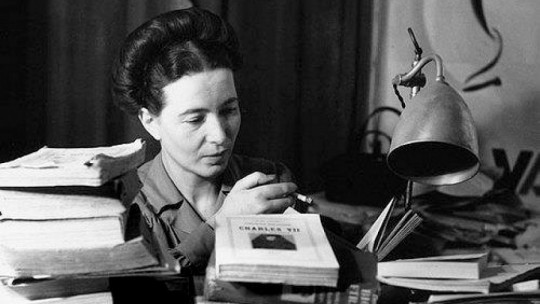
Simone de Beauvoir is one of the great minds of the 20th century. A great thinker, novelist and, although she did not recognize it, a feminist, her fight for women’s rights has been a turning point in achieving gender equality.
His way of being and seeing human relationships was a scandal at the time, especially taking into account the type of relationship he had with another great philosopher, Jean-Paul Sartre.
If you want to know more about the prolific intellectual life of this author and also about her interesting personal life, keep reading to see a brief biography of Simone de Beauvoir with which we will learn about his life and work.
Biography of Simone de Beauvoir
Below we will see the most notable life events of Simone de Beauvoir, among them the great historical figures with whom she was able to meet and her relationship with Jean-Paul Sartre.
1. Early years
Her full name is Simone Lucie Ernestine Marie Bertrand de Beauvoir, born on January 9, 1908 in Paris, France, into a bourgeois family in the French capital. Already from the early years of the young Simone de Beauvoir, there were two tendencies in her family that pushed her to touch the extremes of herself.
On the one hand, her mother was a devout Catholic, while her father was an atheist, and invited the young woman to expand her vision and knowledge of the world through reading. This is perhaps why de Beauvoir’s childhood is deeply marked by an exalted faith in God, wanting to grow up to be a nun. But, When he reaches the age of 14, he definitively abandons these beliefs, ensuring that God simply does not exist
How many of these have you been "meaning to read" for months?
- 1
 AveryGood EnergyThe Surprising Connection Between Metabolism and Limitless HealthListen Free On Audible
 - 2
 PenguinIt Didn't Start with YouHow Inherited Family Trauma Shapes Who We Are and How to End the CycleListen Free On Audible
 - 3
 Spiegel & GrauCodependent No MoreHow to Stop Controlling Others and Start Caring for Yourself (Revised and Updated)Listen Free On Audible
The young woman was always an excellent student, and in fact her father encouraged her to continue her studies. One of the phrases that her father told her and that perhaps contributed to her thinking about the differences between men and women when she grew up was “Simone thinks like a man”, meaning that he saw her as intelligent as a man, according to the sexist perspective clearly predominant at that time.
2. Academic training
At around 16 years of age, Simone de Beauvoir decides that she will study to be a teacher This could not have been possible if the family had not gone through financial problems, which meant that they could not offer a good dowry to marry their daughters and opted for them to study whatever they wanted.
After passing the mathematics baccalaureate exams in 1925, de Beauvoir enrolled at the Catholic Institute of Paris. He also combined this with literature and language studies at the Saint-Marie Institute. Later, he would study philosophy at the Sorbonne finishing his studies in 1928 and presenting his thesis on Leibniz.
At that time, Simone de Beauvoir was the ninth woman to obtain a degree offered by the Sorbonne, because until very recently in France it had not been possible for women to study higher education.
Years later she took the exams to be a teacher in France (agrégation) and decided to attend the Ecole Normale Supérieure of Paris as a student. It was during that time that she had the opportunity to meet some great French thinkers of the 20th century, such as Paul Nizan, René Maheu and, most notably, Jean-Paul Sartre
At the end of the agrégation tests, Sartre came in first place, while de Beauvoir came in second place, becoming at the age of 21 the youngest person to have passed that exam.
3. Wartime
From the time she obtained the agrégation in 1929 until 1943, Simone de Beauvoir He dedicated himself to teaching in secondary education He taught at high schools in several French cities, including Marseille, Rouen and Paris. It was also in 1929 that Simone de Beauvoir and Jean-Paul Sartre became a couple.
In 1943 she decided to abandon her job as a teacher and focus on writing, publishing her first novel that same year, L’invitée. At that time Paris had been taken by the Nazis and de Beauvoir dedicated himself to reflect on the responsibility of intellectuals in times of war exposed in his book Le Sang des Autres.
It was also during the years of the German occupation that he wrote his only dramaturgical work, The useless boucheswhich would be performed in 1945 at the Théâtre des Carrefours in Paris.
In 1944, together with other intellectuals such as Sartre, Raymond Aron, Maurice Merleau-Ponty, Albert Ollivier and Jean Paulhan, he founded the magazine The modern timeswith an ideology close to that of the communist party and a publication in which existential thought was disseminated.
4. End of the war and philosophical maturity
After the end of the occupation he began to publish his first philosophical essays, which would not go unnoticed. In 1947 he held several conferences throughout the United States in which he spread his philosophy. It was also that year that he published probably his best-known book: Le deuxième sexeknown in Spanish as The second sex. The publication of this work was very controversial, even for France at that time, a country which was considered tolerant and very secular with respect to its neighbors Spain and the United Kingdom.
Already into the fifties, he made several trips both inside and outside his native country, including to countries under communist rule such as China and Cuba. interviewing Mao Zedong, Fidel Castro and Che Guevara
5. Last years and death of Sartre
Although he had a marked Marxist ideology, de Beauvoir always defended human rights against his political vision, signing a manifesto against the Soviet invasion of Hungary. Despite being a French citizen, She was very critical of the French administration in Africa, defending the independence of Algeria. He considered that colonialism was nothing more than another form in which the oppression of the strongest towards the weakest occurs.
Years later, de Beauvoir, Together with Sartre, they would formally distance themselves from communism when the invasion of Czechoslovakia occurred by the Soviet authorities.
During the sixties she continued her travels, going to Japan, Egypt, Israel and the USSR and, in the following decade, she showed her opinions on such controversial topics as abortion, the Arab-Israeli conflict and women’s rights.
In 1980 Sartre died, ending their open relationship that had already lasted about 50 years In honor and memory of him, de Beauvoir published the following year The goodbye ceremonychronicling their relationship over five decades.
Simone de Beauvoir died on April 14, 1986 from pneumonia at the age of 78.
Work and thought
The thought of Simone de Beauvoir has laid the foundations for the construction of feminism as it is understood today in addition to being a song to individual freedom, both economic and sexual and reproductive.
Below we will briefly see three texts written by the French philosopher, focused especially on the relationship of women with men, both in the most traditional and personal vision of de Beauvoir.
1. L’invitée
L’invitée, in Spanish translated as “The Guest”, is the first novel by Simone de Beauvoir published in 1943. In it she describes her relationship with Sartre and two of her students when she worked in Rouen, the Kosakiewicz sisters, although changing the names of the characters. In fiction, Sartre and de Beauvoir even have threesomes with the students.
2. Le deuxième sexe
Le deuxième sexe (1949) converts the most important principle of existentialism, that is, that existence precedes essence, into a feminist slogan: one is not born a woman but rather becomes a woman.
The author distinguishes between the concepts of sex and gender On the one hand, sex is something biological, defined by the X and Y chromosomes, while gender is understood as the historical and social construction of what it is to be a man and a woman. De Beauvoir also maintains that oppression of women is strongly linked to the historical concept of what femininity is.
The title of the book is already a declaration of intentions. Simone de Beauvoir refers to women as the second sex because, traditionally, They have been defined based on their relationships with men
Although it may be surprising, de Beauvoir never considered herself a feminist, although feminism has been based on what was explained in her most notable work. de Beauvoir’s doctrine expounded in Le deuxieme sexepromoting the economic independence of women and the right to receive the same education as men, have been a great contribution to the constitution of feminism.
3. The mandarins
The mandarinspublished in 1954, was the work that managed to win the most important literary award in France, the Prix Goncourt.
In this book, de Beauvoir explains in a literary key her relationship with philosophers close to both the author’s environment and her life with her partner, Sartre, in addition to explaining her relationship with Nelson Algren.
Awards and decorations
In 1954 she was awarded the Goncourt Prize for her work The mandarins. In 1975 she received the Jerusalem Prize for the Freedom of the Individual in Society and in 1978 she received the Austrian Prize for European
References:
.
In 1998 an asteroid was named (11385) Beauvoir, followed by the asteroid (11384) Sartre. In 2000, a square was inaugurated in Paris in honor of Simone de Beauvoir and Jean-Paul Sartre and in 2006 a small bridge was inaugurated in that same city in honor of de Beauvoir. The Simone de Beauvoir Prize for Women’s Freedom has been offered since 2008
Personal life
One of the best-known aspects that draws attention to Simone de Beauvoir is that she has maintained numerous relationships, even when she was married to Sartre, something that continues to surprise us today. Although this does not have to be seen as something negative, it has been able to partially overshadow her prolific intellectual production.
The relationship between Simone de Beauvoir and Jean-Paul Sartre lasted fifty years. However, both of them saw other people, maintaining a kind of verbal contract that they renewed every two years, in which they allowed an open relationship
De Beauvoir never intended to marry, nor did she ever intend to become a housewife and have children of her own. This allowed him to focus on her academic training, in addition to dedicating time to her literary production and philosophy, and also being free to see whoever she wanted.
It should be said that although His bisexuality was already controversial at a time when sexual diversity was little tolerated, the most controversial thing was the fact that, like Sisyphus of Lesbos, he had relationships with some of his students. In fact, one of his students at the Lycée Molière in Paris claimed that she was sexually exploited by Simone de Beauvoir. Due to rumors and comments of this type, de Beauvoir was suspended from employment in 1943 after she was also accused, in this case by the mother of a 17-year-old student.
Simone de Beauvoir, along with other great intellectuals of the time, signed a petition to lower the age of sexual consent in France.
Use this citation format to reference the article clearly and help readers find the original source.
PsychologyFor. (2024). Simone De Beauvoir: Biography of This Philosopher. PsychologyFor. https://psychologyfor.com/simone-de-beauvoir-biography-of-this-philosopher/