


You tick off every milestone on your carefully constructed checklist—the promotion, the relationship, the apartment, the savings goal—and find yourself sitting on the couch wondering why that elusive wave of permanent satisfaction never actually arrived. That sudden hollow sensation is painfully common. When we stake our emotional well-being on external achievements, the human brain rapidly adapts, resetting our baseline and leaving us chasing the next arbitrary milestone. It is not a moral failing. Rather, it exposes a fundamental flaw in how modern culture misinterprets sustainable happiness.
For decades, commercial culture has peddled a shallow version of well-being: forced positive affirmations, relentless material acquisition, and the toxic avoidance of negative emotions. When sadness, anxiety, or grief inevitably strike, people often assume they are broken, retreating into isolating shame. However, empirical positive psychology and cognitive neuroscience demonstrate that true human flourishing requires more than fleeting sensory pleasure. It demands cultivating psychological flexibility, character strengths, deep relational bonds, and an authentic sense of existential purpose. Engaging with evidence-based literature provides you with proven, actionable frameworks to construct an authentic foundation for emotional flourishing.
How can reading peer-reviewed psychological literature help you transcend hedonic adaptation and cultivate lasting subjective well-being?
This comprehensive guide details the 12 best books about happiness, examining foundational treatises on flow states, evolutionary psychology, mindset dynamics, and clinical interventions to help you build enduring life satisfaction.
The 12 Best Books About Happiness and Well-Being
Verified Top Picks- 1
 Martin E. P. Seligman Authentic Happiness The foundational positive psychology guide mapping character strengths, virtues, and eudaimonic meaningCHECK TODAY'S PRICE
 - 2
 Sonja Lyubomirsky The How of Happiness Empirically validated interventions to transcend hedonic adaptation and govern 40% of well-beingCHECK TODAY'S PRICE
 - 3Mihaly Csikszentmihalyi Flow: The Psychology of Optimal Experience Unlocking deep cognitive immersion, autotelic engagement, and peak human fulfillmentCHECK TODAY'S PRICE
- 4Daniel Gilbert Stumbling on Happiness A brilliant look into affective forecasting, cognitive prediction errors, and the psychological immune systemCHECK TODAY'S PRICE
- 5Jonathan Haidt The Happiness Hypothesis Examining ancient philosophical wisdom through the lens of modern neuroscience and social psychologyCHECK TODAY'S PRICE
- 6Shawn Achor The Happiness Advantage Proving that positive brain states drive achievement, creativity, and career successCHECK TODAY'S PRICE
- 7Barbara L. Fredrickson Positivity The Broaden-and-Build Theory showing how micro-moments of positivity create upward resilience spiralsCHECK TODAY'S PRICE
- 8Martin E. P. Seligman Flourish: A Visionary New Understanding Introducing the PERMA framework (Positive Emotion, Engagement, Relationships, Meaning, Accomplishment)CHECK TODAY'S PRICE
- 9Rick Hanson Hardwiring Happiness Overcoming the brain's negativity bias using self-directed neuroplasticity and the 4-step HEAL methodCHECK TODAY'S PRICE
- 10Oliver Burkeman The Antidote: Happiness for People Who Can't Stand Positive Thinking Exploring the negative path to contentment through Stoicism, uncertainty, and acceptanceCHECK TODAY'S PRICE
- 11Tal Ben-Shahar Happier: Learn the Secrets to Daily Joy The popular Harvard course framework balancing present enjoyment with long-term future fulfillmentCHECK TODAY'S PRICE
- 12Todd B. Kashdan & Robert Biswas-Diener The Upside of Your Dark Side Harnessing anger, anxiety, and guilt to build psychological flexibility and authentic whole-person successCHECK TODAY'S PRICE
Why Does Hedonic Adaptation Undermine Lasting Happiness?
Hedonic adaptation is the observed neurobiological tendency of humans to quickly return to a relatively stable baseline of happiness despite major positive or negative life events. When individuals acquire wealth, status, or material comforts, the novelty inevitably fades, requiring increasingly intense stimuli to generate the same subjective emotional reward.
Psychologist Sonja Lyubomirsky formalizes this dynamic through her landmark empirical research, demonstrating that roughly fifty percent of individual happiness is genetically predetermined, while only ten percent is dictated by external life circumstances like income or marital status. Crucially, the remaining forty percent is governed entirely by intentional cognitive and behavioral activities. Attempting to purchase or achieve permanent happiness through external circumstances is a biological dead end, whereas practicing daily intentional habits directly rewires our long-term happiness baseline.
Harvard psychologist Daniel Gilbert explains the cognitive mechanics behind this phenomenon through his research on affective forecasting. Humans possess an unconscious “psychological immune system” that synthesizes happiness and rationalizes outcomes, meaning we routinely overestimate the intensity and duration of future emotional reactions. Understanding these built-in cognitive forecasting errors liberates individuals from consumerist chasing and directs attention toward internally generated eudaimonic fulfillment.
- Hedonic adaptation rapidly neutralizes external material gains, resetting an individual’s subjective well-being baseline.
- Empirical data confirms that intentional daily behavioral practices govern forty percent of individual happiness.
- Affective forecasting errors cause individuals to consistently misjudge future emotional satisfaction levels.
- Developing internal psychological resilience protects against chronic overthinking and hedonic treadmill exhaustion.
The 12 Best Books About Happiness and Human Flourishing
The following curated selection represents the definitive academic and clinical canon for understanding subjective well-being, spanning foundational positive psychology literature, ancient philosophical syntheses, and evolutionary behavioral science.
1. Authentic Happiness: Using the New Positive Psychology to Realize Your Potential for Lasting Fulfillment — Martin E. P. Seligman
Authentic Happiness by the father of positive psychology, Martin E. P. Seligman, launched a worldwide paradigm shift by urging the psychological discipline to study human virtues rather than focusing exclusively on mental pathology. Seligman dismantles the hedonistic assumption that well-being is merely sensory gratification, distinguishing rigorously between the pleasant life, the good life, and the meaningful life.
The book introduces the Values in Action (VIA) classification of twenty-four universal character strengths, developed alongside Christopher Peterson. Seligman provides scientifically validated self-assessment diagnostic exercises that guide readers in identifying their top strengths and deploying them in service of something larger than themselves.
- Distinguishes fleeting hedonic pleasure from durable eudaimonic existential meaning.
- Introduces the VIA inventory of twenty-four universal character strengths and virtues.
- Provides validated cognitive exercises to increase subjective life satisfaction.
2. The How of Happiness: A New Approach to Getting the Life You Want — Sonja Lyubomirsky

The How of Happiness by positive psychology researcher Sonja Lyubomirsky is widely regarded as the most empirically rigorous, practical self-help manual on human well-being ever written. Grounded in extensive clinical trials, Lyubomirsky introduces her landmark 50-10-40 pie chart model, demonstrating that individuals retain substantial agency over their daily emotional baselines.
Lyubomirsky outlines twelve evidence-based happiness interventions, including practicing gratitude, cultivating optimistic appraisals, eliminating social comparison, and nurturing interpersonal bonds. Featuring the Person-Activity Fit Diagnostic, this volume enables readers to formulate a tailored, scientifically validated happiness plan.
- Demonstrates through empirical data that intentional activities govern forty percent of individual happiness.
- Features the Person-Activity Fit Diagnostic to tailor personalized positive interventions.
- Provides actionable strategies to counteract hedonic adaptation and prevent chronic overthinking.
3. Flow: The Psychology of Optimal Experience — Mihaly Csikszentmihalyi

Flow: The Psychology of Optimal Experience by pioneering cognitive psychologist Mihaly Csikszentmihalyi reveals that peak human fulfillment does not occur during passive relaxation, but during states of deep immersion where high challenge seamlessly matches personal skill. In this optimal flow state, self-consciousness vanishes, temporal perception distorts, and individuals experience profound intrinsic enjoyment.
Drawing on decades of experience-sampling research across surgeons, athletes, artists, and assembly-line workers, Csikszentmihalyi outlines the precise environmental and cognitive conditions required to achieve autotelic engagement. This profound masterpiece provides an actionable blueprint for transforming routine daily tasks into engines of psychological vitality.
- Identifies the precise neurocognitive conditions required to achieve optimal psychological flow states.
- Explains how matching high challenge with high skill eliminates boredom and acute anxiety.
- Teaches readers how to cultivate an autotelic personality for sustainable intrinsic motivation.
4. Stumbling on Happiness — Daniel Gilbert

Stumbling on Happiness by Harvard psychologist Daniel Gilbert is a witty, deeply researched exploration of affective forecasting—the science of how poorly humans predict what will make them happy in the future. Gilbert explains how the frontal lobe evolved to simulate prospective events, yet routinely fills in imaginary details and projects present emotional states onto tomorrow.
Gilbert illuminates the psychological immune system: the brain’s unconscious rationalization machinery that synthesizes genuine happiness following unexpected adversity. This counterintuitive volume teaches readers why we misjudge future life choices, delivering an indispensable masterclass in cognitive forecasting and human perception.
- Explains the cognitive mechanisms behind affective forecasting and systematic emotional prediction errors.
- Reveals how the psychological immune system rationalizes outcomes and restores emotional baselines.
- Demonstrates why relying on other people’s actual experiences produces more accurate happiness predictions.
5. The Happiness Hypothesis: Finding Modern Truth in Ancient Wisdom — Jonathan Haidt
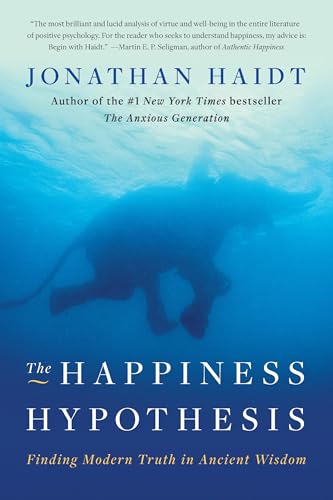
The Happiness Hypothesis by social psychologist Jonathan Haidt examines ten great ancient philosophical truths through the rigorous lens of contemporary cognitive neuroscience and social psychology. Haidt introduces his famous divided mind metaphor: the conscious, rational mind as a rider attempting to guide the much larger, instinctual elephant of automatic emotions.
Haidt explores the happiness formula ($H = S + C + V$), proving that well-being depends on our biological set point ($S$), life conditions ($C$), and voluntary activities ($V$). He investigates how adversity can foster post-traumatic growth, establishing a brilliant bridge between classical philosophy and positive psychology.
- Introduces the divided mind metaphor of the rider and the instinctual elephant.
- Formulates the scientific happiness equation balancing set points, conditions, and voluntary activities.
- Demonstrates how cultivating meaningful work and loving relationships creates vital human engagement.
6. The Happiness Advantage: How a Positive Brain Fuels Success in Work and Life — Shawn Achor

The Happiness Advantage by Harvard researcher Shawn Achor reverses the traditional formula for achievement. While conventional corporate and academic culture teaches that hard work yields success, which eventually produces happiness, Achor proves that the formula is scientifically backward: a brain primed for positivity exhibits superior cognitive performance and creative problem-solving.
Achor translates positive psychology research into seven actionable workplace principles, including the 20-Second Rule for lowering habit friction and the Tetris Effect for retraining cognitive filters. Written with compelling corporate case studies, this volume is essential for professionals seeking to build high-performing organizational cultures.
- Proves that positive emotion fuels professional success rather than functioning as an elusive byproduct.
- Introduces the 20-Second Rule to eliminate friction for positive behavioral habit loops.
- Details the Tetris Effect to retrain the brain for optimism and opportunity recognition.
7. Positivity: Groundbreaking Research Reveals How to Embrace the Hidden Strength of Positive Emotions — Barbara L. Fredrickson
Positivity by pioneering researcher Barbara L. Fredrickson introduces the Broaden-and-Build Theory of positive emotions, one of the most transformative theoretical frameworks in modern psychology. Fredrickson demonstrates that while negative emotions narrow visual and cognitive focus to survival-driven fight-or-flight responses, positive emotions broaden awareness and build lasting personal resources.
Fredrickson outlines ten fundamental positive emotions and explains how cultivating micro-moments of positivity produces an upward spiral of physical health and psychological resilience. This scientifically grounded work teaches readers how to foster authentic positive emotions without denying painful life realities.
- Explains the Broaden-and-Build Theory of evolutionary emotional adaptation.
- Details how micro-moments of positivity generate upward spirals of psychological resilience.
- Identifies the ten fundamental positive emotions and their physical cardiovascular health benefits.
8. Flourish: A Visionary New Understanding of Happiness and Well-being — Martin E. P. Seligman

Flourish represents Martin E. P. Seligman‘s mature theoretical evolution beyond his original authentic happiness model into a comprehensive theory of human flourishing. Seligman redefines the gold standard of positive psychology from subjective happiness to multi-dimensional well-being, introducing his famous PERMA framework: Positive Emotion, Engagement, Relationships, Meaning, and Accomplishment.
Seligman details large-scale real-world applications of positive psychology across education, corporate leadership, and military resilience initiatives. This visionary volume is indispensable for clinicians, educators, and leaders seeking to build flourishing social institutions.
- Introduces the multidimensional PERMA framework for measuring and cultivating human well-being.
- Explores post-traumatic growth as a transformative alternative to chronic post-traumatic stress.
- Demonstrates the systemic implementation of positive psychology in schools and public institutions.
9. Hardwiring Happiness: The New Brain Science of Contentment, Calm, and Confidence — Rick Hanson

Hardwiring Happiness by neuropsychologist Rick Hanson addresses the brain’s evolved negativity bias—the evolutionary survival mechanism that makes the human brain like Velcro for negative experiences and Teflon for positive ones. Hanson proves that simply experiencing positive moments is insufficient; we must actively internalize them to alter physical neural structures.
Hanson introduces the four-step HEAL protocol (Have a positive experience, Enrich it, Absorb it, and Link it) to turn fleeting mental states into lasting neural traits. This accessible, neuroscience-backed manual empowers readers to overcome ancient evolutionary survival conditioning and install durable psychological strengths.
- Explains the evolutionary neurobiology behind the brain’s primal negativity bias.
- Provides the four-step HEAL protocol to turn fleeting positive states into durable neural traits.
- Leverages self-directed neuroplasticity to cultivate unshakeable internal contentment.
10. The Antidote: Happiness for People Who Can’t Stand Positive Thinking — Oliver Burkeman
The Antidote by journalist Oliver Burkeman explores the “negative path” to happiness, drawing upon Stoic philosophy, Buddhist mindfulness, and modern clinical psychology. Burkeman challenges the commercial positive thinking industry, arguing that our desperate, relentless efforts to eliminate negative emotions and uncertainty directly generate psychological distress.
Burkeman investigates ancient practices like the Stoic premeditatio malorum (the premeditation of evils) and non-attachment, showing how confronting worst-case scenarios dissolves catastrophic anxiety. This counterintuitive masterpiece provides an indispensable antidote to commercial toxic positivity myths.
- Critiques the counterproductive psychological mechanisms of forced positive affirmations.
- Revitalizes ancient Stoic mental exercises to reduce catastrophic future anxiety.
- Advocates for non-judgmental acceptance of uncertainty and inevitable human vulnerability.
11. Happier: Learn the Secrets to Daily Joy and Lasting Fulfillment — Tal Ben-Shahar

Happier by former Harvard lecturer Tal Ben-Shahar translates the most popular course in Harvard University’s history into an accessible, beautifully structured guide to meaningful living. Ben-Shahar introduces the Hamburger Model of happiness, categorizing life approaches into four distinct quadrants based on present pleasure and future benefit.
Ben-Shahar emphasizes that happiness is an ongoing process of cultivating “happiness boosters”—small daily routines that provide both meaning and joy. This deeply insightful book serves as an ideal personal handbook for balancing immediate joy with long-term purpose.
- Introduces the Hamburger Model to balance immediate pleasure with future benefit.
- Teaches how to schedule daily happiness boosters to recharge emotional energy reserves.
- Provides practical frameworks to overcome the exhausting rat-racer perfectionism trap.
12. The Upside of Your Dark Side: Why Being Your Whole Self Drives Success and Fulfillment — Todd B. Kashdan and Robert Biswas-Diener
The Upside of Your Dark Side by positive psychology researchers Todd B. Kashdan and Robert Biswas-Diener offers a crucial, evidence-based corrective to the toxic positivity trap. The authors argue that a truly flourishing life requires psychological flexibility—the ability to experience and utilize the full spectrum of human emotions, including anger, anxiety, guilt, and sadness.
Kashdan and Biswas-Diener demonstrate the functional utility of negative states: anger fuels courage to confront injustice, anxiety sharpens vigilance, and guilt motivates moral repair. The book advocates for the 80/20 emotional ratio, where life is predominantly positive but enriched by adaptive difficult feelings.
- Exposes the psychological dangers and emotional costs of forced positive thinking.
- Demonstrates the functional evolutionary utility of anger, anxiety, guilt, and sadness.
- Advocates for psychological flexibility to navigate complex life challenges.
The Science of Well-Being: Unpacking the PERMA Framework
At the center of contemporary positive psychology stands Martin Seligman’s PERMA well-being model, a comprehensive multi-dimensional framework that defines the essential pillars of human flourishing. Unlike simplistic theories that reduce well-being to hedonistic pleasure, the PERMA model demonstrates that flourishing requires cultivating five distinct, intrinsically valued elements: Positive Emotions, Engagement, Relationships, Meaning, and Accomplishment.
Positive emotions encompass feelings of joy, gratitude, serenity, and hope, serving as vital fuel that broadens cognition and builds psychological resilience. Engagement refers to the deep immersion experienced during flow states, where individuals fully deploy their highest capabilities. Relationships represent the profound truth that human beings are fundamentally social organisms whose emotional health depends on secure, loving bonds. Neuroscientist Lisa Feldman Barrett notes that social connection directly regulates our physiological body budget, proving that supportive relationships are biological necessities for health.
Meaning and Accomplishment complete the flourishing equation by connecting daily actions to a broader purpose and fostering personal self-efficacy. Meaning involves serving causes greater than oneself, while accomplishment satisfies the intrinsic human need for mastery, competence, and achievement. Psychiatrist Viktor E. Frankl famously observed that individuals who have a “why” to live can endure almost any “how,” illustrating that meaning provides the ultimate anchor during profound adversity.
- Establishes a balanced multi-dimensional metric for evaluating authentic holistic life satisfaction.
- Prevents burnout by ensuring accomplishment is balanced with restorative relationships and positive emotions.
- Guides educators and leaders to design environments that foster deep intellectual and creative engagement.
- Provides actionable pathways to discover enduring existential purpose and prosocial community contribution.
Hedonic Pleasure vs. Eudaimonic Meaning: What Research Shows
Understanding the fundamental distinction between hedonic pleasure and eudaimonic meaning is essential for cultivating sustainable well-being. Hedonic well-being focuses on maximizing immediate sensory pleasure and minimizing physical or emotional discomfort. In contrast, eudaimonic well-being centers on living in accordance with one’s true self, cultivating character virtues, pursuing personal growth, and contributing to prosocial community causes.
| Dimension of Well-Being | Hedonic Focus | Eudaimonic Focus |
|---|---|---|
| Primary Goal | Maximizing positive sensory pleasure and emotional comfort | Cultivating purpose, character virtues, and personal growth |
| Temporal Duration | Fleeting, transient bursts requiring constant external renewal | Enduring, stable life satisfaction resilient against external adversity |
| Biological Response | Dopaminergic reward activation prone to rapid habituation | Enhanced cellular immune function and reduced inflammatory gene expression |
| Vulnerability | High susceptibility to hedonic adaptation and treadmill exhaustion | Low susceptibility to external disruption and circumstantial volatility |
Extensive neurobiological and psychological research demonstrates that while hedonic pleasures provide enjoyable short-term emotional boosts, they cannot sustain long-term life satisfaction on their own. Studies led by Barbara Fredrickson reveal that individuals with high eudaimonic well-being exhibit healthier genomic profiles—including lower levels of pro-inflammatory gene expression—than those whose well-being is purely hedonic. Prioritizing eudaimonic meaning transforms happiness from an exhausting pursuit of momentary sensory highs into an enduring state of grounded existential fulfillment.
Why Forced Positive Thinking Triggers Emotional Backlash
The cultural mandate demanding relentless, uninterrupted positivity is psychologically toxic and counterproductive. Forcibly suppressing authentic negative emotions such as grief, anxiety, or anger does not eliminate them; rather, emotional suppression dramatically amplifies sympathetic nervous system arousal and fuels internalized psychological shame.
Pioneering cognitive psychologist Aaron T. Beck established that emotional health requires realistic, objective appraisal rather than delusional Pollyanna optimism. When individuals repeat positive affirmations that conflict with their lived reality, the cognitive dissonance triggers acute internal resistance, leaving them feeling more deficient and fraudulent than before. Oliver Burkeman and Todd Kashdan demonstrate that allowing negative emotions to exist without judgment allows emotional waves to complete their natural biological processing cycle, preventing chronic emotional numbness.
Accepting uncomfortable feelings with mindful curiosity is the foundation of genuine psychological flexibility. By abandoning the exhausting struggle to feel happy all the time, individuals build authentic resilience and develop true emotional self-acceptance.
- Forced positive affirmations trigger cognitive dissonance, intensifying feelings of internalized inadequacy and fraudulence.
- Suppressing natural negative emotions measurably increases cardiovascular sympathetic arousal.
- Mindful acceptance allows difficult emotional waves to complete their natural biological regulation cycle.
Daily Evidence-Based Exercises to Rewire Your Well-Being Baseline
Reading positive psychology literature produces lasting well-being only when theoretical concepts are translated into structured, daily behavioral practices. Translating scientific insights into everyday habits requires deliberate routines that bridge the gap between cognitive comprehension and lived emotional experience. Clinical psychologist Carl R. Rogers consistently emphasized that authentic self-actualization requires integrating insight into daily experiential living practices.
To integrate the core lessons from these twelve essential volumes into your life, practice these five evidence-based positive psychology disciplines:
- Practice the “Three Good Things” exercise each evening by writing down three positive events and why they occurred in your day.
- Conduct a weekly signature strength intervention by deploying one top virtue in a completely new creative way.
- Apply the HEAL protocol to absorb micro-moments of joy for twenty seconds to stimulate positive neuroplastic structural changes.
- Schedule two hours of uninterrupted deep work to cultivate optimal psychological flow states.
- Engage in the Stoic premeditation of evils for five minutes to eliminate catastrophic future anxiety.
When Should the Pursuit of Happiness Transition to Clinical Support?
While positive psychology literature offers transformative frameworks for personal flourishing, it is designed for educational purposes and can never replace professional mental health treatment. Understanding the boundary between general existential dissatisfaction and clinical psychiatric illness is an essential mental health literacy competency.
Positive psychology focuses on helping individuals move from baseline functioning to flourishing ($+0$ to $+5$). However, clinical conditions like major depressive disorder, generalized anxiety disorder, and complex trauma operate below the functional baseline ($-5$ to $+0$). If you experience persistent sadness, anhedonia (the inability to feel pleasure), changes in sleep and appetite, or overwhelming despair lasting more than two consecutive weeks, self-help books are insufficient. You should schedule an evaluation with a licensed clinical psychologist or psychiatrist.
Most critically, if you or someone you know is experiencing thoughts of self-harm or suicidal ideation, do not rely on literature. In the United States and Canada, call or text 988 immediately to connect with the Suicide & Crisis Lifeline, available twenty-four hours a day, seven days a week, free and completely confidential. Seeking professional clinical care is not a failure of positive thinking; it is the ultimate act of courageous personal self-advocacy.
- Persistent anhedonia, sleep disruption, and chronic hopelessness warrant an evaluation by a licensed mental health professional.
- Clinical psychiatric disorders require structured, evidence-based psychotherapy rather than positive self-help interventions.
- Acute intrusive thoughts of self-harm or suicidal ideation demand immediate emergency contact with dedicated crisis support services.
FAQs about Books on Happiness and Well-Being
What is the single best book on happiness for a complete beginner?
For a complete beginner seeking an evidence-based yet accessible starting point, The How of Happiness by Dr. Sonja Lyubomirsky is universally regarded as the gold standard. Lyubomirsky breaks down the science of well-being using her famous 50-10-40 pie chart model, proving that intentional daily activities govern forty percent of our happiness baseline. The book includes the Person-Activity Fit Diagnostic, which helps readers identify which specific positive interventions match their unique personality. It avoids superficial motivational fluff, grounding every recommendation in peer-reviewed clinical research.
Can reading books about happiness permanently rewire brain circuitry?
Reading books about happiness can stimulate self-directed neuroplasticity and alter neural circuitry when cognitive insights are paired with active, daily behavioral practice. Neuropsychologist Dr. Rick Hanson shows in Hardwiring Happiness that actively holding positive experiences in conscious awareness for fifteen to twenty seconds physically converts fleeting mental states into lasting neural traits. However, passive reading without behavioral repetition will not alter baseline neural structures; sustained neuroplastic change requires regular, embodied practice of evidence-based habits over several months.
What is the difference between hedonic happiness and eudaimonic well-being?
Hedonic happiness refers to momentary sensory pleasure, comfort, and positive emotional states, such as enjoying a fine meal or buying a new gadget. While enjoyable, hedonic pleasure is temporary and highly susceptible to hedonic adaptation, where the novelty quickly fades. Eudaimonic well-being, in contrast, is rooted in living a life of meaning, personal growth, virtue, and contribution to something greater than oneself. Research shows that eudaimonic well-being provides stable, long-term life satisfaction that remains resilient even during difficult life circumstances.
Why do traditional positive thinking books often make people feel worse?
Traditional positive thinking books often promote toxic positivity, demanding that individuals suppress negative emotions and repeat forced affirmations that contradict their lived reality. When people attempt to deny genuine grief, anxiety, or sadness, the brain experiences cognitive dissonance and sympathetic nervous system arousal, which actually intensifies internal distress. Furthermore, when forced positive thinking fails to cure emotional pain, individuals often experience toxic secondary shame, blaming themselves for not being positive enough. Real well-being requires accepting difficult emotions rather than denying them.
How does the PERMA model define human flourishing?
The PERMA model, developed by Dr. Martin Seligman, defines human flourishing as a multidimensional construct comprising five independent, measurable elements: Positive Emotion (experiencing joy and gratitude), Engagement (entering deep flow states where skills meet challenges), Relationships (nurturing loving, authentic social bonds), Meaning (serving a purpose larger than oneself), and Accomplishment (pursuing mastery and competence for their own sake). Cultivating all five pillars creates a rich, balanced life that goes far beyond simple momentary happiness.
How do I know if I need therapy instead of a positive psychology book?
You should seek therapy when emotional distress persistently interferes with your ability to work, maintain relationships, sleep, or handle daily responsibilities for more than two weeks. Positive psychology books are designed to help functional individuals flourish, but they cannot treat clinical depression, severe anxiety disorders, or unhealed trauma. If you experience persistent anhedonia, overwhelming panic, or thoughts of self-harm, professional clinical intervention from a licensed psychologist or psychiatrist is necessary to ensure safety and provide tailored treatment.
Bibliography
- Achor, S. (2010). The Happiness Advantage: How a Positive Brain Fuels Success in Work and Life. Crown Currency.
- Barrett, L. F. (2017). How Emotions Are Made: The Secret Life of the Brain. Houghton Mifflin Harcourt.
- Beck, A. T. (1979). Cognitive Therapy of Depression. Guilford Press.
- Ben-Shahar, T. (2007). Happier: Learn the Secrets to Daily Joy and Lasting Fulfillment. McGraw-Hill.
- Burkeman, O. (2012). The Antidote: Happiness for People Who Can’t Stand Positive Thinking. Farrar, Straus and Giroux.
- Csikszentmihalyi, M. (1990). Flow: The Psychology of Optimal Experience. Harper & Row.
- Frankl, V. E. (2006). Man’s Search for Meaning. Beacon Press.
- Fredrickson, B. L. (2009). Positivity: Groundbreaking Research Reveals How to Embrace the Hidden Strength of Positive Emotions. Crown Archetype.
- Gilbert, D. (2006). Stumbling on Happiness. Alfred A. Knopf.
- Haidt, J. (2006). The Happiness Hypothesis: Finding Modern Truth in Ancient Wisdom. Basic Books.
- Hanson, R. (2013). Hardwiring Happiness: The New Brain Science of Contentment, Calm, and Confidence. Harmony Books.
- Kashdan, T. B., & Biswas-Diener, R. (2014). The Upside of Your Dark Side: Why Being Your Whole Self Drives Success and Fulfillment. Avery.
- Lyubomirsky, S. (2007). The How of Happiness: A New Approach to Getting the Life You Want. Penguin Press.
- Rogers, C. R. (1961). On Becoming a Person: A Therapist’s View of Psychotherapy. Houghton Mifflin.
- Seligman, M. E. P. (2002). Authentic Happiness: Using the New Positive Psychology to Realize Your Potential for Lasting Fulfillment. Free Press.
- Seligman, M. E. P. (2011). Flourish: A Visionary New Understanding of Happiness and Well-being. Free Press.
Use this citation format to reference the article clearly and help readers find the original source.
PsychologyFor. (2026). The 12 Best Books About Happiness. PsychologyFor. https://psychologyfor.com/the-12-best-books-about-happiness/