


See more of our articles in your search results.
With the speed at which our society advances and with the number of things we must do in our daily lives, it is normal for stress or anxiety responses to appear. Generally, these two terms tend to be understood as the same concept, and it is not surprising, since they are closely associated with each other. Certain anxiety or stress responses are healthy and adaptive, however, the presence of these two responses in abundance can cause serious health problems or psychological disorders. If you are interested in understanding these two phenomena that are so frequent in our lives and understanding those elements that differentiate them, continue reading this article from Psicología-Online: 10 differences between stress and anxiety.
What is anxiety?
Anxiety is a response that causes our body to activate and reproduce defense mechanisms in the face of a certain circumstance. Faced with this set of situations that generate anxiety, an emotional response is awakened, which will vary depending on the stimulus that produces anxiety. This emotional response can be associated with feelings of restlessness, fear, nervousness and can cause the appearance of excessive worries.
Anxiety: symptom
Anxiety symptoms can vary depending on the anxiety disorder that occurs. However, all of them share a set of symptomatic manifestations that can be classified into different groups. In general, anxiety symptoms can be classified into the following groups: physical, psychological, behavioral, cognitive and social, although the specific symptoms of each category are different in different disorders. Therefore, anxiety symptoms can be the following:
- Psychological: fear of losing control, fear of dying, feeling of threat, desire to flee from the situation that is associated with danger, uncertainty or insecurity.
- Of conduct: People who suffer from anxiety disorders are constantly in a state of alert or hypervigilance. On the other hand, impulsivity, motor agitation or hyperactivity may occur. Furthermore, in anxiety disorders a change in body expressiveness or body language may appear, presenting rigid postures, changes in voice, imprecise movements, etc.
- Cognitive: In anxiety disorders there tend to be problems with attention, concentration or memory. On the other hand, excessive worries and negative and irrational cognitions appear.
- Social: Anxiety can limit social circumstances, and may present irritability, speech blocks, a tendency to isolate or difficulty expressing one’s opinion.

What is stress?
Stress appears when the person does not have the adaptive capacity to adapt to demands of the circumstances, that is, the person in these situations feels overwhelmed and stress responses appear. The stress response can give rise to psychological and biological alterations, which can generate certain diseases over time, since stress has effects on the body.
How many of these have you been "meaning to read" for months?
- 1
 New Harbinger PublicationsThe Untethered SoulThe Journey Beyond YourselfListen Free On Audible
- 2
 Sourcebooks, Inc.My Calm Down BookA Sensory Book to Help Kids Calm Their BodiesListen Free On Audible
- 3
 FINGERPRINT with FP logoMeditations (Deluxe Hardbound Edition)FINGERPRINT with FP logoListen Free On Audible
tress: symptom
The presence of stress can give rise to symptoms at an emotional, cognitive or behavioral level. The most common signs of stress and symptoms are the following:
Emotional symptoms of stress
- Loss of energy on a physical or psychological level
- low mood
- Pessimism
- Fear of suffering from an illness
- Anxiety
- Decreases self-esteem
- Emotional lability
- Instability or restlessness
- Strain
Cognitive symptoms of stress
- Difficulty making decisions
- Mental block
- Difficulty accepting criticism
- Confusion
- Ease of distraction
- Frequency of forgetting
Behavioral symptoms of stress
- Stuttering
- Behaviors such as drinking or smoking excessively
- Nervous laugh
- Nail biting or hair pulling
- Use of drugs, such as tranquilizers
- Increased physical activity
- Bad eating habits

10 differences between stress and anxiety
Although stress and anxiety responses are conceived as synonyms, they are two different response processes. They may be related but they have several aspects that differentiate them. The top 10 differences between stress and anxiety are as follows:
1. Origin
Stress maintains a clearly identifiable origin As we have previously indicated, when faced with certain situations that the person must face and feels that they do not have the necessary resources to be able to address it, they feel overwhelmed, causing the origin of stressful responses.
Against, the origin of anxiety is more diffuse. The person may feel sensations of threat or fear, but without the need to know where it comes from, without its origin being identifiable. It is not necessary for an objective circumstance to occur for anxiety responses to be awakened.
2. Triggering factors
The triggering factors stress are related to external factors that surround the person, to the circumstances that overwhelm them and cause this stress response.
The triggering factors of anxiety are more internal, tied to our cognitions, to thoughts of a catastrophic nature or feelings of anguish and fear. It is based mainly on subjective fear, regardless of what is happening outside and there tends to be worry and anticipation of improbable events.
3. Emotions presented
In stress, the predominant emotion is not fear, but Stimulus concerns that has contributed to the person’s overflow. This worry triggers irritable behaviors and feelings of sadness, as well as nervousness and feelings of frustration faced with the inability to overcome what is presented to him.
In anxiety, the predominant emotion is fear, fear that something bad might happen which leads to the person constantly anticipating the possible catastrophic or negative situations that may occur next.
4. Time of appearance
Stress gets stuck in the present causing the time in which the person is stressed to seem endless, feeling that they will not be able to overcome said situation and without finding an alternative to be able to face it. As we have previously commented, the temporal space in anxiety is located in the future in the anticipation characteristic of catastrophic thinking.
5. Duration
Stress, being related to external factors, ends when the stressor disappears or is surpassed. At the moment when the stressful stimulus has disappeared, the person’s physiological and psychological state tends to return to normal.
The duration of anxiety is more complex to understand. Firstly, because it is associated with one’s own internal construction, with irrational thoughts that the person has developed around an idea. Faced with this, anxiety can be prolonged without a fixed end depending totally on the reconstruction of reality that the person executes so that said fear decreases.
6. Remission of symptoms
Although the presentation of symptoms may be similar and they share symptoms, the duration of the symptoms is very different. In stress, symptoms appear only when stimulated stressful, for example, during exam time, and once the stressful circumstance has passed or been overcome, the symptoms disappear and the person returns to their normal state. On the contrary, in anxiety, as it is associated with internal factors and diffuse triggers, tends to persist over time. In the same previous exam, at the end of the exam period the person will leave thinking that they could have done much better, what their grades will be, they wonder how they will face another round of exams,… thus maintaining high levels of anxiety.
7. Objective intensity
In stress, the intensity of its presentation goes more in accordance with the importance of the factor trigger, while in anxiety the intensity is more irrational because a high intensity is presented related to subjective factors that in other people would not cause such an intense response.
8. Anxiety underlies stress
Anxiety is considered a manifestation of stress, being an emotional response to it, a symptom. This relationship does not happen in the opposite direction. That is to say, stress causes anxiety but it is not occasional that anxiety produces stress.
9. Severity
Although both stress and anxiety are two normal and healthy adaptive responses, when they occur in excess they can cause major health problems. Nevertheless, the severity of anxiety is greater, which can cause psychological disorders such as: generalized anxiety disorder, panic attacks or phobias, among others. On the other hand, the severity of stress is not so intense and its excess can cause or aggravate certain organic diseases.
10. Treatment
The treatment for both reactions differs greatly. Anxiety, being more persistent, requires treatment for remission. In stress, if it does not subside, the person can begin psychotherapeutic treatment with the aim of adopting strategies to cope with stress on the other hand, the treatment of anxiety tends to require a psychological and pharmacological treatment combined. Such as, for example, cognitive-behavioral therapy or pharmacological treatment for panic attacks.
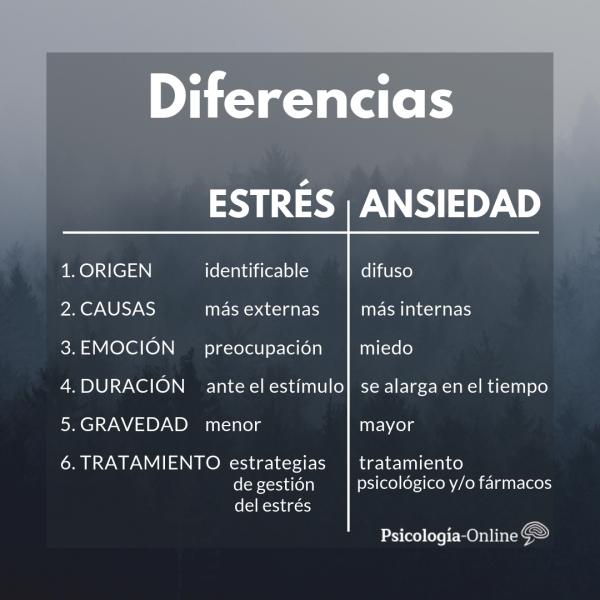
Differences between stress and anxiety: summary
Below, we show a table as a visual summary of the most important differences between stress and anxiety.
This article is merely informative, at PsychologyFor we do not have the power to make a diagnosis or recommend a treatment. We invite you to go to a psychologist to treat your particular case.
If you want to read more articles similar to 10 differences between stress and anxiety we recommend that you enter our Clinical Psychology category.
Bibliography
- Cano, A & Tobal, J. (2001). Emotions and health. Anxiety and Stress. 7(2-3), 111-121.
- Gutiérrez, M. & García, M. (2000). Anxiety and cognition: an integrative framework. Spanish Journal of Motivation and Emotion (REME), 3(4),
- Regueiro, A. Basic concepts: What is stress and how does it affect us? Psychological Care Service of the University of Malaga
- Sierra, J., Ortega, V & Zubeidat, I. (2003). Anxiety, anguish and stress: three concepts to differentiate. Malaise and subjectivity, III, 10-59.
Use this citation format to reference the article clearly and help readers find the original source.
PsychologyFor. (2024). 10 Differences Between Stress and Anxiety. PsychologyFor. https://psychologyfor.com/10-differences-between-stress-and-anxiety/