


See more of our articles in your search results.
I remember the first time I stood in the Court of the Lions at the Alhambra. It was early morning, before the crowds arrived, and the light was hitting the columns in this perfect golden way that made the whole space feel suspended in time. I’d seen thousands of photos, read guidebooks, watched documentaries. None of it prepared me for the actual experience of being there, surrounded by that intricate Islamic geometry, the sound of water trickling through ancient fountains, the scent of jasmine drifting from the gardens.
That’s the thing about Spain’s World Heritage Sites—they’re so famous, so photographed, so documented that you think you know them before you arrive. Then you actually show up and realize you knew nothing at all.
I’ve spent years exploring Spain, partly because my work brings me here often, partly because I fell in love with this country the way you fall into a conversation with someone fascinating at a dinner party—you look up and hours have passed and you’re not ready to leave. Living in Segovia has given me a front-row seat to one of those World Heritage wonders, the Roman Aqueduct, which I pass almost daily and still find myself stopping to stare at like a tourist.
Spain has fifty UNESCO World Heritage Sites, more than almost any country in the world. Fifty. That’s an absurd concentration of historically and culturally significant places for one country to hold. It speaks to Spain’s ridiculously complex history—Romans, Visigoths, Moors, Christians, Jews all leaving their marks, often literally building on top of each other’s structures. A mosque becomes a cathedral. A Roman theater gets a medieval town built over it. History here doesn’t sit neatly in categories; it layers and mingles and creates something you won’t find anywhere else.
Choosing just ten sites from fifty feels almost criminal. I’m leaving out incredible places—the prehistoric cave paintings at Altamira, the Roman walls of Lugo, the modernist architecture of the Catalan Modernisme route, the monasteries of Yuso and Suso where the Spanish language was first written down. But if you’re planning a trip to Spain and want to experience the absolute highlights, the places that will genuinely leave you changed, these ten will do it.
How many of these have you been "meaning to read" for months?
- 1
 Beacon PressMan's Search for MeaningGreat product!Listen Free On Audible
 - 2
 Harriman HouseThe Psychology of MoneyTimeless lessons on wealth, greed, and happinessListen Free On Audible
 - 3
 TyndaleThe Life-Changing Art of Self-Brain SurgeryConnecting Neuroscience and Faith to Radically Transform Your LifeListen Free On Audible
Some are famous tourist magnets where you’ll fight crowds and need advance tickets. Others are quieter, easier to access, equally stunning but somehow less known. All of them represent something essential about Spanish history, culture, and identity. And all of them are worth the effort to visit properly—not rushed, not checked off a list, but actually experienced.
The Alhambra and Generalife in Granada

Let’s start with the obvious one because it’s obvious for good reason. The Alhambra is the most visited monument in Spain, and it deserves that status.
This palace complex, built by the Nasrid dynasty in the 13th and 14th centuries, represents the pinnacle of Islamic architecture in Europe. But that description doesn’t capture what it actually feels like to move through these spaces. The Nasrid Palaces are a masterclass in how architecture shapes experience. Every room flows into the next with perfect proportions. Light and shadow play across elaborately carved stucco that took craftsmen years to complete. Water—always water—channels through courtyards, pools reflecting the sky and columns, the sound creating this constant gentle presence.
The level of mathematical precision and artistic sophistication in the Alhambra is staggering. The geometric patterns aren’t just decorative—they’re expressions of Islamic philosophy about the infinite nature of God, repeated and varied across every surface. You could spend days just looking at the ceiling work in the Hall of the Ambassadors.
The Generalife gardens offer relief after the intensity of the palaces—terraced gardens with roses, fountains, cypress trees, views across Granada to the Sierra Nevada mountains. In spring, everything blooms. In summer, the gardens provide cool shade. Any season works.
Here’s what you need to know practically: book tickets months in advance. The Alhambra limits daily visitors and slots sell out. Go early morning or late afternoon when light is best and crowds are slightly thinner. Budget at least four hours, more if you can. Don’t skip the Alcazaba fortress section—the views from those towers are extraordinary.
The included Albayzín neighborhood, the old Moorish quarter, is where you should spend your evening. Narrow winding streets, white-washed houses, plaza del San Nicolás at sunset where everyone gathers to watch the Alhambra glow golden across the valley.
Gaudí’s Barcelona Legacy

Antoni Gaudí’s work represents something entirely unique in architectural history. Seven of his buildings in Barcelona are collectively designated as a World Heritage Site, and they’re unlike anything else you’ll see anywhere.
La Sagrada Família is the obvious centerpiece—this massive basilica that’s been under construction since 1882 and still isn’t finished. Gaudí knew he wouldn’t live to see it completed. He said “my client is not in a hurry,” referring to God. The building is expected to be finished around 2026, though anyone who’s followed its progress knows to take completion dates with skepticism.
What makes the Sagrada Família extraordinary isn’t just its scale or its bizarre organic forms that make it look like it’s growing rather than built. It’s the way Gaudí combined profound Catholic symbolism with radical structural innovation. The interior feels like standing in a forest—branching columns that spread at the top like trees, light filtering through stained glass that washes the space in color. It’s simultaneously ancient and futuristic, religious and utterly strange.
But don’t stop at the Sagrada Família. Park Güell offers Gaudí’s vision of public space—mosaic-covered structures, the famous serpentine bench, that gingerbread-house entry pavilion. Casa Batlló and Casa Milà (La Pedrera) show what he did with residential architecture, creating buildings that seem to undulate and breathe, where straight lines barely exist.
I find Casa Batlló particularly mesmerizing. The facade looks like it’s made of bone and scales. The interior flows with organic curves. Gaudí designed everything down to the doorknobs. Standing in these spaces, you realize you’re inside someone’s complete vision of how human environments should be—not just functional, not just decorative, but fundamentally different from conventional architecture.
Visit early morning before tour groups arrive if possible. The Sagrada Família is spectacular at any time, but sunrise light through those stained glass windows is something else entirely.
Córdoba’s Mezquita-Cathedral

The Mezquita in Córdoba might be the single most architecturally significant building in Spain, which is saying something in a country this packed with extraordinary architecture.
Here’s the history compressed: Córdoba was the capital of Al-Andalus, the Islamic territory in medieval Iberia, and one of the most sophisticated cities in Europe during the 9th-11th centuries. The Mezquita was built as a mosque starting in 785, expanded repeatedly until it became one of the largest mosques in the world. When Christians reconquered Córdoba in 1236, they converted it to a cathedral but—crucially—didn’t destroy it. They used it. Then in the 16th century, they built a Renaissance cathedral nave right in the middle of the mosque structure.
What you get is this extraordinary hybrid where you’re walking through a forest of columns and horseshoe arches, over 850 columns, red and white striped arches repeating into seeming infinity, and then suddenly there’s a baroque Catholic cathedral erupting from the center. It shouldn’t work. It’s architecturally bizarre. And it’s absolutely stunning.
The aesthetic experience of the Mezquita is unique. That repetition of columns and arches creates a sense of endless space despite being indoors. The geometric patterns, the way light filters through, the sheer scale—it’s overwhelming in the best way. Then you reach the cathedral section and the style completely shifts to elaborate Renaissance and Baroque work, and somehow the contrast makes both elements more powerful.
The whole historic center of Córdoba is the UNESCO site, so wander the old Jewish quarter, see the Alcázar gardens, walk across the Roman bridge at sunset. But the Mezquita is why you’re there. Go when it opens if you can, before it fills with tour groups. The morning light through the building is different from afternoon light, and experiencing that space in relative quiet is worth the early start.
Segovia’s Roman Aqueduct and Medieval Treasures

I pass the Segovia Aqueduct almost every day and I still haven’t gotten over it. This structure is nearly 2,000 years old, built by Romans around 50 AD, and it’s just… there. No mortar holding the stones together, just gravity and engineering genius. It brought water from the mountains fifteen kilometers away to the city, and portions were still functioning into the 20th century.
The aqueduct reaches 29 meters high at its tallest point, this massive granite structure that dominates the Plaza del Azoguejo. What gets me isn’t just that it’s impressively old and impressively tall. It’s that the Romans built this as infrastructure. This wasn’t a temple or palace meant to impress—this was plumbing. They engineered it so precisely that it’s still standing two millennia later, having survived wars, weather, earthquakes, and the general chaos of history.
But Segovia is more than the aqueduct. The Alcázar, that fairytale castle perched on the edge of town, supposedly inspired Disney’s castle designs. The interior has been restored extensively, but the setting is pure medieval drama—stone towers rising from the cliff, views across the plains, everything you imagine a Spanish castle should be.
The Gothic cathedral in the main square is the last Gothic cathedral built in Spain, finished in the 16th century. The interior is all soaring vertical space and detailed stonework, the kind of cathedral that makes you understand why medieval people found these buildings spiritually powerful.
Living here, I’ve learned that Segovia works best when you slow down. Yes, see the aqueduct and castle and cathedral. But also just wander the old town, have cochinillo (roast suckling pig, Segovia’s specialty) at one of the traditional restaurants, sit in the Plaza Mayor with a drink and watch the light change on the buildings. The whole medieval city is the UNESCO site, not just the monuments, and it’s that completeness—the way the town has remained itself despite tourism—that makes it special.
Seville’s Cathedral, Alcázar, and Archive of the Indies

Seville’s three UNESCO sites sit within blocks of each other in the historic center, representing different aspects of Spanish history and achievement.
The Cathedral is the largest Gothic cathedral in the world, built on the site of a grand mosque. They kept the mosque’s minaret, the Giralda tower, and incorporated it into the cathedral complex. Inside, the scale is almost incomprehensible—five naves, elaborate chapels, Christopher Columbus’s tomb, an altarpiece that took 100 years to complete. The treasury holds jaw-dropping displays of gold and jewels. It’s excessive and over-the-top and absolutely magnificent.
Climbing the Giralda tower is essential—the ramps (not stairs, because the muezzin used to ride a horse up) wind past bells and carved details, and the views from the top across Seville’s rooftops and the Guadalquivir River are worth the climb.
The Alcázar is Seville’s royal palace, still used by the Spanish royal family, making it Europe’s oldest royal palace still in use. It’s a stunning example of Mudéjar architecture—Christian buildings incorporating Islamic artistic traditions. The palace rooms are elaborately decorated with tiles, carved plaster, carved wood ceilings. The gardens spread over acres, with fountains, pavilions, orange trees, peacocks wandering around. Game of Thrones filmed scenes here, which tells you something about how photogenic these spaces are.
The Archive of the Indies is less visited but fascinating for history enthusiasts—it holds documents from Spanish colonization of the Americas, letters from conquistadors, maps, administrative records. It’s not as immediately impressive as the cathedral or Alcázar, but if you’re interested in how Spain administered its empire, this is where that documentation lives.
Seville works best over several days. These three sites alone require significant time, and the city itself—the Triana neighborhood, the riverside, the flamenco culture, the tapas scene—deserves attention. Go in spring for the Feria de Abril or Semana Santa if you want full cultural immersion, or fall/winter if you want to avoid crowds and heat.
Toledo’s Medieval Multicultural Marvel

Toledo sits on a hill surrounded on three sides by the Tagus River, this incredibly dramatic natural fortress that’s been strategically important since Roman times. The medieval city that covers that hill is a perfectly preserved example of convivencia—the period when Christian, Muslim, and Jewish communities coexisted in Spain, not always peacefully but productively.
Walking Toledo’s streets feels like time travel. Narrow medieval lanes twist and climb, opening onto sudden plazas. Churches, mosques converted to churches, synagogues, all jumbled together geographically and architecturally. The Synagogue of Santa María la Blanca has horseshoe arches and looks entirely Islamic despite being a Jewish house of worship. The Monastery of San Juan de los Reyes combines Gothic and Mudéjar styles. The Cathedral is Gothic grandeur with art by El Greco and an absurdly elaborate baroque altarpiece.
El Greco lived and worked in Toledo, and his paintings capture something essential about the city’s atmosphere—that mystical, slightly otherworldly quality the place still has. The El Greco Museum and several churches hold his works, and seeing them in the city where he painted them adds context you don’t get in regular museums.
The Alcázar fortress dominates the skyline, rebuilt multiple times throughout history and now housing a military museum. The views from its position are spectacular.
Toledo is close enough to Madrid for a day trip—30 minutes by train—and most visitors do exactly that. But Toledo deserves at least a night. The city transforms after day-trippers leave. Evening light on the stones, streets that empty out, the chance to have dinner at a traditional restaurant without crowds—staying overnight changes the experience completely.
Santiago de Compostela’s Pilgrim Destination
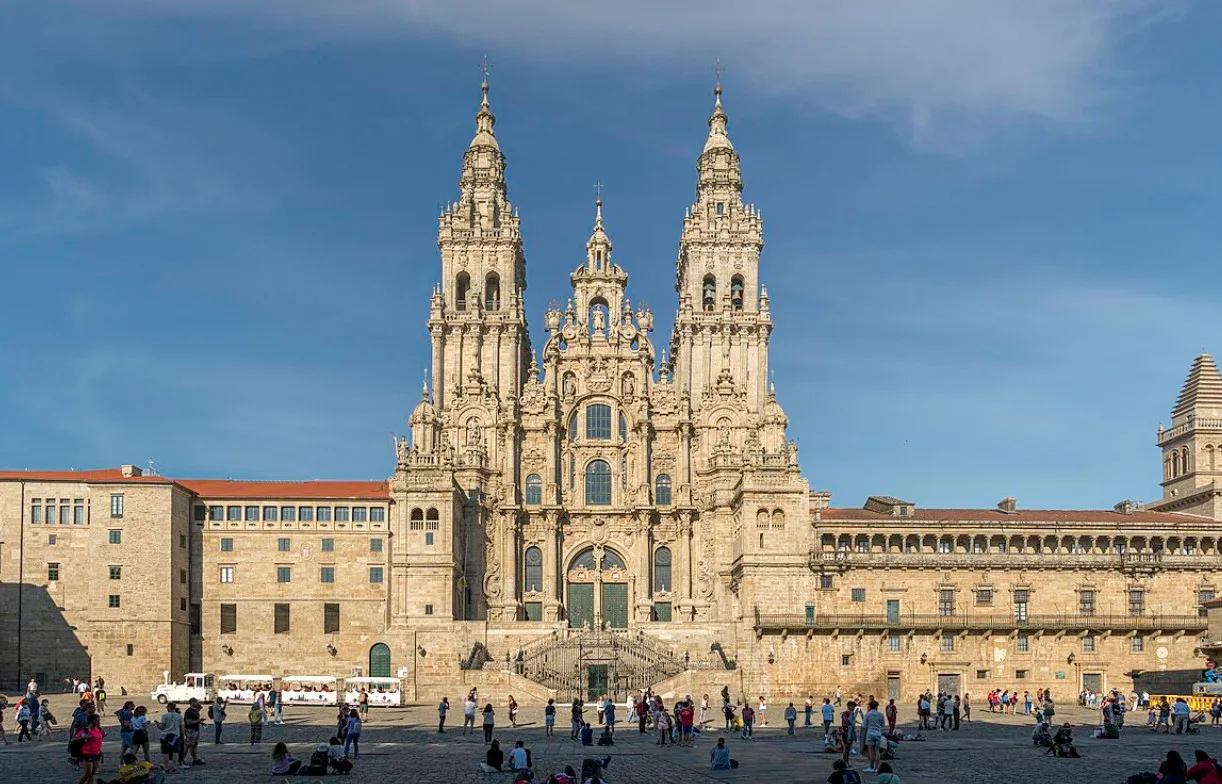
For over a thousand years, pilgrims have been walking to Santiago de Compostela, following the Camino de Santiago routes across Spain to reach the cathedral where Saint James is supposedly buried. The old town that grew around that pilgrimage tradition is the UNESCO site, and it represents one of Christianity’s most important pilgrimage destinations alongside Jerusalem and Rome.
The Cathedral is the obvious focal point—baroque facade facing the grand Plaza del Obradoiro, where pilgrims arrive and often break down crying after walking hundreds of kilometers. The interior holds Saint James’s shrine, the famous Botafumeiro incense burner that swings across the transept during special masses, chapels and altars accumulated over centuries.
But the whole old town matters. Arcaded streets built to shelter pilgrims from rain. Monasteries and hospitals that cared for travelers. Stone buildings with scallop shell decorations—the shell being the Camino symbol. Plaza squares where pilgrims gather still, many of them exhausted and elated and visibly emotional about having completed their journey.
I’ve walked portions of the Camino multiple times, never the full route but enough to understand what draws people to do this. The pilgrimage tradition is alive—thousands of people walk the Camino every year, for religious reasons, spiritual seeking, personal challenge, or simply the experience of long-distance walking through beautiful landscape. Arriving in Santiago, whether you’ve walked from France or just the last 100 kilometers, creates a profound sense of accomplishment.
Even if you haven’t walked the Camino, Santiago is worth visiting for its atmosphere. The blend of medieval architecture, pilgrim culture, Galician food traditions, and the unique energy of a place where people arrive transformed by their journeys—it’s unlike anywhere else in Spain.
Go for the daily Pilgrim’s Mass at noon if you want to see pilgrims from around the world gathering, often in tears, to mark their journey’s completion. Explore the surrounding Galicia region if you have time—green and rainy and filled with exceptional seafood, Celtic heritage, and a completely different vibe from Mediterranean Spain.
Salamanca’s Golden Renaissance Beauty

They call Salamanca “La Dorada”—the golden city—because the sandstone buildings glow that color in sunlight. But Salamanca is more than just pretty buildings. This is one of Europe’s great university cities, home to a university founded in 1218 that taught Columbus’s navigators, hosted the intellectual debates of Spain’s Golden Age, and educated generations of Spanish and international scholars.
The Plaza Mayor might be the most beautiful plaza in Spain, which is a bold claim in a country full of spectacular plazas. But Salamanca’s is special—perfectly proportioned baroque square enclosed by uniform buildings with 88 arches, medallions of famous Spanish figures decorating the facades, cafes under the arcades where students and visitors gather. Evening here, when the square fills with people and the sandstone glows in sunset light, is magical.
The university buildings themselves are architecturally significant—the plateresque facade covered in intricate carvings (look for the hidden frog, tradition says finding it brings good luck), the old library with ancient manuscripts, classrooms where lectures have been given for 800 years. The university is still active, so you see modern students mixing with tourist visitors, giving the place living energy rather than museum atmosphere.
Two cathedrals sit adjacent—the old Romanesque cathedral from the 12th century and the new Gothic cathedral from the 16th century, connected and visitable together. The new cathedral’s facade includes a carved astronaut, added during 20th-century restoration as a mason’s joke, and visitors now hunt for it among the medieval carvings.
The Clerecía towers offer the best views across the city’s rooftops and surrounding plains. The Casa de las Conchas is covered in carved scallop shells. The Roman bridge still crosses the Tormes River after 2,000 years.
Salamanca works beautifully as a long weekend destination—compact enough to see the major sites in a couple days, with excellent food, vibrant student culture that fills the bars and streets at night, and that golden glow that makes every photo look like a Renaissance painting.
Burgos Cathedral’s Gothic Magnificence

Burgos Cathedral might not be as famous as Seville’s or Toledo’s, but architecturally it’s arguably more significant. This is Spanish Gothic at its finest—started in 1221, expanded over three centuries, incorporating multiple Gothic styles as architecture evolved.
The exterior alone is spectacular—the main facade with its ornate spires, the Puerta del Sarmental with its detailed sculptures, the Puerta de la Coronería, the lantern tower that rises above the crossing. The level of sculptural detail covering every surface is extraordinary. You could spend an hour just looking at the exterior carvings before entering.
Inside, the cathedral is a showcase of different Gothic architectural innovations. The Constable’s Chapel is late Gothic gone wild—elaborate star vaulting, the tomb of the Constable of Castile and his wife carved in alabaster, walls covered in heraldry and sculpture. The Golden Staircase, designed by Diego de Siloé, is Renaissance elegance solving the problem of the cathedral floor being at different levels from the street. The lantern over the crossing floods the interior with light through an octagonal opening.
El Cid is buried here, along with his wife Jimena—the legendary medieval warrior knight whose actual historical figure is buried under centuries of mythmaking. Whether you care about El Cid or not, the tomb is medieval Spanish history in physical form.
Burgos itself is a pleasant Castilian city on the pilgrimage route to Santiago, with good food (morcilla, blood sausage, is a local specialty that’s better than it sounds), a pleasant old quarter, and that massive cathedral dominating everything. It’s not typically top of tourist lists, which means it’s less crowded than more famous sites while being equally impressive architecturally.
Visit in late afternoon when light through the stained glass and lantern tower is most dramatic. Budget at least 90 minutes to see the cathedral properly. Combine it with a stop in Burgos if you’re driving between Madrid and Bilbao or San Sebastián—it’s directly on that route and worth the detour.
Royal Monastery of Santa María de Guadalupe

Guadalupe is remote. Tucked in the hills of Extremadura, hours from major cities, this massive fortress-monastery complex feels removed from modern Spain in ways the other sites on this list don’t.
But that remoteness is part of what makes it significant. For centuries, this was one of Christianity’s most important pilgrimage sites, dedicated to the Virgin of Guadalupe whose statue supposedly performed miracles. Spanish royalty came here to pray. Columbus visited before and after his voyages to the Americas and named Caribbean islands after this place. The monastery accumulated enormous wealth and influence.
The complex is architecturally diverse—Gothic, Mudéjar, Renaissance, Baroque elements all present from different construction and renovation periods. The church facade is imposing and fortress-like. The cloister combines Mudéjar and Gothic styles beautifully. The sacristy holds paintings by Zurbarán and Francisco de Zurbarán, making it basically a small museum of Spanish Baroque art.
The Virgin of Guadalupe statue is kept in an elaborate baroque altarpiece, and devotees still come to pray before her. The monastery is functioning—Franciscan monks live and work here, maintaining the buildings and religious tradition.
What I find powerful about Guadalupe is its combination of historical importance and continued religious use. This isn’t a museum. It’s a living monastery that happens to be architecturally and historically significant. The atmosphere feels different from sites that exist primarily for tourism.
Practically, Guadalupe requires commitment. It’s not on the way to anywhere—you have to deliberately go there. The surrounding town is small and charming, and the landscape is beautiful, but you’re not combining this with other major sites in a single day trip. That said, if you want to see Spanish pilgrimage culture in a less touristy context than Santiago, and you appreciate remote, atmospheric places, Guadalupe is worth the journey.
Planning Your World Heritage Journey Through Spain
Here’s the thing about visiting World Heritage Sites in Spain—they’re spread across the entire country, from Galicia in the northwest to Andalusia in the south, Barcelona in the northeast to Extremadura in the west. You can’t see them all in one trip unless you have months.
My advice is to choose a region and go deep rather than trying to hit everything in two weeks. The sites I’ve described here span different regions, different architectural styles, different periods of history. Pick what interests you most.
If Islamic architecture fascinates you, focus on Andalusia—Granada’s Alhambra, Córdoba’s Mezquita, Seville’s Alcázar. Add in Málaga and smaller towns like Ronda, and you’ve got a rich trip centered on Al-Andalus heritage.
If Gaudí and modernism are your priority, Barcelona and surrounding Catalonia offer multiple sites plus the broader context of Catalan culture.
If you want medieval Christian Spain, the route from Burgos through Salamanca to Santiago de Compostela follows pilgrimage roads and gives you that Gothic and Romanesque architecture, university towns, religious heritage.
If you’re based in Madrid, Toledo, Segovia, and Salamanca are all doable as day trips or short overnights, giving you variety without complex logistics.
Some practical realities: Major sites require advance tickets, especially the Alhambra, Sagrada Família, and sometimes Seville’s Alcázar. Book as far ahead as possible. Go early morning or late afternoon when crowds are lighter and light is better for photography. Budget more time than you think you need—these places are dense with detail and rushing through them misses the point.
Consider seasons carefully. Summer in Andalusia is brutally hot—45°C days in Seville and Córdoba make sightseeing miserable. Spring and fall are ideal for southern Spain. Northern Spain (Santiago, Burgos) is greener and rainier but more comfortable in summer. Barcelona works year-round but is most crowded in summer.
FAQs About World Heritage Sites in Spain
Do I need to buy tickets in advance for Spain’s World Heritage Sites?
For the most popular sites, absolutely yes. The Alhambra in Granada is the most critical—they limit daily visitors and tickets often sell out months in advance, particularly for the Nasrid Palaces during peak season. Book as early as possible, at least six weeks ahead if you’re traveling in spring or fall. Barcelona’s Sagrada Família also requires advance tickets, and buying online saves you waiting in the ticket line. Seville’s Alcázar can sell out during peak times but is generally easier to get same-day or next-day tickets. Most other sites don’t require advance booking—you can buy tickets at the door for places like Burgos Cathedral, Santiago’s Cathedral, or Segovia’s Alcázar. That said, booking online in advance when possible saves time and guarantees entry at your preferred time. Many sites offer official ticket booking through their websites or through platforms like Tiqets or GetYourGuide. Avoid resellers charging massive markups—official ticket prices are reasonable, usually 10-15 euros for major monuments. If you’re visiting multiple sites in one city, check whether combination tickets or tourist passes offer better value. Some cities have cards that include multiple monuments plus public transportation.
How many days do I need to visit Spain’s major World Heritage Sites?
This depends entirely on how many you want to see and how deeply you want to experience them. If you’re trying to visit just the ones in this article, you’d need minimum two weeks, and even that would be rushed. A more realistic breakdown: Granada deserves two days minimum—one full day for the Alhambra and Generalife, another for the Albayzín and rest of the city. Barcelona needs three to four days to see Gaudí’s works properly plus experience the city. Seville merits two to three days for its sites and overall atmosphere. Toledo and Segovia can each be done as long day trips from Madrid, but overnight stays are better. Córdoba, Salamanca, Santiago, and Burgos each deserve at least a full day to overnight stay. Guadalupe requires factoring in travel time to remote Extremadura. If you’re focusing on one region, say Andalusia, you could see Granada, Córdoba, and Seville in a week and actually have time to enjoy them rather than just checking boxes. Northern route from Burgos to Santiago could be done in four to five days. Barcelona and surrounding Catalonia could fill a week easily. My strong recommendation is to pick three to five sites maximum for a week-long trip, build in travel days and rest, and experience each place properly rather than trying to hit everything superficially. Spain rewards slow travel—these places are meant to be savored, not rushed through. You’ll have a much better experience spending two days in Granada really seeing it than trying to hit five cities in those same two days.
Are Spain’s World Heritage Sites accessible for people with mobility limitations?
Accessibility varies significantly because many of these are medieval or ancient structures built centuries before accessibility was considered. The Alhambra has made efforts to improve accessibility—wheelchairs and mobility scooters are available, and certain routes through the complex are accessible, though the gardens and some palace areas have unavoidable stairs and uneven surfaces. Barcelona’s Gaudí sites vary—the Sagrada Família is reasonably accessible with elevators and ramps, but Park Güell has significant slopes and stairs. Seville’s Cathedral has ramp access and an elevator for the treasury, though the Giralda tower climb isn’t accessible. The Alcázar has accessible routes through ground floor areas but gardens have some challenging terrain. Medieval old towns like Toledo, Segovia, and Salamanca present the biggest challenges—cobblestone streets, steep hills, stairs, buildings not designed for accessibility. Toledo is particularly difficult with its hilly terrain and stepped streets. That said, major monuments in these cities usually have some accessible entrance options, even if the surrounding neighborhoods are challenging. Modern accessibility requirements in Spain mean that when renovations or improvements are made, accessibility is considered, but you can’t fundamentally alter 900-year-old buildings without compromising their historical integrity. My advice for travelers with mobility limitations: research specific sites in advance, contact the monuments directly to ask about accessibility and available accommodations, consider hiring guides who can help navigate or suggest accessible alternatives, and be realistic about which sites will work for your needs versus which will be frustrating. Many sites offer virtual tours or detailed photography online if physical access isn’t feasible.
Can I visit these World Heritage Sites with children?
Absolutely, though which sites work well with kids depends on their ages and interests. The Alhambra fascinates older children and teenagers interested in history or architecture, but younger kids might get bored with the slow pace required to appreciate the palace details—though the gardens and water features usually hold their attention. Segovia’s Aqueduct and fairytale Alcázar castle are hits with kids of all ages. Barcelona’s Gaudí sites, particularly Park Güell, work well for families—the colorful mosaics, unusual shapes, and outdoor spaces keep children engaged. Seville’s Alcázar gardens with peacocks and fountains appeal to kids. The challenge with young children is that these sites require significant walking, waiting in lines, and relative quiet in certain spaces. Toddlers and preschoolers will struggle with the patience required. School-age kids who’ve been prepared with some context about what they’re seeing usually do fine. Teenagers can fully appreciate the history and architecture, though you’ll need to work to keep them engaged rather than just dragged along. Practical tips for families: go early before kids are tired and sites are crowded, build in breaks and non-heritage activities, provide context ahead of time through books or videos so kids understand what they’re seeing, let kids take photos or keep travel journals to stay engaged, choose one or two major sites per day rather than marathon sightseeing, and combine heritage sites with kid-friendly activities like playgrounds, ice cream stops, or hotel pool time. Many sites offer family-friendly audio guides or scavenger hunt-style activities designed to keep children interested. Spain overall is very family-friendly—restaurants welcome children, museums often have kids programs, and Spanish culture is generally accommodating to families.
What’s the best time of year to visit Spain’s World Heritage Sites?
This depends on which region you’re visiting because Spain’s climate varies dramatically from north to south. For southern sites—the Alhambra, Córdoba, Seville—spring (April to early June) and fall (September to October) are ideal. Weather is warm but not oppressively hot, flowers are blooming in spring, and these are shoulder seasons with fewer crowds than peak summer. Summer in Andalusia can hit 40-45°C, making outdoor sightseeing genuinely unpleasant and even dangerous. If you must go in summer, visit major monuments first thing in the morning, rest during afternoon heat, and resume exploring in evening. Northern Spain including Santiago and Burgos is wetter and cooler year-round, making summer actually pleasant while spring and fall can be rainy. Winter in northern Spain is cold and wet but has the advantage of very few tourists. Barcelona works year-round—Mediterranean climate means mild winters and warm summers, though August is crowded with tourists and many locals on vacation. Central Spain including Madrid, Toledo, Segovia, and Salamanca has continental climate—hot summers, cold winters, pleasant spring and fall. Segovia in winter can be beautiful under snow but cold, while summer is warm and dry. Holy Week (Semana Santa) in spring brings spectacular processions, especially in Seville, but also massive crowds and higher prices. Consider this when planning—if you want to experience the religious festivals, book well ahead; if you want to avoid crowds, don’t visit major cities during Semana Santa. My personal recommendation is late April to early June or mid-September to October for most of Spain—weather is reliable, sites aren’t overwhelmingly crowded, prices are reasonable, and you experience Spain at its most beautiful without extreme temperatures.
How much does it typically cost to visit Spain’s World Heritage Sites?
Individual monument entrance fees are generally reasonable, typically ranging from 10 to 15 euros for major sites. The Alhambra costs around 14-19 euros depending on which parts you visit and whether you include a guided tour. Barcelona’s Sagrada Família is about 26 euros with tower access, less for just the basilica. Seville’s Cathedral and Alcázar are each around 12-14 euros. Many smaller sites cost 5-8 euros. Churches often have free entry for worship with small fees to visit as tourists or access special areas. Some sites offer free entry during specific hours—many museums and monuments have free evening hours once or twice weekly. EU citizens under 25 often get discounts or free entry, as do students with valid ID and seniors. Audio guides usually cost additional 3-5 euros but are often worth it for historical context. Guided tours cost more—typically 20-40 euros depending on length and group size—but provide depth you won’t get wandering alone. Photography is included in entrance fees at most sites. Beyond entrance fees, budget for transportation between cities, accommodation, meals, and incidental costs. Spain is generally affordable compared to much of Western Europe—mid-range accommodation runs 60-100 euros per night, meals at decent restaurants 15-25 euros per person, public transportation and trains are reasonable. A week-long trip visiting four or five World Heritage Sites, staying in mid-range hotels, eating at normal restaurants not tourist traps, would cost roughly 800-1200 euros per person not including flights, assuming you’re traveling as a couple sharing accommodation. Budget travelers can do it cheaper staying in hostels and eating cheaper meals; luxury travelers can spend far more on high-end hotels and Michelin restaurants. Site entrance fees themselves are a small portion of total trip cost.
Are guided tours worth it or should I explore these sites independently?
This depends on your interests, learning style, and what you want from the experience. Guided tours provide historical context and stories you’d miss exploring alone. A good guide at the Alhambra explains the Islamic philosophy behind the architecture, points out details you’d walk past, tells stories about the Nasrid sultans who lived there. At Córdoba’s Mezquita, a guide can explain the architectural evolution, the religious and political history, the significance of specific design elements. You learn more with a knowledgeable guide than reading plaques or audio guides. However, tours move at group pace, focus on guide’s priorities not yours, and eliminate the freedom to linger where something interests you or skip what doesn’t. Some people find group tours exhausting or don’t like being herded around. Quality varies enormously—exceptional guides make sites come alive while mediocre ones just recite facts you could read yourself. My recommendation: consider guided tours for complex sites where historical context significantly enhances the experience. The Alhambra, Mezquita, Toledo’s medieval city, Santiago’s pilgrimage history—these benefit from expert explanation. Sites like Segovia’s Aqueduct or Park Güell are visually self-evident and might not need guided tours. Compromise options exist—many sites offer excellent audio guides you can do at your own pace, or you can hire private guides for small group or individual tours with more flexibility than large group tours. Some travelers do guided tours for major sites and independent exploration for smaller ones. Rick Steves and similar guidebooks provide good self-guided tour instructions if you want context without an actual guide. Whatever you choose, do some advance reading so you understand what you’re seeing—even independent exploration is richer with basic historical knowledge.
Use this citation format to reference the article clearly and help readers find the original source.
PsychologyFor. (2025). 10 World Heritage Sites You Should Visit in Spain. PsychologyFor. https://psychologyfor.com/10-world-heritage-sites-you-should-visit-in-spain/