

Few professions demand the same combination of intellectual depth, emotional intelligence, and practical adaptability that teaching requires. Pedagogy books — spanning foundational theory, classroom strategy, and psychological insight — are among the most powerful tools an educator can have. Whether you are stepping into your first classroom or reassessing your methods after decades of practice, the right book can reframe your entire approach to teaching and learning.
The demands placed on educators have never been more complex. Teachers today must simultaneously cultivate critical thinking, address diverse cognitive and emotional needs, integrate technology thoughtfully, and create environments where every student feels genuinely seen. These are not challenges that a weekend workshop resolves. They require the kind of deep, evidence-based understanding that only serious reading and reflection can build over time.
Pedagogy — the study of how teaching and learning happen — draws from cognitive psychology, developmental science, sociology, and educational research. The best books in this field don’t just tell you what to do in the classroom. They explain why certain approaches work, equipping teachers to adapt intelligently rather than follow prescriptions mechanically. They make the invisible visible: the cognitive processes behind learning, the emotional dynamics beneath classroom behavior, the systemic forces shaping educational outcomes.
This curated list of twenty essential pedagogy books covers the full breadth of the field — from Paulo Freire’s radical reimagining of the teacher-student relationship to John Hattie’s rigorous meta-analysis of what the research actually shows, from Vygotsky’s sociocultural theory to Daniel Pink’s insights on motivation. Each book has been selected for its capacity to inform, challenge, and transform teaching practice in ways that endure beyond any single school year.

Why Pedagogy Books Still Matter in the Age of Digital Learning
Books remain the deepest format for pedagogical learning — not because digital resources lack value, but because serious professional development requires sustained, structured engagement with complex ideas that short-form content simply cannot provide. A blog post can summarize growth mindset theory. A book by Carol Dweck can change how you understand intelligence, effort, and the messages you send students every day.
The teachers who develop most significantly over their careers are almost always readers. Not passive consumers of technique-of-the-week articles, but people who engage genuinely with the intellectual traditions behind their craft — who understand Vygotsky’s Zone of Proximal Development not as a buzzword to drop in meetings but as a living framework that shapes how they sequence instruction and respond to struggle.
The twenty books collected here span several distinct categories, each addressing a different dimension of what it means to teach well:
- Theoretical foundations — books that explain why learning works the way it does, drawing from cognitive science, developmental psychology, and sociocultural theory.
- Critical and social pedagogy — books that examine the political and ethical dimensions of education, challenging teachers to think about whose knowledge is valued and whose voices are centered.
- Practical classroom guides — books grounded in real classroom experience that translate theory into actionable strategy for lesson design, classroom management, and assessment.
- Psychological frameworks for teaching — books that apply insights from motivation research, mindset theory, and behavioral science to the specific challenges of instruction.
Together, they form a comprehensive professional library for any educator serious about their craft.
1. Pedagogy of the Oppressed by Paulo Freire
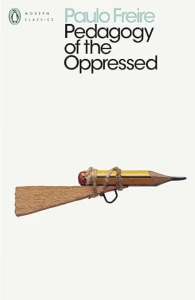
Few books have shaped modern educational thought as profoundly as Paulo Freire’s 1968 masterwork. First published in Portuguese as Pedagogia do Oprimido, it has been translated into dozens of languages and remains compulsory reading in teacher education programs worldwide — not because it is comfortable, but because it is honest in ways that most educational texts are not.
Freire’s central argument is that traditional education operates as what he calls the “banking model” — a system in which students are treated as empty receptacles to be filled with knowledge by authoritative teachers. This model, he argues, is not politically neutral. It reproduces existing power structures by training students to be passive receivers rather than active agents of their own learning and their world.
His alternative is dialogical education: a pedagogical relationship in which teachers and students become co-investigators of reality, each bringing their experience and knowledge to a shared process of meaning-making. This isn’t a romantic notion — Freire was deeply rigorous in developing its implications for curriculum design, classroom dynamics, and the ethical responsibilities of educators.
The practical takeaway for any teacher: examine the power dynamics in your classroom. Ask who speaks, whose knowledge counts as valid, and what messages your instructional design sends about students’ capacity to think for themselves. Even in conventional educational settings, Freire’s framework supports creating more participatory, agency-centered learning environments.
2. How Children Learn by John Holt
John Holt was one of the most perceptive observers of children’s learning ever to write about education. Originally published in 1967 and revised in 1983 with new material reflecting decades of classroom observation, How Children Learn is a book built on close attention — to what children actually do when they are genuinely curious, and what happens to that curiosity when formal instruction takes over.
Holt’s central observation is deceptively simple: children are natural, voracious learners before they enter formal schooling, and something about school — the grading, the performance pressure, the disconnection from genuine interest — frequently diminishes rather than amplifies that drive. His remedy is not the elimination of instruction but a fundamental reorientation of its purpose: toward supporting children’s existing learning drives rather than replacing them with externally imposed agendas.
The book is structured around richly detailed observations of children engaged in play, reading, mathematics, and problem-solving. These vignettes are not anecdotes for their own sake — they are evidence for a coherent theory of learning that emphasizes intrinsic motivation, tolerance for ambiguity and error, and the importance of genuine challenge over managed difficulty.
For classroom teachers, Holt’s most immediately applicable insight is the importance of preserving what might be called the learning impulse: the child’s willingness to attempt, fail, revise, and attempt again without shame. Any instructional environment that makes error feel dangerous undermines this impulse at its root.
3. The Skillful Teacher by Stephen D. Brookfield
Stephen Brookfield’s The Skillful Teacher occupies a rare position in the pedagogy library: it is simultaneously deeply theoretical and immediately practical. Now in its third edition, it addresses the full range of challenges that teachers at every level encounter — not with prescriptive formulas but with a framework for critically reflective practice that teachers can apply to any situation they face.
Brookfield’s central argument is that skilled teaching is not a fixed set of techniques but a disposition — a way of continuously examining one’s assumptions, attending to students’ experiences, and adjusting in response to evidence. He introduces the concept of the “four lenses” of critical reflection: the teacher’s own autobiographical experience, students’ eyes, colleagues’ perceptions, and theoretical literature. Using all four simultaneously, he argues, is what separates genuinely reflective practice from mere self-assessment.
Particularly valuable are his chapters on facilitating discussion, dealing with resistance, and navigating the emotional dimensions of teaching — the fear, the imposter syndrome, the power dynamics that rarely appear in pedagogical theory but are present in every classroom. Brookfield addresses these honestly, from the perspective of someone who has taught for decades and hasn’t pretended the difficulties disappear with experience.
The practical takeaway: after each significant lesson or unit, apply Brookfield’s four lenses deliberately. What did you assume? What did students actually experience? What would a trusted colleague notice? What does the research suggest? This practice of structured reflection is one of the most powerful engines of professional growth available to any educator.
4. Visible Learning by John Hattie
When John Hattie published Visible Learning in 2009, it immediately became the most cited work in educational research — and for good reason. By synthesizing the findings of thousands of studies covering hundreds of millions of students, Hattie produced the most comprehensive empirical analysis of what actually influences student achievement ever assembled. For educators accustomed to following fashion rather than evidence, it was both revelatory and humbling.
Hattie’s method is meta-analysis: he doesn’t conduct new studies but synthesizes the findings of existing ones, calculating effect sizes to compare the relative impact of different educational interventions. His key insight is the concept of the “hinge point” — an effect size of 0.40, which he identifies as the threshold above which an intervention produces more than average growth. Many widely used and politically popular educational reforms fall below this threshold. Some of the highest-effect interventions — such as formative feedback, teacher-student relationships, and self-reported grades — are relatively low-cost and require no structural change to implement.
The book’s most important message for classroom teachers is about the centrality of deliberate, specific feedback — not generic praise or criticism, but targeted information about what students understand, where the gap from the learning goal lies, and how to close it. This kind of feedback, Hattie’s data shows, is among the highest-leverage actions a teacher can take.
Reading Visible Learning doesn’t mean treating educational research as a rulebook. It means making evidence-informed decisions rather than assumption-driven ones — a shift that benefits students profoundly.
5. Mindset: The New Psychology of Success by Carol S. Dweck
Carol Dweck’s research on implicit theories of intelligence has produced one of the most educationally consequential psychological frameworks of the past fifty years. The concept of growth mindset — the belief that ability is not fixed but can be developed through effort, strategy, and guidance — has been widely applied in education, sometimes superficially, but the original research behind it is rigorous and the implications for teaching are profound.
Dweck’s core finding is that students who hold a “fixed mindset” — who believe their intelligence is a stable, innate trait — respond to challenge very differently from those who hold a “growth mindset.” Fixed-mindset students avoid difficult tasks (because failure threatens their identity), give up more quickly in the face of obstacles, and interpret criticism as evidence of inadequacy. Growth-mindset students approach challenge as an opportunity to develop, persist longer, and extract more learning from failure.
For teachers, the book’s most practically important chapter concerns the language of praise and feedback. Praising students for being “smart” — a phrase that seems encouraging — actually reinforces fixed-mindset thinking by attributing success to a fixed trait rather than to effort and strategy. Praising effort and process (“you worked really hard on this,” “I can see you tried a different approach when the first one didn’t work”) supports growth-mindset development.
The broader implication: classroom culture is built through thousands of small linguistic and behavioral choices that signal to students whether intelligence is something they have or something they grow. Dweck’s book helps teachers make those choices consciously.
6. The Courage to Teach by Parker J. Palmer
Parker Palmer’s The Courage to Teach addresses a dimension of teaching that most pedagogical texts leave almost entirely unexplored: the inner life of the educator. Published in 1997 and still widely read in teacher education programs, it begins from a deceptively simple premise — that good teaching cannot be reduced to technique, because it comes from the identity and integrity of the teacher.
Palmer’s argument is that teachers who are disconnected from their own values, motivations, and authentic sense of self inevitably create disconnected classrooms — spaces where technique is performed rather than genuine relationship built. The book explores what it means to teach from a place of genuine presence: to bring your whole self into the room, to be honest about uncertainty, to create conditions for genuine intellectual encounter rather than information transfer.
This is not soft advice. Palmer is honest about the difficulties — the fear that authentic presence invites real failure, the professional vulnerability of admitting what you don’t know, the institutional pressures that push toward performance over genuine engagement. His response to these difficulties is not reassurance but the invitation to examine them directly, as the necessary condition of genuine professional growth.
The practical takeaway for educators: spend time regularly asking what drew you to teaching in the first place, and whether your current practice honors that. Reconnecting with personal purpose is not a luxury — it is one of the most effective antidotes to the burnout and disengagement that prematurely end teaching careers.
7. How People Learn by the National Research Council
How People Learn is the most authoritative synthesis of learning science available in a single accessible volume. Produced by the National Research Council and now in its second edition, it synthesizes findings from cognitive psychology, neuroscience, developmental science, and educational research into a unified framework for understanding how human beings learn — and what this means for how they should be taught.
The book’s central themes reflect the state of the science: that prior knowledge is the most powerful determinant of new learning (new information is always processed in relation to what is already known); that deep learning requires understanding — not just recall — of underlying structure and principle; that metacognition — the ability to monitor and regulate one’s own thinking — is a learnable skill that dramatically improves learning outcomes; and that learning is always social and culturally situated.
Each of these principles has direct instructional implications. The primacy of prior knowledge means that effective teaching begins with activating and assessing what students already know — not treating each lesson as a blank slate. The importance of deep conceptual understanding means that coverage-focused instruction, which sacrifices depth for breadth, systematically undermines durable learning. The centrality of metacognition means that helping students think about their own thinking — explicitly teaching them how to plan, monitor, and evaluate their learning — is as important as teaching content.
For any educator who wants their instructional decisions grounded in the actual science of learning rather than tradition or intuition, this book is essential.
8. Teaching to Transgress by bell hooks
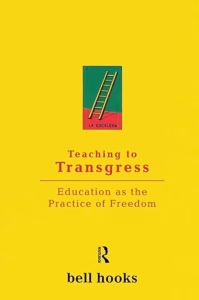
bell hooks wrote Teaching to Transgress as an act of intellectual and political conviction, and it reads that way. Published in 1994, it remains one of the most important books in critical pedagogy — not because it tells teachers what techniques to use, but because it invites educators to examine the political and ethical dimensions of everything that happens in a classroom.
hooks draws from her own experience as a Black woman navigating predominantly white educational institutions, and from her engagement with Freire’s critical pedagogy, to develop a vision of education as a practice of freedom — not in an abstract sense, but as a daily, concrete commitment to creating classrooms where all students’ voices, experiences, and knowledge systems are genuinely valued.
Her concept of engaged pedagogy goes beyond Freire in one important respect: she insists that the teacher’s own wellbeing and self-actualization are not separable from their capacity to support students’ growth. A teacher who is not themselves engaged — not genuinely curious, not emotionally present, not committed to their own ongoing development — cannot create the conditions for genuine student engagement regardless of how skillfully they deploy technique.
The book addresses race, gender, and class in education with a frankness that many pedagogical texts avoid — examining how power operates in curriculum choices, classroom dynamics, and the unspoken hierarchies that shape who speaks and whose knowledge is treated as authoritative. For educators committed to equity and inclusion, it is indispensable.
9. Teaching for Learning by Claire Howell Major
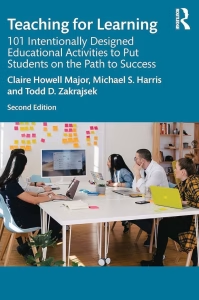
Claire Howell Major’s Teaching for Learning is one of the most practically comprehensive pedagogy books currently available — a detailed, research-grounded guide to the full range of instructional decisions that teachers face, from lesson design through assessment, classroom interaction, and student support.
The book is organized around the premise that teaching and learning are inseparable: the quality of student learning is the primary evidence of teaching effectiveness, and instructional design should be built backward from clear, honest analysis of what deep learning actually requires. Major draws extensively from the active learning literature, making the case that passive reception — listening to lectures without structured processing, reading without reflection — produces shallow and rapidly fading learning, while active engagement — discussion, problem-solving, application, peer teaching — produces durable understanding.
What distinguishes this book from other active-learning guides is its specificity and rigor. Major doesn’t simply advocate for “more discussion” or “student-centered learning” — she examines different types of discussion, their respective cognitive demands, the conditions under which each is most effective, and the assessment strategies that can reveal whether genuine learning has occurred. This level of nuance is exactly what practicing teachers need.
The practical takeaway: use Major’s framework to audit your instructional design for cognitive load and active engagement. Ask, for each component of a lesson, what cognitive work students are actually doing — and whether that work is aligned with the learning outcomes you intend.
10. Educating the Reflective Practitioner by Donald Schön
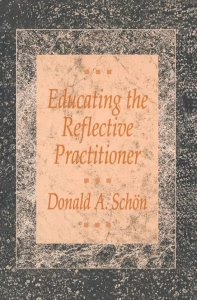
Donald Schön’s work on reflective practice transformed professional education across multiple fields — not just teaching, but medicine, architecture, management, and psychotherapy. Educating the Reflective Practitioner, published in 1987, applies his framework specifically to professional education, examining how practitioners develop competence through a cycle of action, observation, and reflection that goes far beyond the application of technical knowledge.
Schön’s central distinction is between technical rationality — the application of established theory and technique to well-defined problems — and reflective practice, which is what professionals actually do when they face the messy, ambiguous, underdetermined situations that characterize real work. Teachers know this distinction intimately: the lesson plan that assumes a specific cognitive readiness, only to discover that the actual students in the room are somewhere entirely different. The student whose apparent disengagement turns out to be profound anxiety. The explanation that worked perfectly for thirty previous classes and fails completely with this one.
Schön describes two modes of reflection: “reflection-in-action” (the real-time adjustment of thinking and behavior in response to what is happening) and “reflection-on-action” (the retrospective analysis of what happened and why). Both are learnable, and both can be deliberately cultivated through the kind of structured professional dialogue that effective mentoring and professional learning communities provide.
For teachers, this book reframes professional development from the acquisition of new techniques to the cultivation of a thinking disposition — one that treats every classroom moment as data and every unexpected outcome as an invitation to learn.
11. The Art and Science of Teaching by Robert J. Marzano
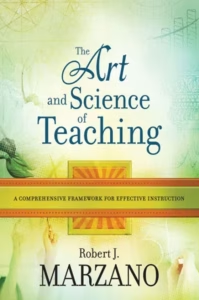
Robert Marzano’s The Art and Science of Teaching is one of the most practically structured pedagogy books available — a comprehensive instructional framework that organizes research-based strategies into a coherent model that teachers can apply systematically without sacrificing the professional judgment that effective teaching requires.
The book is organized around ten “design questions” that guide instructional planning: How will I establish and communicate learning goals? What evidence will I use to track student progress? How will I engage students? How will I introduce new knowledge? How will I maintain student attention and engagement over time? These questions structure the book’s chapters and provide teachers with a framework for thinking about instruction holistically rather than as a collection of isolated techniques.
Marzano’s integration of research on classroom management, direct instruction, and student motivation into a single framework is the book’s most distinctive contribution. Too often, these are treated as separate domains with separate literatures. Marzano shows how they are deeply interconnected — that classroom management is inseparable from instructional design, that student motivation is shaped by the quality of feedback as much as by any explicit motivational intervention.
The practical value for working teachers: use Marzano’s ten design questions as a checklist for lesson and unit planning. Not as a formulaic constraint, but as a reminder of the full range of considerations that effective instruction requires.
12. Fair Isn’t Always Equal by Rick Wormeli

Rick Wormeli’s Fair Isn’t Always Equal addresses one of the most practically contentious areas in contemporary teaching: assessment and grading in classrooms that serve learners with diverse needs and abilities. The title captures its central argument: treating all students identically is not the same as treating them equitably, and the design of assessment and grading systems sends powerful messages about what learning means and who it is for.
Wormeli challenges several deeply held assumptions about grading — the value of averaging scores over time, the use of zeros for missing work, the equation of grades with compliance behaviors like attendance and participation. Each of these practices, he argues, obscures rather than reveals what students actually know and can do. A student whose early work was weak but who has achieved genuine mastery by the end of a unit is poorly served by an average that buries that mastery under earlier struggles.
The book’s strongest sections deal with differentiated assessment — the design of tasks and evaluation criteria that allow students with different learning profiles to demonstrate competence in ways that are challenging and meaningful for each of them. This is not about lowering standards; it is about recognizing that standards can be assessed through multiple pathways, and that requiring every student to demonstrate learning in identical ways measures compliance as much as understanding.
For any teacher navigating the tension between standardization and genuine responsiveness to individual learners, this book provides both the philosophical grounding and the practical tools to move forward.
13. Drive: The Surprising Truth About What Motivates Us by Daniel H. Pink
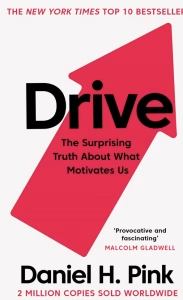
Daniel Pink’s Drive synthesizes decades of motivation research into a framework with direct and powerful implications for education. Drawing primarily from the self-determination theory developed by Edward Deci and Richard Ryan, Pink argues that for tasks requiring creativity, conceptual understanding, and sustained engagement — precisely the kind of learning that education aims to produce — traditional extrinsic reward systems are not just ineffective but actively counterproductive.
Pink’s framework identifies three core drivers of intrinsic motivation: autonomy (the experience of genuine choice and self-direction), mastery (the satisfaction of developing genuine competence at something that matters), and purpose (the sense that one’s work connects to something meaningful beyond the immediate task). When all three are present, people engage deeply and sustain effort through difficulty. When they are absent — replaced by external rewards and punishments — intrinsic motivation diminishes.
The implications for classroom design are significant. Grading systems that focus exclusively on external evaluation, instructional approaches that leave students no genuine choice about how to demonstrate learning, and curricula disconnected from students’ actual lives and concerns all undermine the motivational conditions that drive deep learning. Pink’s book doesn’t provide a classroom management program — it provides a framework for asking whether the structures and practices of your classroom are building intrinsic motivation or gradually dismantling it.
The practical takeaway: identify one domain in your teaching where you can introduce more genuine student autonomy — in topic selection, in how learning is demonstrated, in the pace of progression — and observe the effect on engagement.
14. Making Thinking Visible by Ron Ritchhart
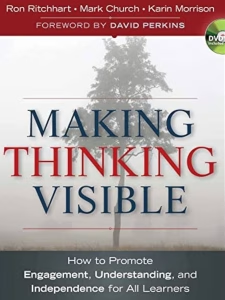
Ron Ritchhart’s Making Thinking Visible addresses a challenge that sits at the heart of effective teaching: how do you know whether your students are actually thinking, and what kind of thinking they’re doing? Most classroom assessment captures products — answers, essays, test scores — rather than the thinking processes that produced them. This makes it very difficult to support, deepen, or redirect student thinking in the ways that genuine learning requires.
Ritchhart, working from research conducted at Harvard’s Project Zero, developed a set of structured classroom routines — called Thinking Routines — designed to make students’ reasoning processes visible and discussable. These are not activities or lesson plans; they are flexible frameworks that can be integrated into virtually any subject or grade level to scaffold the kinds of thinking that deepen understanding: questioning, observing, connecting, wondering, perspective-taking, uncovering complexity.
Examples include “See-Think-Wonder” (observing carefully, forming interpretations, generating questions), “Think-Pair-Share” used with greater intentionality than its usual application suggests, and “I used to think… now I think…” (a routine that makes learning visible by documenting conceptual change). Each routine has been tested in real classrooms and refined based on evidence of their effects on student thinking and engagement.
The book’s broader argument — that classroom culture is built through the thinking that is valued, noticed, and modeled — is as important as any individual routine. A classroom where thinking is made visible is one where students gradually internalize that their ideas matter, that reasoning is valued over right answers, and that intellectual risk-taking is safe.
15. The First Days of School by Harry K. Wong and Rosemary T. Wong
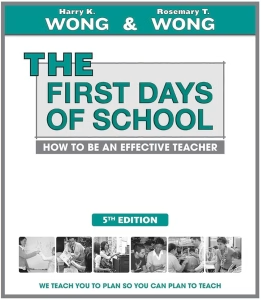
For practical classroom management guidance, few books have earned the reputation of Harry and Rosemary Wong’s The First Days of School. Originally published in 1991 and continuously updated since, it has sold millions of copies worldwide and is the book most frequently recommended to first-year teachers by experienced educators. Its premise is simple: the most important days of a school year are the first ones, because classroom culture, routines, and expectations established in September shape everything that follows.
The Wongs argue — and the research supports — that effective classroom management is not primarily about responding to misbehavior. It is about designing environments in which misbehavior is much less likely to occur because students have clear expectations, consistent routines, and a genuine sense of procedural security. A classroom where students know exactly what to do when they arrive, how to transition between activities, what to do when they finish work early, and how to get help without disrupting others is one where teachers spend their energy on instruction rather than management.
The book covers the establishment of procedures (which the Wongs carefully distinguish from rules), the design of the first week of school, strategies for building positive teacher-student relationships from day one, and the habits of mind that characterize effective classroom managers. It is deliberately practical — full of scripts, checklists, and concrete examples rather than abstract principles.
Even experienced teachers find value in returning to this book when they take on a new grade level, school, or student population. The fundamentals of establishing a well-functioning classroom community are universal.
16. Learning and Instruction by Richard E. Mayer
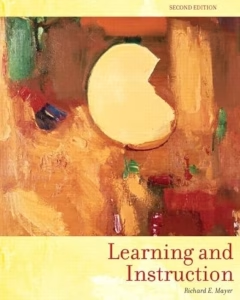
Richard Mayer is one of the most rigorous and educationally influential cognitive psychologists working today, and Learning and Instruction is his most comprehensive statement of how cognitive science applies to teaching. Unlike many educational psychology textbooks, it is organized around research-based principles rather than theoretical schools — each chapter addresses a specific instructional question and synthesizes the evidence bearing on it.
Mayer’s work on multimedia learning is particularly significant for contemporary educators. His cognitive theory of multimedia learning identifies the conditions under which combinations of text, images, audio, and animation support or impair learning — findings that are directly relevant to the design of presentations, digital materials, and online learning experiences. His key principles include the coherence principle (removing extraneous material improves learning), the signaling principle (highlighting organization aids comprehension), and the modality principle (spoken explanation with visuals is more effective than written text with the same visuals).
The book also addresses cognitive load theory — the principle that working memory is limited, and that instructional design must account for the total cognitive demand placed on learners. Instruction that overloads working memory — through excessive complexity, irrelevant information, or poor sequencing — impairs the learning process at a fundamental level regardless of the quality of the content itself.
For any teacher who designs learning materials, delivers technology-enhanced instruction, or simply wants to understand why some explanations work and others don’t, Mayer’s research provides a rigorous and directly actionable foundation.
17. The eLearning & Instructional Design Roadmap by Aubrey Cook
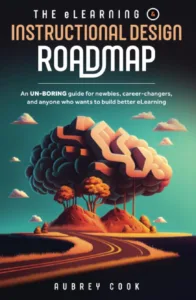
As digital learning environments become an increasingly permanent feature of education, the need for pedagogically grounded eLearning design has never been more urgent. Aubrey Cook’s The eLearning & Instructional Design Roadmap addresses this need directly, providing a structured, step-by-step guide to designing online and blended learning experiences that are genuinely effective rather than merely digitized versions of traditional classroom content.
The book bridges the gap between instructional design theory — the ADDIE model, Bloom’s taxonomy, learning objectives — and the practical realities of building courses for learning management systems, asynchronous environments, and diverse learner populations. Cook addresses the full design cycle: analyzing learner needs and context, designing learning objectives, selecting appropriate media and activities, developing content, and evaluating effectiveness.
What distinguishes this guide from purely technical eLearning manuals is its consistent grounding in learning science. Cook doesn’t just explain how to use authoring tools — she explains why certain design choices support or undermine learning, drawing from cognitive load theory, active learning research, and the multimedia learning principles that Mayer’s research established. This means the guidance remains applicable regardless of which specific platforms or tools an educator uses.
For teachers transitioning to online or hybrid instruction, instructional designers supporting faculty development, or anyone building self-paced learning materials, this roadmap provides a trustworthy framework that keeps learner outcomes at the center of every design decision.
18. Assessment for Learning by Paul Black and Dylan Wiliam
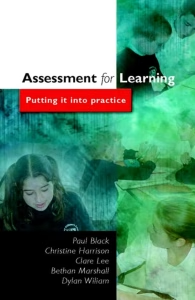
Paul Black and Dylan Wiliam’s work on formative assessment is among the most consequential contributions to educational research of the past three decades. Their landmark review of the research evidence, first published in 1998, demonstrated that well-implemented formative assessment — ongoing, embedded assessment used to inform and adjust instruction in real time — produces among the largest effect sizes of any educational intervention. Assessment for Learning translates this research into practical guidance for classroom implementation.
The distinction the book centers on is between assessment of learning (summative evaluation of what students have achieved, typically for reporting and accountability purposes) and assessment for learning (ongoing assessment used to inform teaching and support learning, primarily for the benefit of the learner). Both have legitimate roles in education, but the balance in most school systems is severely weighted toward summative assessment, at the cost of the formative practices that most directly support student learning.
Black and Wiliam identify five key strategies of formative assessment: clarifying and sharing learning intentions and criteria for success; engineering effective classroom discussions; providing feedback that moves learners forward; activating students as instructional resources for one another; and activating students as owners of their own learning. Each of these is developed in practical terms — with specific techniques, examples, and responses to the obstacles that teachers commonly encounter in implementation.
The core message: assessment is not something that happens after learning — it is woven into the learning process at every stage, and its quality determines whether students receive the information they need to develop and whether teachers receive the information they need to teach effectively.
19. Mind in Society by Lev Vygotsky
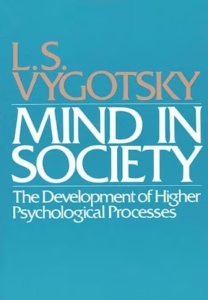
Lev Vygotsky’s work, written in the Soviet Union in the 1920s and 1930s before his early death at thirty-seven, was not widely known in the West until the 1970s — but its influence on educational psychology has been enormous. Mind in Society, compiled and edited from his manuscripts, presents his most educationally relevant ideas in accessible form and remains one of the most important theoretical texts in the pedagogy library.
Vygotsky’s central contribution is the sociocultural theory of development: the argument that higher cognitive functions do not develop in isolation within individual minds but emerge through social interaction — through language, collaborative activity, and the internalization of culturally transmitted tools and practices. Learning, in this framework, is fundamentally a social process before it becomes an individual one.
His most practically influential concept is the Zone of Proximal Development (ZPD) — the space between what a learner can do independently and what they can accomplish with appropriate support. Effective instruction, Vygotsky argues, should target this zone: challenging enough to require genuine cognitive effort and support, not so difficult as to overwhelm. The role of the teacher, and of more capable peers, is to provide the scaffolding that allows learners to operate at the upper edge of their ZPD — and gradually to internalize the capacity that was initially supported externally.
This framework has shaped everything from peer learning research to the design of graduated instructional sequences to the understanding of feedback. For teachers, the practical implication is consistent: learning happens at the edge of current competence, in supported encounters with genuine challenge.
20. Teaching as a Subversive Activity by Neil Postman and Charles Weingartner
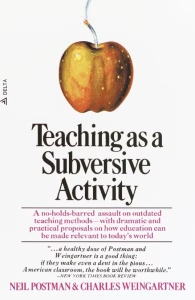
Published in 1969 and still remarkably relevant, Teaching as a Subversive Activity is the most provocative book on this list — and one of the most important. Postman and Weingartner were writing in response to the educational failures of their own era, but their critique of schooling as a system that systematically rewards compliance and punishes genuine inquiry resonates with uncomfortable clarity in contemporary classrooms.
Their central argument is that the primary purpose of education should be the cultivation of what they call the “crap detector” — the capacity to think critically, question assumptions, and evaluate the validity of claims regardless of their source. This is not a skill that can be taught through direct instruction; it must be developed through practice in environments where questioning is valued, where right answers are less important than good questions, and where the teacher models genuine intellectual humility rather than authoritative certainty.
Postman and Weingartner advocate for what they call inquiry-based, student-centered education: classrooms organized around genuine questions rather than predetermined answers, where students practice the habits of mind that critical citizenship requires. They are deliberately provocative — some of their proposals, including the suggestion that textbooks be banned for a year, are intended to shock teachers into examining their assumptions rather than as literal policy recommendations.
The book’s lasting value is not as a blueprint but as a provocation: a sustained argument that education’s deepest purpose is the development of independent, critical minds, and that many of the most familiar features of conventional schooling actively work against this purpose. Reading it alongside the more practically oriented books on this list creates a productive tension that sharpens one’s thinking about what education is ultimately for.
How to Build Your Pedagogy Reading Practice: A Guide to Getting the Most from These Books
Owning pedagogy books matters less than reading them with intention. Professional reading — as opposed to leisure reading or research scanning — benefits from a deliberate approach that bridges the gap between ideas encountered on the page and practice enacted in the classroom.
- Read with a specific question in mind. Before beginning a book, identify one genuine challenge in your current practice — an aspect of student engagement, assessment, or classroom management that you want to think more carefully about. Reading with a specific question activates the prior knowledge and motivational structures that make new ideas stick.
- Take processual notes. Rather than underlining passages, write brief responses in the margins or in a reading journal: questions the text raises, connections to your own classroom, disagreements you want to think through. This transforms reading from passive reception into active dialogue.
- Identify one implementation commitment per book. After completing each book, commit to one specific change in your practice — however small. The gap between pedagogical reading and classroom transformation is bridged only by deliberate action, not by accumulated knowledge.
- Read in community when possible. A professional learning community that reads and discusses pedagogy books together creates the collaborative reflection that Schön identifies as essential for genuine professional development. Ideas that seem clear on the page often reveal their complexity and nuance in conversation with colleagues who bring different perspectives and experiences.
FAQs about the Best Pedagogy Books for Educators
What is the best pedagogy book for new teachers?
For teachers in their first years in the classroom, The First Days of School by Harry K. Wong and Rosemary T. Wong is consistently the most recommended starting point — and for good reason. It addresses the practical fundamentals of classroom management, routine-building, and establishing a productive learning environment with a directness and specificity that theory-heavy texts cannot provide. New teachers also benefit significantly from The Art and Science of Teaching by Marzano, which provides a structured framework for planning and delivering instruction that is grounded in research without being overly academic. Reading both together — one for the practical management foundation, one for the instructional framework — gives new teachers a solid platform from which to develop.
How do pedagogy books improve actual teaching practice?
Pedagogy books improve teaching practice through two distinct mechanisms. The first is conceptual: they provide frameworks — for understanding how learning works, how motivation operates, how assessment should be designed — that allow teachers to make more informed and intentional decisions. The second is behavioral: the best pedagogy books don’t just describe principles but illustrate their application in real classroom contexts, providing teachers with concrete strategies to test and adapt. The combination of theoretical grounding and practical application is what distinguishes genuinely useful pedagogy books from both purely theoretical academic texts and purely prescriptive how-to guides. The key is reading with an implementation intention — identifying, after each significant text, one specific change in practice to attempt.
Which pedagogy books are most relevant for understanding student motivation?
Two books on this list address student motivation most directly and most powerfully. Daniel Pink’s Drive synthesizes self-determination theory research to show why intrinsic motivation — built on autonomy, mastery, and purpose — produces deeper and more durable engagement than external reward systems, with direct implications for how classrooms and learning tasks should be designed. Carol Dweck’s Mindset examines how students’ beliefs about their own intelligence shape their relationship with challenge and failure, providing teachers with a framework for the kinds of feedback and classroom culture that support resilient, growth-oriented learners. Together, these two books provide a comprehensive psychological foundation for understanding what genuinely motivates students to learn.
Are these pedagogy books suitable for online and blended learning environments?
Most of the books on this list address principles of learning and teaching that apply across delivery formats. Hattie’s findings about the importance of feedback, for example, are as relevant in asynchronous online courses as in face-to-face classrooms — the challenge is designing feedback mechanisms that work in the online environment, not abandoning the principle. Mayer’s multimedia learning research is arguably more directly relevant to online course design than to traditional classrooms. For educators specifically focused on digital environments, The eLearning & Instructional Design Roadmap by Aubrey Cook provides the most directly applicable guidance. The broader point is that learning science doesn’t change with the medium — cognitive load, motivation, prior knowledge, and feedback matter in every environment.
Which book on this list is most important for understanding learning theory?
For pure learning theory — the cognitive and developmental science of how learning actually happens — How People Learn by the National Research Council is the most comprehensive and authoritative single source. It synthesizes research from cognitive psychology, neuroscience, and education into a unified framework covering prior knowledge, deep understanding, metacognition, and the social context of learning. For teachers who want to understand the sociocultural dimensions of learning — how social interaction and language shape cognitive development — Vygotsky’s Mind in Society is essential. And for teachers interested in the motivational and dispositional conditions that support learning, Dweck’s Mindset provides the most directly applicable framework. Ideally, reading all three together provides a genuinely comprehensive theoretical foundation.
How many pedagogy books should a teacher read per year to grow professionally?
Quality matters far more than quantity in professional reading. A single pedagogy book read slowly, with genuine reflection and a specific implementation commitment, produces far more professional growth than five books consumed passively. That said, a reasonable and achievable goal for most educators is three to four substantial pedagogy books per year — supplemented by relevant articles, research summaries, and professional dialogue with colleagues. This pace allows for genuine engagement with each text rather than rushed consumption. A practical approach is to choose books that address your most pressing current challenge, read them in community with colleagues when possible, and commit in writing to at least one specific change in practice after completing each one.
Use this citation format to reference the article clearly and help readers find the original source.
PsychologyFor. (2026). 20 Essential Pedagogy Books (Manuals, Texts and Guides). PsychologyFor. https://psychologyfor.com/20-essential-pedagogy-books-manuals-texts-and-guides/