

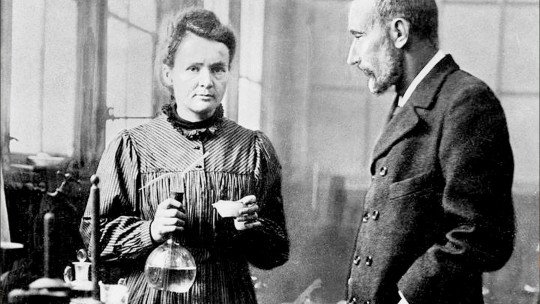
See more of our articles in your search results.
We often picture great discoveries as the work of a solitary genius, one person alone in a laboratory, library, or study suddenly seeing what nobody else could. That story is appealing, but it is usually incomplete. Many of the most influential ideas in science, psychology, medicine, and philosophy emerged through intellectual collaboration: long conversations, disagreements, complementary skills, shared drafts, and the rare experience of finding someone who can challenge your thinking without shutting it down.
Collaborative work is not always easy. Close partnerships can involve competition, unequal recognition, conflict over authorship, and the strain of working beside someone whose strengths expose your own limitations. Yet productive partnerships often create something neither person could have produced alone. The most successful pairs tend to combine different forms of expertise, such as theory and experimentation, analysis and observation, imagination and discipline, or emotional intuition and statistical rigor.
So what makes an intellectual partnership genuinely transformative?
This article explores five important pairs of scientists and intellectuals who worked together, the discoveries or ideas their collaborations produced, and the broader psychological lessons these partnerships offer about creativity, trust, and shared thinking.
Why Do Intellectual Partnerships Matter So Much?
Intellectual partnerships matter because complex problems often require more than one cognitive style, perspective, or area of expertise. Collaboration can improve creativity, reduce blind spots, and help people persist through difficult work by turning isolated effort into shared inquiry.
How many of these have you been "meaning to read" for months?
- 1
 THE LOST SKILLS ACADEMYThe Lost Skills of IndependenceBe Ready for Anything Life Throws at You - Hardcover-SpiralListen Free On Audible
 - 2
 A Navy SEALs Bug-In GuideA Navy SEAL's Bug-In GuideHow to Turn Your House into the Safest Place on EarthListen Free On Audible
 - 3
 Clarkson PotterHomemaking with BabsTips and Tricks for Making a House a HomeListen Free On Audible
Psychologist Vera John-Steiner, whose research examined creative collaboration, argued that major intellectual achievements are frequently social rather than individual events. Her work emphasized that long-term partnerships can create a shared language, a common set of questions, and a level of trust that allows people to take creative risks without fearing immediate rejection.
A strong partnership is not simply two talented people standing beside each other. It involves repeated intellectual exchange, with one person offering a question, insight, method, or contradiction that changes what the other person can see. The result can be a kind of distributed creativity, where the most important idea belongs not fully to either individual but to the relationship between them.
Collaboration also has practical benefits. It can divide labor, combine specialized knowledge, and create accountability during long projects that would otherwise feel overwhelming. Still, productive partnerships need enough difference to generate new ideas and enough mutual respect to keep disagreement useful rather than destructive.
James Watson and Francis Crick: Building the DNA Double Helix
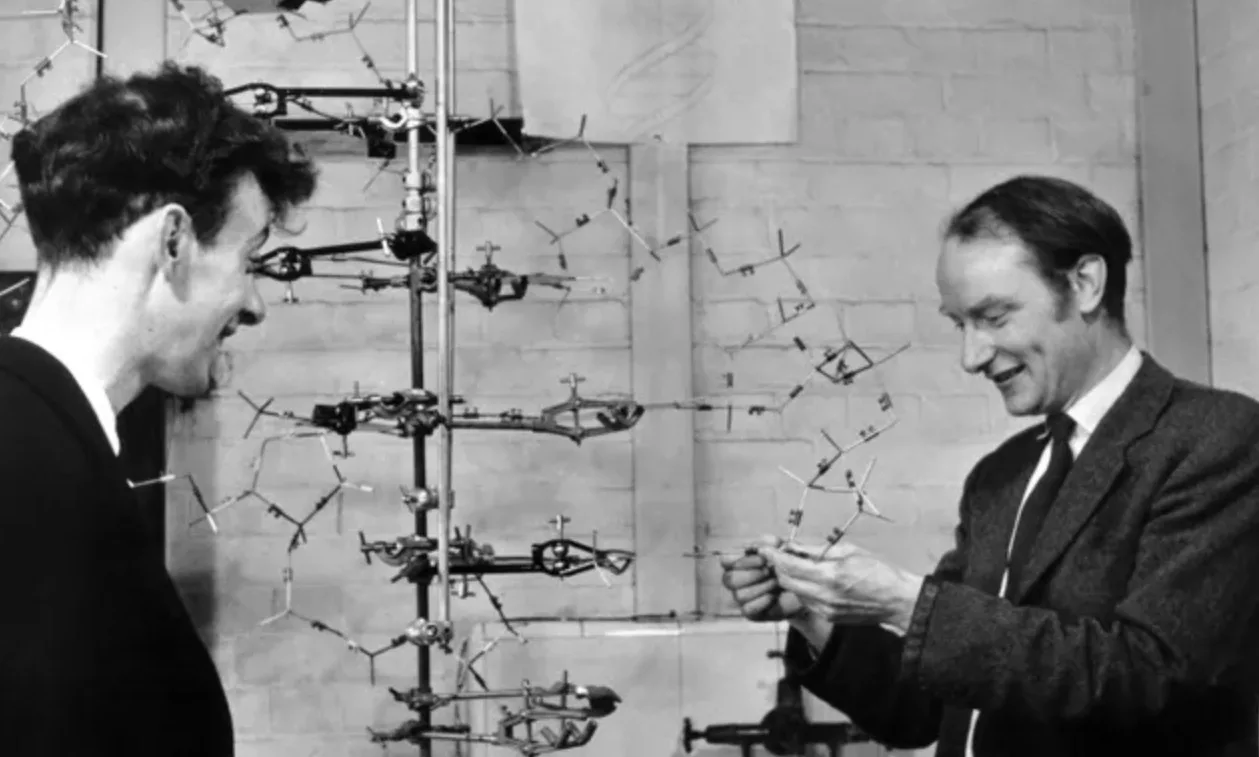
James Watson and Francis Crick are among the best-known scientific collaborators because their 1953 model of DNA as a double helix transformed genetics, biology, and medicine. Their partnership combined rapid theoretical model-building with close attention to chemical and structural evidence.
Watson and Crick worked at the Cavendish Laboratory in Cambridge during a highly competitive period of DNA research. Neither conducted the key X-ray diffraction experiments themselves, but they drew heavily on existing work, including crucial data produced by Rosalind Franklin and Maurice Wilkins. Their eventual model showed how paired nucleotide bases could explain both DNA’s structure and its ability to replicate.
Their collaboration was unusually intense. They discussed the problem constantly, challenged one another’s assumptions, and used physical models to test whether a proposed structure could actually fit the available evidence. Watson brought strong biological intuition and urgency; Crick contributed broad physical reasoning and structural analysis. Together, they created a powerful complementary partnership.
The story also carries an important ethical lesson. Franklin’s contributions were historically underrecognized, and her X-ray crystallography work was essential to the final model. Modern discussions of scientific collaboration increasingly emphasize credit, authorship, and research ethics, especially when discoveries emerge from wider networks rather than a single celebrated pair.
Marie and Pierre Curie: A Partnership in Radioactivity
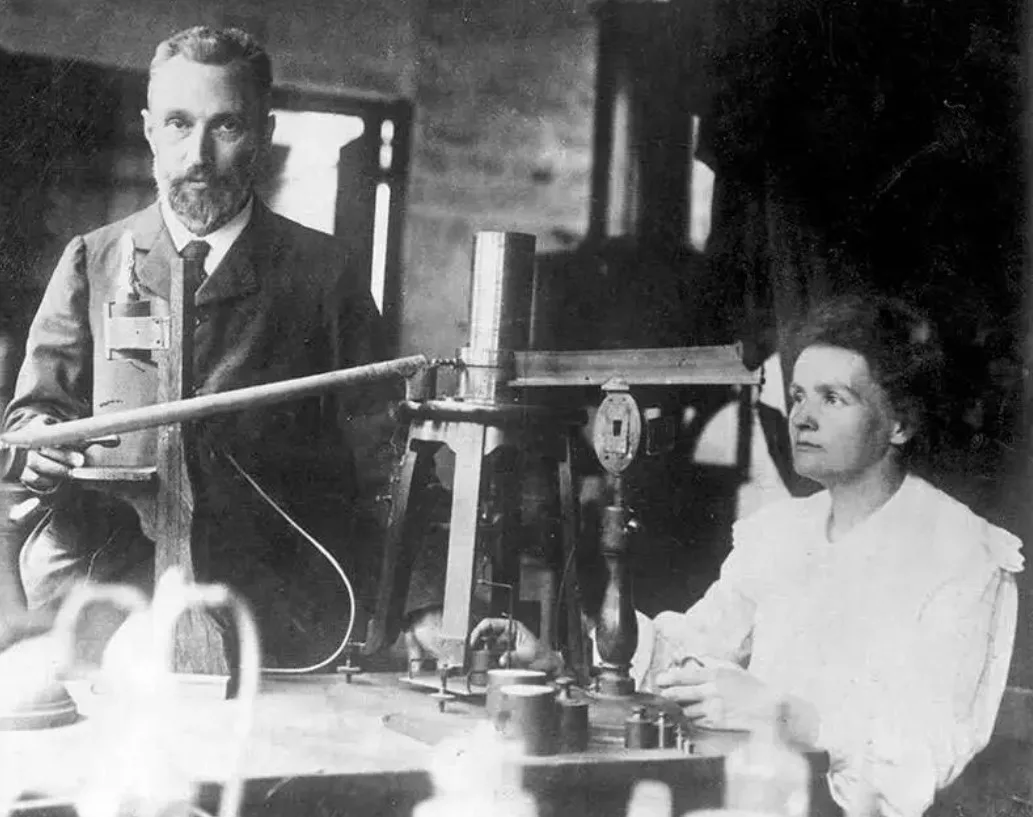
Marie and Pierre Curie formed one of history’s most influential scientific partnerships, combining experimental persistence, mathematical precision, and a shared commitment to studying radiation. Their work helped establish the field of radioactivity and led to the discovery of polonium and radium.
Marie Curie arrived in Paris from Poland to study science at a time when women faced extraordinary barriers in higher education and laboratory work. Pierre Curie, already an accomplished physicist, recognized her intellectual ability and became both her research collaborator and husband. Their relationship was built around a shared scientific life, with difficult laboratory conditions becoming part of their joint purpose.
The Curies worked with pitchblende, a mineral containing uranium, to isolate new radioactive elements. The labor was physically exhausting, involving large quantities of raw material, limited equipment, and years of repeated chemical processing. Their persistence reflects an important feature of scientific achievement: discovery often depends less on dramatic insight than on long-term disciplined effort.
Marie Curie later became the first person to win Nobel Prizes in two scientific fields. Yet her career also shows the unequal recognition women often faced in science. Her partnership with Pierre was deeply collaborative, but her independent achievements after his death demonstrate that collaboration can strengthen, rather than erase, a person’s own intellectual identity.
Daniel Kahneman and Amos Tversky: Changing How We Think About Decisions
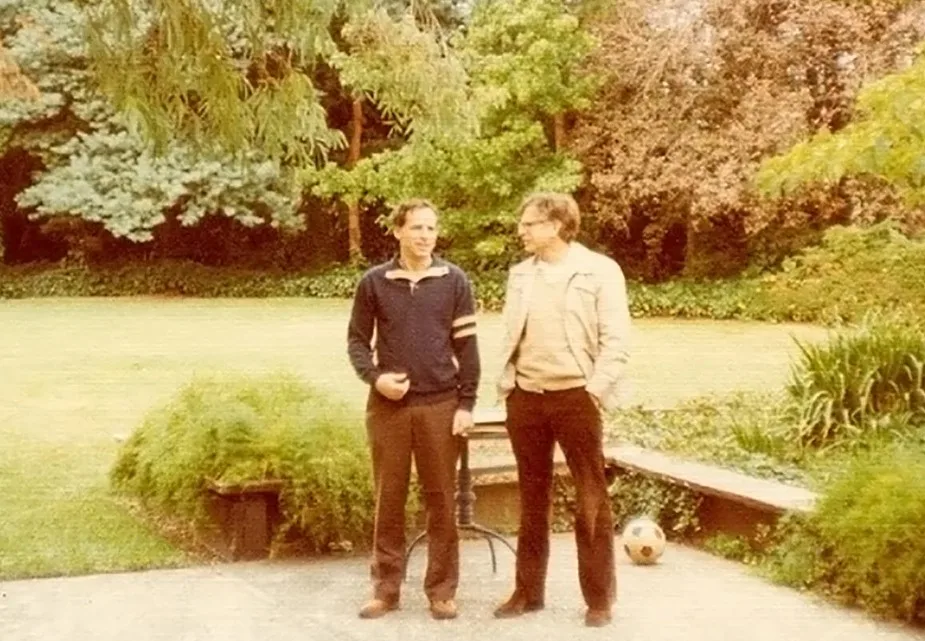
Daniel Kahneman and Amos Tversky transformed psychology and economics by showing that human decision-making is often shaped by shortcuts, biases, and predictable errors rather than perfect rationality. Their collaboration laid much of the groundwork for modern behavioral economics.
They began working together in Israel during the late 1960s and quickly developed an unusually close intellectual friendship. Kahneman brought careful experimental thinking and concern with human judgment; Tversky was known for remarkable analytical speed, conceptual precision, and an ability to identify the hidden assumptions inside an argument.
Their work on heuristics and biases challenged the assumption that people consistently make rational decisions based on probability and available evidence. They explored errors such as availability bias, representativeness, anchoring, and overconfidence. These ideas changed how researchers understand financial decisions, medical judgment, public policy, and everyday thinking under uncertainty.
Their partnership also illustrates the psychological power of intellectual play. Kahneman described their conversations as unusually joyful, full of shared humor and rapid idea generation. The most productive collaborations often include this quality: serious work without constant self-protection, allowing both people to question assumptions and make mistakes in a climate of psychological safety.
Sigmund Freud and Josef Breuer: Early Work on Hysteria
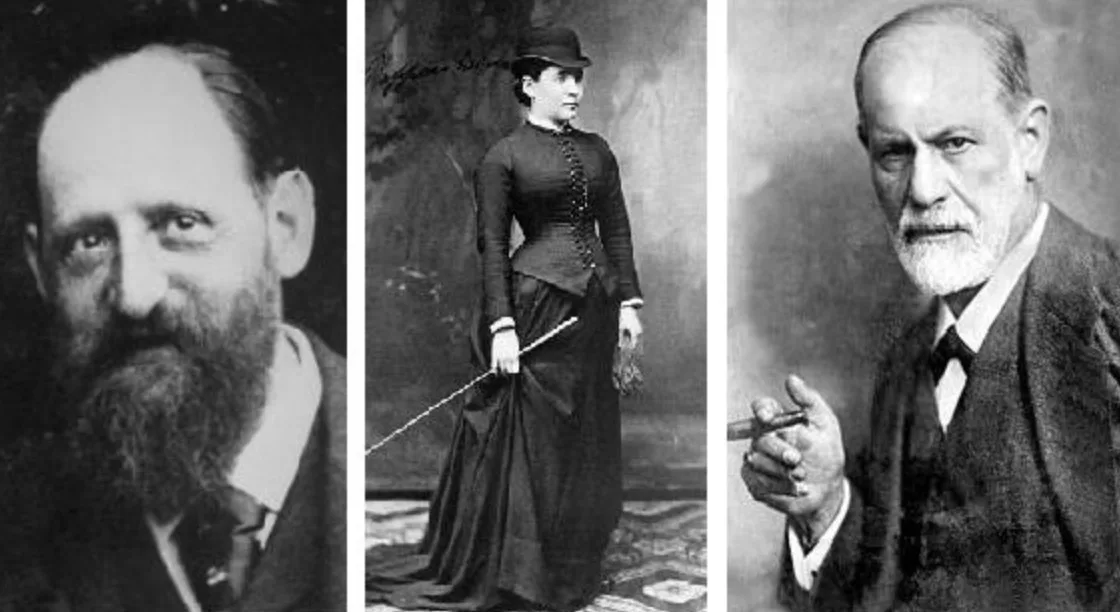
Sigmund Freud and Josef Breuer worked together on early ideas about hysteria, trauma, and unconscious processes, producing concepts that helped shape the beginnings of psychoanalysis. Their collaboration shows how intellectual partnerships can be productive even when they later end in disagreement.
Breuer was a respected Viennese physician whose treatment of Bertha Pappenheim, later referred to as “Anna O.,” influenced early theories about symptoms and emotional expression. He observed that discussing emotionally charged experiences sometimes appeared to reduce symptoms, a process later described as the talking cure.
Freud built on Breuer’s clinical observations and pushed their ideas in increasingly theoretical directions. Their joint publication, Studies on Hysteria, argued that psychological symptoms could be connected to experiences and emotions that had not been consciously processed. This was a major departure from explanations that treated such symptoms as purely physical or imaginary.
The partnership eventually fractured, partly because Freud developed theories Breuer was unwilling to endorse. Still, their collaboration demonstrates that disagreement does not invalidate earlier shared work. Sometimes intellectual partnerships create the conditions for growth precisely because collaborators begin with common questions and later take those questions in different directions.
Charles Darwin and Alfred Russel Wallace: Natural Selection and Shared Discovery
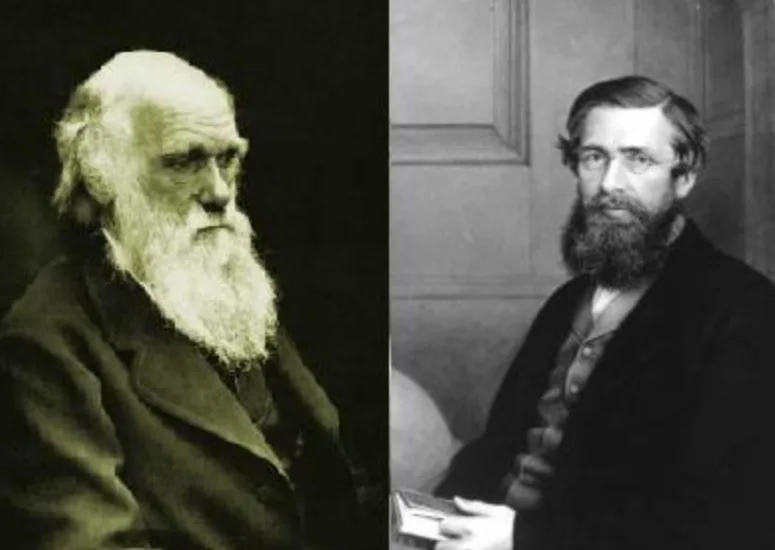
Charles Darwin and Alfred Russel Wallace independently developed ideas about natural selection, and their work became linked through one of the most important moments in scientific history. Their relationship demonstrates how collaboration can emerge even when two researchers initially arrive at similar ideas separately.
Darwin had spent decades developing his theory of evolution by natural selection but delayed publication, partly because he worried about criticism and wanted more evidence. Wallace, working independently while collecting specimens in the Malay Archipelago, reached a similar conclusion about how organisms change over time through natural selection.
When Wallace sent Darwin an essay outlining his idea, Darwin faced a difficult ethical situation. Rather than claiming the theory alone, Darwin’s colleagues arranged for Wallace’s paper and excerpts from Darwin’s earlier unpublished writings to be presented jointly at the Linnean Society in 1858. This created a rare example of shared scientific priority.
Darwin later published On the Origin of Species, which became far more widely known than Wallace’s work. Their story remains important because it challenges the idea that discovery always belongs to one person. Scientific progress sometimes involves parallel insight, timing, and the ethical choices people make when recognition and credit are at stake.
How Did Their Different Strengths Create Better Work?
These scientific and intellectual pairs succeeded partly because their strengths were different enough to create new insight but compatible enough to support long-term cooperation. Complementary skills often matter more than having two people with identical knowledge or identical working styles.
| Collaboration Pair | Complementary Strengths |
| Watson and Crick | Biological intuition, structural reasoning, model-building |
| Marie and Pierre Curie | Chemical persistence, physics, experimental precision |
| Kahneman and Tversky | Experimental psychology, mathematical analysis, conceptual clarity |
| Freud and Breuer | Clinical observation, theory-building, interest in emotional processes |
| Darwin and Wallace | Natural observation, evolutionary reasoning, field experience |
Psychologist Keith Sawyer, whose work examines group creativity and innovation, has argued that breakthroughs often emerge from interaction rather than isolated brilliance. One collaborator may notice a problem, another may supply a method, and a third may create the language needed to explain the discovery to others.
Complementarity does not mean each partner remains locked into one narrow role forever. Strong collaborators often learn from one another, gradually expanding their own expertise through prolonged contact. This mutual development is one reason long-term partnerships can become more productive over time, creating a shared intellectual system larger than either person started with alone.
The best collaborations also allow people to disagree productively. If every idea receives automatic approval, there is little pressure to improve it. If every disagreement becomes personal, progress stops. The balance lies in maintaining enough constructive friction to sharpen ideas without making the relationship unsafe.
What Can We Learn About Creativity From These Partnerships?
These partnerships show that creativity is often relational: ideas improve when people exchange perspectives, test assumptions, and combine distinct experiences. The stereotype of the lone genius misses how frequently major discoveries depend on networks of colleagues, mentors, critics, and collaborators.
Creative work often begins with uncertainty. One person may have a half-formed intuition while another sees a way to test it, organize it, or connect it to a broader theory. In this sense, collaboration provides more than practical assistance; it provides a structure for thinking aloud before an idea is fully ready.
Vera John-Steiner described several forms of creative collaboration, including complementary partnerships where each person brings a distinct strength, and integrative partnerships where people develop a deeply shared intellectual language over time. The pairs discussed here show both forms. Watson and Crick worked through rapid complementary exchange, while Kahneman and Tversky developed an unusually integrated way of reasoning together.
For modern teams, the lesson is not that every project needs a famous partnership. It is that creativity often improves when people deliberately seek collaborators who see the problem differently. Intellectual diversity, when combined with trust and shared purpose, can turn a promising idea into a more rigorous and durable contribution.
What Makes Collaboration Difficult Even for Brilliant People?
Collaboration can be difficult because intellectual work often involves identity, status, ownership, and vulnerability. Even highly talented people may struggle with criticism, unequal recognition, incompatible work styles, or disagreement about who deserves credit for a shared idea.
Scientific history includes many examples where collaborators experienced tension over authorship or recognition. Rosalind Franklin’s role in the DNA story remains a powerful reminder that collaboration is not automatically fair simply because several people contribute to the same discovery. Clear agreements about credit, access to data, and authorship are essential parts of ethical collaboration.
Different working rhythms can also create strain. One collaborator may value speed and experimentation, while another needs time, precision, and repeated verification. Neither style is inherently better, but unspoken differences can become sources of conflict if collaborators interpret one another’s behavior as laziness, control, or lack of commitment rather than a legitimate difference in process.
Successful partnerships often make room for explicit discussion of these tensions rather than pretending they do not exist. Talking openly about goals, responsibilities, deadlines, and credit may feel less romantic than the idea of spontaneous creative chemistry, but it often protects the relationship that makes sustained collaboration possible.
How Can You Build Better Intellectual Partnerships Today?
Building a strong intellectual partnership today requires choosing people with compatible values and complementary skills, establishing clear expectations early, and creating regular opportunities for honest disagreement, feedback, and shared reflection throughout the work.
- Choose complementary strengths rather than looking only for people who think exactly as you do.
- Clarify shared goals early, including what success, contribution, and credit should look like for everyone involved.
- Create psychological safety so people can offer unfinished ideas, criticism, and uncertainty without immediate embarrassment.
- Discuss conflict directly before small frustrations become long-term resentment or avoidance.
Modern collaboration often happens across distance, disciplines, and cultures, which creates new opportunities but also new communication challenges. Written expectations, regular check-ins, and a willingness to ask what someone means rather than assuming intent can prevent many avoidable misunderstandings in remote collaboration.
It also helps to separate criticism of an idea from criticism of the person offering it. Productive partners can say, “This argument needs more evidence,” without implying, “You are not capable.” That distinction protects intellectual confidence, which is especially important when people are doing difficult work that naturally involves uncertainty and revision.
Collaboration is not simply a productivity strategy. At its best, it is a relationship in which people become more capable thinkers because another person helped them see beyond the limits of their own perspective. That kind of shared work can be one of the most meaningful forms of intellectual growth available.
Why Do Collaborative Stories Matter Beyond Science?
Stories about scientific and intellectual partnerships matter because they challenge the idea that achievement requires total independence. They show that asking for feedback, sharing unfinished thoughts, and relying on another person’s strengths can be signs of intellectual maturity rather than weakness.
This lesson has relevance far beyond laboratories or universities. Students, artists, entrepreneurs, clinicians, and community organizers all face problems too complex for one person to solve alone. Knowing how to collaborate, listen, disagree, and repair trust becomes part of the skill set needed for meaningful achievement in nearly every field.
These stories also humanize famous figures. Watson, Crick, Curie, Kahneman, Tversky, Darwin, Wallace, Freud, and Breuer were not isolated machines producing discoveries. They were people shaped by friendship, rivalry, conflict, grief, institutional power, and the unpredictable chemistry of working relationships.
That is perhaps the broader takeaway: exceptional work does not require becoming a solitary genius. It often requires finding people who make your questions sharper, your evidence stronger, and your thinking more generous than it would have been alone.
FAQs about Scientists and Intellectual Partnerships
Who are the most famous scientific pairs in history?
Some of the best-known scientific pairs include James Watson and Francis Crick, who developed the double-helix model of DNA; Marie and Pierre Curie, whose work helped establish radioactivity research; Daniel Kahneman and Amos Tversky, who transformed the study of decision-making; Sigmund Freud and Josef Breuer, who collaborated on early ideas related to hysteria and unconscious processes; and Charles Darwin and Alfred Russel Wallace, whose work became jointly associated with natural selection. Each partnership differed significantly in method and personality, but all demonstrate how shared inquiry can produce discoveries or theories that might not have emerged through isolated work alone.
Did Watson and Crick discover DNA alone?
No. Watson and Crick developed the famous double-helix model, but their work depended heavily on a broader network of research, especially crucial X-ray diffraction data produced by Rosalind Franklin and work from Maurice Wilkins and other scientists studying DNA structure. Franklin’s contributions were not adequately recognized at the time, and her role remains central to modern conversations about scientific credit, gender, and ethics. The DNA story is best understood not as a simple two-person discovery but as a collaborative and competitive scientific process involving several people using different methods and forms of evidence.
Why did Kahneman and Tversky work so well together?
Kahneman and Tversky appeared to work well together because their cognitive strengths complemented one another. Kahneman brought careful experimental thinking and interest in human judgment, while Tversky was especially skilled at analytical reasoning and identifying hidden assumptions in arguments. They also shared an unusual ability to challenge each other without immediately becoming defensive, creating a playful but rigorous intellectual environment. Their collaboration produced influential research on cognitive biases, heuristics, probability judgment, and decision-making. The partnership is frequently cited as an example of how friendship, trust, humor, and productive disagreement can combine to create unusually durable intellectual work.
What makes a collaboration scientifically ethical?
Ethical scientific collaboration involves clear agreements about authorship, credit, data access, responsibilities, and decision-making from the beginning of a project. All contributors should receive recognition appropriate to their actual role, and researchers should avoid using another person’s data or ideas without permission or proper acknowledgment. The historical treatment of Rosalind Franklin’s work in DNA research is frequently discussed as a cautionary example of how unequal power and unclear credit can distort scientific recognition. Ethical collaboration also requires transparency about conflicts of interest, careful communication, and a willingness to address disagreements directly rather than allowing resentment or unfairness to accumulate quietly over time.
Can collaboration make people more creative?
Yes, collaboration can increase creativity when it brings together genuinely different perspectives, skills, and experiences in an environment where people feel safe sharing unfinished ideas. A collaborator may notice assumptions you have missed, offer a method you do not know, or connect your idea to a completely different field. However, collaboration is not automatically creative; it can also become unproductive when partners fear criticism, compete excessively, or avoid discussing disagreements. The most effective creative partnerships tend to balance trust with intellectual challenge, allowing people to question one another’s ideas rigorously without treating disagreement as a personal attack.
What happens when intellectual collaborators disagree?
Disagreement can be productive when collaborators treat it as information rather than a personal threat. Different interpretations, methods, or priorities can reveal weak assumptions and improve a project before mistakes become embedded in the final work. Problems arise when disagreement becomes tied to status, identity, or unresolved resentment, especially if people avoid discussing conflict directly. Some famous partnerships ended because collaborators developed fundamentally different theoretical views, as happened with Freud and Breuer. Even then, the collaboration may still have been valuable, since early shared work can create questions and frameworks that later lead people toward different but meaningful intellectual paths.
Are famous intellectual partnerships always equal?
No. Many celebrated partnerships involve unequal recognition, different levels of institutional power, or uneven access to resources and authorship credit. Women, junior researchers, assistants, and people from marginalized groups have historically been especially vulnerable to having their contributions minimized or overlooked. This is why modern research culture increasingly emphasizes transparent authorship criteria, careful documentation of contributions, and explicit discussion of credit early in a project. A partnership can be intellectually productive while still being ethically uneven, so admiring the discovery should not prevent us from examining how recognition, power, and fairness operated within the collaboration itself.
How can students find good intellectual collaborators?
Students can find good collaborators by looking for people who are reliable, curious, and willing to engage seriously with ideas rather than simply agreeing quickly. Complementary skills often matter more than identical interests: one person might be strong at research design, another at writing, data analysis, or creative problem-solving. It helps to begin with smaller projects, establish clear expectations about workload and credit, and pay attention to how a potential collaborator handles disagreement or missed deadlines. Good intellectual partnerships are usually built gradually through repeated experiences of reliability, honest feedback, and mutual respect rather than instantly appearing through shared enthusiasm alone.
Bibliography
- John-Steiner, V. (2000). Creative Collaboration. Oxford University Press.
- Watson, J. D. (1968). The Double Helix: A Personal Account of the Discovery of the Structure of DNA. Atheneum.
- Curie, M. (1923). Pierre Curie. Macmillan.
- Kahneman, D. (2011). Thinking, Fast and Slow. Farrar, Straus and Giroux.
- Tversky, A., & Kahneman, D. (1974). Judgment Under Uncertainty: Heuristics and Biases. Science, 185(4157), 1124-1131.
- Breuer, J., & Freud, S. (1895). Studies on Hysteria. Franz Deuticke.
- Darwin, C. (1859). On the Origin of Species. John Murray.
- Sawyer, R. K. (2007). Group Genius: The Creative Power of Collaboration. Basic Books.
- Science History Institute. (2026). Francis Crick, Rosalind Franklin, James Watson, and Maurice Wilkins. Science History Institute.
Use this citation format to reference the article clearly and help readers find the original source.
PsychologyFor. (2026). 5 Pairs of Scientists (And Intellectuals) Who Worked Together. PsychologyFor. https://psychologyfor.com/5-pairs-of-scientists-and-intellectuals-who-worked-together/