

See more of our articles in your search results.
Christmas scenes surround us throughout December—in storefronts, on greeting cards, across social media feeds. The nativity, the adoration of the shepherds, the arrival of the Magi—these images feel timeless and universal, as though they’ve always existed. Yet the artistic representation of Christmas wasn’t always common or even acceptable in Christian visual culture.
During the earliest centuries of Christianity, when believers faced persecution and practiced their faith in catacombs and secret meeting spaces, religious art relied on cryptic symbols intelligible only to the initiated: the fish (ichthys), the good shepherd, the anchor, the lamb. Direct representations of Christ’s birth were virtually nonexistent. Christmas iconography didn’t become universal until well into the Middle Ages, but once established, it became one of the most enduring themes in Western art.
From the luminous Byzantine mosaics of Ravenna—where some of the earliest depictions of the Magi appear—to the dramatic baroque canvases of the Counter-Reformation, Christmas art reflects not just biblical narrative but the evolving spiritual, political, and aesthetic concerns of each era. These works tell us as much about the societies that created them as they do about the events they portray.
Today we invite you on a journey through six masterpieces that capture the mystery of Christmas. Each painting or mosaic opens a window not just into the nativity story, but into the minds and hearts of the artists who reimagined it for their time. Discover how genius transforms sacred narrative into visual poetry.
Art and Christmas: A Visual Theology
Christmas art serves multiple functions simultaneously. On the surface, these works illustrate biblical events—the humble birth in Bethlehem, the angelic announcement to shepherds, the journey of eastern astrologers following a star. But beneath this narrative layer lies profound theological meaning encoded through composition, color, gesture, and symbol.
How many of these have you been "meaning to read" for months?


Medieval and Renaissance artists worked within established iconographic traditions where every element carried significance. The ox and donkey represented Gentiles and Jews united in recognizing Christ. The cave or stable symbolized the darkness of sin into which divine light entered. Mary’s colors—typically blue for divinity and red for humanity—embodied the theological truth of Christ’s dual nature. Even seemingly minor details like the positioning of hands, the direction of gazes, or the inclusion of architectural ruins conveyed complex doctrinal messages to viewers trained in visual literacy.
The evolution of Christmas art also mirrors shifts in Christian worship and belief. Byzantine mosaics emphasized Christ’s divine majesty even as an infant. Gothic paintings stressed his humanity and suffering, even at birth. Renaissance works celebrated both the intellectual beauty of proper proportion and the emotional intimacy of the holy family. Baroque canvases deployed dramatic light and shadow to evoke intense spiritual experience and reinforce Catholic doctrine against Protestant critique.
For believers across centuries, these images weren’t mere decorations or illustrations. They functioned as windows into sacred reality, points of encounter with the divine, aids to meditation and prayer. Understanding these works requires appreciating not just their aesthetic beauty but their theological purpose and devotional use.
1. Nativity, by Federico Barocci (Prado Museum, Madrid)
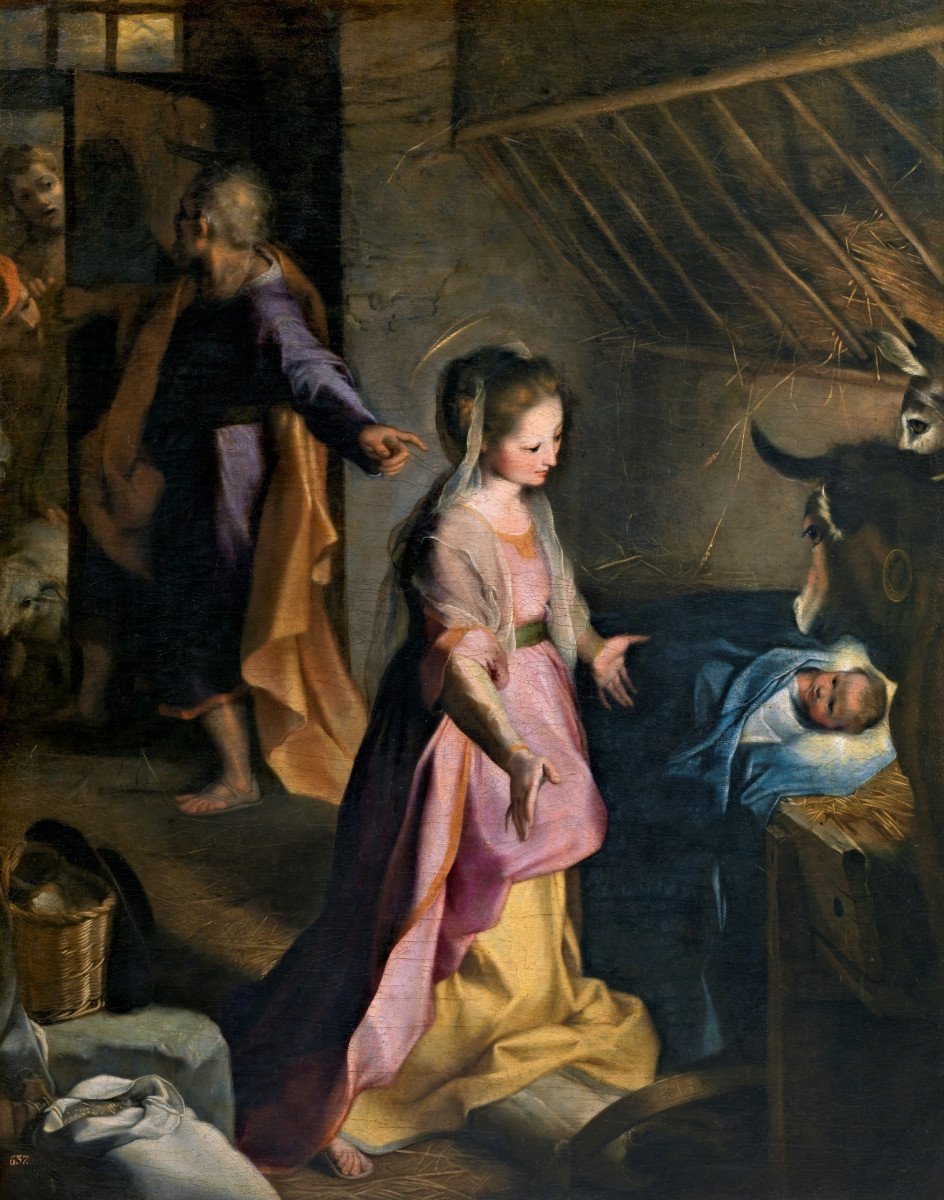
The most striking quality of Barocci’s Nativity is the intimate, almost otherworldly light that seems to emanate from the Christ child himself, bathing the Virgin in a warm, golden glow that creates an atmosphere of profound tenderness and wonder. In the humble setting of a stable, Mary kneels in ecstatic adoration before the miracle that has just occurred, her entire being focused on the newborn who lies among straw in the manger.
What distinguishes this 1597 canvas by Federico Barocci (1535-1612) from other nativity scenes is the radical simplification of the composition to emphasize the intimate connection between mother and child. Unlike traditional representations that crowd the stable with shepherds, angels, animals, and the Magi, here Mary and Jesus command absolute visual and emotional priority. Saint Joseph and the shepherds occupy a much more distant plane; the Virgin’s husband gestures excitedly toward the scene, directing the arriving shepherds’ attention to the miracle, but he remains clearly secondary to the mystical communion happening in the foreground.
The rumor and activity in the background don’t disturb Mary’s contemplative focus in the slightest. She’s dressed in a soft pink garment—a departure from traditional Marian iconography that typically represents her in red (symbolizing passion) and blue (symbolizing divinity). This color choice emphasizes her humanity, her role as mother rather than queen of heaven, making the scene more accessible and emotionally immediate for viewers.
The symbolic elements Barocci includes reward careful observation. In the immediate foreground, a basket of bread and a sack of wheat create clear eucharistic allusions—bread representing Christ’s body in the sacrament. Even more striking, two ears of wheat crossed above the heads of mother and son form the shape of a cross, a visual prophecy of the passion and crucifixion that awaits this infant. The painting thus holds birth and death in tension, celebrating incarnation while acknowledging its ultimate purpose.
The light—Barocci’s signature element—functions both naturalistically and symbolically. It appears to originate from the Christ child himself, reversing normal light logic where external sources illuminate subjects. This supernatural radiance suggests that divinity has entered the world as light entering darkness, a visual interpretation of John’s Gospel: “The light shines in the darkness, and the darkness has not overcome it.”
2. Adoration of the Shepherds, by Caravaggio (Regional Museum of Messina)
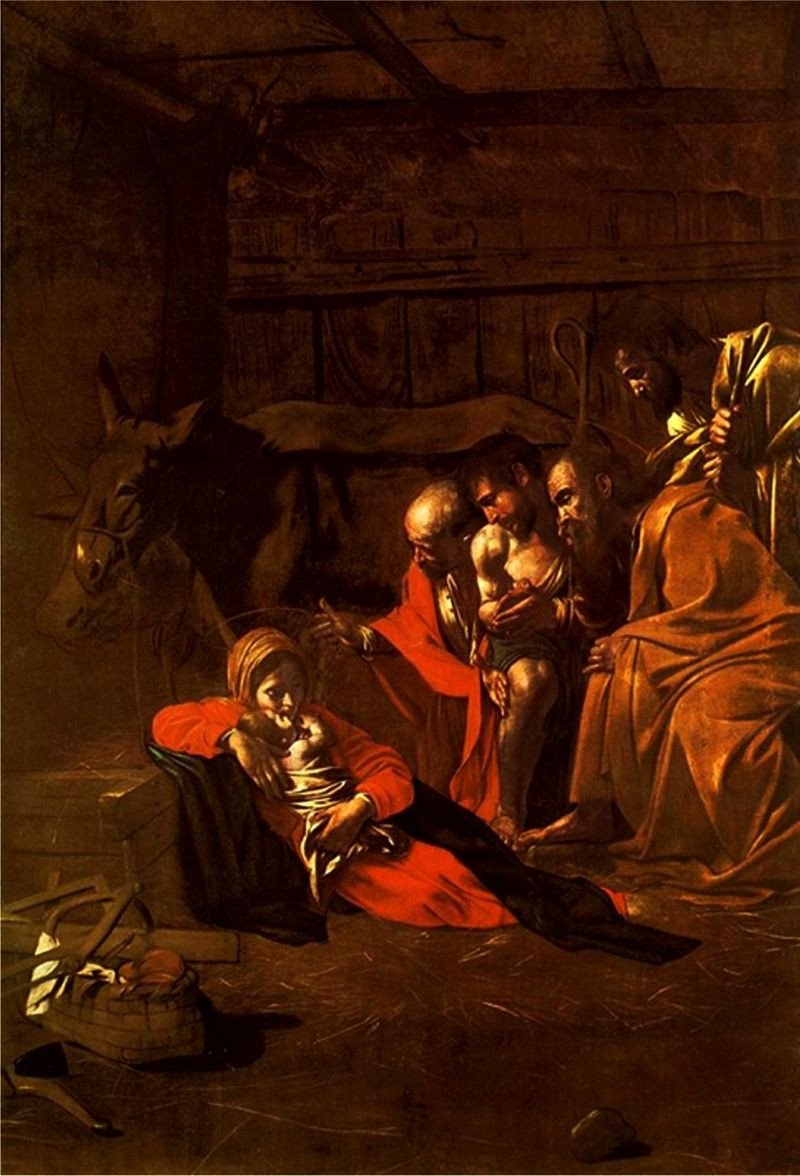
The revolutionary genius of Michelangelo Merisi da Caravaggio (1571-1610) manifests brilliantly in this canvas that remains surprisingly unknown even among art enthusiasts familiar with his major works. The composition’s most original and touching element is the Virgin herself who, utterly exhausted after childbirth, has fallen asleep with the infant Jesus cradled in her arms, completely unaware of the shepherds’ arrival. Joseph, seated protectively beside her, keeps watch over her sleep while the shepherds bow in reverence. This work was completed in 1609, just one year before Caravaggio’s death.
The radical realism of both setting and characters epitomizes Caravaggio’s approach and the broader aims of Baroque religious art. The Counter-Reformation Catholic Church, responding to Protestant criticisms of excessive ornamentation and distance from ordinary believers, embraced artistic styles that brought sacred events into recognizably human contexts. Rather than idealized, ethereal figures inhabiting celestial realms, Caravaggio presents the holy family as genuinely poor people in an authentically humble stable.
Caravaggio’s practice of using models from lower social strata—laborers, beggars, street people—created scandal among contemporaries but served his artistic and theological vision. These weren’t generic “types” representing abstract concepts but specific individuals whose weathered faces and work-hardened bodies testified to real suffering and labor. The shepherd in this painting looks like an actual Sicilian shepherd, not an actor costumed for a pageant. This realism insisted that the incarnation happened not in some sanitized biblical fantasy but in the gritty reality of poverty, exhaustion, and vulnerability.
The sleeping Virgin represents a daring choice. Traditional iconography showed Mary in perfect serenity, sometimes kneeling in worship of her son even immediately after birth, her maternity miraculous and painless. Caravaggio’s Mary is genuinely spent, her body sagging with fatigue, dark circles visible under her closed eyes. This unflinching acknowledgment of the physical reality of childbirth humanizes her completely while paradoxically deepening rather than diminishing the miracle—God chose to enter the world through this utterly human process, subjecting himself to the vulnerability of requiring a mother’s exhausted body and milk.
The dramatic chiaroscuro—Caravaggio’s trademark use of extreme contrasts between light and shadow—creates both visual drama and theological meaning. Light falls on the holy family and the adoring shepherds while darkness presses in from all sides, a visual metaphor for divine light penetrating fallen creation. The technique also focuses attention ruthlessly, eliminating distracting details and forcing viewers to confront the central mystery: God made flesh, cradled in a poor woman’s arms in a stable.
3. Mosaic of the Magi (San Apollinare Nuovo, Ravenna)
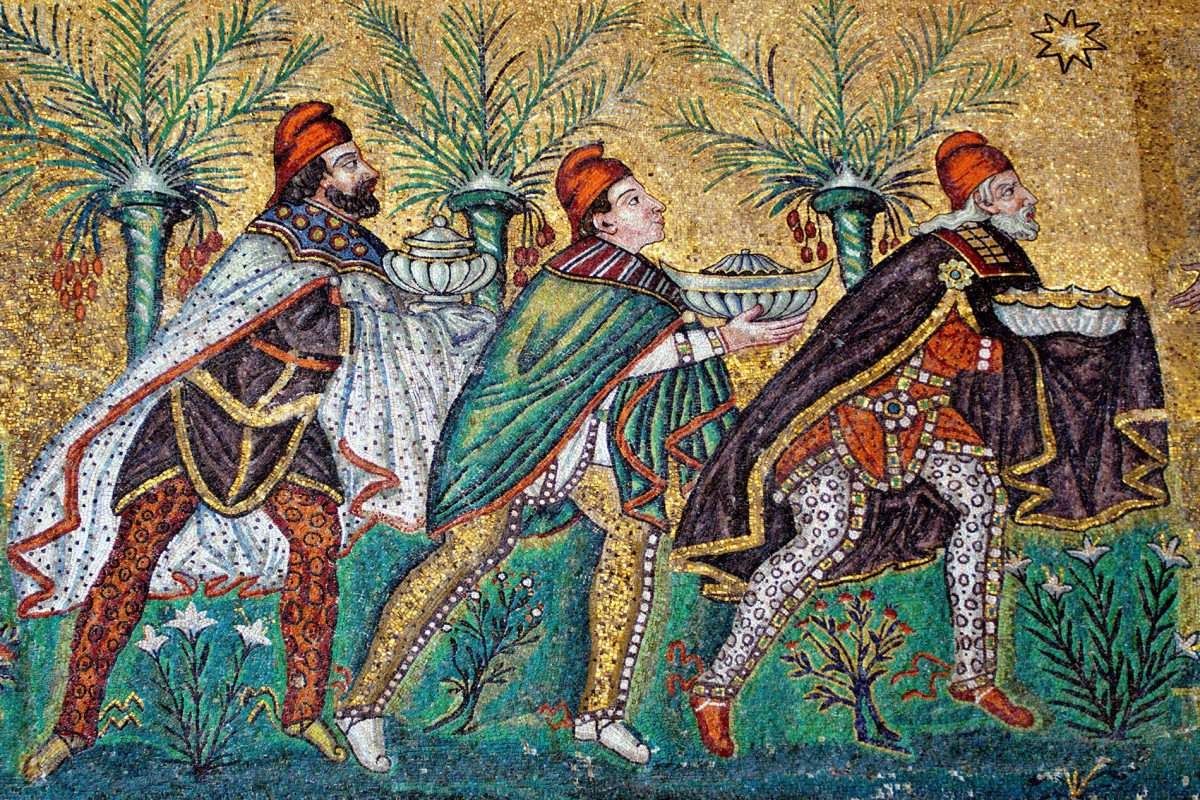
When considering great works of Christmas art, we often overlook the earliest examples—the pioneering images that established iconographic traditions that would endure for centuries. One of the most spectacular appears in the magnificent mosaics of San Apollinare Nuovo in Ravenna, Italy, a city that served as capital of the Ostrogothic kingdom under Theodoric and later as a principal center of Byzantine power in Italy during the 6th century.
While not the absolute first representation of the Magi in Christian art, this mosaic ranks among the earliest and most influential. The composition features a long, stately procession of figures moving toward the enthroned Virgin and Child, and among these figures appear the three individuals the Bible describes simply as “magi”—a term meaning magicians, astrologers, or wise men from the East. Their designation as “kings” and their specific number of three emerged from later tradition rather than biblical text, which provides neither detail.
In the Ravenna mosaic, the three Magi wear sumptuous oriental garments and distinctive Phrygian caps—pointed hats associated with Eastern regions, particularly Persia and Phrygia in Asia Minor. This headwear carried significant symbolic weight, as the Phrygian cap was closely linked to Mithraic mystery cults that had enormous influence on early Christianity. The visual connection suggests the transformation of pre-Christian wisdom and worship into Christian truth.
Above each figure’s head appears an inscription providing the names by which they would become known throughout Christian tradition: Melchior, Gaspar, and Balthasar. These names, like much else about the Magi, developed through legend and tradition rather than scripture. The three figures represent the three ages of human life—Melchior embodies old age with his white beard, Gaspar represents mature adulthood, and Balthasar depicts youth.
A particularly interesting detail: in the Ravenna mosaic, Balthasar is not yet depicted as African or Black. This representation wouldn’t begin to be established until the 15th century, when artists increasingly portrayed one of the three Magi with dark skin to symbolize that Christ came for all nations and peoples, from all corners of the known world. The evolution of this iconographic detail traces changing European awareness of global diversity and theological emphasis on Christianity’s universal rather than ethnic or regional character.
The mosaic technique itself merits attention. Byzantine artists achieved luminous, almost supernatural effects by setting tiny glass tesserae at slightly varied angles so they caught and reflected light differently, creating shimmering, living surfaces that seemed to glow with inner radiance. Gold tesserae, used extensively in these mosaics, transformed walls into representations of heaven itself, materialized light that transcended ordinary earthly illumination.
4. Nativity, by Andrei Rublev
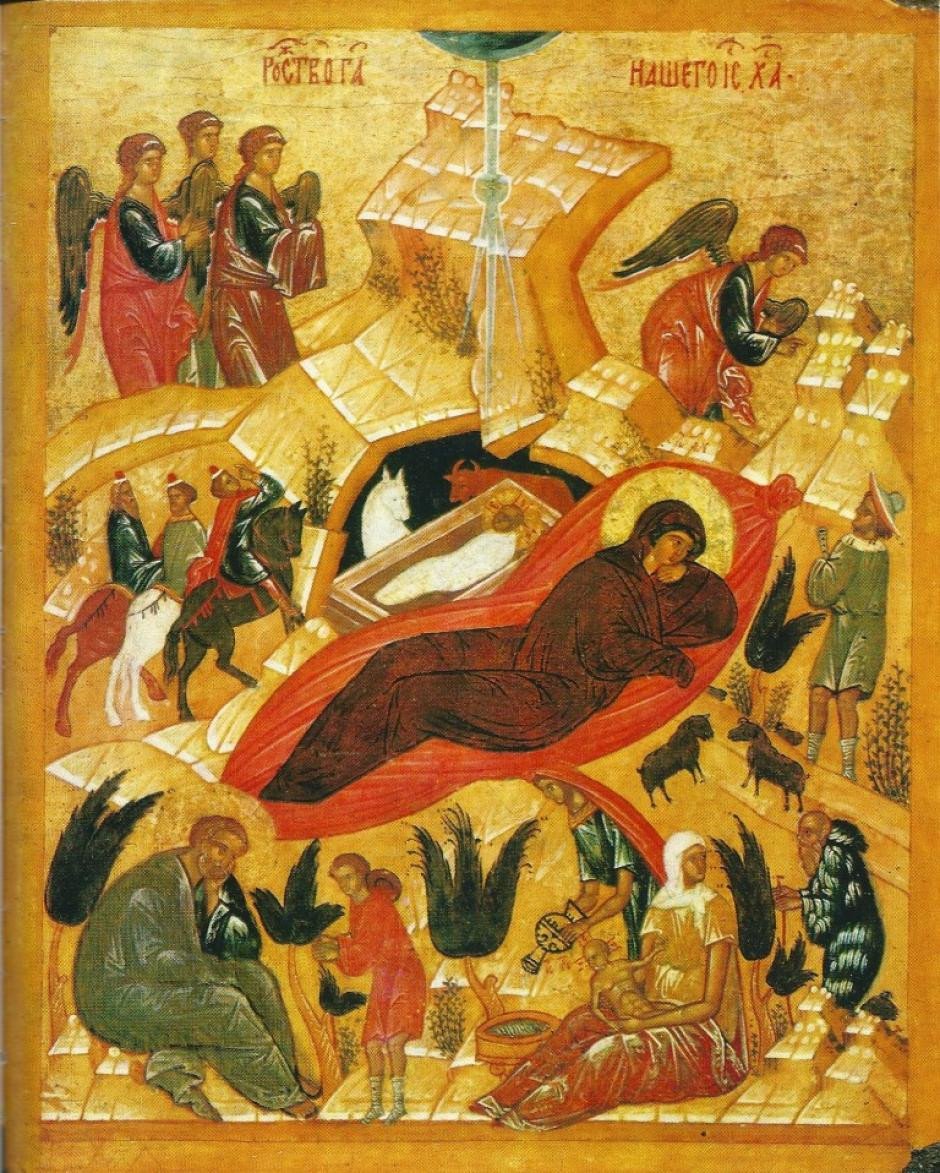
Very little is known with certainty about Andrei Rublev, this extraordinary 15th-century Russian icon painter whose work represents one of the pinnacles of Orthodox Christian art. Canonized as a saint by the Russian Orthodox Church in the 20th century, historical records suggest he lived and worked at the monastery of the Holy Trinity and Saint Sergius, approximately 70 kilometers from Moscow. His earliest documented work consists of frescoes in the Kremlin’s Cathedral of the Annunciation, but his most celebrated masterpiece is the icon of the Trinity, depicting the three divine persons seated at table in perfect circular harmony.
The icon tradition carries extraordinary weight in Slavic Orthodox culture, heir to Byzantine spiritual and artistic sensibilities. While Western European religious art increasingly pursued naturalism, emotional expression, and individual artistic innovation from the Gothic period onward, Russian iconography maintained a more symbolic, intellectual, and traditional approach well into the modern era. Icons functioned not as mere illustrations but as “windows into heaven,” liturgical objects through which the faithful encountered divine reality.
Rublev’s Nativity icon presents fascinatingly complex iconography that rewards careful study. At the top of the composition, the heavens open and divine light descends in the form of a ray that divides into three streams—a clear visual representation of the Trinity, the three-personed God whose Second Person is being born in the scene below. This heavenly realm, rendered in gold to suggest its transcendent nature, breaks into the earthly realm depicted below.
The center of the composition features the Virgin Mary who, strangely, turns her back to the Christ child, as if still processing the overwhelming mystery of what has occurred. This positioning, unusual in Western nativity scenes, reflects Orthodox theological emphasis on Mary’s interior spiritual state. She’s not simply a joyful mother but a contemplative figure pondering incomprehensible divine mysteries, her posture suggesting both acceptance and the difficulty of fully comprehending her role in salvation history.
The Christ child himself lies in a distinctive manger that appears more like a coffin or tomb than a feeding trough—a characteristic feature of Orthodox nativity iconography that prophetically connects Christ’s birth with his death and burial. The cave setting reinforces this connection, as caves served as tombs in the ancient Near East. The icon thus holds beginning and end together, birth and death, incarnation and passion, reminding viewers that Christmas makes sense only in light of Easter, that this child is born specifically to die and rise again.
Additional symbolic elements fill the composition: angels announce the birth to shepherds, the Magi journey toward the scene, Joseph sits apart in contemplation or perhaps doubt, and a midwife bathes the infant—a detail from apocryphal gospels included to emphasize Christ’s genuine humanity and Mary’s real childbirth. Every element serves theological purpose, creating not a realistic scene but a visual meditation on incarnation’s meaning.
The icon’s formal characteristics—flattened space, reversed perspective, stylized figures, symbolic rather than naturalistic colors—all serve to signal that this image depicts sacred rather than ordinary reality. Icons don’t attempt to bring heaven down to earth through realistic representation; they open windows through which earth glimpses heaven’s transfigured reality.
5. Mystical Nativity, by Sandro Botticelli (National Gallery, London)
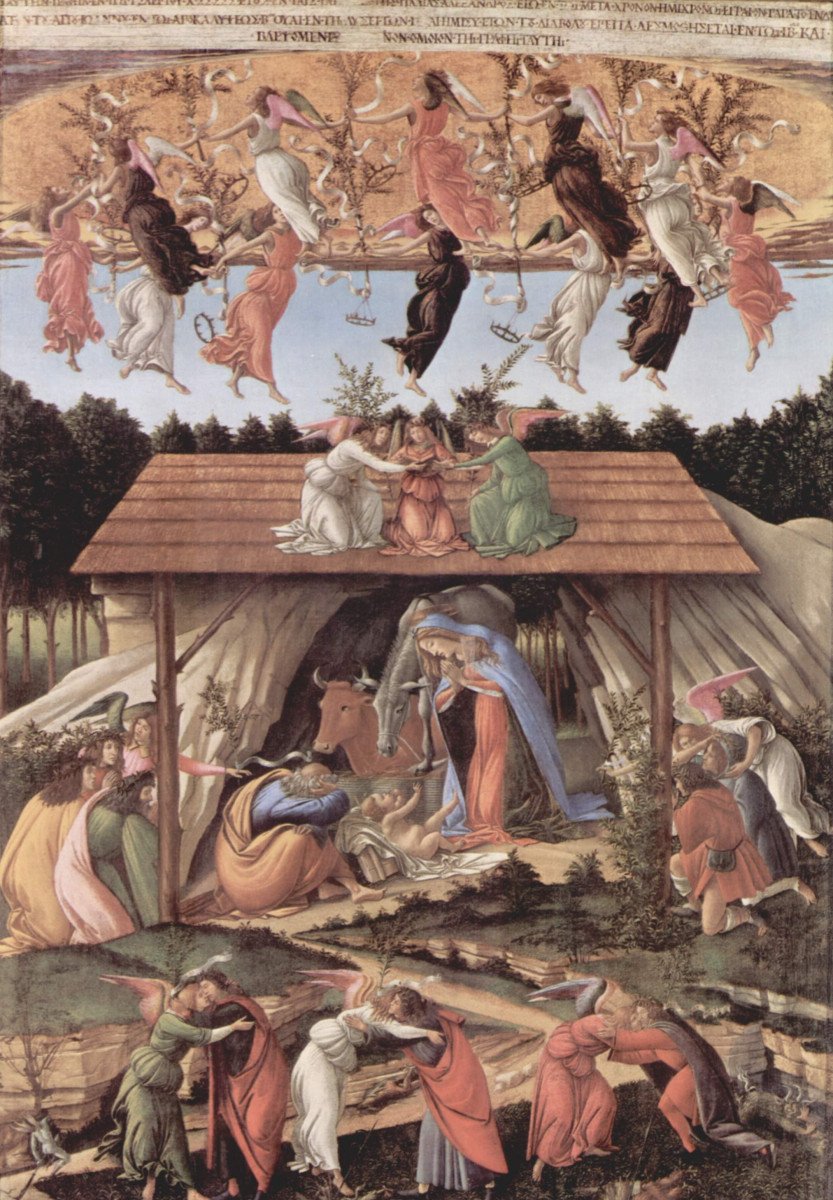
This is surely Botticelli’s most enigmatic and disturbing work, a painting that seems to emerge from fevered apocalyptic vision rather than conventional Christmas celebration. To understand it properly requires situating it precisely in its tumultuous historical context. Botticelli himself inscribed Greek text in the upper margin of the painting stating that he painted it “at the end of the year 1500 during the troubles in Italy”—a reference to the French invasions that had thrown the Italian peninsula into chaos and Florence into crisis.
But the painting’s strangeness goes far deeper than contemporary politics. This represents a radically unconventional nativity that abandons Renaissance norms and deliberately adopts medieval artistic conventions—elongated, sinuous figures, hierarchical scaling where importance rather than perspective determines size, symbolic rather than naturalistic space. The Virgin Mary towers over other figures, so large that were she to stand, she couldn’t fit under the stable’s thatched roof—a deliberate scaling choice that emphasizes her supreme importance in the composition.
At the top of the canvas, twelve angels dance in a circular formation holding hands, their joyous movement suggesting celestial celebration of the incarnation. They wear robes in three colors—white, green, and red—representing the theological virtues of Faith, Hope, and Charity. In the central stable, the Holy Family appears, but Saint Joseph’s posture is striking and troubling: rather than gazing adoringly at the child or welcoming visitors, he slumps with his face buried in his knees, apparently saddened or overwhelmed.
The painting’s most shocking and distinctive elements appear at the bottom. Demons tumble into the abyss, fleeing from the light of Christ’s coming. Above them, angels embrace human figures in gestures of reconciliation and peace, a motif typically associated with Last Judgment scenes rather than nativity imagery. The ground is littered with broken weapons and armor, suggesting that Christ’s birth inaugurates an age of peace where warfare becomes obsolete.
The entire work functions as a complex messianic allegory deeply connected to the apocalyptic preaching of the Dominican friar Girolamo Savonarola, who had plunged Florence into a period of religious fervor bordering on mass hysteria before his execution in 1498. Savonarola preached that Italy’s troubles represented divine judgment and that tribulation would precede Christ’s Second Coming and the establishment of God’s kingdom. Botticelli, apparently profoundly affected by these teachings, created a nativity that’s simultaneously about Christ’s first coming and his prophesied return.
The painting’s symbolic density rewards extended contemplation. The cave setting alludes both to the traditional birthplace and to the tomb where Christ would be laid after crucifixion. The sheet on which the infant rests evokes his future burial shroud. The cross appears marked on the donkey’s back. Everything points forward to passion and resurrection even while celebrating incarnation. The embracing angels and humans suggest the reconciliation between heaven and earth that Christ’s coming accomplishes—but only for those who accept him, as the fleeing demons make clear.
Botticelli created this painting during what appears to have been a spiritual crisis, abandoning the graceful classical humanism of his earlier works for an intense, anxious, medieval-inflected apocalypticism. The result is unsettling, disturbing, and unforgettable—a Christmas vision filtered through fear, hope, judgment, and redemption all at once.
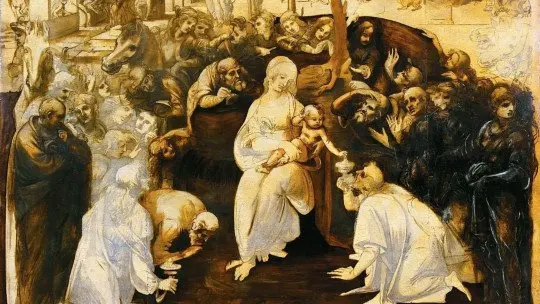
6. Adoration of the Magi, by Leonardo da Vinci (Uffizi Gallery, Florence)
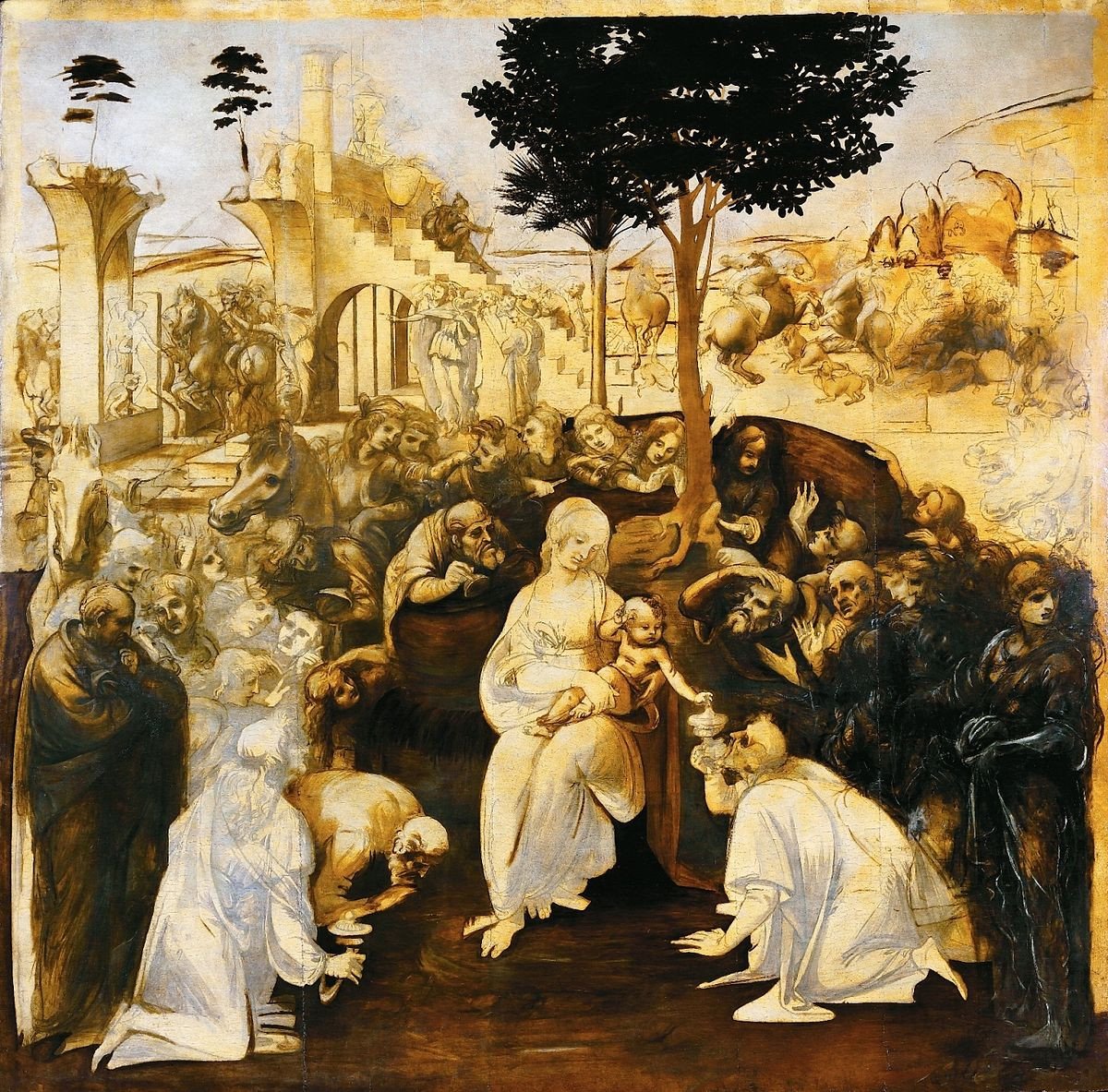
This early Leonardo masterpiece remains unfinished, abandoned when the artist left Florence for Milan in 1482, yet many argue that its incomplete state actually enhances rather than diminishes its power and beauty. Documentary evidence records payments to Leonardo from the monks of San Donato a Scopeto in July and August 1481, confirming a commission for an altarpiece. The contract required delivery within 24-30 months, but Leonardo’s departure left the work incomplete, and the monks eventually commissioned Filippino Lippi to create an alternative in 1496.
The composition employs Leonardo’s characteristic pyramidal structure, with the Virgin Mary forming the apex of the triangle, her figure anchoring the entire scene. Below her, the Christ child and the kneeling Magi create the triangular base, their bodies and gestures directing all attention toward the central mystery of divine incarnation. The calm, meditative quality of this central grouping contrasts dramatically with the chaos and activity visible in the background and sides, where soldiers on horseback surge and clash in apparently violent motion.
This contrast between peaceful adoration in the foreground and violent activity in the background has provoked extensive scholarly debate. Some interpret the background turmoil as representing the political and spiritual upheaval that Christ’s coming provokes—the kingdoms of this world threatened by God’s kingdom breaking into history. Others see it as depicting the dramatic transformation that occurs when humans encounter the divine: what had been routine existence (soldiers on a normal patrol or cavalcade) becomes urgent, reoriented, as the riders suddenly become aware of the supernatural event and turn toward it.
Particularly fascinating and enigmatic are the architectural ruins visible in the background, especially a staircase that leads nowhere—a haunting image that art historian Pierre Francastel interpreted as representing the path to Paradise. The ruins themselves carry rich symbolic meaning: classical architecture in decay suggests the old pagan order giving way to the new Christian dispensation, ancient wisdom and power revealed as insufficient and crumbling before divine truth made flesh.
The unfinished state allows extraordinary insight into Leonardo’s working methods. The underpainting and preliminary layers remain visible, showing how he built up compositions, established spatial relationships, and developed forms. Infrared imaging has revealed even more about his creative process, exposing changes, adjustments, and the “struggle” (as one scholar describes it) to orchestrate the complex crowd of adorers while maintaining compositional clarity.
The adoring crowd itself demonstrates Leonardo’s genius for capturing diverse human responses to extraordinary events. Each figure reacts individually—some kneel in reverence, others gesture in excited discussion, some appear lost in contemplation, others caught between skepticism and belief. This psychological specificity, where every figure has distinct personality and reaction rather than generic devotional expression, became a hallmark of Leonardo’s approach and profoundly influenced subsequent art.
Though incomplete, the Adoration of the Magi reveals Leonardo’s revolutionary vision fully formed. The pyramidal composition that would characterize his mature works, the psychological depth and individuality of figures, the integration of background and foreground into unified spatial drama, the use of gesture and positioning to convey narrative and emotion—all these innovations appear here, making this unfinished panel one of the most influential works in Renaissance art despite never receiving its final layers of paint.
The Enduring Power of Christmas Art
These six masterpieces span centuries, regions, and artistic movements, yet they share a common purpose: making visible the invisible, rendering in material form the mystery of divine incarnation. From Byzantine mosaics shimmering with golden light to Renaissance panels exploring human psychology, from Russian icons opening windows to heaven to Baroque canvases deploying dramatic shadow and illumination, each work uses the visual language of its era to grapple with the central Christian claim that God became human.
What makes these works endure isn’t just technical mastery or aesthetic beauty, though both are evident. They endure because they transform theological abstraction into emotional and visual experience. They allow viewers across centuries to contemplate the nativity not as distant historical event but as present mystery. They invite us into the stable, the cave, the moment when everything changed.
The diversity of approaches—Caravaggio’s gritty realism, Rublev’s symbolic complexity, Leonardo’s psychological depth, Botticelli’s apocalyptic anxiety, Barocci’s intimate tenderness—demonstrates that the Christmas story contains enough depth to support infinite reinterpretation. Each generation, each artist, each viewer finds different aspects illuminated, different questions raised, different meanings discovered.
These are not museum pieces preserved as cultural artifacts, though they certainly deserve preservation and study. They remain living works that continue to speak, to challenge, to inspire, to disturb, to comfort. They remind us that great art doesn’t merely illustrate ideas—it embodies them, makes them present, transforms how we see and understand. In contemplating these masterpieces, we encounter not just artistic genius but the enduring human need to make meaning visible, to capture mystery in material form, to see with our eyes what we grasp only dimly with our minds.
The Christmas story, told and retold through paint, mosaic, and wood panel across continents and centuries, proves inexhaustible. As long as humans create art, they will continue finding new ways to explore the ancient mystery of divine light entering human darkness, infinite love made vulnerable flesh, eternity entering time. These six works represent only a fraction of that vast artistic exploration, but they demonstrate its extraordinary range, depth, and continuing power to move hearts and minds.
Use this citation format to reference the article clearly and help readers find the original source.
PsychologyFor. (2025). 6 Works of Art About Christmas: What is Their Story?. PsychologyFor. https://psychologyfor.com/6-works-of-art-about-christmas-what-is-their-story/