

See more of our articles in your search results.
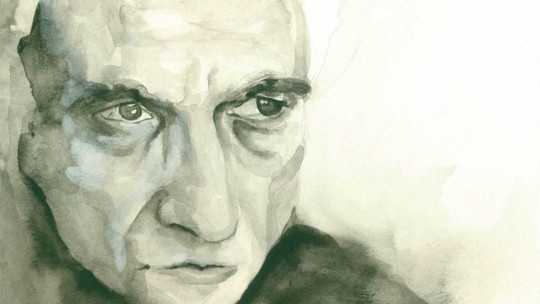
Father of Deconstructivism, Jacques Derrida is surely the most controversial and influential philosopher and writer of the 20th century Born in Algeria in 1930, he went into exile in Paris to begin his academic studies.
This author revolutionized all the bases of Western structuralism and grammatical architecture, giving rise to various neologisms and terminologies that would bring him worldwide recognition.
Derrida was also an academic and political activist, he opposed any type of war and was positioned in favor of human rights (he himself had to go into exile due to his condition as a Sephardic Jew) and made notable appearances against the Vietnam War. and the Iraq War of 2003.
Jacques Derrida’s phrases to reflect on
In this article we are going to guide you about the thoughts of the Algerian author with some of his most famous phrases.
1. Politics is the dirty game of discrimination between friends and enemies
This is how the author described his way of seeing politics. He experienced that discrimination firsthand.
How many of these have you been "meaning to read" for months?
- 1
 TarcherThe Artist's Way30th Anniversary EditionListen Free On Audible
- 2
 Undercover Publishing HouseStop Letting Everything Affect YouHow to break free from overthinking, emotional chaos, and self-sabotage.Listen Free On Audible
- 3
 MajostaDon't Believe Everything You ThinkWhy Your Thinking Is The Beginning & End Of Suffering (Beyond Suffering)Listen Free On Audible
2. Translation itself is writing. This is productive writing inspired by the original text
For Derrida, translation was not literally copying into another language, but rather enriching the original text.
3. We must forget the Manichaean logic of truth and lies, and focus on the intentionality of those who lie
This phrase represented a conceptual revolution between the art of lying and the goodness of the truth.
4. The singularity of the other being questioned is increasingly being betrayed
He thus denounced the interpretation and manipulation that was made of people when analyzing their ideas.
5. I have verified that frontal criticism always ends up being appropriated by the discourse it is intended to combat.
Sometimes people are this incoherent and cynical, criticizing what we often defend.
6. The method is a technique, a procedure to obtain control of the path and make it viable
Every structure needs guidelines and guidelines to follow, if it wants to be well understood.
7. Each book is a pedagogy designed to train its reader
Books are not only entertainment, they are also a way to learn.
8. The question of architecture is in fact the problem of place, of taking place in space
Space is limited and architecture is the technique to organize and redistribute it.
9. We know that the political space is that of lies par excellence
Derrida always saw politics as a relentless tool of manipulation and contrary to the truth.
10. Deconstruction is not only the technique of a “disrupted construction”, since it conceives the idea of construction
This is how the author defended his terminology, which many misinterpreted due to his critical spirit.
11. If the translator does not copy or restore an original it is because it survives and is transformed
A reflection on literature.
12. What is relevant in a lie is never its content, but the purpose of the liar
Jacques always placed emphasis on the final objective of the lie.
13. A lie is not something that opposes the truth, but rather lies in its purpose.
Once again, with this phrase he justified the use of lying according to its intention.
14. The translation will actually be a moment of his own growth, he will complete himself in it by growing
The translation technique is not only based on literally copying the original into another language, it is also used to enrich it.
15. The decisive thing is the damage it causes to the other, without which lying does not exist.
Derrida was a thinker and analyst between relationships with one another, and how they are affected.
16. It could be said that there is nothing more architectural and at the same time nothing less architectural than deconstruction
Deconstruction was a controversial and controversial concept It was not defined in a single way. He sinned in what he criticized equally.
17. The establishment of a place that until then had not existed and that is in accordance with what will happen there one day: that is the place
The place as a phenomenon invented by the hand of man, and consensual at the same time.
18. When the original of a translation demands a complement, it is because it was not originally there without deficiencies, full, complete, total
Original texts are often poorly translated due to poor linguistic or grammatical expression.
19. The modern political lie no longer hides anything behind it, but is based on what everyone knows.
Political lies reflect the lies of fellow citizens.
20. Mass productions do not train readers, but rather presuppose in a phantasmatic way an already programmed reader
With this phrase Jacques Derrida criticized the structure and hierarchy of book publishers, as an indoctrinating tool.
21. The path is not a method; this should be clear
The way forward is not a method, the technique that follows the path is.
22. Every architectural space, every habitable space, starts from a premise: that the building is located on a path
This is the relationship that Jacques makes between the path and the architectural, as a technique to achieve it
23. The difficulty of defining the word deconstruction comes from the fact that all the syntactic articulations that seem to lend themselves to that definition are also deconstructable.
Even the very concept of deconstructing can be easily dismantled and invalidated
24. There is no building without paths leading to it, nor are there buildings without interior routes, without corridors, stairs, corridors or doors
Every building has multiple paths, whether for entry, exit or orientation.
25. Deconstruction is neither analysis nor criticism, and the translation should take this into account
Derrida insisted on the lack of confrontation that his theory intended, and thus many followers misinterpreted it.
26. It is not enough to say that deconstruction cannot be reduced to a mere methodological instrumentality, to a set of rules
So diffuse and complex was the very definition of the term deconstruction
27. It is also necessary to point out that deconstruction is not even an act or an operation
This is how Derrida tried to define his deconstructivism, as something abstract.
28. The very instance of the crisis (decision, choice, judgment, discernment) is one of the essential objects of deconstruction
Once again, the author highlighted the critical sense of his thesis
29. The desire for a new place, for galleries, corridors, for a new way of living, of thinking. It is a promise
The physical place is a set of desires and promises that, until they are fulfilled, are not effective.
30. Places are where desire can recognize itself, where it can dwell
As has been said repeatedly, a place is something consensual and agreed upon between a specific community in order to coexist.
31. All deconstruction takes place; It is an event that does not await deliberation, the organization of the subject, not even modernity.
More than a technique, Derrida referred to deconstruction as a literary event.
32. A community must assume and achieve architectural thinking
Architecture as a technique of social construction.
33. There is nothing that is present to itself independently of the other in the constitution of the world
Human interdependence was another of the topics that fascinated the philosopher.
34. I am at war against myself
Derrida was the first to recognize and assume contradictions, and often made self-criticism of himself.
35. I cried when it was time to go back to school shortly after I was old enough to be ashamed of such behavior
Jacques Derrida didn’t always like going to school and learning.
36. I wrote some bad poetry that I published in North African magazines, but while I retreated into this reading, I also led the life of a kind of young hooligan
He always maintained an attitude of self-criticism in everything he did, and he recognized it as such.
37. I dreamed of writing and models were instructing the dream, a certain language governed
Derrida thus affirmed that all of us, from the moment we begin to dream, are told how we have to do it.
38. Everything is arranged to be this way, this is what is called culture
Culture and values as something imposed, something that we must accept in order to survive.
39. If you ask me what I believe in, I don’t believe in anything
He often appeared diffuse and had unenlightening ideas.
40. I do everything possible or acceptable to escape this trap
Jacques was no illusionist. He did nothing that could not be empirically proven or disproven.
41. I never do things just for the sake of complicating them, that would be ridiculous
He always had a purpose when analyzing things. Like a path that guides us to a certain place.
42. The problem with the media is that they do not publish things as they are, but rather adapt them to what is politically acceptable
Jacques was also a detractor of the language used by the media, always adapting it according to his interests.
43. It doesn’t matter how the photo turns out. It is the gaze of the other that will give value
Interpretation, even of an image, is purely subjective. It all depends on how you look at it.
44. If a job is threatening, it is because it is good, competent and full of conviction
This is how the reaction stood out when one of his works was vetoed and/or firmly criticized.
45. My critics organize a series of obsessive cults with my personality
Some of Derrida’s academic colleagues paid more attention to him than to his works.
46. Every speech, poetic or oracular, carries with it a system of rules that define a methodology
Everything is ready and predisposed for us to say it in a concrete way.
47. I do not believe in the purity of languages
For this author, languages were a communication tool, not an identity symbol.
48. My staunchest opponents believe that I am too visible, too alive and too present in the texts
Sometimes Derrida got on his critics’ nerves, as he dismantled many of their works.
49. Nobody gets angry with a mathematician or a physicist who they don’t understand. You only get angry when you are insulted in your own language.
A curiosity that the Algerian author saw and that few of us highlight.
50. We are all mediators, translators
We always interpret what we are told, what we want to say or what is explained to us.
51. As long as there is a language, generalities come into play
It was the great criticism that Jacques made as a linguist.
52. Who says we were born only once?
He often blurted out phrases that went beyond logic.
53. Some authors get offended at me because they stop recognizing their field, their institution
This is how he explains the behavior of some colleagues who criticized him so much.
54. I have always had problems recognizing myself in institutionalized political language
Perhaps this is the best time to mention it: Derrida was a politically incorrect man, he always escaped from what others expected of him.
55. To this day, I continue to teach classes without having crossed the physical barrier. My stomach, my eyes and my anxiety all play a role. I haven’t left school yet
For Derrida the physical also counts. Apart from being an emotional being, he took into account the physical part to explain human behavior.
56. My years at the Ecole Normale were dictatorial. I was not allowed to do anything
He once again denounces how systematic and hierarchical everything is, especially teaching.
57. The boarding school years were a hard period for me. He was always nervous and had problems of all kinds.
He was unfairly treated for being Jewish and for his Arab origins.
58. What I cannot see about myself, the Other may see
The other is everything else after the self, ours, and we cannot get rid of it.
59. Everything I miss about myself, I am able to observe in others
He was always a humanist philosopher, and he had others as a reference when looking for their shortcomings.
60. We must wait for the Other to come as justice and if we want to have the possibility of negotiating with him, we must do so with justice as a guide
Jacques Derrida was, above all, a just and equitable man.
61. God does not give the law but only gives a meaning to justice
This is how the author interprets the divine commandments
62. Those of us who are entrusted with power must frame ourselves within responsible justice.
Social justice is one of the basic principles for a cohesive society.
63. Philosophy, today, runs the serious risk of being forgotten
A phrase that is still valid.
Use this citation format to reference the article clearly and help readers find the original source.
PsychologyFor. (2024). 63 Famous Phrases from the Philosopher Jacques Derrida. PsychologyFor. https://psychologyfor.com/63-famous-phrases-from-the-philosopher-jacques-derrida/