


See more of our articles in your search results.
Most therapeutic approaches ask you to look backward — to examine your childhood, unpack your trauma, and trace the roots of your suffering. Reality therapy asks a different question: What do you want right now, and what are you doing to get it? Developed by psychiatrist William Glasser in the 1960s, reality therapy is a present-focused, action-oriented approach that places personal responsibility and conscious choice at the heart of psychological wellbeing. It is not about blaming yourself for your struggles. It is about recognizing — often for the first time — that you have far more control over your life than you have been led to believe.
Glasser’s core conviction was radical for its time and remains quietly revolutionary today: human beings choose their behavior, even when it feels involuntary, and the path to a more fulfilling life runs directly through that recognition. Rather than diagnosing mental illness as something that happens to people, Glasser reframed most psychological suffering as the result of unsatisfying relationships and unmet psychological needs. The solution, in his view, was not medication or years of uncovering the past — it was learning to make better choices, right now, in service of the life you genuinely want.
Reality therapy is practiced today in counseling, schools, correctional facilities, addiction recovery programs, and organizational settings across the world. Its influence extends far beyond the therapy room. Understanding Glasser’s framework — his Choice Theory, the five basic needs, and the WDEP system — offers any person a practical lens for examining their own behavior, their relationships, and the gap between where they are and where they want to be.
This article explores reality therapy in depth: its theoretical foundations, how it works in practice, who it helps, how it compares to other approaches, and what decades of research say about its effectiveness.
Who Was William Glasser and Why Did He Reject Traditional Psychiatry?
William Glasser (1925–2013) was an American psychiatrist who trained in the conventional psychoanalytic tradition before growing disillusioned with what he saw as its fundamental passivity. Working with delinquent adolescent girls at the Ventura School in California in the early 1960s, Glasser noticed that the standard approach — exploring unconscious drives and past experiences — did little to change the behaviors that were landing these young women in trouble. What seemed to work, he observed, was direct conversation about what they were doing, whether it was working, and what they genuinely wanted from their lives.
How many of these have you been "meaning to read" for months?
- 1
 New Harbinger PublicationsThe Untethered SoulThe Journey Beyond YourselfListen Free On Audible
- 2
 Sourcebooks, Inc.My Calm Down BookA Sensory Book to Help Kids Calm Their BodiesListen Free On Audible
- 3
 FINGERPRINT with FP logoMeditations (Deluxe Hardbound Edition)FINGERPRINT with FP logoListen Free On Audible
In 1965, Glasser published Reality Therapy: A New Approach to Psychiatry, which challenged the prevailing psychiatric model in several fundamental ways. He rejected the concept of mental illness as a medical condition that excused irresponsible behavior. He rejected the emphasis on the unconscious and the past as primary drivers of present behavior. And he rejected the therapeutic stance of detached neutrality, arguing instead that therapists should build warm, genuine relationships with clients while holding them accountable for their choices.
Glasser was particularly critical of what he called external control psychology — the widespread human habit of trying to control others through punishment, reward, criticism, and coercion. He argued that this instinct, however natural it feels, is the primary destroyer of relationships and, by extension, of mental health. His later work developed this critique into a comprehensive theory called Choice Theory, published in 1998, which provides the philosophical backbone of reality therapy as it is practiced today.
Glasser also founded the William Glasser Institute (now the William Glasser International organization), which has trained thousands of practitioners worldwide and spread reality therapy principles into education through his related Quality School model.
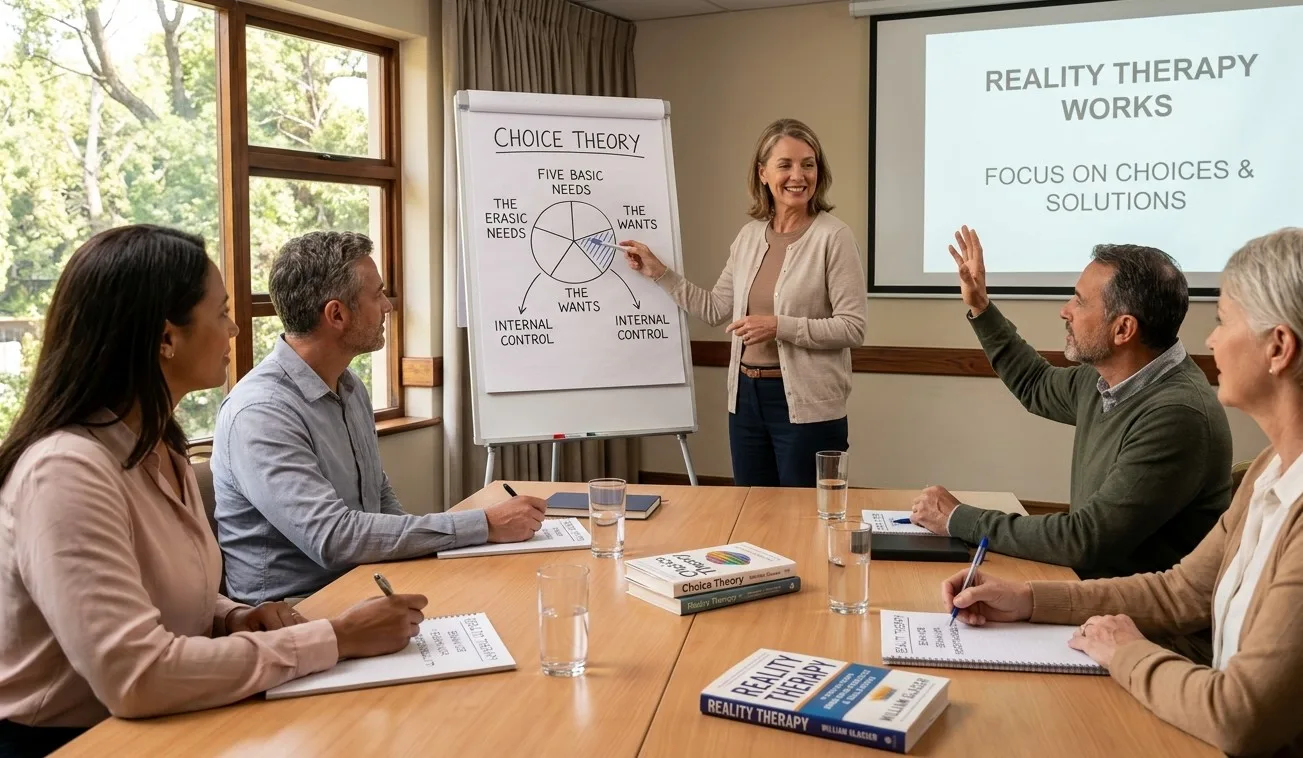
Choice Theory: The Foundation That Makes Reality Therapy Work
Choice Theory is the theoretical framework that underpins reality therapy. Its central premise is straightforward: all human behavior is chosen, and we choose our behavior in an attempt to satisfy one or more of five basic psychological needs. We are not passive recipients of our circumstances. We are active agents, constantly generating behavior — including thoughts, feelings, and physiological responses — in pursuit of what we want.
This does not mean that people consciously decide to be depressed, anxious, or angry. Choice Theory’s insight is more subtle: Glasser argued that what we call depression, for example, is not something that happens to us like a virus — it is a behavioral strategy, often chosen outside conscious awareness, that serves a function. It may reduce the intensity of overwhelming anger, communicate distress to others, or provide a reason to withdraw from a situation that feels impossible. Understanding this reframe — that depressing is something a person does, not something done to them — is often unsettling at first, then profoundly liberating.
The Five Basic Needs in Choice Theory
According to Glasser, all human behavior is driven by five genetically encoded basic needs. These needs are universal, though their intensity varies from person to person:
- Survival: the need for physical safety, health, shelter, and reproduction. This is the biological foundation — the body’s drive to stay alive and functional.
- Love and belonging: the need for connection, intimacy, friendship, and community. Glasser considered this the most critical need for psychological health. Almost all mental suffering, in his view, traces back to an unsatisfying relationship or the absence of one.
- Power (or achievement): the need to feel competent, to be heard, to achieve, and to matter. This is not about domination — it is about the deep human drive for self-efficacy and recognition.
- Freedom: the need for autonomy, choice, and independence. People need to feel that they can direct their own lives, make their own decisions, and move through the world without being controlled.
- Fun: the need for play, laughter, learning, and enjoyment. Glasser linked fun closely to learning — the pleasure that comes from acquiring new skills and experiencing novelty.
These needs are often in tension with each other, and with the needs of people around us. A marriage may satisfy love and belonging while threatening freedom. A high-achieving career may fulfill power while starving fun. Much of human psychological conflict, in Choice Theory terms, is the friction between competing needs — or between one person’s needs and another’s.
The Quality World
Glasser introduced another key concept: the Quality World. This is a personal mental album — a collection of images, people, beliefs, and experiences that each person perceives as deeply need-satisfying. Your Quality World contains the image of the partner you want, the career you dream of, the version of yourself you aspire to be. It is entirely subjective and deeply personal.
Behavior, in Choice Theory, is always an attempt to bring the real world into alignment with the Quality World. The gap between what we have and what we want — between perceived reality and the Quality World image — generates the drive to act. When that gap feels permanent or unbridgeable, it generates suffering.
How Reality Therapy Sessions Actually Work: The WDEP System
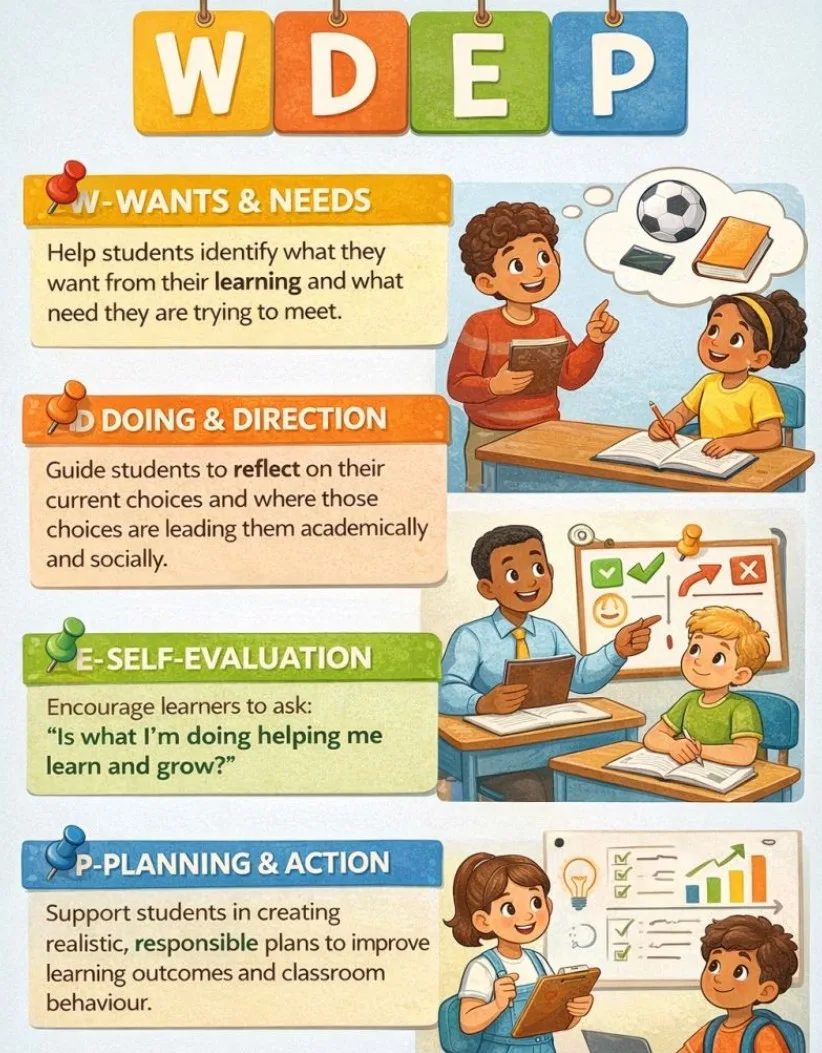
Reality therapy has a practical, structured methodology that distinguishes it from more open-ended therapeutic approaches. The primary tool is the WDEP system, developed by Robert Wubbolding, one of Glasser’s closest collaborators and the author of Reality Therapy for the 21st Century. WDEP stands for Wants, Doing, Evaluation, and Planning.
The WDEP system is not a rigid script. It is a flexible conversational framework that a skilled therapist weaves naturally through sessions, always within the context of a warm, supportive therapeutic relationship.
W — Wants
The therapist begins by exploring what the client truly wants — from their life, from their relationships, from this therapy, from themselves. This goes deeper than surface desires. Through skilled questioning, the therapist helps the client clarify the needs behind the wants: What does getting that job really mean to you? What would having that relationship give you that you don’t have now?
This stage often surfaces the gap between what the client says they want and what they are actually pursuing. It also helps the client identify Quality World images they may never have articulated consciously before.
D — Doing
The therapist then focuses on what the client is currently doing — the total behavior they are generating right now. Glasser’s concept of total behavior is important here: it encompasses four inseparable components — acting, thinking, feeling, and physiology. All four are happening simultaneously, but we have the most direct control over acting and thinking, and least direct control over feeling and physiology.
The “Doing” exploration is deliberately non-blaming. It is not “what have you done wrong?” but “what are you doing?” — a neutral inventory of current behavior patterns. This includes not just actions but self-talk, avoidance patterns, and habitual responses.
E — Evaluation
This is the pivotal step, and the one that most distinguishes reality therapy from approaches that focus purely on empathy and validation. The therapist helps the client evaluate whether their current behavior is actually getting them what they want. Is what you are doing working?
The evaluation is always the client’s own — the therapist does not judge. But the therapist does ask direct, honest questions that make it hard for the client to avoid confronting the ineffectiveness of certain patterns. Is staying in bed all day bringing you closer to the life you want? Is snapping at your partner helping you build the connection you need? The evaluation stage creates the internal motivation for change by making the cost of current behavior visible.
P — Planning
Once a client has evaluated that their current behavior is not getting them what they want, the work shifts to planning — creating specific, concrete, achievable plans to behave differently. Wubbolding describes effective reality therapy plans using the acronym SAMIC: plans should be Simple, Attainable, Measurable, Immediate, and Controlled by the client.
Plans in reality therapy are small and actionable, not grandiose. Instead of “I will fix my marriage,” the plan might be “I will ask my partner one genuine question every evening this week and listen without interrupting.” The emphasis on client control is critical — plans that depend on other people’s behavior are not reality therapy plans, because the client cannot control others, only themselves.
The Therapeutic Relationship in Reality Therapy: Involvement as Medicine
One of Glasser’s most important — and often underappreciated — contributions was his insistence on the therapeutic relationship as the active ingredient of therapy. He called this involvement, and he considered it the prerequisite for everything else in reality therapy.
Without a genuine, warm, respectful connection between therapist and client, the WDEP framework is just a set of questions. With it, those same questions become transformative. Glasser was emphatic that the therapist must be personally present — not hiding behind professional detachment, not coldly evaluating the client, but genuinely caring about their wellbeing while refusing to do the work of living for them.
This warmth is always paired with accountability. A reality therapy practitioner will not accept excuses or join the client in blaming others, circumstances, or the past. The combination — genuine warmth plus honest accountability — mirrors what the healthiest human relationships feel like. For many clients, especially those whose early relationships were characterized by either coldness or enabling, this therapeutic relationship is itself a corrective experience.
Reality Therapy for Addiction and Substance Use
Reality therapy has a long history in addiction treatment, stemming in part from Glasser’s early work and his conviction that addiction is not a disease but a behavioral choice made in the attempt to satisfy unmet needs — particularly love and belonging, freedom, and power.
This framing is controversial. Many addiction specialists and researchers emphasize the neurobiological dimensions of substance dependence, and the disease model of addiction has significant evidence and advocacy behind it. Reality therapy does not deny the physiological aspects of withdrawal and dependence, but it challenges the narrative that the addict is powerless — a narrative Glasser believed was itself harmful, as it removed the sense of agency that is essential for sustained recovery.
In addiction settings, reality therapy explores what needs the substance is meeting for the person: relief from anxiety, a sense of belonging within a using community, escape from unbearable circumstances, or the one reliable source of pleasure in an otherwise joyless life. The WDEP process then works to identify alternative behaviors that can meet those same needs without the destructive costs.
Research has supported the utility of this approach. A study by Lawrence (1987), cited extensively in Wubbolding’s work, found meaningful reductions in substance use and improvements in psychological functioning among participants who received reality therapy-based treatment compared to control groups.

Reality Therapy in Schools: The Glasser Quality School Model
Glasser extended his principles into education through what he called the Quality School model, described in his 1990 book The Quality School. His argument was that traditional schools, built on external control — grades, punishments, and coercion — destroy students’ motivation and damage their sense of power, freedom, and belonging. The result is the epidemic of disengagement, behavioral problems, and underachievement that characterizes so many educational systems.
In a Glasser Quality School, students are partners in their own education. Learning is connected explicitly to students’ Quality World images — why does this matter to you? How does this serve your goals? Evaluation focuses on quality and self-assessment rather than punitive grading. Teachers build genuine relationships with students, and discipline focuses on problem-solving rather than punishment.
School counselors trained in reality therapy use the WDEP framework with students in crisis — not to lecture them, but to help them evaluate whether their current behavior is serving their genuine interests and to plan more effective alternatives. This approach has been implemented in schools across the United States, Australia, and South Korea, among other countries, with documented improvements in school climate, attendance, and student wellbeing.
How Reality Therapy Differs from CBT, Psychoanalysis, and Person-Centered Therapy
| Approach | Key Difference from Reality Therapy |
|---|---|
| Psychoanalysis / Psychodynamic | Focuses on unconscious processes and past experiences as primary drivers of present behavior. Reality therapy is present-focused and rejects the primacy of the past. |
| Cognitive Behavioral Therapy (CBT) | Both are present-focused and action-oriented. CBT targets maladaptive thought patterns specifically; reality therapy targets total behavior and unmet needs. CBT has a larger evidence base for specific disorders. |
| Person-Centered Therapy (Rogers) | Shares emphasis on the therapeutic relationship but is non-directive. Reality therapy is more structured and explicitly challenges the client’s behavior choices through the WDEP process. |
| DBT (Dialectical Behavior Therapy) | DBT was developed specifically for borderline personality disorder and emphasizes distress tolerance and emotion regulation skills. Reality therapy is broader in application and more focused on needs and planning. |
| ACT (Acceptance and Commitment Therapy) | ACT emphasizes psychological flexibility and accepting difficult internal experiences. Reality therapy is more behaviorally directive and less focused on mindfulness-based acceptance. |
It is worth noting that reality therapy is not mutually exclusive with these approaches. Many therapists integrate elements of reality therapy — particularly the WDEP process and Choice Theory’s needs framework — with CBT techniques, motivational interviewing, or person-centered principles.
What the Research Says About Reality Therapy’s Effectiveness
Reality therapy has a meaningful but still developing evidence base. It is not yet classified as an empirically supported treatment (EST) under the same criteria as CBT for specific disorders, partly because its research tradition has historically emphasized case studies, qualitative research, and practitioner-reported outcomes rather than large-scale randomized controlled trials.
However, the existing research is encouraging across a range of populations and settings. Robert Wubbolding’s comprehensive reviews of the literature identify consistent positive outcomes in studies examining reality therapy’s application to:
- Adolescent behavioral problems — multiple studies show reductions in disruptive behavior and improvements in academic engagement
- Substance use disorders — studies in correctional and community settings show improvements in recovery outcomes and reduced relapse
- Self-esteem and locus of control — reality therapy consistently shifts clients toward a more internal locus of control, which is itself associated with better psychological health outcomes
- Correctional populations — one of reality therapy’s most established application areas, with studies showing reductions in recidivism
- School counseling — research in South Korea has produced a particularly robust body of evidence, with multiple controlled studies supporting reality therapy’s effectiveness in school settings
Kim (2002) conducted a meta-analysis of 21 Korean studies on reality therapy and found an average effect size of 0.80 — a large effect — across outcomes including self-esteem, internal locus of control, and relationship quality. While this meta-analysis was conducted within a specific cultural context, its findings are consistent with the broader pattern of positive outcomes reported in Western research as well.
Critics of reality therapy note that its rejection of psychiatric diagnosis and the disease model of mental illness, while philosophically interesting, may lead practitioners to underestimate the biological dimensions of conditions like schizophrenia, bipolar disorder, and severe depression. Most contemporary reality therapy practitioners take a more nuanced stance, acknowledging biological contributions while maintaining the emphasis on behavioral choice and personal agency.

Practical Takeaways from Reality Therapy You Can Use Today
You do not need to be in therapy to begin applying the principles of reality therapy to your own life. The framework offers several immediately actionable tools.
Ask the WDEP questions yourself. Sit with a current problem and work through the framework honestly: What do I genuinely want here? What am I actually doing right now? Is what I’m doing getting me what I want? What is one small, concrete thing I could do differently tomorrow?
The power of this sequence is in its honesty. Most of us know, on some level, that certain behaviors are not working — but we rarely pause to confront that gap between what we want and what we are doing. Reality therapy makes that confrontation gentle but unavoidable.
Identify which need is being unmet. When you feel anxious, irritable, sad, or stuck, try to trace it to the five basic needs. Is this a love and belonging problem? A power/achievement deficit? A freedom issue? Naming the underlying need often clarifies what action would actually help, rather than reaching for the nearest available relief (which may be satisfying one need while undermining another).
Notice external control habits. Glasser’s concept of external control psychology — the impulse to criticize, coerce, threaten, or reward others into behaving the way you want — is worth examining in your own relationships. Every time you feel the urge to control someone else’s behavior, ask: how is this affecting our relationship? What need am I trying to meet? Is there a different approach that honors both my needs and theirs?
Keep plans small and within your control. When making commitments to change, follow Wubbolding’s SAMIC criteria. A plan that depends on someone else changing is not a plan — it is a wish. A plan that is so large it feels overwhelming will not be executed. Small, self-controlled, specific commitments made consistently over time are what actually change lives.
Who Can Benefit Most from Reality Therapy?
Reality therapy tends to be particularly well-suited to people who are ready to take action and who respond well to a direct, structured therapeutic style. It is often less suited, at least as a standalone approach, to people in acute psychological crisis, severe dissociation, or who need extensive trauma processing before behavioral change is possible.
Populations and contexts where reality therapy has shown particular promise include:
- Adolescents and young adults struggling with identity, motivation, and self-direction
- Individuals in recovery from substance use disorders
- People dealing with relationship difficulties, particularly patterns of codependency or external control
- Individuals in correctional or court-mandated settings where motivation for traditional therapy may be low
- Students and school counseling contexts
- Anyone who feels stuck in patterns they know are not working but cannot seem to change
- Organizations and leadership development contexts where Choice Theory’s needs framework and external control critique offer powerful tools
Reality therapy is also valuable for people who have been in more exploratory therapies for some time and are ready to shift from insight to action. Understanding why you do what you do is valuable; learning what to do differently is equally necessary — and reality therapy specializes in that second step.
FAQs about Reality Therapy
What is reality therapy in simple terms?
Reality therapy is a present-focused approach to counseling developed by psychiatrist William Glasser. Its core idea is that all human behavior is chosen — consciously or not — in an attempt to meet five basic psychological needs: survival, love and belonging, power, freedom, and fun. The therapy helps people examine whether their current choices are actually meeting those needs, and supports them in developing more effective plans. Rather than exploring the past or diagnosing mental illness, reality therapy asks: What do you want? What are you doing? Is it working? What will you do differently?
How does reality therapy differ from other types of therapy?
Reality therapy is distinctive in several ways. It is present-focused rather than past-focused, unlike psychodynamic approaches. It emphasizes behavioral choice and personal responsibility rather than symptoms and diagnosis. It is more directive and structured than person-centered therapy. While it shares CBT’s action orientation, it frames problems in terms of unmet needs rather than cognitive distortions. Reality therapy also has a strong philosophical foundation — Choice Theory — which offers a comprehensive model of human motivation that extends beyond the therapy room into education, relationships, and organizational life.
What are the five basic needs in Choice Theory?
According to William Glasser’s Choice Theory, all human behavior is driven by five genetically encoded basic needs. Survival covers physical safety and health. Love and belonging encompasses connection, intimacy, and community — Glasser considered this the most critical for psychological health. Power (or achievement) is the need to feel competent, recognized, and effective. Freedom is the need for autonomy and self-direction. Fun includes play, humor, and the pleasure of learning. These needs are universal, though their relative intensity varies between individuals. Most psychological suffering, in Glasser’s view, traces back to one or more of these needs being chronically unmet.
What is the WDEP system in reality therapy?
The WDEP system, developed by reality therapy practitioner Robert Wubbolding, is the primary practical framework used in reality therapy sessions. W stands for Wants — exploring what the client genuinely wants from their life and relationships. D stands for Doing — examining what the client is currently doing, including their thoughts, actions, and feelings. E stands for Evaluation — helping the client honestly assess whether their current behavior is getting them what they want. P stands for Planning — collaboratively developing specific, achievable, client-controlled plans to behave more effectively. The WDEP process is guided by the therapist but driven by the client’s own insight and motivation.
Is reality therapy effective? What does research show?
Reality therapy has a growing evidence base, though it is not yet classified as an empirically supported treatment under the same criteria as CBT. Research consistently shows positive outcomes for self-esteem, internal locus of control, substance use recovery, adolescent behavioral problems, and school counseling applications. A meta-analysis by Kim (2002) examining 21 Korean studies found a large average effect size of 0.80 across multiple outcome measures. Reality therapy has a particularly well-established track record in school settings and correctional populations. Critics note that its evidence base would benefit from more large-scale randomized controlled trials, particularly for specific clinical disorders.
Can I use reality therapy principles without seeing a therapist?
Yes — many of the core principles of reality therapy are highly applicable to everyday life without formal therapeutic intervention. You can use the WDEP framework informally by regularly asking yourself: What do I genuinely want in this situation? What am I actually doing right now? Is my behavior getting me what I want? What is one specific, realistic thing I could do differently? You can also use the five basic needs as a diagnostic lens — when you feel stuck or distressed, identifying which need is unmet often clarifies what action would help. Glasser’s concept of external control psychology offers a particularly powerful tool for examining how control-based habits may be damaging your most important relationships.
What conditions or populations is reality therapy best suited for?
Reality therapy is particularly well-suited to adolescents and young adults, individuals in substance use recovery, people dealing with relationship difficulties or codependency patterns, court-mandated or correctional populations, and anyone who feels stuck in patterns they know are not working. It is widely used in school counseling and has strong applications in organizational and leadership development contexts. Reality therapy tends to work best with people who are ready for action and respond well to a structured, direct style. It may be less suited as a standalone approach for people in acute crisis, severe trauma, or conditions with strong biological components that require medical management alongside psychological support.
Bibliography
- Glasser, W. (1965). Reality Therapy: A New Approach to Psychiatry. Harper & Row.
- Glasser, W. (1998). Choice Theory: A New Psychology of Personal Freedom. HarperCollins.
- Glasser, W. (1990). The Quality School: Managing Students Without Coercion. Harper & Row.
- Wubbolding, R. E. (2000). Reality Therapy for the 21st Century. Brunner-Routledge.
- Wubbolding, R. E. (2011). Reality Therapy: Theories of Psychotherapy Series. American Psychological Association.
- Kim, R. I. (2002). The effectiveness of reality therapy programs for personal growth: A meta-analysis of Korean studies. International Journal of Reality Therapy, 22(1), 25–29.
- Lawrence, D. H. (1987). The effects of reality therapy group counseling on the self-determination and self-esteem of secondary students. Journal of Reality Therapy, 6(2), 31–36.
- Corey, G. (2021). Theory and Practice of Counseling and Psychotherapy (10th ed.). Cengage Learning.
Use this citation format to reference the article clearly and help readers find the original source.
PsychologyFor. (2026). Reality Therapy by William Glasser. PsychologyFor. https://psychologyfor.com/reality-therapy-by-william-glasser/