

See more of our articles in your search results.
In the animal kingdom, the strongest is the one who survives. The survival of wild species is always complicated, given the numerous dangers that nature entails: predators, but also pathogens that can destroy entire communities.
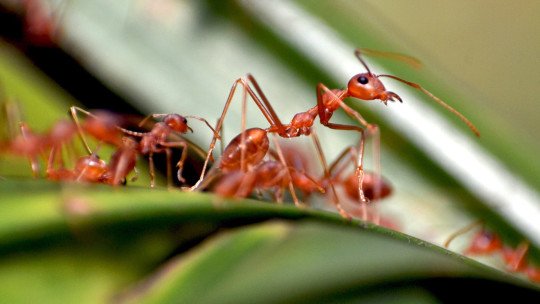
According to the recent study carried out by a team from the Department of Biology at the University of Oxford and published in Current Biology (see bibliography), black garden ants (Lasius niger) carry out a surprising survival strategy: they cannibalize larvae infected by pathogens at a time of incubation when the disease is not yet contagious. Below, we give you more details on the research that reveals how ants contain the spread of diseases through cannibalism of their young.
“Filial cannibalism”: a chilling survival strategy against diseases
All species, whether animals or plants, need to survive the environment in order to reproduce and replicate their genetic code. Poor adaptation inevitably leads to the death of the members and, in the long run, their extinction. For this reason, different species have developed a series of strategies to perpetuate themselves over time and not succumb to obstacles.
In some cases, these strategies can seem downright scary. And they are, from the point of view of our condition as humans. This is the case of the black garden ant (Lasius niger); specifically, their queens, who use the cannibalism of infected offspring to contain the spread of diseases that could be lethal to the colony.
This shocking strategy, called filial cannibalism by biology, is common in many species, particularly insects. The case of the black ant, studied by the Oxford team, is especially illustrative.
How many of these have you been "meaning to read" for months?
- 1
 S&S/Simon ElementProtocolsAn Operating Manual for the Human BodyListen Free On Audible
 - 2
 Undercover Publishing HouseStop Letting Everything Affect YouHow to break free from overthinking, emotional chaos, and self-sabotage.Listen Free On Audible
 - 3
 Grand Central PublishingIn the Shadow of EightSurviving the Reality of My ChildhoodListen Free On Audible
Why do queen ants cannibalize their sick young?
The behavior is shocking not only if we look at it from our human moral perspective, but also from a biological perspective. Because, in fact, in the animal kingdom most adults protect their young in some way. This is particularly common in mammals, the family to which we belong, whose bonds between mother and child are especially deep.
However, we should not think that this is the reality of the entire animal kingdom. In the case of the black ant, the aforementioned study has shown that, in fact, the founding queen of the colony can devour her own offspring if she detects that they are infected. According to the conclusions of the study, the objective of this cannibalism is diverse: on the one hand, the containment of diseases that can cause the budding colony to collapse; on the other hand, the use of nutrients from the larvae, which are reinvested in the next offspring.
The queen is alone
We must remember that the process of founding and consolidating a colony is not an easy task for the queen. At first, she is completely alone, at the mercy of the pathogens found in the environment. When some of the larvae become infected, the danger of the project failing is more than likely, since the disease can kill the rest of the offspring and even the queen herself.
Thus, the filial cannibalism exhibited by the founding queen is a survival strategy that allows the disease not to spread. In fact, it is a highly “refined” measure: The queen is able to detect which larvae are sick and which are not, and can also know if the infection is contagious or if it is still latent. If the infection is not yet contagious, the queen ant proceeds to devour the offspring.
On the other hand, if the pathogen has managed to reproduce enough in the larva’s body, the queen has a good chance of contracting the disease herself if she eats the infected offspring, so she then simply sprays them with an acidic poison. which it produces in its abdomen and which has antimicrobial properties, in a desperate attempt to protect the colony.
Nothing is wasted here
The other reason that researchers have found that drives the queen ant to cannibalize her infected offspring is the reuse of nutrients. We must bear in mind that, in this very early phase of colony construction, the queen does not leave her cubicle, so her access to food is frankly low. However, The queen must guarantee a profuse laying of eggs to provide the newly founded colony with inhabitants as soon as possible.
Here the reuse of larval protein comes into play. Through its ingestion, the queen uses the nutrients from the offspring condemned to death from the infection to produce new eggs that will produce healthy larvae.
The same case does not occur with worker ants, in which the aforementioned cannibalism is not observed. One of the possible explanations is that, by having access to the entrances and exits of the colony, workers can more easily get rid of infected larvae and corpses and, in addition, they have greater access to food.
Some data
Translated into data, the Oxford research confirmed the following: when larvae artificially infected by the pathogen Metarhizium were introduced into the queen’s nest, she cannibalized 92% of the sick offspring and only 6% of the healthy ones. What’s more, since the pathogen was still in a state of incubation, all the queens that had devoured the offspring survived. However, When infected larvae were introduced at a more advanced stage of the disease, 80% of the queens that ate them died shortly afterwards.
That is precisely the reason why, when the queen ant observes that her larvae are already in the contagion phase, she refrains from cannibalizing them and simply sprays them with the poisonous substance from her abdomen. In most of these cases, however, the guarantees of success are minimal.
The animal world and its survival strategies is a constant source of fascination and horror in equal parts. Many studies are still needed to shed light on the adaptive behaviors of many species, a topic that is always surprising.
Use this citation format to reference the article clearly and help readers find the original source.
PsychologyFor. (2024). Filial Cannibalism: How Ants Contain the Spread of Disease. PsychologyFor. https://psychologyfor.com/filial-cannibalism-how-ants-contain-the-spread-of-disease/