

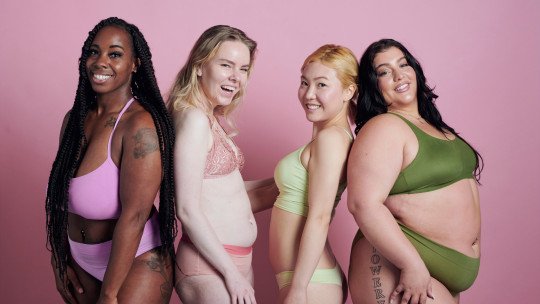
For centuries, human beings have been more or less enslaved by fashion and beauty standards. And, although both genders have suffered the consequences, various studies have confirmed that, even today, Women continue to be the people who have the most pressure (especially from the media) to have a “normative body”; that is, a body that “fits” with the prevailing canons of beauty.
This is the idea behind the two main movements that reject this aesthetic slavery: body positive and body neutrality. However, although both combat the pressures of normative beauty, they have significant differences that need to be known to decide which one we are better suited to. In today’s article we talk about body positive and body neutrality and make a comparison of the two current currents that defend the non-normative body.
Which is the best approach, body positive or body neutrality?
Of course, to answer this question we must know what exactly both currents consist of. Because, although they both fight against the pressure that society (and, specifically, the media and the internet) exerts on people in terms of aesthetics, their characteristics are remarkably diverse.
Both body positive and body neutrality draw from a common source, which is none other than the fight for the acceptance of bodies with all their diversity. In fact, its beginnings (especially those of body positivity) can be traced back to the 1960s, when, inspired by the fight for civil rights in the United States, a group of men and women began to demand the rights of women. fat people
The movement gained significant momentum in the following decade, when, in 1973, the Fat Underground appeared. All of this crystallized in the founding, in 1969, of the NAAFA (National Association to Advance Fat Acceptance), which focused on the discrimination suffered by fat people and attempted to guarantee their right to a dignified life.
As we can see, in these first years of protest, activists focused on fatness and the prejudices that society had about it. Later, With the appearance of the body positive concept (directly related to these demands of the 60s and 70s) all people who did not feel identified with the prevailing aesthetics were included in the fight.
Body positive or the (unconditional) love towards our body
The body positive movement has gained great momentum in recent years, especially since big brands like Victoria’s Secret or Calvin Klein opted to include all types of bodies in their advertising. It is about the demand for “real beauty” instead of the “ideal beauty” with which the population was (and is) pressured.
Thus, body positive aims for the inclusion of all bodies; But not only that, it is also committed to promoting unconditional love for one’s own body. The philosophy of this current is, therefore, that you must love your “flaws” and embrace them fully and safely.
But, as often happens, the original idea has been distorted. Currently, there are many who criticize body positivity for having “sold out” to consumerist society and having “becomed commercialized.” Not only that; He is also accused of having created a new pressure on women, that is: to love each other at all costs, despite not achieving it.
The answer to body positive: body neutrality or body acceptance
In response to the pressure that body positive was beginning to exert on some women, body neutrality appeared, championed by actress Jameela Jamil and which advocates full acceptance of one’s own body, but in a neutral way. In other words: you don’t have to love your flaws if you don’t want to, but don’t let them disturb you or undermine your mental health.
According to the British actress, it is necessary to “learn to escape from the body” and “stop thinking about it.” This is what he declared to Vogue Spain in 2021, forceful and firm. Body neutrality is not, therefore, loving your body unconditionally, but rather not focusing the hours of your day on it.
The idea is interesting, especially taking into account the results of certain investigations. According to a study by the Body Rebellion movement, carried out in 2017, women spend an average of 3.6 hours a day thinking about their bodies, which is equivalent to… almost two months a year! The study also confirmed that 89% of women recognize that their physical appearance affects their life satisfaction, and that 1 in 2 girls have problems with the self-perception of their body.
Today's Top Picks
Updated Daily


In conclusion, we think too much about our body and its “normativeness.” That’s what body neutrality focuses on: not so much on loving it above all things, but on not focusing on it as if it were the most important thing in the world on an aesthetic level. For standard bearers like Jamil, the most important thing is the functionality of the body, not its aesthetics.
So what is the best approach?
We have seen how both currents come from a reaction against normative beauty and the pressure it puts on people and, specifically, on women. In this sense, the intention is good, but are both options equally effective?
Body positive has several disadvantages. The first is that it is impossible to truly feel comfortable with all our appearance. And the second (and this is perhaps the most worrying) is that, on a psychological level, this option can cause even more pressure by imposing a love that we may not always be able to feel.
On the other hand, body neutrality proposes a more natural solution: accept that we are like this and that’s it, and not give more importance to our appearance than it really has. And the body, in terms of something aesthetic, is something that is linked to the society of the moment, so it is society that gives it the importance that, in reality, it does not have.
In any case, each person should choose the option with which they feel most comfortable. In this sense, there are no rules: The most important thing is not to put pressure on yourself and decide with total freedom which of the two ideas we fit with. And in this (as in so many things) sincerity is essential.
Use this citation format to reference the article clearly and help readers find the original source.
PsychologyFor. (2024). “Body Positive” and “Body Neutrality”: Which is the Best Approach?. PsychologyFor. https://psychologyfor.com/body-positive-and-body-neutrality-which-is-the-best-approach/