

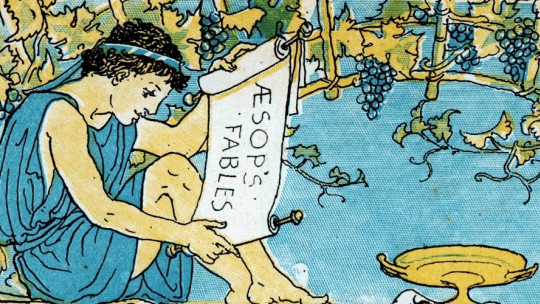
Few collections of stories have traveled as far, lasted as long, or taught as stubbornly as Aesop’s fables. Written — or more accurately, gathered and attributed — more than two thousand years ago in ancient Greece, these compact narratives have survived empires, languages, centuries of translation, and the relentless march of cultural change. They appear in the earliest literacy education in the Western world, in the moral philosophy of the Stoics, in the essays of Montaigne, and in the children’s books on shelves today. Their staying power is not accidental.
What makes Aesop’s fables remarkable isn’t their simplicity — it’s their precision. Each story uses the minimum number of elements required to make a specific point land as hard as possible. A tortoise. A hare. A race. A lesson about consistency that has outlasted virtually every piece of advice ever offered by any philosopher who lived in the same era. Aesop’s fables work because they bypass argument and go directly to image — and images, unlike propositions, are almost impossible to forget.
Aesop himself is a figure wrapped in uncertainty. Ancient sources describe him as a slave who lived in sixth-century BCE Greece, possibly from Phrygia or Ethiopia, whose gift for storytelling eventually brought him freedom and renown. Whether the man existed as described, or whether “Aesop” is a name attached to a tradition of oral storytelling that predates any single author, matters less than what the fables themselves have carried across millennia: a clear-eyed, often unsentimental view of human nature — rendered through the behavior of animals, gods, and ordinary people facing ordinary dilemmas.
This guide presents eleven of Aesop’s best and most enduring fables, each with its full story, its traditional moral, and a reflection on why the lesson still resonates in contemporary life.
1. The Tortoise and the Hare — Consistency Beats Talent Without Effort
A hare mocked a tortoise for his slow, plodding way of moving through the world. The tortoise, stung but unbowed, challenged the hare to a race. The hare accepted, amused. When the race began, the hare sprinted so far ahead so quickly that he decided to rest — surely there was no need to hurry. He lay down and fell asleep. The tortoise, meanwhile, kept moving. Slow, steady, unhurried. When the hare woke and ran to the finish line, he found the tortoise already there.
Traditional moral: Slow and steady wins the race.
This is perhaps the most cited fable in the collection, and it’s worth asking why it has lasted so long. The surface lesson — consistency matters more than raw speed — is straightforward enough. But the deeper observation is psychological: the hare lost not because he was slower, but because his talent made him complacent. Overconfidence in ability is one of the most reliable paths to underperformance that human psychology has ever documented, and Aesop identified it cleanly in a story that takes sixty seconds to read.
In contemporary terms, this fable appears in every conversation about habits, discipline, and long-term success. The person who shows up consistently — who writes a paragraph every day, who practices the instrument every morning, who builds the business one decision at a time — typically outperforms the brilliantly talented person who relies on bursts of effort. The tortoise is not inspiring because slow is better. The tortoise is inspiring because persistent is better.
2. The Fox and the Grapes — On Rationalization and Sour Grapes
A fox spied a bunch of ripe grapes hanging high on a vine. Hungry and eager, he leaped for them — and missed. He tried again. And again. Each attempt fell short. Finally, exhausted and unable to reach the grapes, the fox turned away with a dismissive flick of his tail. “They were probably sour anyway,” he said to himself, and walked on.
Traditional moral: It is easy to despise what you cannot have.
This fable gave the world one of its most durable idioms — “sour grapes” — to describe the human tendency to devalue what we cannot obtain. But the psychological insight runs deeper than the idiom suggests. What Aesop is describing, more than two thousand years before the field existed, is what cognitive psychology would later call rationalization: the process by which the mind constructs post-hoc justifications for outcomes driven by inability or failure, protecting the ego from the discomfort of honest disappointment.
The fox doesn’t decide the grapes are sour because he has tasted them. He decides they are sour because he cannot reach them — and admitting failure is more painful than revising desire. This is recognizable in every domain: the job applicant who decides the company “wasn’t a good fit anyway” after being rejected, the person who devalues the relationship they couldn’t sustain, the student who dismisses the course they failed as “not really useful.” The grapes remain where they are. The fox simply rewrites what they mean.
3. The Boy Who Cried Wolf — The Price of Dishonesty
A shepherd boy watched over his village’s flock on a hillside. Bored with the solitude, he decided to create some excitement. He ran down to the village shouting “Wolf! Wolf!” The villagers dropped what they were doing and rushed up the hill to help — only to find the boy laughing at having fooled them. He did it again. They came again, and again found it a lie. Then one afternoon, a wolf actually came. The boy screamed for help with all the desperation of genuine terror. The villagers heard him — and stayed where they were. The wolf destroyed the flock.
Traditional moral: Nobody believes a liar, even when he is telling the truth.
Of all Aesop’s fables, this one carries perhaps the most unsparing consequence. The boy doesn’t escape lightly — the punishment is proportional and irreversible. Trust, once eroded through repeated deception, doesn’t recover simply because the truth eventually arrives. The villagers’ skepticism isn’t cruelty; it’s the rational response to a pattern they have learned from experience.
The contemporary relevance of this fable extends well beyond individual dishonesty. Institutions, organizations, and individuals who communicate selectively, exaggerate for effect, or manufacture urgency to generate attention find themselves in exactly the shepherd boy’s position: the moment a genuine alarm needs to be heard, the audience has already learned not to listen. Credibility is not rebuilt by telling the truth once. It’s built — slowly — by telling it consistently.
4. The Ant and the Grasshopper — Preparation, Pleasure, and Consequences
Through the long, warm summer, the grasshopper sang and played, enjoying every moment of abundance. The ant, working nearby, spent the season carrying food to its underground store — grain by grain, day by day. The grasshopper mocked the ant’s industriousness. Why work so hard when there was music to be made and sun to enjoy? When winter came, the grasshopper was cold and hungry, its summer stores long exhausted. It went to the ant to beg for food. The ant asked what the grasshopper had done during summer. “I sang,” the grasshopper replied. “Then dance now,” said the ant, and closed the door.
Traditional moral: There is a time for work and a time for play.
This fable has generated more debate than almost any other in the collection, precisely because its moral isn’t as comfortable as it first appears. The ant’s final response is cold. Not wrong, perhaps — but cold. And this is part of what makes the fable sophisticated: it doesn’t present the ant as a warm role model, only as a survivor. The lesson isn’t that pleasure is wrong. It’s that pleasure taken at the expense of preparation has a cost that arrives reliably, regardless of how good the summer was.
The deeper psychological tension in this fable is between present enjoyment and future security — a conflict that behavioral economics has spent decades studying under the label of temporal discounting. The grasshopper isn’t stupid. It simply weights the present more heavily than the future in a way that feels natural and then proves catastrophic. Most people recognize both the ant and the grasshopper in themselves.
5. The Lion and the Mouse — Why Every Kindness Has Value
A lion caught a mouse that had inadvertently disturbed its rest. As the lion prepared to eat it, the mouse begged for its life — promising that someday, somehow, it would repay the kindness. The lion, amused that such a small creature imagined it could ever help such a powerful one, laughed and let it go. Some time later, hunters caught the lion and bound it with ropes to a tree. The mouse heard the lion’s roars, came, and gnawed through the ropes. The lion was free.
Traditional moral: No act of kindness, however small, is ever wasted.
This fable operates on several levels simultaneously. On the surface, it’s a story about the value of mercy — the lion’s willingness to release the mouse is repaid directly. But it’s also a story about the dangers of underestimating what appears insignificant. The lion’s initial laughter at the mouse’s promise isn’t malicious — it’s a failure of imagination. The idea that a mouse could ever matter to a lion seems absurd until the moment it isn’t.
The practical wisdom here extends naturally to how people treat those with less apparent power, status, or resources. The colleague who seems junior, the contact who seems peripheral, the person who appears to have nothing useful to offer — the fable gently insists that this assessment is frequently wrong. Kindness offered without calculation, to people whose value isn’t immediately apparent, is not naivety. It is, the fable suggests, simply accurate about how networks of reciprocity actually function over time.
6. The Crow and the Pitcher — Ingenuity in the Face of Adversity
A crow, dying of thirst on a hot day, found a pitcher with water at the bottom — but the water level was too low to reach with its beak. The crow tried tipping the pitcher. Too heavy. It tried reaching deeper. Too short. Then it noticed stones lying nearby. The crow picked up a stone and dropped it into the pitcher. Then another. And another. Slowly, the water level rose, stone by stone, until the crow could finally drink.
Traditional moral: Little by little does the trick.
This is one of Aesop’s most optimistic fables — and one of the most psychologically interesting. The crow doesn’t have the physical ability to solve its problem directly. What it has is the capacity to think around the problem. Rather than abandoning the pitcher, rather than exhausting itself in futile direct attempts, it identifies what it can do — drop a stone — and repeats it until the indirect approach achieves what the direct one couldn’t.
The fable is often cited in discussions of creative problem-solving, persistence, and lateral thinking. The crow’s solution is not obvious. It requires the ability to recognize that an action without immediate effect (dropping a single stone) is still worth taking because of what it accumulates toward. This is a sophisticated cognitive move — and the fable presents it through a bird, which suggests Aesop understood that wisdom is not always where we expect to find it.
7. The Wolf in Sheep’s Clothing — On Deception and Hidden Motives
A wolf found a sheepskin and draped it over himself. Disguised as a sheep, he entered the flock and moved among them undetected. The shepherd, seeing only sheep, locked the entire flock — including the wolf — into the pen for the night. Later that evening, the shepherd returned to the pen wanting lamb for his supper. Reaching in darkness for an animal, he grabbed the wolf by mistake and killed it.
Traditional moral: Appearances can be deceptive — and deception often destroys the deceiver.
What makes this fable more interesting than its surface lesson is its ending. The wolf is not caught through vigilance, cleverness, or the sheep recognizing the disguise. It’s caught because its own deception places it in the wrong category at the wrong moment. The sheep’s clothing saves the wolf from detection — and kills it anyway. The deception that enabled entry ultimately enabled destruction.
This ironic structure — the deceiver undone by the very mechanism of their deception — recurs throughout literature and history. The more contemporary lesson may be about the hidden costs of sustained inauthenticity: maintaining a false identity requires ongoing effort, and the longer it’s maintained, the more thoroughly it becomes a trap. The wolf gets what it wanted in the short term and pays for it in the most absolute way possible.
8. The Goose That Laid the Golden Eggs — The Destruction of Impatience
A farmer discovered that his goose laid a golden egg each morning. Every day, one egg. The farmer grew wealthy — but not wealthy enough, and not fast enough. He became convinced that the goose must contain an enormous supply of golden eggs inside. If he could have them all at once, he’d be immediately rich beyond measure. He killed the goose and cut it open. Inside, he found nothing — just the ordinary anatomy of an ordinary goose. He had destroyed the source of all his wealth for the promise of more.
Traditional moral: Greed destroys the source of good fortune.
This is Aesop at his most economically astute. The farmer isn’t unintelligent — his reasoning has a logic to it. If one egg per day comes from the goose, surely the goose is the source, and if the source could be accessed directly, the yield would be far greater. What the farmer fails to understand is that the process is the asset, not the product. The daily egg is not a distribution from a fixed reserve. It’s the output of an ongoing, living system — one that requires patience and care, not extraction.
The fable maps with striking accuracy onto virtually every domain where short-term thinking destroys long-term value: the company that cuts its R&D budget to hit quarterly earnings, the athlete who overtrain and breaks down before the season, the relationship that’s mined for what it can give rather than cultivated for what it can become. The golden eggs were real. The farmer had them every day. He simply couldn’t wait.
9. The North Wind and the Sun — Persuasion Beats Force
The North Wind and the Sun argued about which of them was stronger. They agreed on a contest: whichever could cause a traveler walking below to remove his cloak would be declared the more powerful. The North Wind went first. It blew with all its force — a fierce, cold, howling gale. The traveler pulled his cloak tighter and hunched against the wind. The harder the North Wind blew, the more tightly the traveler held on. Then the Sun took its turn. It shone, gently and warmly, growing gradually brighter. The traveler relaxed. He loosened the cloak. Then he took it off entirely and sat down to enjoy the warmth.
Traditional moral: Persuasion is more effective than force.
This fable is one of the most sophisticated in the collection because it doesn’t simply say force is wrong — it demonstrates precisely why it fails in this context. The North Wind’s approach produces resistance proportional to the force applied. This is not a moral observation — it’s a behavioral one. When people feel coerced, threatened, or overpowered, their natural response is to resist more fiercely, not to comply. The traveler doesn’t loosen the cloak to spite the wind; he tightens it because that’s what cold and threat produce.
The Sun succeeds not through greater power but through a fundamentally different approach: creating conditions in which the desired behavior becomes the traveler’s own natural choice. No force. No command. Just an environment in which taking off the cloak becomes what the traveler genuinely wants to do. This distinction — between compliance through coercion and behavior change through environmental design and persuasion — remains one of the most practically important insights in psychology, leadership, and education.
10. The Fox and the Crow — On Flattery and Vanity
A crow sat in a tree, holding a piece of cheese it had found. A fox walking below noticed the cheese and wanted it. Knowing he couldn’t reach it directly, the fox looked up at the crow and began to praise it lavishly — what a magnificent bird, what beautiful feathers, what a proud bearing. Surely, said the fox, a bird of such obvious distinction must also have a remarkable voice. If it would only sing, it would undoubtedly be acknowledged the queen of all birds. The crow, flattered and eager to demonstrate its voice, opened its beak to sing. The cheese fell. The fox caught it, thanked the crow for the gift, and walked away.
Traditional moral: Beware of flatterers — they seek to serve themselves, not you.
This fable is a masterclass in manipulation — and in the vulnerability that makes manipulation possible. The fox doesn’t deceive the crow about facts; it deceives it about itself. Flattery works because it offers people something they want: confirmation of their own worth. The crow wasn’t foolish in wanting to be admired — that desire is entirely human. The crow was foolish in allowing that desire to override its judgment at a moment when something valuable was at stake.
The lesson isn’t to distrust all praise — genuine appreciation and accurate positive feedback are valuable. The lesson is to notice when praise arrives precisely as you’re about to make a decision, and to ask whose interests that praise actually serves. The fox’s timing is not coincidental. Neither is the timing of most flattery that precedes a request.
11. The Two Pots — Knowing Your Own Limits
A river in flood carried two pots downstream — one made of earthenware, one of brass. The brass pot called out to the earthenware pot: come close to me, and I will protect you. The earthenware pot declined. “If I come close to you,” it said, “whether you strike me or I strike you, I will be the one to break. Better that we keep our distance.” The earthenware pot floated to the far bank safely. It knew what the brass pot, with the best intentions in the world, did not: that proximity to something harder than yourself is dangerous, regardless of goodwill.
Traditional moral: The weak should avoid close association with the powerful.
This is one of Aesop’s least sentimental fables, and one of his most honest. The brass pot is not a villain — it genuinely offers to help. The danger isn’t malice; it’s the difference in material nature between the two objects. When they collide — as objects in a flood inevitably do — the outcome is predetermined by what each is made of, not by what either intended.
The contemporary lesson has multiple applications. It describes the dynamics of unequal power in relationships — personal, professional, or institutional — where the more vulnerable party absorbs damage in collisions that the stronger party barely notices. It’s a fable about self-knowledge: the earthenware pot survives because it accurately understands its own fragility. And it’s a gentle but firm reminder that good intentions do not change material realities — knowing your own limits, and acting accordingly, is a form of wisdom, not weakness.
FAQs about Aesop’s Fables
Who was Aesop and did he really exist?
Aesop is a historical figure shrouded in considerable uncertainty. Ancient sources — including Herodotus, one of the earliest Greek historians — describe him as a slave who lived in ancient Greece around the sixth century BCE, renowned for his wit and storytelling. Some accounts place his origin in Phrygia, others in Ethiopia or Thrace. What is clear is that the fables attributed to him represent a tradition of oral storytelling that likely predates any single author and was compiled, modified, and attributed to the name “Aesop” over centuries. Whether the man existed precisely as described, or whether the name represents a tradition, the fables themselves have an internal consistency of voice and moral philosophy that has made them among the most enduring literature in the Western tradition.
What is the purpose of a fable?
A fable is a short narrative — typically featuring animals with human characteristics — designed to illustrate a moral lesson. The fable form works because it embeds abstract ethical observations in concrete, memorable images. The lesson of “don’t count your chickens before they hatch” is far more memorable and emotionally resonant when it’s attached to the story of a milkmaid daydreaming about her future riches and spilling her pail than when it’s simply stated as a principle. Fables operate through image rather than argument, which is why they survive translation, cultural change, and the test of millennia in ways that most direct moral instruction does not. They bypass intellectual resistance and go straight to the part of the brain that stores stories.
What are the most famous Aesop’s fables?
The most frequently cited and taught fables include The Tortoise and the Hare, The Fox and the Grapes, The Boy Who Cried Wolf, The Ant and the Grasshopper, The Goose That Laid the Golden Eggs, The North Wind and the Sun, The Fox and the Crow, and The Lion and the Mouse. These particular fables have achieved the widest cultural penetration — several have contributed idioms to the English language directly, including “sour grapes,” “crying wolf,” and “slow and steady wins the race.” The staying power of these specific stories reflects the universality of the human tendencies they illuminate: complacency, rationalization, dishonesty, impatience, vanity, and the vulnerability of the powerless.
How many fables did Aesop write?
No definitive count exists, partly because “Aesop’s fables” is a category that has expanded and contracted across centuries of compilation and attribution. The most commonly referenced collections — including those compiled by the ancient writers Phaedrus and Babrius, and later the Renaissance-era collections — typically contain between 350 and 650 individual fables. Many scholars believe the corpus grew significantly after Aesop’s time as later storytellers added their own fables to the collection under his name, a common practice in ancient attribution. The Perry Index — the modern scholarly classification system for ancient fables — contains over 700 entries attributed to the Aesopian tradition.
Are Aesop’s fables appropriate for adults?
Aesop’s fables are often classified as children’s literature, but this categorization significantly underestimates their depth. Many of the fables deal with sophisticated psychological and social dynamics — rationalization, manipulation, the abuse of power, the self-defeating nature of greed — that children may appreciate on a surface level but that adults can engage with at considerably more depth. Several fables, including The Two Pots and The Wolf in Sheep’s Clothing, carry a notably unsentimental view of power and vulnerability that resonates more fully with adult experience. The ancient Greek and Roman educational tradition used Aesop’s fables as texts for advanced rhetorical and philosophical study, not only elementary literacy. They work at multiple levels simultaneously, which is a defining characteristic of genuinely great literature.
What is the difference between a fable, a parable, and a myth?
These three narrative forms are often confused but serve distinct purposes. A fable typically uses animal characters to illustrate a specific, practical moral lesson about behavior or conduct — Aesop’s work is the defining example. A parable uses human characters in realistic situations to convey a deeper spiritual, ethical, or philosophical truth — the parables of Jesus in the New Testament are the most widely known examples in Western culture. A myth typically explains natural phenomena, the origins of the world or human practices, or the nature of divine beings — Greek mythology and Norse mythology are primary examples. All three use story to convey meaning beyond the literal narrative, but they differ in their characters, their scope, and the type of truth they’re designed to transmit.
Why do Aesop’s fables still resonate today?
Aesop’s fables have survived more than two thousand years because the human tendencies they describe — overconfidence, impatience, self-deception, the vulnerability to flattery, the temptation to take more than sustainable — are not historical artifacts. They are stable features of human psychology that appear consistently across cultures, centuries, and contexts. The fables also benefit from extreme formal efficiency: each one uses the minimum number of elements necessary to make its point as clearly and memorably as possible. Nothing is wasted. The stories are short enough to remember perfectly and precise enough to apply directly to new situations. This combination of universal subject matter and rigorous formal economy is rare in any era of literature — and it is what has kept Aesop’s fables alive and actively useful long after the civilization that produced them has passed.
Use this citation format to reference the article clearly and help readers find the original source.
PsychologyFor. (2026). Aesop’s 11 Best Fables. PsychologyFor. https://psychologyfor.com/aesops-11-best-fables/