

See more of our articles in your search results.
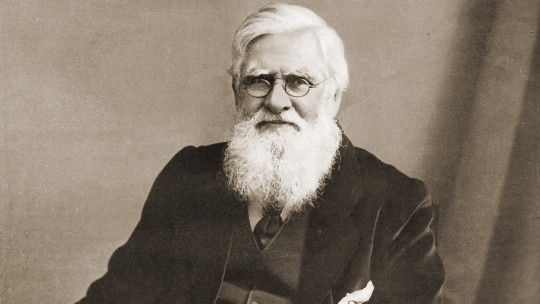
The life of Alfred Russel Wallace is not as well known as that of another great naturalist of his time, Charles Darwin, but his life and work were certainly very important in the last decades of the life of the great English naturalist.
Younger than Darwin, Wallace reached conclusions that he had spent decades trying to clarify. Wallace’s life is characterized by having many similarities with that of his English counterpart, and also by having had some controversy. Let’s see his story in this biography of Alfred Russel Wallace
Biography of Alfred Russel Wallace
Below we will see Wallace’s entire life in summary, talking especially about his trips to Malaysia, his similarities and differences with Darwin and the well-known and controversial incident of the letters he sent to Darwin.
Early years
Alfred Russel Wallace was born in Monmouthshire, Wales, on January 8, 1823, into a modest family of Anglican faith At the age of 13 he decided to finish his studies to go to work as a carpenter’s apprentice for his brother and, in 1837, he went to help another brother in surveying tasks.
Although in his adolescence he chose to dedicate himself to more mundane jobs, in 1844 he changed his mind when he received a book called Vestiges of the natural history of creationin which scientific studies were combined with theology. The book, written by Robert Chambers, argued that species were progressing on the evolutionary scale according to divine will a belief very consistent with the Victorian times that were passing.
How many of these have you been "meaning to read" for months?
- 1
 TarcherThe Artist's Way30th Anniversary EditionListen Free On Audible
 - 2
 New Harbinger PublicationsThe Dialectical Behavior Therapy Skills WorkbookPractical DBT Exercises for Learning Mindfulness, Interpersonal Effectiveness, Emotion Regulation...Listen Free On Audible
 - 3
 New Harbinger PublicationsAdult Children of Emotionally Immature ParentsHow to Heal from Distant, Rejecting, or Self-Involved ParentsListen Free On Audible
That is why, after reading this book, Wallace decided that his profession would be that of a naturalist. However, no matter how much he wanted to start this professional career, he was faced with the problem of where he would get the money and training that would help him travel to exotic lands and be able to face possible threats in those distant places. He managed to get by and earn a modest salary by selling rare specimens that he collected.
Trip to Brazil and Malaysia
Inspired by reading The journey of the BeagleAlfred Wallace He traveled to Brazil between 1848 and 1852, with Henry Walter Bates, another naturalist There they crossed the Amazon and Negro rivers and reached regions that no European had previously visited.
Although his dream was coming true, the beginning of his professional career already started quite badly, given that it was in the South American country where he contracted malaria and suffered for years from fevers that forced him to stay in bed. But he fought against the disease, and it did not prevent him from beginning to propose some biogeographic principles, based on the distribution of insect species. Unfortunately, while trying to return to Europe, the ship he was traveling on caught fire and sank, losing the manuscripts of two books that he was preparing.
In 1854 he would travel to Malaysia and, over the next 12 years, he would write more than 50 scientific articles on the natural history of the archipelago While there he would be able to offer a clearer Darwinian definition of the idea of species, in relation to reproductive isolation and differences with subspecies and local races.
From his beginnings in the field of naturalism, Wallace was characterized by being an admirer of Darwin, but at the same time being, to a certain extent, critical of him. He accepted the reproductive barrier posed by the English naturalist as a cause of speciation formation, that is, if two groups of individuals cannot reproduce with each other, they are most likely two different species.
However, despite accepting this principle, Wallace did not accept this idea as a definition of a species. More factors had to be taken into account to define the limits of a species, be it animal or plant. He did consider that natural selection could lead to the formation of two new species from the same ancestral group of individuals, which today is known as the “Wallace effect.”
It is also being in Malaysia where Wallace reaches conclusions very similar to those made by Charles Darwin while in the Galapagos Islands such as that similar species, such as finches, underwent modifications depending on the demands of the environment and the ability of the species to adapt to it.
What is worth highlighting about this thought is that Wallace, and it is something that has been largely ignored by the scientific community, came to propose these ideas before Darwin, who was warned by his friend Charles Lyell upon learning that a young naturalist was formulating so convincing theories.
In 1856 Wallace traveled to Bali, traveling the channels between this island and neighboring Lombok, separated by only 20 kilometers. It was striking that, despite being so close, they housed such different species He saw that in Bali there were animals typical of continental Asia, in Lombok there were marsupials, like those that can be found in Australia. It is at this moment that Alfred Wallace draws the line that would receive his surname, which serves to delimit the Indian fauna. Western Malaya from Eastern Austro-Malay.
This line has been interpreted by other scientists as evidence of continental drift, since it would allow us to understand the reason for two very different faunas in the same archipelago, in addition to supporting the idea of a primordial continent, Wallacea.
Based on these data and those obtained in other places in the world, Wallace wrote his book “Geographic distribution of animals”, where he proposed dividing the earth into six biogeographic zones. Later he would travel to the islands of Ternate and Gilolo, where he would read Principles of Geologywritten by Charles Lyell It is the same book that Darwin read while aboard the Beagle.
While on the islands, and suffering from a terrible episode of fever, he wrote “On the tendency of varieties to depart indefinitely from the original type” (1858), where he argued that there were two factors that controlled evolution: the divergence between groups of individuals (Sarawak law), and the survival of the most adapted, the “successors”.
Knowing that his work could benefit evolutionary theses, He decided to send the manuscript to Darwin for his opinion and asked him to show it to Charles Lyell and Joseph Hooker After reading the manuscript, Darwin had a bittersweet feeling. It was interesting to see how some questions from his own research were answered, even though he had been a naturalist and traveling for much longer than Wallace.
Thinking about natural selection
While in Ternate, an island in Indonesia, the idea of natural selection began to crystallize in his mind. While on the island, and suffering from fevers that left him practically paralyzed with pain and anguish, andbegan to see in the thought of Malthus and the ideas of Lyell the principles that could explain the adaptation of organisms to the habitat It is here where he begins to explain the process of divergence that is behind the important diversity of living beings.
Advantageous changes in certain individuals help them survive and reproduce, making it easier for their genes to have the best chance of being passed on to the next generation. After several generations, these genes become common throughout the group or species.
Wallace was critical of the term “natural selection,” especially when it was used as a synonym for survival of the fittest For Wallace, specimens with not so advantageous characteristics should not necessarily be left behind in the race for survival, they simply would not have as many privileges as the more adapted ones.
The incident of the letters between Wallace and Darwin
When talking about the figures of Wallace and Darwin, it is inevitable to talk about how the famous English naturalist took advantage of the discoveries of his Welsh counterpart, although the way in which he did it and the events happened in general has caused debate.
In March 1858 Wallace sent his work On the Trend of Varieties… to Darwin for his opinion The problem is that it is not known exactly when the letter arrived.
It is believed that the text arrived on June 18, something stated by Darwin himself, and that it would be proof that his principle of divergence, that is, the explanation of how species differ from each other despite coming from the same common ancestor, would have formulated it completely independently of Wallace’s ideas
However, his detractors consider that Darwin was in possession of the letter before, between June 2 and 3, which would have allowed him to read it for two weeks and study it in depth to draw his own conclusions, reworking his theories. This idea is based on the fact that a letter sent by Wallace to Henry Bates’s brother, and which would have been dispatched the same day as the one addressed to Darwin, arrived in London on June 2.
Darwin was very meticulous about the letters he received, filing them in case he had to take a look at them in the future. However, and as something that raises even more suspicions, the first letter he received from Wallace was not archived and has not been found. The rest of the letters sent by the Welshman to Darwin were found.
Darwin, who was 49 at the time, had spent the last two decades trying to find an explanation for the divergence between species and, suddenly, he received a letter from someone much younger who had reached a fairly plausible conclusion on his own. Did the English naturalist feel envy? What is known is who was quite taken aback by the letter, even considering abandoning his own job
Despite the blow, his friends Charles Lyell and Joseph Dalton Hooker intervened to encourage Darwin and protect his extensive scientific work. The problem was that, Unlike Wallace, he had nothing presentable at that time The only thing that came to mind was to rethink Wallace’s thinking and adapt it into more Darwinian language.
There has been much talk that, based on this incident, to resolve it amicably, Darwin and Wallace agreed to jointly prepare a work on the origin of species, and how they differentiated as generations passed. However, there is broad consensus that both scientists never read or published a co-authored work. What happened is that Lyell and Hooker highlighted the contributions of both, although without Wallace’s permission in a lecture at the Linnean Society on July 1, 1858.
Despite this incident, in 1860 Alfred Russel Wallace received a copy of Charles Darwin’s “On the Origin of Species” and expressed his great admiration for the English naturalist. In fact, he was proud of having helped Darwinian evolutionary theses with his idea of the divergence between species.
Although he agreed with certain aspects of Darwin, it is worth noting that Wallace was very opposed to the idea that the human mind had evolved through natural selection Like other Victorian thinkers, Wallace believed that properly human capacities such as mathematical thinking, morality, and spirituality were something revealed by divine will, not as a result of the evolutionary process.
Another aspect in which he differed from Darwin was that some traits present in certain human races, such as the loss of body hair, hand structure or brain size, had not contributed significantly to the survival of those races. Besides, He did not share Darwin’s idea that there were intellectually superior races compared to so-called “savage” races
In 1889 Wallace published Darwinism: an exposition of the theory of natural selection – with some of its applications, a text in which he coined the term Darwinism and which, possibly, was what caused Alfred Russel Wallace to be overshadowed within the field of evolution by the great work of Charles Darwin. Far from having distanced himself from him due to the correspondence incident, Wallace helped ensure that the figure of Darwin did not perish with the passage of time.
Return to Britain and final years
In 1862 Wallace returned to England as a well-known naturalist, although not as much as Darwin was. Being a second man, no matter how famous one is, does not benefit, and Wallace’s life upon returning to the British Isles demonstrates this. Without financial security, he continued to depend on the sale of exotic specimens and lived off the taxes received for his writings Despite the controversy, Charles Darwin and some of his friends ensured that Alfred Russel Wallace received a civil service pension from 1881.
Wallace had a much more spiritual vision of evolution than Darwin’s. Not only did he believe that mental faculties could not be the result of evolution, wanting to unite science with religious vision, but he also He had beliefs that were somewhat removed from what would be considered appropriately scientific
He was a defender of phrenology, that is, that the shape of the skull supposes differences in certain cognitive abilities and behavioral aptitudes. Furthermore, he was against vaccination, considering that its application, rather than a measure of improving the health of the population, was a control measure.
Alfred Russel Wallace He died in Dorset, England, on November 7, 1913 at the age of 90 Despite falling under Darwin’s shadow, his death was widely reported in the press at the time, and in fact, several scientists ensured that a medallion in his honor was placed near Darwin’s grave two years later.
Use this citation format to reference the article clearly and help readers find the original source.
PsychologyFor. (2024). Alfred Russel Wallace: Biography of This Welsh Naturalist. PsychologyFor. https://psychologyfor.com/alfred-russel-wallace-biography-of-this-welsh-naturalist/