


See more of our articles in your search results.
When you ask any paleontologist closely linked to the field of phylogeny, they may not hesitate to affirm that birds are dinosaurs. Entering a more confusing debate, surely also will clarify that birds are “avian dinosaurs” and, in turn, reptiles
Despite getting lost in semantic nuances and over-complicating things with this type of topics, terminological and phylogenetic reflections in the world of evolution are necessary: Rome was not built in a day, and human knowledge requires an exhaustive analysis. and the testing of theories and multiple points of view to cement their foundations.
Therefore, in this space we are going to focus on the “scientific consensus” based on the matter that concerns us today, but we must be clear that none of what is stated is an ironclad, immovable dogma. For example, some specialists continue to argue that birds evolved from crocodilemorphs, a theory that is difficult to justify, but it exists.
It is because of this disparity of opinion that nothing is entirely real or absolutely false. We are moving in a highly speculative terrain, which in my personal opinion is quite stimulating. In the world of science, black and white are out of use: the answer is usually found in a gray scale. Good, Are birds dinosaurs or not? Do not despair, because here we present the possible answers.
Are birds dinosaurs? A phylogenetic conglomerate
Phylogeny is a term that refers to a scientific discipline responsible for studying kinship relationships between species or taxa in general To reconstruct the evolutionary history of a taxonomic group, it is not enough to look at the external characteristics of the animal and place the families as far or close as we want to the ancestor: strict genetic analyzes must be followed and mathematical criteria applied.
How many of these have you been "meaning to read" for months?
- 1
 CrosswayDust to DustAging Wisely in an Anti-Aging WorldListen Free On Audible
- 2
 THOUGHT CATALOGThe Mountain Is YouTransforming Self-Sabotage Into Self-MasteryListen Free On Audible
- 3
 Thomas NelsonBreath as PrayerCalm Your Anxiety, Focus Your Mind, and Renew Your Soul (80+ Breath Prayers and Devotional Medita...Listen Free On Audible
Certain computer programs based on the application of algorithms build phylogenetic trees with the genetic evidence provided from the different organisms. It is important to note that this reconstruction is based on the famous Ockham’s razor or principle of parsimony. This is, The most likely answer lies in the tree that is built from the smallest number of possible changes
For example, faced with a winged animal analyzed today, two different assumptions could arise:
We accept under the assumption that evolution happens in the simplest way and therefore, unless reliable paleontological evidence is provided, the second option at first glance will always seem more viable.
The complex phylogeny of birds
When approaching the evolutionary history of birds, we have to start by making things clear: the current scientific consensus is that their evolutionary divergence surely began in the Triassic period from a unique clade of theropod dinosaurs, the coelurosaurs. But what do today’s birds share with these primitive beings?
1. The feather debate
At this point it is essential to introduce perhaps the most key piece of this puzzle: the fossil of Archeopteryx found in 1861 This evolutionary imprint shows us an individual clearly transitional between a dinosaur and a modern bird: the relationship is undeniable.
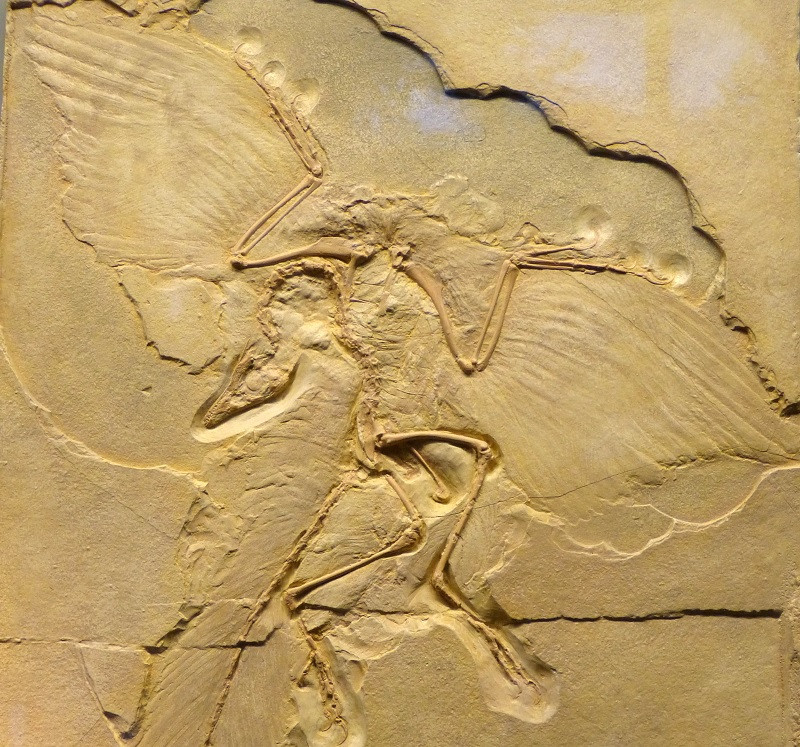
Since this point, feathers have been discovered in many other taxonomic groups of dinosaurs. Until relatively recently, this morphological trait had been associated only with theropods (as we have already said, the considered ancestors of modern birds), but a series of fossils dating back 160 million years found in Siberia suggest something different. , as evidence of feathered ornithischian dinosaurs has been found.
According to scientists interviewed by National Geographic, “this probably means that the common ancestor of all dinosaurs had feathers.” Following the principle of parsimony previously explained, it is more coherent to think that the ancestral group had feathers and that some members lost them, that the record of a history without feathers-with feathers-without feathers again (two evolutionary steps with respect to three).
Even so, there is no shortage of detractors who oppose this idea. A small scientific minority argues that the presence of certain “protofeathers” in fossilized imprints would correspond to the degradation of collagen fibers, and that the species that unquestionably possess feathers, such as oviraptorosaurs and dromaeosaurs, are not dinosaurs, but true birds not related to they. This argument is considerably dismantled when some studies have shown the presence of supporting colored melanin in these structures, something that is expected from a feather but not from collagen formation.
2. Skeleton
The relationships between the skeletal structures of birds and dinosaurs is reliable, and it is an essential reality to take into account when establishing relationships between birds and dinosaurs. More than 100 avian anatomical aspects have been detected in theropod fossils among which are similarities in these structures:
The number of general similarities reaches more than 20. Still, The presence of furcula, the result of fusing the two clavicles, is especially striking, since it is only present in birds and theropod dinosaurs As has been demonstrated today, this strengthening structure of the rib cage appeared before flight. Along with the presence of feathers, the furcula is one of the characteristics that has most allowed the direct correlation between birds and theropods.
3. Lack of DNA
We can continue naming similarities between theropods and birds endlessly: laying eggs, lung air sacs, four-chambered hearts, the use of gastroliths (structures that facilitate digestion in the animal’s stomach…etc). Still, an essential clarification is necessary. For now, no reliable record of DNA extraction from fossil samples has been obtained
This greatly complicates the task of reconstructing phylogenetic trees, since any geneticist will affirm that genetic tests should always be the first basis when reconstructing the evolutionary history of any living being. Even so, there is other reliable evidence that is not based only on external skeletal and morphological characteristics.
For example, traces of tissue have been obtained inside bones of the Tyrannosaurus rexand after rehydration and analysis, seven different types of collagen were discovered When compared to those of various birds (especially the chicken), their morphological similarity provided even more evidence of the correlation between theropods and modern birds.
Even so, despite all these morphological and structural similarities, we are still missing the definitive key: a concordant DNA that silences all the voices against the facts presented here. Despite this, something is clear from the scientific community, and that is that There is no more accepted theory of the origin of birds today that is not linked to theropods
Summary
We can answer yes, that birds are dinosaurs and leave behind all the nuances exposed so far. This statement errs on the side of oversimplifying things, but the supposed “debate” between the relationship between theropods and birds is something that is already considered settled in the scientific community. Although there are detractors of this idea, the same propositions made by them violate dogmas that are so accepted in the world of phylogeny today, such as the principle of parsimony.
Birds are most likely direct descendants of coelurosaur theropods, since there is no other theory that explains its emergence with a smaller number of evolutionary steps. It’s that simple.
Therefore, the current consensus is that birds are a group of maniraptoran theropod dinosaurs that originated during the Mesozoic.
- Are birds really dinosaurs? Berkeley University. Collected September 9 at https://ucmp.berkeley.edu/diapsids/avians.html#:~:text=Ask%20your%20average%20paleontologist%20who,birds%20are%20technically%20considered%20reptiles.
- Feduccia, A. (2002). Birds are dinosaurs: simple answer to a complex problem. The Auk, 119(4), 1187-1201.
- Feduccia, A. (2012). Riddle of the Feathered Dragons: Hidden Birds of China.
- Rezende, EL, Bacigalupe, LD, Nespolo, RF, & Bozinovic, F. (2020). Shrinking dinosaurs and the evolution of endothermy in birds. Science advances, 6(1), eaaw4486.
- Schweitzer, M.H., Wittmeyer, J.L., & Horner, JR. (2005). Soft-Tissue Vessels and Cellular Preservation in Tyrannosaurus rex. Science 307:1952–1955
- Wellnhofer, P. (1988). “Ein neuer Exemplar von Archeopteryx.” Archeopteryx. 6:1–30.
- Xu, X; Norell, M.A.; Kuang, X; Wang, X; Zhao, Q; Jia, C (October 2004). “Basal tyrannosauroids from China and evidence for protofeathers in tyrannosauroids.” Nature 431 (7009): 680-4.
Use this citation format to reference the article clearly and help readers find the original source.
PsychologyFor. (2024). Are Birds Dinosaurs? The Keys to Their Classification as Animals. PsychologyFor. https://psychologyfor.com/are-birds-dinosaurs-the-keys-to-their-classification-as-animals/