

See more of our articles in your search results.
Your heart pounds before a difficult phone call you haven’t even dialed yet. Your stomach twists into knots before a presentation, your palms turn damp, and your breathing quickens, all without you consciously deciding any of it should happen. Or perhaps you’ve noticed the opposite: a strange difficulty calming down after stress has passed, as though your body forgot how to switch off the alarm. These experiences can feel bewildering, even a little embarrassing, especially when you can’t explain why your body reacts so strongly to things your mind knows aren’t truly dangerous. Behind every one of these moments is a vast, largely invisible control network: the autonomic nervous system.
It’s genuinely unsettling to feel physically hijacked by your own body, especially when the reaction seems disproportionate to the actual situation in front of you. This disconnect between what you consciously feel and what your body automatically does can leave people feeling like something is wrong with them personally, rather than recognizing it as a normal, biologically wired process shared by every human being. This confusion becomes even more pronounced for people managing chronic stress, anxiety, or conditions affecting autonomic function, since symptoms like a racing heart, digestive upset, or unpredictable sweating can appear seemingly out of nowhere and are often dismissed by others as “all in your head.” Understanding how this system actually works can replace that self-blame with a clearer, more compassionate picture of what’s really happening beneath the surface.
So how does a system you can’t consciously control end up shaping so much of how you feel, moment to moment?
This article explains what the autonomic nervous system is, its major parts, and how it regulates the body’s automatic functions every second of the day.
What Is the Autonomic Nervous System and What Does It Control?
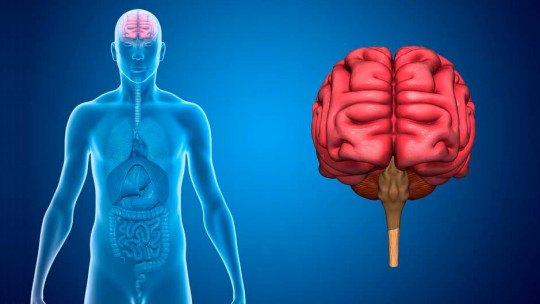
The autonomic nervous system, often abbreviated as the ANS, is the division of the peripheral nervous system responsible for managing the body’s involuntary functions. It operates continuously, without conscious effort, regulating processes like heart rate, digestion, breathing rate, and pupil size around the clock, whether you’re awake, asleep, focused, or distracted.
How many of these have you been "meaning to read" for months?
- 1
 S&S/Simon ElementProtocolsAn Operating Manual for the Human BodyListen Free On Audible
 - 2
 Undercover Publishing HouseStop Letting Everything Affect YouHow to break free from overthinking, emotional chaos, and self-sabotage.Listen Free On Audible
 - 3
 Grand Central PublishingIn the Shadow of EightSurviving the Reality of My ChildhoodListen Free On Audible
Nineteenth-century physiologist Claude Bernard was among the first to describe the concept of the body’s internal environment, recognizing that living organisms must actively maintain stable internal conditions despite constant changes in the outside world. This early insight laid the groundwork for what physiologist Walter Cannon later termed homeostasis, the body’s ongoing, automatic effort to keep internal conditions within a healthy, functional range, a process the autonomic nervous system carries out almost entirely without our awareness.
Structurally, the ANS reaches into nearly every organ system in the body, including the heart, lungs, digestive tract, blood vessels, glands, and reproductive organs. Physiologist John Newport Langley, who coined the very term autonomic nervous system in the early twentieth century, helped establish the framework still used today, dividing this system into distinct branches based on their opposing yet complementary functions.
Because the ANS governs so many essential survival functions simultaneously, disruptions here rarely stay confined to just one symptom; they tend to ripple outward into digestion, heart rate, temperature regulation, and emotional reactivity all at once, which is exactly why understanding this system’s basic organization offers such practical value for making sense of confusing physical symptoms.
What Are the Main Parts of the Autonomic Nervous System?
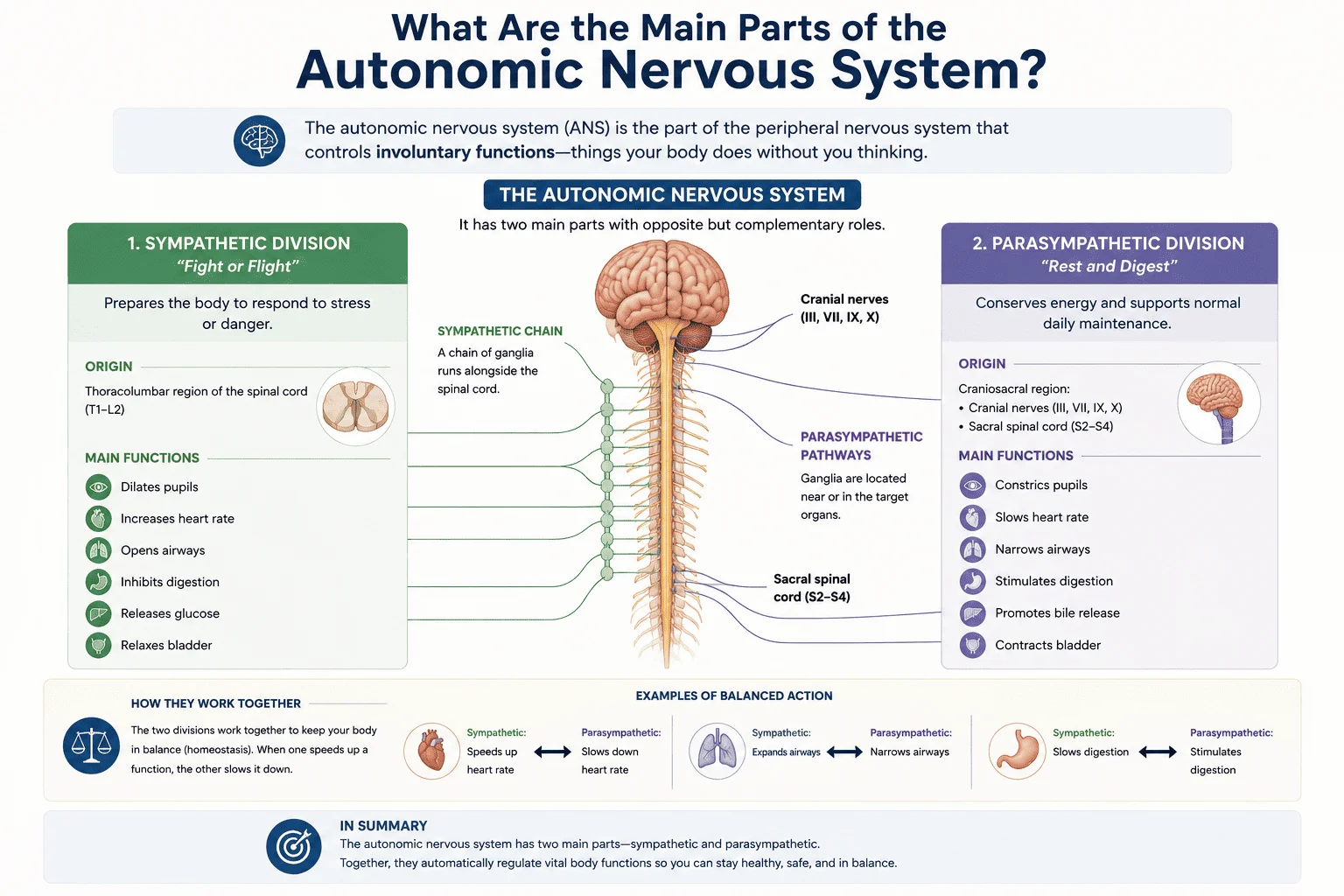
The autonomic nervous system divides into three distinct branches: the sympathetic, parasympathetic, and enteric divisions. Each plays a different, specialized role, though all three work in continuous coordination to keep the body functioning smoothly.
- The sympathetic nervous system mobilizes the body for action, increasing heart rate and redirecting energy toward muscles during moments of stress or perceived danger.
- The parasympathetic nervous system promotes rest, digestion, and recovery once a stressful situation has passed.
- The enteric nervous system manages digestive processes largely independently, sometimes described as the body’s “second brain.”
- Autonomic nerve fibers connect to nearly every major organ, including the heart, lungs, digestive tract, and glands, allowing coordinated, body-wide regulation.
Structurally, the ANS includes both central components, originating in the brainstem and hypothalamus, and peripheral components, consisting of nerve pathways and clusters of neurons called ganglia located outside the brain and spinal cord. Signals typically travel through a two-neuron pathway: a preganglionic neuron originating within the central nervous system connects to a postganglionic neuron within a ganglion, which then carries the signal onward to its target organ, a structural arrangement that allows for widespread, coordinated activation across multiple organs simultaneously.
This layered organization explains why a single triggering event, like sudden fear, can produce such a broad, whole-body response, including a racing heart, dilated pupils, and slowed digestion all at once, since these seemingly separate reactions all trace back to the same coordinated autonomic pathway.
How Does the Sympathetic Nervous System Prepare the Body for Action?
The sympathetic nervous system activates the body’s rapid, energizing response to perceived threats or physical demands. It functions like an accelerator, quickly mobilizing the resources needed for immediate action.
Physiologist Walter Cannon’s influential early twentieth-century research described this response in detail, coining the now-famous term fight-or-flight response to capture how the sympathetic nervous system prepares the body to either confront a threat or flee from it. When activated, this system increases heart rate and blood pressure, redirects blood flow away from digestion and toward large muscle groups, dilates the pupils to sharpen vision, and triggers the release of stress hormones like adrenaline from the adrenal glands.
This response evolved as a genuinely life-saving mechanism for responding to immediate physical danger, but in modern life, it often activates in response to psychological stressors, like a demanding deadline or a difficult conversation, that don’t require an actual physical fight-or-flight reaction. Endocrinologist Hans Selye’s extensive research on stress physiology, which he termed the general adaptation syndrome, demonstrated that repeated or prolonged sympathetic activation without adequate recovery can contribute to a range of long-term health problems, since the body was never designed to remain in this heightened state indefinitely.
A practical takeaway: recognizing physical sensations like a racing heart or shallow breathing as sympathetic nervous system activation, rather than a sign of personal weakness, can help you respond with self-compassion and reach more quickly for effective calming strategies.
How Does the Parasympathetic Nervous System Promote Rest and Recovery?
The parasympathetic nervous system counterbalances the sympathetic response, promoting relaxation, digestion, and recovery once a perceived threat has passed. It functions like a brake, slowing the body’s systems back down to a calmer baseline.
Often summarized by the phrase “rest and digest,” the parasympathetic nervous system slows heart rate, stimulates digestive activity, constricts the pupils, and supports the body’s repair and recovery processes. A significant portion of parasympathetic activity travels through the vagus nerve, the longest cranial nerve in the body, which connects the brainstem to the heart, lungs, and digestive organs, making it a central player in the body’s relaxation response.
Psychiatrist and researcher Stephen Porges’s influential polyvagal theory expanded scientific understanding of this system, proposing that the vagus nerve contributes not only to physical relaxation but also to social engagement and emotional regulation, suggesting that vagal tone, the vagus nerve’s overall activity level, plays a meaningful role in how effectively a person can shift between states of stress and calm. While some aspects of this theory remain actively debated within the scientific community, it has meaningfully influenced how clinicians think about the connection between physiological regulation and emotional wellbeing.
A genuinely practical takeaway: activities that stimulate the vagus nerve, such as slow, deep breathing with an extended exhale, can help actively engage the parasympathetic nervous system, offering a concrete, evidence-supported tool for calming the body during periods of stress.

How Do Neurotransmitters Enable Autonomic Nervous System Communication?
The autonomic nervous system relies on specific chemical messengers to transmit signals between neurons and their target organs. These neurotransmitters determine whether a given signal produces excitation or inhibition in the tissue it reaches.
Pharmacologist Otto Loewi’s classic 1920s experiments provided the first direct evidence that nervous system communication involves chemical signaling, identifying acetylcholine as a key neurotransmitter released by parasympathetic nerve fibers and by the preganglionic fibers of both autonomic branches. Sympathetic postganglionic fibers, by contrast, primarily release norepinephrine, a chemical closely related to adrenaline, which produces the excitatory, energizing effects characteristic of the fight-or-flight response.
This distinct chemical signaling explains why certain medications can selectively target one branch of the autonomic nervous system over the other; beta-blockers, for instance, work by blocking the effects of norepinephrine on the heart, reducing heart rate and blood pressure in people with certain cardiovascular conditions or significant anxiety-related symptoms. Understanding this chemical basis also clarifies why some medical conditions and medications can produce very specific, predictable patterns of autonomic symptoms, depending on which neurotransmitter pathway they affect.
Recognizing that these chemical processes have a real, measurable biological basis can be genuinely reassuring for people experiencing autonomic symptoms, reinforcing that these reactions reflect actual physiology rather than something imagined or exaggerated.
What Is the Enteric Nervous System and How Does It Relate to the ANS?
The enteric nervous system is a specialized division of the autonomic nervous system embedded directly within the walls of the digestive tract. It manages digestion with a remarkable degree of independence, even without constant input from the brain.
This system contains hundreds of millions of neurons distributed throughout the esophagus, stomach, and intestines, coordinating the rhythmic muscle contractions, called peristalsis, that move food through the digestive system. While capable of substantial independent function, the enteric nervous system still maintains close, bidirectional communication with the central nervous system primarily through the vagus nerve, part of the parasympathetic division, which is part of why emotional states like anxiety or excitement can produce very real, physical digestive symptoms.
This connection, often referred to as the gut-brain axis, has become an increasingly important area of ongoing research, exploring how digestive health and nervous system function influence one another in both directions throughout life. Recognizing this connection can be genuinely validating for people who notice digestive symptoms flaring during stressful periods, since these physical sensations reflect real, measurable nervous system activity rather than an imagined or overblown reaction.
A practical takeaway: because the enteric nervous system responds so directly to broader autonomic input, stress-reduction strategies that calm the sympathetic nervous system, such as regular physical activity and adequate sleep, can meaningfully support healthier digestive function over time.

What Happens When the Autonomic Nervous System Malfunctions?
Autonomic nervous system dysfunction, sometimes called dysautonomia, occurs when this normally automatic regulatory system fails to respond appropriately, producing a wide and sometimes puzzling range of symptoms. Because the ANS touches so many organ systems, dysfunction here rarely produces a single, clear-cut symptom.
Common causes include diabetes, certain autoimmune conditions, Parkinson’s disease, and, in some cases, no clearly identifiable underlying cause at all. One well-recognized example is postural orthostatic tachycardia syndrome, a condition in which standing up triggers an abnormally rapid heart rate along with dizziness and fatigue, reflecting a breakdown in the ANS’s normal ability to regulate blood pressure and heart rate during position changes. Other manifestations of autonomic dysfunction include abnormal sweating, digestive irregularities, and difficulty regulating body temperature.
- Orthostatic intolerance can cause dizziness or a racing heart when standing up quickly.
- Digestive irregularities may result from disrupted enteric or parasympathetic nervous system function.
- Abnormal sweating patterns, either excessive or insufficient, can reflect autonomic dysfunction.
- Chronic sympathetic overactivation can contribute to persistent anxiety-like physical symptoms even without an identifiable external stressor.
Because these symptoms can appear so varied and are sometimes dismissed as purely psychological, a thorough medical evaluation, including specific autonomic function testing when appropriate, is genuinely important for anyone experiencing persistent, unexplained symptoms of this kind.
How Are Autonomic Nervous System Disorders Diagnosed and Treated?
Diagnosing autonomic nervous system disorders typically involves specialized testing designed to measure how the body responds to specific physiological challenges. Because symptoms can overlap with many other conditions, this structured approach helps clarify whether the ANS itself is the underlying source of the problem.
Tilt table testing, which monitors heart rate and blood pressure while a person is gradually moved from lying down to standing, is a common tool for diagnosing conditions like postural orthostatic tachycardia syndrome. Heart rate variability testing can assess the balance between sympathetic and parasympathetic activity, offering insight into overall autonomic regulation. Additional tests, such as sweat testing or specialized digestive motility studies, may be used depending on the specific symptoms a person is experiencing.
Treatment depends heavily on the underlying cause and often combines lifestyle strategies, such as increased fluid and salt intake for certain blood pressure regulation issues, with targeted medications when appropriate. For stress-related sympathetic overactivation, evidence-based approaches like cognitive behavioral therapy, regular physical activity, and structured relaxation techniques can meaningfully support healthier autonomic balance over time.
- Seek thorough evaluation for persistent, unexplained symptoms like dizziness, rapid heartbeat, or digestive irregularities.
- Request specific autonomic testing when standard evaluations don’t explain your symptoms adequately.
- Practice vagus nerve-engaging techniques, like slow breathing, to actively support parasympathetic recovery.
- Manage underlying conditions like diabetes consistently, since this reduces the risk of progressive autonomic nerve damage.

How Does Autonomic Nervous System Function Change Across the Lifespan?
Autonomic nervous system function develops steadily through childhood and shows measurable, predictable changes in older adulthood. Understanding this trajectory helps distinguish typical development and aging from patterns that deserve closer medical attention.
In infancy, the autonomic nervous system is still maturing, which is part of why newborns show less stable regulation of heart rate, temperature, and digestion compared to older children and adults; this instability generally resolves gradually over the first months and years of life as autonomic pathways continue developing. In older adulthood, natural changes in autonomic regulation can contribute to a reduced ability to quickly adjust blood pressure with position changes, increasing the risk of dizziness upon standing, distinct from any specific disease process. Chronic health conditions that become more common with age, particularly diabetes and Parkinson’s disease, substantially raise the risk of significant autonomic dysfunction, making consistent management of these underlying conditions an important preventive strategy.
Practical strategies for supporting healthy autonomic nervous system function across the lifespan include managing chronic health conditions proactively, staying physically active, prioritizing consistent sleep, practicing stress-reduction techniques that engage the parasympathetic nervous system, and seeking prompt medical evaluation for any persistent, unexplained changes in heart rate, digestion, or temperature regulation.
FAQs about the Autonomic Nervous System
What is the main function of the autonomic nervous system?
The autonomic nervous system’s primary role is regulating the body’s involuntary functions, including heart rate, digestion, breathing, and blood pressure, all without requiring conscious effort. It maintains homeostasis, the body’s stable internal balance, by continuously adjusting these processes based on internal and external conditions. The system divides into the sympathetic branch, which mobilizes the body for action, and the parasympathetic branch, which promotes rest and recovery. Because it governs so many essential survival functions simultaneously, the ANS is considered one of the most critical regulatory systems in the entire body.
What are the three parts of the autonomic nervous system?
The autonomic nervous system divides into three main parts: the sympathetic nervous system, which triggers the fight-or-flight response during stress or perceived danger; the parasympathetic nervous system, which promotes rest, digestion, and recovery; and the enteric nervous system, which manages digestive processes largely independently within the walls of the gastrointestinal tract. These three divisions work together continuously, adjusting their relative activity based on the body’s changing needs throughout the day. Understanding this three-part structure helps clarify why autonomic symptoms can affect such a wide range of bodily functions at once.
What is the difference between the sympathetic and parasympathetic nervous systems?
The sympathetic nervous system activates the body’s energizing fight-or-flight response, increasing heart rate and redirecting blood flow toward muscles during moments of stress or danger. The parasympathetic nervous system works in the opposite direction, often summarized as rest and digest, slowing heart rate and supporting digestion and recovery once a perceived threat has passed. These two systems exist in constant, shifting balance rather than operating in complete isolation from one another. Chronic overactivation of the sympathetic branch without adequate parasympathetic recovery has been linked to a range of long-term physical health concerns.
What happens when the autonomic nervous system doesn’t work properly?
Autonomic nervous system dysfunction, sometimes called dysautonomia, can produce a wide range of symptoms, including dizziness upon standing, an abnormally rapid heart rate, digestive irregularities, and problems regulating body temperature or sweating. Common underlying causes include diabetes, certain autoimmune conditions, and neurodegenerative diseases like Parkinson’s disease, though sometimes no clear underlying cause is identified. Because symptoms can be so varied and are sometimes mistaken for anxiety or other unrelated conditions, thorough medical evaluation, including specific autonomic function testing, is important for accurate diagnosis. Treatment depends heavily on the underlying cause and often combines lifestyle adjustments with targeted medication.
How does the autonomic nervous system relate to stress and anxiety?
The autonomic nervous system’s sympathetic branch drives the body’s physical stress response, producing symptoms like a racing heart, rapid breathing, and heightened alertness during the fight-or-flight response. The parasympathetic nervous system works to calm these physical responses once a perceived threat has passed, though chronic stress can disrupt this natural balance, leaving the body in a prolonged state of heightened arousal. This connection explains why anxiety often produces very real physical symptoms rather than existing purely as a mental or emotional experience. Techniques that engage the vagus nerve and parasympathetic system, such as slow, controlled breathing, offer a genuinely evidence-supported way to help regulate this stress response.
Can you strengthen or improve autonomic nervous system function?
While you cannot consciously control most autonomic functions directly, certain practices can meaningfully influence the overall balance between the sympathetic and parasympathetic nervous systems. Regular physical activity, consistent sleep, and stress-reduction techniques like slow diaphragmatic breathing have all been associated with improved autonomic regulation and increased vagal tone over time. Managing chronic health conditions like diabetes and cardiovascular disease also helps protect autonomic nerve function, since these conditions can otherwise contribute to progressive autonomic damage. For persistent or significant autonomic symptoms, working with a healthcare provider to identify and address any underlying cause remains the most effective long-term approach.
Bibliography
- StatPearls Publishing. (2025). Anatomy, Autonomic Nervous System. National Center for Biotechnology Information Bookshelf.
- Cleveland Clinic. (2022). Autonomic Nervous System: What It Is, Function & Disorders.
- Kenhub. (2019). Autonomic Nervous System: Anatomy, Divisions, Function.
- Bernard, C. (1865). An Introduction to the Study of Experimental Medicine. J.B. Baillière et Fils.
- Cannon, W. B. (1932). The Wisdom of the Body. W.W. Norton & Company.
- Langley, J. N. (1921). The Autonomic Nervous System, Part 1. W. Heffer & Sons.
- Loewi, O. (1921). Über humorale Übertragbarkeit der Herznervenwirkung. Pflügers Archiv für die gesamte Physiologie.
- Selye, H. (1956). The Stress of Life. McGraw-Hill.
- Porges, S. W. (2011). The Polyvagal Theory: Neurophysiological Foundations of Emotions, Attachment, Communication, and Self-Regulation. W.W. Norton & Company.
Use this citation format to reference the article clearly and help readers find the original source.
PsychologyFor. (2026). Autonomous Nervous System: What it Is, Parts, Functions and Characteristics. PsychologyFor. https://psychologyfor.com/autonomous-nervous-system-what-it-is-parts-functions-and-characteristics/