

See more of our articles in your search results.
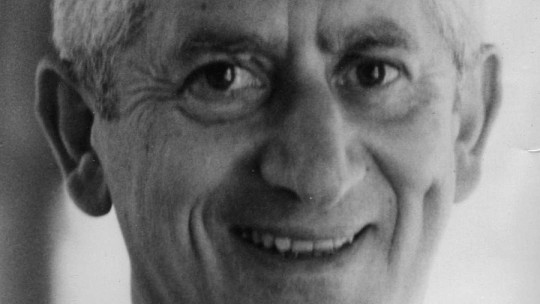
Benjamin Bloom was an American psychologist and educator who made important contributions to the field of mastery learning and the taxonomy of educational objectives.
His work has influenced multiple pedagogical fields in the second half of the 21st century, in addition to allowing a clearer understanding of children’s cognitive development.
Let’s see the life of this psychologist throughout a brief biography of Benjamin Bloom in which we will learn about his work and his theory of the taxonomy of educational objectives.
Benjamin Bloom Biography
This is a summary of the life of Benjamin Bloom, including his life and professional career.
Childhood and youth
Benjamin Samuel Bloom born in Lansford, Pennsylvania, USA on February 21, 1913 He was the son of Jewish immigrants from Russia, who were fleeing the discrimination that existed in the country towards this group at the beginning of the century.
How many of these have you been "meaning to read" for months?
- 1
 S&S/Simon ElementProtocolsAn Operating Manual for the Human BodyListen Free On Audible
 - 2
 Undercover Publishing HouseStop Letting Everything Affect YouHow to break free from overthinking, emotional chaos, and self-sabotage.Listen Free On Audible
 - 3
 Grand Central PublishingIn the Shadow of EightSurviving the Reality of My ChildhoodListen Free On Audible
From a young age he showed great curiosity about the world and knowledge. From his early years he showed himself to be an insatiable reader, and if he was given the opportunity to investigate something he had read in a book, he did not hesitate to do so.
He was good at learning what he had read. He also stood out for his ability and reading comprehension, reaching the point that in the library where he borrowed books, they did not allow him to return them the same day he had taken them, since they did not believe that he would be able to read an entire book in one. less than a day.
Professional life
Benjamin Bloom earned a bachelor’s degree from Pennsylvania State University in 1935 and subsequently He received his doctorate in Education in 1942 from the University of Chicago He was admitted as a member of the examination board of the University of Chicago, serving in this capacity until 1943. After this, he became an examiner of the university until 1959.
He traveled the world and worked as an educational advisor for governments of countries that were developing and establishing democratic regimes, such as Israel and India.
Benjamin Bloom saw education as a process in which it was necessary to strive to achieve academic achievements, but this goes beyond the purely school Education was the way that, as long as it was carried out in the most appropriate way, allowed the full human potential of students to be extracted. Education had to acquire an optimistic vision of students, seeing them as people who, if they set their minds to it, could achieve their dreams.
Bloom’s very human vision towards education was a true source of inspiration for other educational psychologists, pedagogues and philosophers of education in addition to those who had the opportunity to become his students.
Benjamin Bloom died in Chicago, Illinois, USA on September 13, 1999, at the age of 86.
Contributions as a researcher
Bloom had a profound influence on the field of educational psychology. His main contributions to this discipline were his ideas on mastery learning, children’s cognitive development, and his famous taxonomy of educational objectives
His work focused on research in the study of education from a psychological perspective, specifically in relation to the cognitive, emotional and psychomotor aspects of learning.
The cognitive aspects refer to the students’ ability to handle in a useful way and give meaning to the information learned in the classroom. The emotional ones would be related to the feelings and attitudes that are generated as a result of the educational process. Finally, psychomotor aspects are everything in which physical skills are involved, such as manipulating objects or exercising the body, to acquire new knowledge.
In 1956 he published his main work, Taxonomy of Educational Objectives, Handbook 1: Cognitive Domain, in which he presented his new educational model. This taxonomy was developed to help teachers in their teaching tasks, especially to define what are the pedagogical objectives to be achieved in the classroom
The main idea of this taxonomy is that Not all educational objectives should be treated and prioritized in the same way For example, memorizing historical dates, although it has its importance, is not the same as analyzing the historical facts behind them, the political depth of the events that occurred and how they have shaped society to this day.
Taxonomy of educational objectives
This is a classification of different objectives that educators must propose to students. Benjamin Bloom divided these objectives into three domains:
1. Affective
It is the domain of how people react emotionally to educational content. Within this domain there are five levels: reception, response, assessment, organization and characterize.
2. Psychomotor
Relates to the skills to physically manipulate objects as are tools.
Although Bloom and his colleagues did not really give levels to this domain, several educational psychologists have given it sublevels. Some of them are: reflexes, fundamental movements, perception, physical skills, expert movements and non-verbal communication.
3. Cognitive
This domain refers to knowledge acquired in its most literal form in addition to the understanding of new information and the critical thinking capacity.
Traditionally, education has sought to strengthen the skills found within this domain, especially rote learning of what is explained in class.
In the taxonomy of educational objectives, this domain is subdivided into 6 levels, which go from the lowest level to the highest: knowledge, understanding, application, analysis, synthesis and evaluation
Some detractors of Bloom do agree with him in these categories that form the cognitive domain, but they do not consider that this is the real hierarchy, changing the order or considering that the majority of these levels are really subcomponents that acquire the same importance in the cognitive domain. learning process.
Legacy of Benjamin Bloom
This psychologist has come to be considered a guru in the field of educational psychology. Besides, He was a prominent educational activist. He took an important role in founding the International Association for the Evaluation of Educational Achievement (IEA).
When I was in the education department at the University of Chicago, developed the MESA (Measurement, Evaluation, and Statistical Analysis) program with the aim of preparing schoolchildren who had very striking critical thinking abilities a type of specialized education, to be able to make the most of their potential.
Use this citation format to reference the article clearly and help readers find the original source.
PsychologyFor. (2024). Benjamin Bloom: Biography of This Psychologist and Researcher. PsychologyFor. https://psychologyfor.com/benjamin-bloom-biography-of-this-psychologist-and-researcher/