

See more of our articles in your search results.
When we talk about medieval art, Carolingian art does not usually come to mind, even though it was one of the most outstanding episodes of artistic creation in the Middle Ages. Circumscribed to the years (few, on the other hand) that the Carolingian dynasty lasted, which ruled the kingdom of the Franks between the 8th and 9th centuries, Carolingian art meant, in part, a recovery of Roman culture, which materialized in the figure of the most important member of the dynasty that also gave it its name: Charlemagne. In today’s article we are going to briefly analyze what Carolingian art consists of and why this period represented a true renaissance in the middle of the medieval period.
Carolingian art and the Renovatio Imperii
To fully understand the meaning of the art created during the Carolingian era, we must know the context that promoted it. We have already commented that this art is limited to the Carolingian dynasty, started by Pepin III the Short in 751 and ended with the death of Charles the Fat just over a century later.
It is, therefore, a relatively brief historical period that, however, left posterity works of great beauty, whose creation is part of the Renovatio Imperii (Renewal of the empire) initiated by Charlemagne, the great monarch of the dynasty, with his coronation as Roman Emperor on Christmas in the year 800.
Charlemagne, Emperor of the Romans
Son of the first king of the Franks, Charles, later known as the Great (c. 742-814) was crowned in 768 along with his brother Carloman (751-771). His sudden death and his son’s minority caused the nobles of the kingdom to de facto recognize Charlemagne as the sole sovereign.
The Franks were one of the Germanic peoples who penetrated the limits of the Roman Empire in the 5th century, coming from the eastern area of the Rhine. They settled in the territory of present-day Belgium and France as federates of the Romans (that is, as allies), and were the first barbarian people to convert to Christianity in the figure of their king Clovis (466-511), the initiator of the Merovingian dynasty.
How many of these have you been "meaning to read" for months?
- 1
 S&S/Simon ElementProtocolsAn Operating Manual for the Human BodyListen Free On Audible
 - 2
 Undercover Publishing HouseStop Letting Everything Affect YouHow to break free from overthinking, emotional chaos, and self-sabotage.Listen Free On Audible
 - 3
 Grand Central PublishingIn the Shadow of EightSurviving the Reality of My ChildhoodListen Free On Audible
The conversion to Christianity allowed the Franks to get closer to the Gallo-Roman population, as well as to the Eastern power (the Byzantine emperor) and the Pope of Rome. In fact, and along with the Visigoths, the Franks were the most Romanized Germanic people of those who settled within the borders of the empire.
With the coronation of Charlemagne as Emperor of the Romans in the year 800, the Frankish king’s condition as a successor of the Roman Empire and, therefore, of its culture, was symbolically established. Although the title of Roman Emperor continued to fall to the Emperor of the East, the legitimate holder, let us remember that, at the time of Charlemagne’s coronation, the position was considered vacant, while the one wearing the imperial crown was a woman. , Empress Irene (c. 756-802). Irene’s feminine condition, as well as the interests of the pope and Charlemagne himself, led to the latter accessing the imperial throne and thus beginning a reconstruction of the Roman empire in the western part of Europe, in parallel to Byzantium.
The cultural project of the new Roman emperor was colossal. The monarch surrounded himself with scholars from different backgrounds, and established in the new capital of the empire, Aachen (present-day Aix-la-Chapelle, Germany) a court of scholars and artists that was known as the New Rome. The intention was none other than to recover classical culture and project a renewed image of the newborn empire as a bastion of wisdom, art and letters.
Thus, Charlemagne’s renovatio project can be summarized in two aspects: on the one hand, and as we have already commented, a recovery of classical knowledge (which by the way had never been completely lost); and, on the other, and as emperor anointed by the pope, the extreme protection of the Roman faith as a unifier of the empire. It is in this context that the spectacular artistic and cultural boom that unfolded on the borders of Regnum Francorum in the 9th century must be understood.
The palatine chapel of Aachen and Carolingian architecture
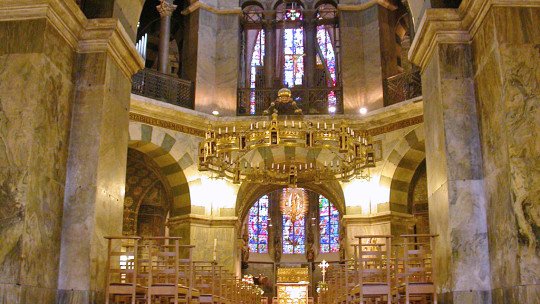
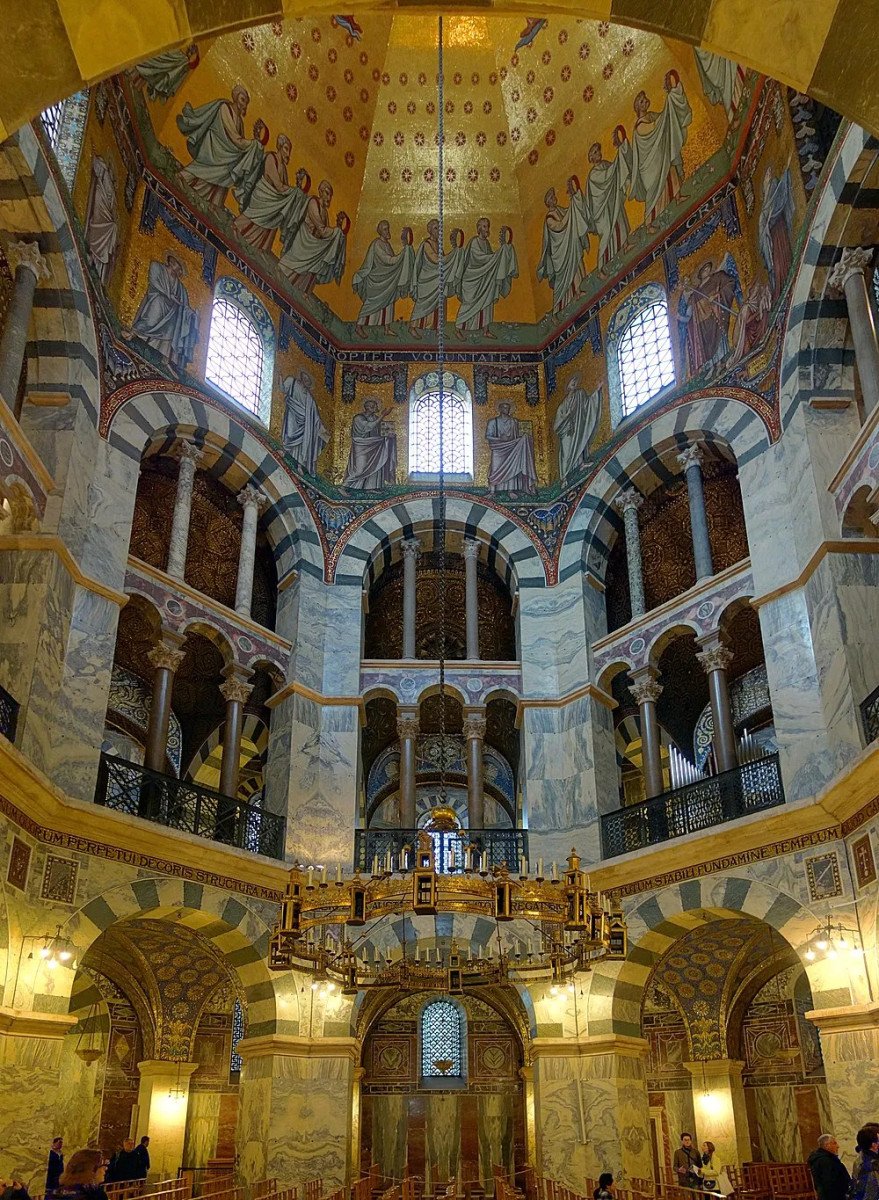
One of the most impressive examples of this cultural renewal is, of course, the palatine complex of the capital, Aachen, of which only the chapel remains. Inspired by the Basilica of San Vitale in Ravenna (although duly simplified), it consists of an octagonal central plan with a semicircular apse on its western side and two apsidioles on the north and south of the building. At the entrance to the chapel, preceded by a porticoed atrium, there was an impressive façade, built like a triumphal arch. The interior is truly impressive, with decoration of colored marble and mosaic, with obvious Byzantine reference.
The connection with Byzantium and Roman culture is even more obvious if we take into account that Charlemagne himself visited Ravenna on several occasions and that, in 787, he wrote to Pope Hadrian I to ask that material from this city be sent to him, as well as as from Rome, to decorate his palace. The result must have been an impressive palatine complex, built for the greater glory of the emperor, of which, unfortunately, only the chapel remains.

The architect responsible for the impressive Aachen complex, Eudes de Metz (742-814), is the same one who carried out the works on another of the important buildings of Carolingian architecture, the oratory of Saint Germigny-des-Près, in the Loire region. Also centralized in plan, it has Visigothic influence in the horseshoe arches. Saint Germigny-des-Près also has the honor of containing the only Byzantine mosaic in all of France, an impressive representation of two angels guarding the Ark of the Covenant which, curiously, occupy the place where the Virgin or Christ used to be represented.
But perhaps the most representative and original element of Carolingian architecture is the so-called westwerk or antechurch. It is a monumental architectural complex that is usually located in front of the entrance to the buildings, and is usually formed by a central tower and two secondary towers on the sides. One of the buildings that are preserved and in which this Carolingian characteristic can be observed is Corvey Abbey, in present-day Germany.
The Carolingian miniature
The most recognized artistic manifestation of Carolingian art are, without a doubt, the beautiful miniatures of the so-called Evangeliaries, compilations of the four canonical gospels. Although it does not constitute a single style, two important currents can be recognized. The first repeats classical motifs almost strictly, and was especially promoted by Louis, Charlemagne’s heir, a monarch even more classicist than his father. As for the second, it represents a much more original creation and takes its inspiration from various sources; among them, the plastic art of the British monasteries, undoubtedly under the influence of Alcuin of York, one of the scholars who was part of the court of Aachen and who came from the islands.
In the Carolingian world, monasteries and their respective scriptoria proliferated, places where classical texts were copied, adorned with wonderful miniatures. In addition to Aachen, the capital, which gave rise to the so-called School of the Court or of Ada, we find other copyist centers such as Saint-Gall, which also had its own school founded by Pepin III the Short, and the centers of Tours and Reims. The miniature of the latter is perfectly recognizable for its restless lines, surprisingly close to expressionism.
One of the innovations of the Carolingian scriptoria is the creation of a new typeface for handwriting, the so-called Carolina minuscule, which quickly replaced the intricate writing of the Merovingian period. We can appreciate the great importance of this literary innovation if we consider that many of the current fonts are based on this letter created by Charlemagne’s copyists.
The end of an era
The death of Charlemagne in 814 was the swan song of the Carolingian empire. His extensive domains, which came to occupy large territories of present-day Germany, France, Belgium and Italy, were fragmented as a result of the famous Treaty of Verdun (843), signed by the three grandsons of the great Charles. Through this document, Lothair, Louis the Germanic and Charles the Bald divided up the now extinct Carolingian empire and awarded themselves, respectively, Middle France, Eastern France and Western France.
With the Treaty of Verdun, Charlemagne’s dream and his renovatio imperii disappeared. However, a few years later, it would be reborn again in the figure of the Holy Roman Empire, which had its roots in the Germanic part of the dismembered Carolingian empire, and which would give rise to Ottonian art, another of the great renaissances of the Age. Average.

Use this citation format to reference the article clearly and help readers find the original source.
PsychologyFor. (2024). Carolingian Art: What it is and What Are Its Characteristics. PsychologyFor. https://psychologyfor.com/carolingian-art-what-it-is-and-what-are-its-characteristics/