


You have probably ever considered why most people have a tendency to follow the dictates of the majority
Psychology has tried to find out what makes people submit to group pressure, what are the causes of herd behavior, what is the nature of group pressure and to what extent an individual is capable of renouncing his or her own criteria. in favor of the masses.
Conformism: definition
He conformism can be defined as those modifications or changes that occur in a person’s behavior or opinion as a result of real or imagined pressure of people or groups of people.
Several experiments that bring us closer to the phenomenon of conformism
One of the most significant psychological experiments was carried out in the 1950s by Solomon Asch. I propose that you put yourself in the following situation.
You volunteer to participate in an experiment on perceptual judgment. In a room together with other participants, the experimenter shows you all a straight line (line X), at the same time he shows you three other comparison lines (lines A, B and C). The task is to determine which of the three lines has the same length as line X.
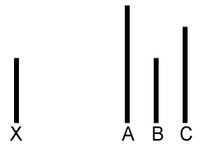
You clearly know that the correct answer is line B and you will indicate this to the experimenter when your turn comes. However, the first participant answers that it is line A, logically you are surprised by his answer. When the second person’s turn comes, answer line A as well. This second answer will probably surprise you even more and you will begin to think how can it be, if it is clearly line B? But when the third participant’s turn comes and he also says line A, you examine the lines once again and begin to doubt and wonder if you might be wrong. A fourth participant clearly answers line A in his turn. Finally, your turn comes and you naturally answer line A, you knew it from the beginning.
This is the conflict that participants in Asch’s study experienced. The experiment was simple: it consisted of gathering university students and showing them different cards with the standard line and three other lines for comparison. The participants had to respond out loud, and the experimental subject was never placed in the first positions to respond, so that the rest of the experimenter’s accomplices could give the agreed incorrect answer before the subject.
Group pressure ‘modifies’ our perception
The results of the experiment showed that when the subject was not subject to group pressure and was allowed to make a series of judgments about the length of the lines alone, there was an almost complete absence of errors, given the simplicity of the task. In cases where the subject was faced with a unanimous majority that answered incorrectly, approximately 35 percent of all the answers were incorrect, they reflected the incorrect judgments made by the accomplices
Other experiments similar to Asch’s
Asch’s experiment has been replicated in more than one hundred studies in different countries showing identical results. The results show that when a majority makes an erroneous judgment, people tend to conform to the wrong social perception
In a situation in which there were no restrictions on individuality, nor sanctions against non-conformity, the participants tended to conform. Why did the participants bow to the opinions of others?
The causes and factors of conformity
The conformity was due to two possible causes: they were convinced, in the face of the unanimous judgment of the majority, that their opinion was wrong or they followed the opinion of others in order to be accepted by the majority or avoid the rejection that disagreement would produce. in the group. That is, the subjects had two goals: to be right and to ingratiate themselves with the rest of the group. In many circumstances, both goals can be satisfied with a single action.
In Asch’s experiment, if others’ opinions about the length of the lines were the same as yours, both goals could be satisfied. However, both goals came into conflict, producing the effect of conformity The effect of accommodating the responses of others has less to do with imitation than with the need to reduce the dissonance between one’s own perception and the judgments made by others.
Factors that increase or reduce conformity
1. Unanimity
The unanimity or lack of unanimity in the opinion of the majority, is one of the crucial factors that determine the subject’s propensity to conformism. If one of the members of the group gives a different answer than the majority, the pressure towards conformity is drastically reduced and the chances that the subject will be more inclined to give their opinion increases.
That is to say, It is enough for a single person to provide a different answer for conformity to be reduced and the power of the group to decrease However, if there is unanimity, it is not necessary for the volume of the majority to be high to provoke maximum conformity in a person. The tendency to adapt to group pressure, with a unanimous majority, is practically the same regardless of the number of people who make up that majority.
2. Commitment
He commitment It is one of the factors that can reduce conformism, when individuals have publicly committed to a judgment or opinion before listening to the opinion of the majority, the person is more likely to maintain his or her opinion and not conform to those of the majority
3. Individual variables: self-esteem and ability
There are certain individual variables that increase or reduce conformity. In general, people with a low opinion of themselves are more likely to bow to group pressure in order to avoid rejection than those with high self-esteem. Another factor to take into account is the person’s belief in their own ability to perform the task successfully, for example in Asch’s experiment those subjects who were allowed prior to the experiment to judge the length of the lines indicating the correct answer , tended less to conform than those who were not allowed to perform the task previously.
4. Group composition
The group composition What pressure exerts is another of the factors that modulate the effect of conformity. So, A group will be more effective in inducing conformity if it is composed of experts whether the members are important to the individual and whether they are in some way similar or comparable to the individual, such as classmates.
5. Feeling of group belonging
The assessment of the group membership influences the degree of conformity. So, Those who value belonging to the group and feel only moderately accepted will show a greater tendency to adapt to the norms and guidelines created by the group that those who feel fully accepted.
6. Authority
Lastly, the authority conformism increases. In situations where the opinion or judgment comes from an authority figure, the appearance of authority can lend legitimacy to an opinion or request and generate a high degree of compliance As was found in another of the most famous experiments in psychology, the Milgram experiment, in which the majority of participants showed obedience to authority.
Conclusions
In conclusion, this experiment shows the great influence that others have on our own creation of beliefs and opinions. It also shows that in some cases We are easily manipulated and we can vary our most subjective beliefs such as ideals, political tendencies and even one’s own tastes.
By citing this article, you acknowledge the original source and allow readers to access the full content.
PsychologyFor. (2024). Conformity: Why Do We Submit to Group Pressure?. https://psychologyfor.com/conformity-why-do-we-submit-to-group-pressure/