

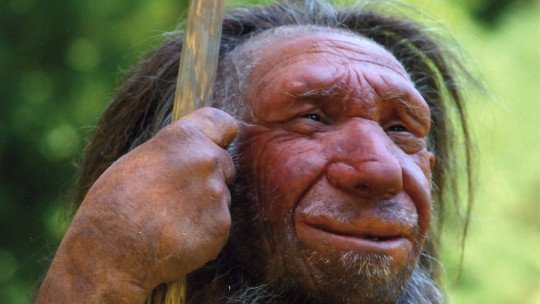
They became extinct approximately 30,000 years ago and coexisted with modern humans for ten centuries. Since the first evidence of these close relatives was found near Düsseldorf in 1856, Neanderthal man has been one of the most studied questions in human evolution.
There are many questions that, throughout all these years of study, have been asked about Neanderthals. One of these questions, which has led scientists on their minds in recent decades, is whether or not Neanderthals were capable of speaking The extraordinary similarity of these men and women to us is evident; But there was a piece of the evolutionary puzzle that refused to be deciphered. Now, recent research seems to have found the answer.
Could Neanderthals speak? New discoveries
It is estimated that Neanderthals emerged on the European continent about 300,000 years ago. They descend from the so-called Homo Heidelbergensis, the first human species that spread throughout numerous regions of the world.
It is estimated that, during the second ice age (Mindel Ice Age, about 400,000 years ago), the Heidelbergensis They sought protection from the extreme cold in southern Europe, where they were isolated and generated new species such as Neanderthal man. So, Neanderthals can be considered the first human species native to Europe
Currently, genetic studies have been able to find out that Sapiens and Neanderthals were much more related than previously believed. In fact, thanks to DNA analysis it has been proven that, about 300,000 years ago, hybridization of both species occurred, which would explain that, currently, a large part of the non-African population has Neanderthal DNA in its genome.
So how similar are we? Both species mated and produced fertile individuals (unlike other animal hybridizations), which seems to indicate that Both species were genetically very close Let’s examine these similarities in more depth.
Our closest relatives
Extraordinarily similar to us, Neanderthal men and women nevertheless had a much larger build than the Sapiens. Thus, they had great thoracic capacity and a large, heavy bone structure; The weight of an adult could reach 70 kilograms and be around 165 centimeters in height.
Recent studies have been more detailed and maintain that the majority were redheaded and light-skinned, to maximally absorb solar radiation, which is much scarcer in northern Europe than in Africa. This data was discovered by Carles Lalueza-Fox, from the University of Barcelona, who found a mutation in the MC1R gene, coming from fossil material from two Neanderthal sites, one in Asturias and the other in Italy.
On the other hand, The cranial capacity of these relatives was somewhat greater than ours: while that of the modern human being is around 1200 cm3, that of the Neanderthals reached the figure of 1,550, something that, a priori, could make us question whether the level of intelligence of these “cousins” was higher than ours.
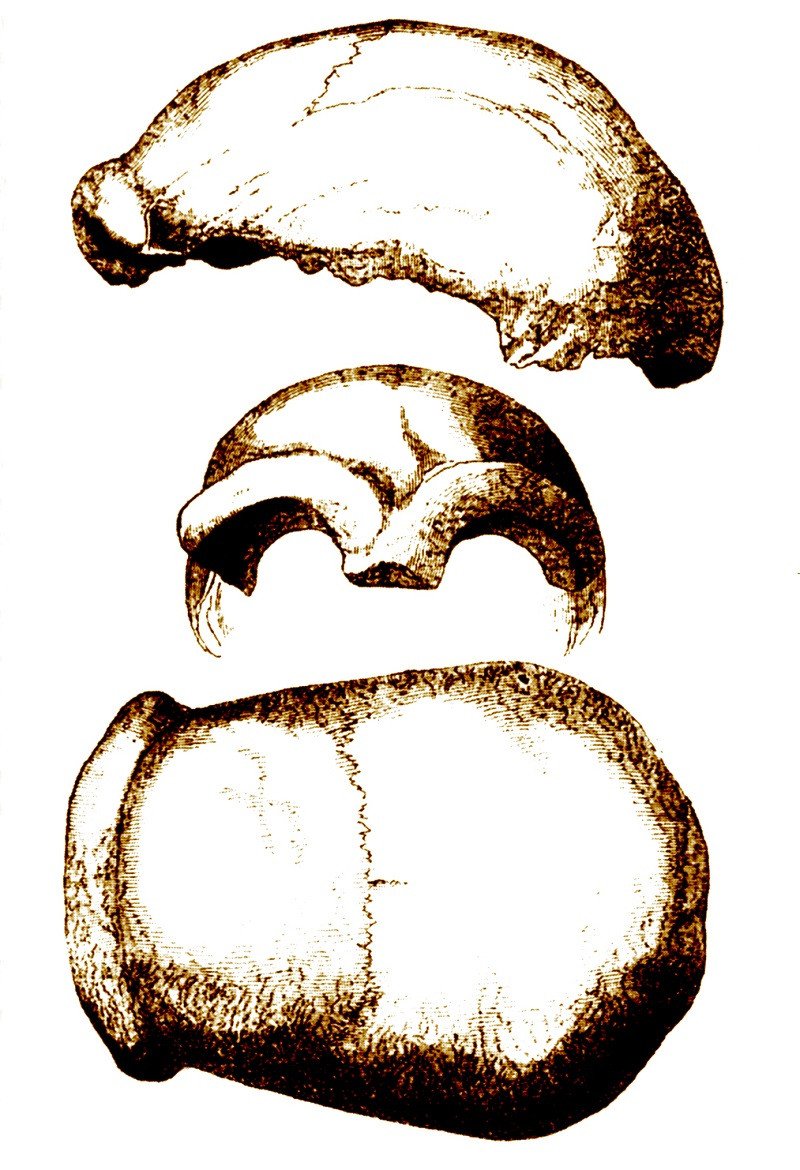
So, were Neanderthals more intelligent than Sapiens? Does greater cranial capacity have anything to do with the ability to make sounds and express oneself with more or less articulate language? In a word: could Neanderthals speak?
The problem: the speaking organs do not fossilize
Skull size does not necessarily indicate greater linguistic abilities; However, skeletal remains have revealed that The Neanderthal cranial areas that house the areas of the brain related to language are very similar to those of modern humans Would this be the definitive sign?
There is a problem regarding the study of language in extinct species, and that is that the organs related to speech (the larynx, tongue, glottis and vocal cords) do not fossilize. This means that, in the Neanderthal remains that have been found, there are not and could never be elements that would give us a clue about the oral expression capacity of our relatives. How to study it, then?
Fortunately, we have the hyoid bone, a tiny bone located at the level of the third and fourth vertebrae, which plays a great role in terms of the speaking system. And it is that It is on the hyoid bone, the only bone of the vocal tract, where the tongue and larynx sit; As a bone, it goes without saying that the hyoid has the same ability to fossilize as any other bone in the human body.
In 1989, the remains of a Neanderthal were discovered in Kebara (Israel) with the hyoid bone intact, to which X-rays were applied. The results of the research, published in the journal Plus Oneconcluded that, indeed, the location and morphology of this bone in the Neanderthal species were practically identical to ours, so it was very possible that our relatives spoke the same as us.
The hearing abilities of Homo neanderthalensis
Now, a joint study by the Chair of Primitive Otoacoustics and Paleoanthropology of HM Hospitals and the University of Alcalá has reached similar conclusions through the analysis of the hearing abilities of Neanderthals. Using computed axial tomography techniques, It has been possible to reconstruct the cavities of the parts of the external and middle ear of some of the Neanderthal fossils from the Sima de los Huesos, in Atapuerca; The result has shed light on the controversy of whether or not our relatives could speak.
The results of the study were published in the journal Nature Ecology & Evolution; They state that Neanderthals could hear the same range of sounds as us, which would also imply that they were probably capable of making a variety of sounds, since in general hearing ability is related to communication. In other words: it is more than likely that Neanderthal men and women were capable of constructing articulate language.
If it is true that Neanderthals were capable of speaking, we would have to accept that we are not the first and only species to do so. We already had to “give in” when it was shown that our relatives had abstract thinking, and that they even embellished themselves just like us and also felt affection and compassion. If the theory of Neanderthal speech is true, the similarities that unite us with our relatives would increase to unsuspected limits.
As María Martinón-Torres maintains in her interesting article on the oral capacity of Neanderthals, it is really difficult to believe that a species of such high intelligence (which, remember, had a cranial capacity superior to ours), with an indisputable ability to adorn himself and create art, did not have the ability to express himself in a more or less complex language. The path towards understanding Neanderthals remains open; Let’s hope that we continue studying them without prejudice and with an open mind to new surprises and possibilities.
By citing this article, you acknowledge the original source and allow readers to access the full content.
PsychologyFor. (2024). Could Neanderthals Speak?. https://psychologyfor.com/could-neanderthals-speak/