

See more of our articles in your search results.
Ask ten hiring managers what they look for in a candidate and you’ll get ten different answers — but most of them will eventually circle back to the same two categories: what you can do, and who you are while doing it. That’s the essential tension at the heart of the difference between soft and hard skills, and it’s one of the most practically important distinctions in psychology, education, and professional development today.
Hard skills are the technical competencies — measurable, teachable, credential-backed. The nurse who can perform a clinical assessment. The data analyst who writes clean Python. The architect who reads structural load calculations. These abilities are visible on a resume, verifiable through a test, and essential for professional credibility. They get you through the door.
Soft skills are what happen once you’re inside. They’re the interpersonal and psychological capabilities that determine whether you build trust with colleagues, navigate conflict without escalating it, lead a team through uncertainty, or communicate a complex idea to someone who doesn’t share your expertise. They are harder to measure, harder to teach — and, increasingly, harder to fake in a competitive labor market that has learned to take them seriously.
For decades, education and recruitment systems prioritized technical competence as the primary marker of professional worth. That emphasis is shifting — and the shift is supported by decades of research in organizational psychology, emotional intelligence theory, and workforce development. The evidence consistently points toward the same conclusion: neither category alone is sufficient. The most capable professionals at every level combine both. Understanding precisely how these two skill sets differ — and how they interact — is the first step toward developing both with genuine intentionality.
What Are Hard Skills? Definition, Characteristics, and Examples
Hard skills are the technical, quantifiable abilities that can be taught through structured instruction, measured through objective assessment, and verified through credentials, portfolios, or demonstrated performance. They represent the domain-specific knowledge and procedural competence that qualify someone for a particular role or profession.
How many of these have you been "meaning to read" for months?
- 1
 TarcherThe Artist's Way30th Anniversary EditionListen Free On Audible
 - 2
 New Harbinger PublicationsThe Dialectical Behavior Therapy Skills WorkbookPractical DBT Exercises for Learning Mindfulness, Interpersonal Effectiveness, Emotion Regulation...Listen Free On Audible
 - 3
 New Harbinger PublicationsAdult Children of Emotionally Immature ParentsHow to Heal from Distant, Rejecting, or Self-Involved ParentsListen Free On Audible
What makes hard skills distinctive is their precision. You either know how to operate a piece of machinery or you don’t. You can read a financial statement or you can’t. You’ve passed the bar exam or you haven’t. This binary quality makes hard skills both easier to acquire through deliberate study and easier to evaluate through testing — which is why they have historically dominated recruitment processes, academic curricula, and professional certification systems.
From a psychological standpoint, acquiring hard skills is fundamentally a cognitive learning process. It draws on memory consolidation, attention, pattern recognition, and procedural learning — the mechanisms by which the brain converts new information into reliable competence through practice and repetition. The more structured and consistent the learning environment, the more efficiently hard skills are acquired. This is why formal education, apprenticeships, and certification programs are effective delivery systems for technical knowledge.
Hard skills also tend to be domain-specific — they apply within a particular professional context rather than transferring freely across all situations. A surgeon’s procedural competence in laparoscopic techniques doesn’t transfer to structural engineering. A securities lawyer’s knowledge of financial regulation doesn’t translate to organic chemistry. This specificity is both a strength (it produces genuine expertise) and a vulnerability (it means hard skills can become obsolete as technologies and industries evolve).
Examples of hard skills across professional domains include:
- Healthcare: Clinical assessment, pharmacology knowledge, surgical technique, medical coding, diagnostic imaging interpretation
- Technology: Programming languages (Python, JavaScript, SQL), cybersecurity protocols, machine learning, cloud infrastructure, database architecture
- Finance and Business: Financial modeling, accounting principles, market analysis, project management methodologies, supply chain logistics
- Creative Industries: Video editing, 3D animation, UX/UI design, photography, audio production, copywriting for SEO
- Engineering: CAD software, structural analysis, materials science, thermodynamics, electrical systems design
- Law and Compliance: Knowledge of legal codes and case precedents, contract drafting, regulatory compliance, litigation procedure
What Are Soft Skills? Definition, Characteristics, and Examples
Soft skills are the interpersonal, emotional, and behavioral competencies that shape how a person interacts with others, manages themselves under pressure, and navigates the social dynamics of professional and personal environments. Unlike hard skills, they are not learned from a textbook or earned through a certification — they develop through lived experience, reflection, feedback, and the kind of psychological growth that comes from repeatedly engaging with other human beings in all their complexity.
The word “soft” is somewhat misleading. It implies flexibility, malleability — even fragility. In practice, soft skills are among the most demanding competencies to develop because they require sustained self-awareness, the willingness to receive difficult feedback, and the patience to change deeply ingrained behavioral patterns. A person can learn the syntax of a programming language in months. Developing genuine empathy, or the ability to regulate emotions under sustained professional pressure, or the leadership capacity to inspire rather than simply direct — these are years-long projects that most people work on throughout their entire careers.
Psychologically, soft skills are rooted in emotional intelligence (EI) — a framework introduced by psychologists Peter Salovey and John Mayer and later expanded and popularized by Daniel Goleman. EI describes the capacity to perceive, understand, manage, and effectively apply emotional information — both in relation to oneself and in interaction with others. High emotional intelligence is consistently associated with better leadership outcomes, stronger interpersonal relationships, greater resilience under stress, and improved long-term job satisfaction.
Soft skills also draw heavily on Albert Bandura’s social learning theory, which holds that much human behavior is learned through observation, modeling, and feedback within social contexts. You don’t develop effective communication skills in isolation — you develop them by communicating, noticing what works and what doesn’t, receiving honest feedback, and gradually refining your approach. This social, iterative development process is precisely why soft skills cannot be acquired through passive instruction alone.
Core soft skills — with their psychological underpinnings — include:
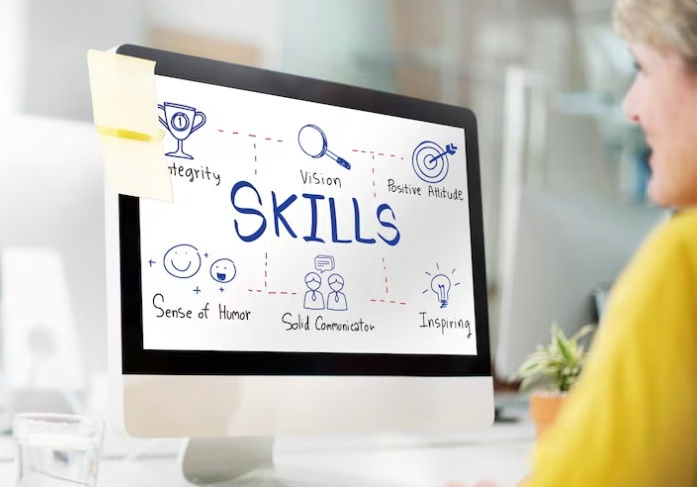
- Communication: Active listening, clear expression, adapting tone and register to different audiences, nonverbal awareness — rooted in pragmatics, social cognition, and perspective-taking.
- Emotional intelligence: Recognizing one’s own emotional states, regulating responses to them, and reading and responding empathetically to others’ emotional experiences.
- Leadership: Motivating and guiding others, making decisions under uncertainty, managing conflict constructively, and maintaining psychological safety within a team.
- Adaptability: Remaining cognitively and emotionally flexible when circumstances change unexpectedly — a capacity closely linked to stress tolerance and growth mindset.
- Teamwork and collaboration: Building productive working relationships, respecting diverse perspectives, and contributing constructively to collective goals even when personal preferences differ.
- Critical thinking: Evaluating information systematically, identifying logical gaps, challenging assumptions, and reaching sound conclusions under conditions of incomplete data.
- Conflict resolution: Navigating disagreement without escalation, finding workable compromises, and maintaining relational trust through difficult conversations.
- Growth mindset: Carol Dweck’s concept — the belief that abilities and intelligence can be developed through effort and learning — underpins willingness to persist through challenge rather than retreating from it.

Soft Skills vs. Hard Skills: The Key Differences Explained
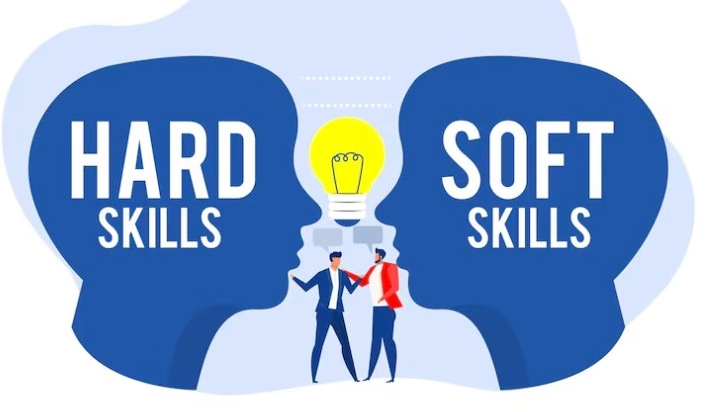
The difference between soft and hard skills is not simply a matter of one being more important than the other. They are fundamentally different types of human capability, developed through different processes, assessed through different methods, and applied in different — though often overlapping — domains. Understanding these differences clearly is what allows you to develop both with genuine strategy.
| Dimension | Hard Skills |
|---|---|
| Nature | Technical, quantifiable, domain-specific |
| How they’re learned | Formal education, structured training, deliberate practice |
| How they’re assessed | Exams, certifications, portfolios, technical tests |
| Transferability | Mostly profession- or industry-specific |
| Durability | Can become outdated as technology evolves |
| Psychological basis | Cognitive learning, procedural memory, logical reasoning |
| Dimension | Soft Skills |
|---|---|
| Nature | Interpersonal, emotional, behavioral |
| How they’re learned | Experience, self-reflection, social feedback, mentorship |
| How they’re assessed | Behavioral interviews, peer feedback, observation, 360 assessments |
| Transferability | Fully transferable across all professions and life contexts |
| Durability | Remain relevant and valuable throughout life |
| Psychological basis | Emotional intelligence, social learning theory, personality psychology |
One of the most important differences lies in how quickly each type of skill can be acquired. Hard skills — because they can be structured into curricula and practiced in controlled environments — can often be developed to a functional level within weeks or months. Soft skills rarely work this way. A two-day communication workshop may introduce useful frameworks, but it does not produce lasting behavioral change in the same way that months of deliberate practice, honest feedback, and real-world application do. This is precisely why organizations that try to address soft skill deficits through one-off training events typically see little lasting impact.
Another critical distinction is automation vulnerability. As artificial intelligence and machine learning systems become increasingly capable of performing complex technical tasks — data analysis, pattern recognition, code generation, document processing — many hard skills face accelerating obsolescence pressure. Soft skills, by contrast, represent competencies that are deeply and perhaps inherently human: the capacity for genuine empathy, ethical judgment in ambiguous situations, creative synthesis across domains, and the interpersonal attunement required to lead people through change. These cannot be replicated by algorithm.
The Emotional Intelligence Foundation of Soft Skills
No framework is more central to understanding soft skills than emotional intelligence (EI) — the psychological capacity first formally theorized by Peter Salovey and John Mayer in 1990 and subsequently brought to popular and organizational attention by Daniel Goleman’s influential 1995 work.
Salovey and Mayer defined emotional intelligence as the ability to perceive, use, understand, and manage emotions accurately and effectively. Goleman expanded this into a five-component model that maps directly onto the core soft skills most valued in professional contexts:
- Self-awareness: The capacity to accurately recognize your own emotional states, understand how they influence your thinking and behavior, and know your strengths and limitations with honest clarity. Self-awareness is the foundation on which all other EI components rest — you cannot regulate what you haven’t noticed.
- Self-regulation: The ability to manage disruptive emotional impulses, maintain composure under pressure, and act from deliberate intention rather than reactive instinct. Leaders with strong self-regulation handle crises without emotionally contaminating the people around them.
- Intrinsic motivation: A drive to achieve that is internally rather than externally generated — the orientation toward goals for their inherent meaning rather than solely for reward or status. This connects to Carol Dweck’s growth mindset research: people with this orientation persist through difficulty because effort itself feels meaningful.
- Empathy: The capacity to understand and share the emotional experience of others — not just to intellectually recognize their perspective but to genuinely resonate with it. Empathy is the core of effective leadership, therapeutic relationships, customer service, teaching, and any human role in which trust is essential.
- Social skills: The ability to build and maintain productive relationships, navigate social complexity, communicate persuasively, manage conflict constructively, and create environments in which others feel seen and valued.
Research consistently finds that EI is a stronger predictor of professional success than IQ alone in roles that involve significant interpersonal complexity. This doesn’t diminish the importance of cognitive ability — it contextualizes it. High IQ without high EI produces people who are analytically sharp but relationally limited. The combination of both is what characterizes genuinely outstanding professionals in virtually every domain.

Why Hard Skills Alone Are No Longer Enough in Modern Workplaces
There was a time when technical mastery was the primary — sometimes the only — currency of professional value. In highly structured industrial workplaces with clear hierarchies and narrow job definitions, a worker who could reliably perform a specific task well was an asset, and little else was required. That model of work has been steadily replaced by something far more complex.
Modern professional environments are characterized by collaboration across disciplines, rapid change, ambiguity, and distributed decision-making. A software engineer today isn’t just writing code in isolation — they’re communicating requirements with non-technical stakeholders, giving and receiving feedback in code reviews, adapting to shifting project scopes, mentoring junior developers, and sometimes leading cross-functional teams. Every one of those activities requires soft skills. The technical ability to write excellent code is necessary but not sufficient.
Consider a few illustrative scenarios:
- A physician with exceptional diagnostic skills but limited ability to communicate empathetically with patients — or to receive critical feedback from colleagues — creates a clinical environment marked by distrust, poor patient adherence, and professional friction.
- A financial analyst who produces brilliant models but cannot present findings clearly to non-specialist decision-makers fails to translate expertise into organizational impact.
- A highly skilled teacher with deep subject knowledge but limited classroom empathy and behavioral management capability struggles to create the conditions in which learning actually happens.
- A talented software developer who dismisses the ideas of colleagues, misreads interpersonal dynamics, and cannot navigate conflict without escalating it becomes a friction point within any team they join — regardless of the quality of their code.
The pattern across all these examples is the same: hard skills determine the ceiling of what someone can technically accomplish; soft skills determine how much of that technical potential actually translates into real-world professional contribution. One without the other consistently underperforms what the combination achieves.
How to Develop Hard Skills Effectively: Evidence-Based Approaches
Developing hard skills is one of the more tractable challenges in professional development — because the learning pathways are relatively clear and the feedback mechanisms are relatively fast. You study, practice, receive objective feedback on your performance, and adjust. Repeat until competent.
That said, not all hard skill development is equally effective. Research in cognitive psychology and learning science consistently identifies certain approaches as significantly more efficient than others:
- Deliberate practice. Anders Ericsson’s research on expert performance established that it is not hours of practice alone that produce expertise — it is practice that is specifically targeted at the edge of current competence, with immediate feedback and conscious attention to error correction. This is more cognitively demanding than simply repeating what you already know how to do, but it produces far greater skill gains.
- Spaced repetition. Distributing learning over time — rather than massing it into a single intensive session — significantly improves long-term retention. The spaced repetition effect is one of the most robustly replicated findings in memory research.
- Active retrieval practice. Testing yourself on material (rather than passively re-reading it) produces stronger and more durable memory encoding. This is why practice problems, flashcards, and application exercises are more effective learning tools than re-reading notes.
- Real-world application. Skills consolidated in authentic professional contexts generalize more robustly than those learned only in artificial training environments. Internships, apprenticeships, project-based learning, and applied coursework all leverage this principle.
- Formal certification where appropriate. For many hard skills — particularly in regulated industries — formal credentials provide both structured learning pathways and socially recognized markers of competence that facilitate professional advancement.
How to Develop Soft Skills: The Psychology of Interpersonal Growth
Developing soft skills requires a fundamentally different approach than developing hard skills — because the learning mechanisms involved are fundamentally different. You cannot acquire emotional intelligence by studying a textbook, any more than you can develop physical fitness by reading about exercise. Soft skill development is experiential, iterative, and deeply personal.
Psychologically, the most effective approaches to soft skill development draw on social learning theory, cognitive-behavioral principles, and mindfulness-based practices:
- Seek honest feedback — and actually use it. Most people receive feedback that is either too vague to act on or too softened to convey real information. Actively seek specific, behaviorally grounded feedback from people who know you well enough to be honest. Then resist the impulse to defend yourself. The gap between how you intend to come across and how you actually land is one of the richest sources of soft skill development available.
- Work with a mentor or coach. Social learning theory established that modeling — observing skilled practitioners and receiving guided feedback — is one of the most efficient routes to behavioral skill acquisition. A mentor who demonstrates effective leadership, communication, or conflict navigation gives you a concrete reference point for what competence looks like in practice.
- Engage in structured reflection. Journaling, supervision conversations, or even brief daily review of how an interpersonal situation went — what you did well, what you’d do differently — consolidates learning from experience in a way that unreflective experience alone does not produce.
- Deliberately expand your social range. Soft skills develop fastest when you engage across difference — with people whose communication styles, cultural backgrounds, emotional expressions, and professional perspectives differ from your own. Homogeneous social environments tend to reinforce existing patterns rather than challenging them.
- Practice mindfulness and emotional regulation. The capacity to notice your emotional state before acting on it — to create the small but crucial gap between stimulus and response — is one of the most foundational soft skills and one of the most directly trainable through mindfulness practice. Even ten minutes of daily mindfulness practice, maintained consistently, produces measurable improvements in emotional regulation over time.
- Take on leadership responsibilities early. Nothing develops leadership, communication, and conflict management skills faster than actually being responsible for them. Volunteer for team-lead roles, mentoring relationships, and cross-functional projects that require you to influence without authority.
Soft Skills in the Age of AI: Why They Are More Valuable Than Ever
Artificial intelligence is not approaching the labor market — it has already arrived. Large language models can produce professional-grade written content, write and debug code, analyze datasets, generate design mockups, and perform many tasks that previously required years of technical training. The trajectory strongly suggests that the economic value of many hard skills will continue to compress as AI tools become more capable and more accessible.
What AI cannot do — at least not in any genuinely meaningful sense — is what soft skills represent. It cannot feel genuine empathy for a patient navigating a terminal diagnosis. It cannot read the subtle emotional dynamics in a boardroom and adjust its communication accordingly. It cannot make ethically nuanced judgments in contexts where values genuinely conflict. It cannot build the kind of interpersonal trust that sustains long-term professional relationships. It cannot inspire people to follow a vision through difficulty and uncertainty.
The World Economic Forum’s Future of Jobs reports have consistently identified soft skills — including complex problem-solving, critical thinking, creativity, emotional intelligence, and leadership — as among the most in-demand competencies for the coming decade. The reasoning is straightforward: as automation handles more of the routine and the technical, the distinctively human becomes more valuable, not less. The professional who will thrive in an AI-augmented economy is not the one who can perform technical tasks that AI can replicate, but the one who brings irreplaceable human judgment, relational depth, and ethical reasoning to work that technology cannot substitute for.
This means that investing in soft skill development is not simply a matter of rounding out your professional profile. It is a strategic priority for long-term career resilience.
FAQs About the Difference Between Soft and Hard Skills
What is the clearest difference between soft skills and hard skills?
The clearest difference is in measurability and development pathway. Hard skills are technically specific competencies that can be quantified, tested, and credentialed — like programming, medical procedures, or financial analysis. Soft skills are interpersonal and psychological competencies — like emotional intelligence, communication, leadership, and adaptability — that are less easily quantified and develop primarily through experience, feedback, and reflection rather than structured instruction. Both are essential for professional effectiveness, but they operate through fundamentally different learning mechanisms and apply in different but complementary domains.
Can soft skills be taught, or are they innate personality traits?
Soft skills can absolutely be developed — though the process differs significantly from how hard skills are learned. The misconception that soft skills are fixed personality traits is both common and limiting. While personality factors (like introversion/extraversion or dispositional empathy) create a starting point, the research in emotional intelligence and social learning theory clearly demonstrates that interpersonal and emotional competencies are malleable. They develop through sustained practice, honest feedback, mentorship, self-reflection, and deliberate engagement with challenging interpersonal situations. Growth is slower and less linear than with hard skills, but it is genuine and measurable. The key is approaching soft skill development with the same intentionality you would bring to learning a technical competency.
Which matters more in the workplace: soft skills or hard skills?
The question slightly misframes the issue — both are necessary, and their relative importance depends on the role. Entry into most professions requires a threshold of relevant hard skills. But research in organizational psychology consistently shows that soft skills are the primary differentiator at higher levels of responsibility and in roles involving significant collaboration, leadership, or client-facing interaction. Many organizations report that when senior hires fail, it is more often due to soft skill deficits — poor communication, inability to build trust, difficulty navigating conflict — than to technical shortcomings. The most effective professionals excel at both; the most common professional limitation is technical strength combined with underdeveloped interpersonal competence.
Why are soft skills harder to assess in hiring than hard skills?
Hard skills are easier to assess because they can be demonstrated objectively — through tests, work samples, certifications, and technical interviews. Soft skills are harder to observe in the compressed, artificial context of a hiring process. Behavioral interview techniques (asking candidates to describe specific situations in which they demonstrated a relevant competency) and structured assessment tools like 360-degree feedback instruments attempt to address this challenge. Some organizations use role-play assessments, situational judgment tests, or extended probationary periods specifically to evaluate soft skill competencies that standard interviews cannot easily surface. The difficulty of assessment is one reason why soft skills are sometimes undervalued in hiring — not because they matter less, but because measuring them requires more sophisticated methodology.
How do hard skills become outdated, and what should I do about it?
Hard skills become outdated primarily through technological change — when new tools, platforms, or methodologies supersede older ones. A programmer proficient only in legacy languages, an analyst still working exclusively with spreadsheet tools in an era of sophisticated data platforms, or a designer unfamiliar with current UX research methods are all at risk of skills obsolescence. The most effective response is treating hard skill maintenance as an ongoing professional responsibility rather than a one-time educational achievement. This means actively monitoring the direction of your industry, investing in continuous learning through professional development courses and certifications, and building relationships with peers at the forefront of technical change in your field. Soft skills, notably, don’t face the same obsolescence pressure — which is another reason to invest in them alongside your technical development.
What are the most valuable soft skills to develop for career advancement?
While the specific answer depends on your field and role, several soft skills consistently appear at the top of employer priority lists across industries: effective communication (particularly the ability to adapt your message to different audiences and contexts), emotional intelligence (especially self-regulation and empathy), leadership and the ability to influence without authority, critical thinking and sound decision-making under uncertainty, and adaptability in the face of change. For people in or aspiring to management roles, conflict resolution and the ability to build and maintain psychological safety within a team are particularly high-leverage. The practical advice is to identify the soft skill most limiting your current impact — not the most comfortable one to develop, but the most consequential one — and build a deliberate development plan around it.
How do soft skills relate to mental health and wellbeing at work?
The relationship between soft skills and workplace wellbeing is significant and bidirectional. People with well-developed soft skills — particularly emotional regulation, empathy, and communication — tend to experience lower levels of workplace stress, navigate interpersonal conflict more effectively, and build stronger social support networks at work, all of which are protective factors for mental health. Conversely, soft skill deficits — difficulty managing emotional reactivity, poor boundary-setting, ineffective communication of needs — are associated with higher levels of occupational burnout, interpersonal friction, and psychological distress. Developing soft skills is therefore not only a career development investment but a genuine contribution to long-term psychological wellbeing. The two are more intertwined than they might initially appear.
Bibliography
- Goleman, D. (1995). Emotional Intelligence: Why It Can Matter More Than IQ. Bantam Books.
- Salovey, P., & Mayer, J. D. (1990). Emotional intelligence. Imagination, Cognition and Personality, 9(3), 185–211. https://doi.org/10.2190/DUGG-P24E-52WK-6CDG
- Bandura, A. (1977). Social Learning Theory. Prentice Hall.
- Dweck, C. S. (2006). Mindset: The New Psychology of Success. Random House.
- Ericsson, K. A., Krampe, R. T., & Tesch-Römer, C. (1993). The role of deliberate practice in the acquisition of expert performance. Psychological Review, 100(3), 363–406. https://doi.org/10.1037/0033-295X.100.3.363
- World Economic Forum. (2023). Future of Jobs Report 2023. World Economic Forum. https://www.weforum.org/reports/the-future-of-jobs-report-2023
- Roediger, H. L., & Butler, A. C. (2011). The critical role of retrieval practice in long-term retention. Trends in Cognitive Sciences, 15(1), 20–27. https://doi.org/10.1016/j.tics.2010.09.003
Use this citation format to reference the article clearly and help readers find the original source.
PsychologyFor. (2026). Difference Between Soft and Hard Skills and Examples. PsychologyFor. https://psychologyfor.com/difference-between-soft-and-hard-skills-and-examples/