

See more of our articles in your search results.
When relationships face difficulties, many couples wonder if therapy can be an effective solution to improve their situation. The dynamics of a relationship can become complicated, and problems can often arise from differences in communication, lack of intimacy, constant conflict, or mistrust. In this context, couples therapy is presented as an option that seeks to address these problems and strengthen the connection between the members of the couple.
In this PsychologyFor article we will evaluate the effectiveness of couples therapy and we will address the key question: Does it work? Additionally, we will talk about the effectiveness of couples therapy and what to do when therapy doesn’t work.
How couples therapy work
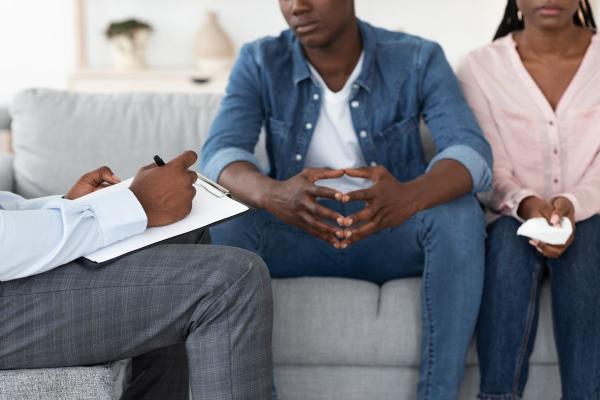
Couples therapy is a collaborative process in which a couple works together with a therapist to address difficulties in their relationship. Through a series of stages, couples therapy aims to strengthen communication, foster mutual understanding, and promote positive changes in relationship dynamics.
Below is a step-by-step breakdown of how couples therapy works.
How many of these have you been "meaning to read" for months?
- 1
 Sounds TrueHow to Carry What Can't Be FixedA Journal for GriefListen Free On Audible
 - 2
 AzujosThe Zen Monkey and the Lotus Flower52 Stories to Relieve Stress, Stop Negative Thoughts, Find Happiness, and Live Your Best LifeListen Free On Audible
 - 3
 MajostaDon't Believe Everything You ThinkWhy Your Thinking Is The Beginning & End Of Suffering (Beyond Suffering)Listen Free On Audible
- initial evaluation: The first step consists of an initial evaluation, where the therapist meets with the couple to gather information about the history of the relationship, current problems, and therapeutic goals. During this phase, the therapist will also establish a trusting relationship with the couple and discuss expectations and boundaries of therapy.
- Exploring Themes and Patterns: The therapist will help the couple identify recurring themes and problematic interaction patterns in their relationship. This involves exploring communication difficulties, recurring conflicts and underlying emotions that contribute to problems.
- Improved communication: Couples therapy focuses on improving communication between members of the couple. The therapist will teach active listening, assertiveness, and constructive negotiation techniques to facilitate more effective and empathetic communication.
- R conflict resolution: The therapist will guide the couple in identifying and resolving conflicts in a healthy way. Different approaches to handling disagreements will be explored and the search for mutually satisfactory solutions encouraged.
- Exploration of emotions and needs: Couples therapy provides a safe space for each member of the couple to explore their individual emotions and needs. The therapist will help the couple develop a deeper understanding of each other’s emotions and find ways to meet each other’s emotional needs.
- Strengthening intimacy and connection: Couples therapy focuses on improving emotional intimacy and connection between partners. The therapist will provide exercises and activities designed to foster closeness and trust in the relationship.
- Planning and maintaining change– As therapy progresses, the therapist will help the couple develop a plan of action to maintain the positive changes made during therapy. They will be provided with strategies to deal with future conflicts and the couple will be encouraged to continue working together even after therapy has concluded.
When couples therapy works, several positive results are seen. First of all, communication improves, allowing couples to express their needs and emotions more effectively. In turn, this leads to greater mutual understanding and empathy promoting a renewed sense of connection.
How effective is couples therapy?
Numerous studies support the effectiveness of couples therapy in the treatment of a wide range of problems in relationships.
However, the effectiveness of couples therapy can vary depending on several factors, such as the nature of the problems in the relationship, the couple’s motivation to actively participate in the therapeutic process, and the quality of the therapeutic relationship established with the therapist.
What is couples therapy for?
Couples therapy has been shown to be effective in treatment of interpersonal conflicts communication problems, lack of intimacy, infidelity, sexual difficulties, financial or family problems and various discrepancies related to raising children.
Additionally, couples therapy can help couples develop conflict resolution skills, allowing them to address problems constructively and avoid harmful patterns of interaction. Couples may also experience an increase in overall relationship satisfaction, greater emotional intimacy and greater stability and mutual commitment.
However, couples therapy is not a quick fix and results may vary depending on the couple and the complexity of the problems they face. In fact, Not all couples experience significant improvements and in some cases, you can make the mutual decision to separate in a healthier way. However, couples therapy provides a safe, structured space to address relationship issues, explore solutions, and strengthen the relationship. In this article you will find more information about How to have a healthy relationship.
What to do when couples therapy doesn’t work
Although couples therapy can be effective in many cases, there are situations in which it may not work as expected. Here are some scenarios in which couples therapy may not work.
- Lack of compromise: Couples therapy requires the active commitment of both parties. If one or both members of the couple are not willing to fully participate in the therapeutic process or are not open to change, the therapy may have difficulty progressing. In these cases, it may be helpful to consider individual therapy or explore other intervention options.
- Violence or abuse: When there is physical or emotional violence or abuse in the relationship, couples therapy may not be appropriate or safe. In these cases, the safety of the partners is paramount and it is important to seek specialized help, such as individual therapy and support resources for victims of domestic or gender violence.
- Unilateral separation decisions: If one or both members of the couple have already made the decision to separate permanently and both parties are not willing to work on the relationship, couples therapy may have a limited scope. In such cases, it may be more appropriate to consider individual therapy to address emotional conflicts and seek support in the separation transition.
- Q Unaddressed underlying issuesIn some cases, couples therapy may not be effective if individual problems are being addressed, such as untreated mental health disorders or active addictions. In such situations, it is important to address these issues individually before embarking on couples therapy.
If the couple has irreconcilable differences in terms of values, life goals or long-term desires, couples therapy will not be effective. In some cases, it may be necessary to consider separation or seek help in mediation to address the practical issues surrounding the breakup.

This article is merely informative, at PsychologyFor we do not have the power to make a diagnosis or recommend a treatment. We invite you to go to a psychologist to treat your particular case.
If you want to read more articles similar to Does couples therapy work? we recommend that you enter our Couples Therapy category.
Bibliography
- Montesano, A. (2015). Fundamental keys in couples therapy: a navigation guide for practice. Dialnet. https://dialnet.unirioja.es/servlet/articulo?codigo=5399362
- De La Espriella, R. (2011). Couples therapy: systemic approach. Colombian Journal of Psychiatry. http://www.scielo.org.co/scielo.php?pid=S0034-74502008000500014&script=sci_arttext
- García, MA, Zuluaga, JC, and Torres, EA (2023). Evidence-based psychological interventions for relationship difficulties: A systematic review. Forest University. https://repositorio.unbosque.edu.co/handle/20.500.12495/9792
Use this citation format to reference the article clearly and help readers find the original source.
PsychologyFor. (2024). Does Couples Therapy Work?. PsychologyFor. https://psychologyfor.com/does-couples-therapy-work/