

See more of our articles in your search results.
The mother-child relationship is the first that human beings establish and one of the most, if not the most, important for the development of the future man or woman. This bond, which begins to be forged during pregnancy, will mark the baby’s pattern of interaction with the world and its understanding of reality as well as the social and emotional bond with others.
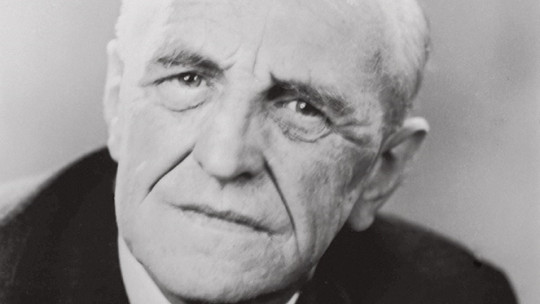
This type of relationships has been studied from different perspectives, such as psychoanalysis, being Donald Woods Winnicott one of the authors who focused his work on it. In this article we are going to briefly review the biography of this important author.
Winnicott Biography: His Early Years
Donald Woods Winnicott was born in Plymouth during the year 1896 Son of Frederick Winnicott, a merchant and politician who would obtain the status of sir and who would transmit to his son the importance of not being tied to dogmas, and Elizabeth Martha Winnicott, he was the youngest and only boy of three brothers.
Winnicott began studying at the age of 14 at Leys College in Cambridge, and later enrolled at the University of Cambridge, studying medicine. During World War I he was drafted and served as a surgeon. Once his service was completed, he was able to finish his career, specializing in the branch of pediatrics. During this race begins to show interest in Freudian psychoanalysis
In 1923 he married Alice Taylor, as well as going to work at Paddington Green Children’s Hospital where he would work for around forty years. That same year would begin to be analyzed by James Strachey while his career as a pediatrician was consolidating.
How many of these have you been "meaning to read" for months?
- 1
 American GirlThe Care and Keeping of You 1The Body Book for Younger Girls (American Girl® Wellbeing)Listen Free On Audible
 - 2
 New Harbinger PublicationsThe Dialectical Behavior Therapy Skills WorkbookPractical DBT Exercises for Learning Mindfulness, Interpersonal Effectiveness, Emotion Regulation...Listen Free On Audible
 - 3
 Penguin Random HouseAtomic HabitsAn Easy & Proven Way to Build Good Habits & Break Bad OnesListen Free On Audible
Beginning of contact with Melanie Klein
Once the analysis with Strachey was concluded and interested in continuing to understand and train in psychoanalysis and especially in its relationship with children, Winnicott would receive the recommendation to contact Melanie Klein.
He began to train with the author, to whom he would propose that she also analyze him. Klein refused and would in turn propose that Winnicott analyze her son Eric, under her supervision. The end result was that Eric’s analysis was accepted but without Klein’s supervision. In this way, a somewhat turbulent relationship would begin between Winnicott and Klein, who were torn between friendship and conflict. Likewise, Winnicott began working with some patients.
Melanie Klein and Winnicott would diverge on several aspects such as the need or not to include the parents in the analysis (while for Winnicott it was essential for Klein not due to the belief that anxiety is due to the projection and introjection carried out by the child and this has nothing to do with the real figure of the parent) or the importance of providing external stimulation.
Over time, a confrontation would arise within the psychoanalytic school of the moment between the followers of Melanie Klein and those of Anna Freud, who had a different vision of psychoanalytic treatment, which, although it came from ancient times, resurfaced at this time in the Society. London Psychoanalysis. In this conflict Donald Woods Winnicott would not take a position for neither of the two, establishing himself as an independent with ideas that brought him closer to both positions.
Second World War and psychoanalytic development
During World War II Winnicott studied the effects of parental separation on children, also participating in minor accommodation programs in shelters due to the risk of bombings. She would also be interested in the changes in the minors upon returning to his family.
Some time later he would separate from his wife, in 1949. In 1951 he would marry Clare Britton, who would be analyzed by Klein after her previous therapist emigrated to Canada. They would not be able to establish a good relationship, considering the first that the second was a bad analyst and the second that Clare was too aggressive to be analyzed.
Donald Woods Winnicott also worked with psychotic patients This author’s opposition to treatments such as electroshock, both for these and other types of patients, is also well known.
During all that time her work was evolving, incorporating different concepts based on both Klein’s theory, the more orthodox postulates of Anna Freud and pediatric practice. Her contribution was of great importance in the development of psychoanalysis.
Winnicott died in 1971 due to cardiac arrest.
Contributions to psychoanalysis
Throughout his career, Winnicott would develop his own thinking of great relevance in the psychoanalytic field, based on various concepts coming from both the Kleinian influence and more orthodox positions within psychoanalytic work.
Her work focused on the dyadic mother-child relationship, considering the father a support for the maintenance of the family nucleus. The mother is a fundamental figure in the psychological development of the child, and her emotional behavior is what will determine whether the baby can achieve her true self by serving as an auxiliary self.
Another aspect that I would take into account is the holding or holding behavior of the mother towards the baby, which allows the baby to gain security and feel loved, allowing it to integrate the representation of itself and others.
I would establish that throughout the development The human being goes through different phases in which there is at first an absolute dependence of the baby on the parents in which he is not able to contain the anguish, and from six months onwards he begins to be aware of the need for them and their care and to express his need, until finally progress is made towards greater and greater independence.
A concept of great importance that Winnicott created is that of a transitional object as one that allows the child to establish a beginning of differentiation between the self and the non-self and that allows him to reduce anxiety in the absence of the mother by provide them with narcissistic libido and object libido Also important are transitional phenomena such as babbling, phenomena and actions that the child does with the same purpose and that allow progressive individuation and socialization.
Use this citation format to reference the article clearly and help readers find the original source.
PsychologyFor. (2024). Donald Woods Winnicott: Biography and Psychoanalytic Legacy. PsychologyFor. https://psychologyfor.com/donald-woods-winnicott-biography-and-psychoanalytic-legacy/