

Understanding normal reactions to stressful situations, knowing how to manage them, and treating symptoms as soon as possible can speed recovery and prevent long-term problems. That is why, in this PsicologíaOnline article, we will talk about the Psychological techniques and strategies that have proven to be effective in controlling stress
Introduction
In addition to what was said above, we also have more professional psychological techniques that after much research have proven to be tremendously effective. Let’s look at some:
Stress syndrome, as we have said, is defined as a combination of several elements: the environment or situation, thoughts (Cognitive response: what we think), physical responses (Physiological response: what we feel) and the way we respond to these elements (Motor response: what we do).
Anxiety inevitably leads us to anguish, helplessness, failure<. Events, negative thoughts and physiological activation of the body contribute to generating stress syndrome. The final result will be anxiety loaded with such anguish that it will provoke a painful emotion. If, as we said at the beginning, a person values or perceives a situation, stimulus or event as dangerous, if in addition to this they interpret the physiological reaction of their body as threatening, they will inevitably feel fear and consequently anxiety will make an appearance. , which in turn will increase fear and thus emotional discomfort.
Formulas
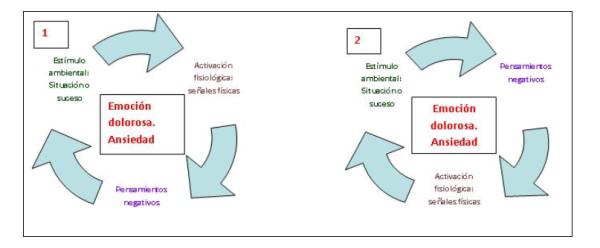
We can explain stress syndrome based on these two formulas.
In the first formula, An environmental stimulus (a broken down vehicle on the road) produces a physiological activation (tension and efforts necessary to look for solutions) followed by a negative interpretation of the activation (I’m fuming, what a disaster, right now, with the rush I’m in, what I was missing..) and finally a painful emotion (anger, rage, despair..). The painful emotion will depend on the interpretation we make and the amount of physiological activation manifested in each person. The greater the physiological activation, the greater the anxiety and the greater the emotional discomfort!
How many of these have you been "meaning to read" for months?


In the second formula an environmental stimulus (starting a business) if negative thoughts occur (it could ruin me, and if it goes wrong, and if I can’t handle it, and if I fail..), it will cause unpleasant physiological activation (tachycardia, sweating, stomach discomfort.. ) which will give rise to a painful emotion (anxiety, anguish, emotional discomfort..).
Given these reactions, a negative feedback loop is created between mind and body that, if it persists over time, will result in stress syndrome. To break this circuit there will be no choice but to modify the thoughts, physical responses or the situation that triggers an alarm reaction or modify our own behavior derived from all this.
The psychological intervention of stress will allow us to use psychophysiological mechanisms in such a way that they allow us to face different situations in the best possible way. At first we defined stress syndrome as a combination of several elements: environment, negative thoughts, physiological responses and behaviors. Anyone can break the stress circuit as soon as we intervene or change one of these elements. As soon as we act and modify one of them we will be intervening and modifying the rest.
It doesn’t matter which of them we intervene in Well, in order to intervene in one of them we will be modifying and breaking the chain generated up to that moment for the mere fact of doing something different from what was being done. The negative feedback loop will be modified as soon as we act differently than we were doing. Once we learn to detect negative thoughts and the physical activation that accompanies these thoughts or the behaviors derived from all of this and we modify them for our own benefit, physical activation will no longer be able to increase until it produces painful emotions, because We will learn to deactivate the stress system in its beginnings and with this we will have taken a big step towards self-control and towards positive change.
After years of experience and research, we have proven that it is essential to learn to discover the anticipatory and automatic thoughts that contribute to generating anxiety and psychophysiological discomfort. Their knowledge will allow us to guarantee the success of the psychotherapy that we apply in each case.
See more of our articles in your search results.
Example
“In front of a group of elderly people, a woman scolds another for being late to a meeting, yells at her and insults her, criticizing her for having interrupted what was being discussed at that moment.
Each of the people who have seen the scene reacts and interprets it in their own way, one of the attendees is startled and begins to cry, another agrees with her, another gets angry and responds that it is not for her to get like that, a man criticizes her Because it is so intolerant, others feel embarrassed by the scene and remain silent..” There will be as many different responses and opinions as there are people in the room.”
With this example we see how the same situation can provoke the most disparate responses and emotions. These responses will be very varied and the immediate consequence of how each of the observers thinks, perceives, interprets and judges the problem.
It is a characteristic of the human being to continually self-describe the world, providing each of the events or experiences with labels that little by little we turn into absolute truths based on which we give our opinions, behave and adapt to the environment. These labels will be more or less adaptive depending on how we tell ourselves things throughout the endless dialogue we maintain with ourselves. and that we adorn it with interpretations that we contribute as we tell ourselves the same things over and over again until it gains more and more strength, this makes us internalize it until it becomes part of our functioning repertoire. We can compare this internal dialogue as a waterfall of thoughts that flows from the mind without any interruption. On rare occasions we are aware of such thoughts because most of the time they are automatic and unconscious, although powerful enough to create the most intense emotions.
These thoughts have, among others, the following characteristics:
- Are specific messages and concrete things that we give to ourselves.
- They are shorthand, composed of few words or by very brief visual images.
- They are automatic and although on many occasions they are totally irrational and absurd, we almost always believe them and assume them as absolute truths.
- They are spontaneous, they appear suddenly and bombard us without being able to stop them.
- They usually come accompanied by expressions like: “would have to, would have to, should, and if..”<
- When they are negative, they tend to anticipate all kinds of disasters, dramatizing and tending to see things, even the simplest ones, in a totally negative, harmful and complex way.
- They are relatively idiosyncratic, That is, the same situation can generate different thoughts and emotions depending on each person, culture and even a national, regional or ethnic community.
- They are very difficult to cut divert or substitute.
- They are totally learned thanks to the continuous repetition of them..
Our “mind/thought” is a very powerful instrument that can increase or decrease the amount of pressure, anxiety or stress that a circumstance or situation can “produce” in us. Our education in general, coming from family, school, society, etc., teaches us to evaluate the world and experiences in certain specific ways, which leads us to develop various areas of sensitivity and behaviors. We also develop different expectations and beliefs about events, people, personal self-worth, abilities, and the nature of things in general.
We can influence anxiety and emotional disorders that we experience by changing the way we perceive and interpret experiences, modifying our attitude towards events and therefore our way of responding to them. It is about having alternative objectives, resources, skills and strategies to achieve them; We review the strategies and keep the most promising and effective ones, discarding those that turn out to be less effective. Later we put them into practice and evaluate the consequences of the decision made.
Many of the problems that arise and that we do not always know how to solve in an adaptive way are due to a series of errors that, without realizing them, we often make. It will be essential to learn to observe them, detect them and act accordingly, for this it will be essential to know them first so that once known, you can act and solve them.

Cognitive error
Among the most frequent cognitive errors that cause us the most damage, we can consider the following:
- All or nothing thinking (polarized, absolutist)
- Perfectionism
- Overgeneralization or overgeneralization
- Catastrophic thinking
- Filtering or attentional focusing
- Amplification of the negative and minimization of the positive (selective abstraction)
- Disqualify the positive by magnifying or minimizing
- Negative self-evaluation
- Psychological need
- Attention focused on satisfying the other in an absolutist way
- The shoulds, excessive demands (to oneself or others)
- Personalization or self-referential thinking (self-centered attention)
- Hasty conclusions (without presenting doubts or evidence)
- emotional reasoning
- Guessing or interpreting the thoughts of others (mind reading)
- Future prediction
- Anticipation with negative prediction
- label thinking, improper labeling (self or others)
- Low self-confidence (I can’t do it, I can’t stand it)
- Guilt (attributing blame to self or others)
- control fallacy
- fallacy of justice
- fallacy of change
- Be right
- Justifications or self-deception
This article is merely informative, at PsychologyFor we do not have the power to make a diagnosis or recommend a treatment. We invite you to go to a psychologist to treat your particular case.
If you want to read more articles similar to Effective psychological techniques and strategies to control stress we recommend that you enter our Cognitive Psychology category.
Use this citation format to reference the article clearly and help readers find the original source.
PsychologyFor. (2023). Effective Psychological Techniques and Strategies to Control Stress. PsychologyFor. https://psychologyfor.com/effective-psychological-techniques-and-strategies-to-control-stress/