

See more of our articles in your search results.
Living beings adopt two types of basic vital strategies when it comes to conceiving offspring: asexual and sexual reproduction.
In asexual reproduction, a cell or a group of cells from a parent organism gives rise to another functional individual, genetically equal to its father or mother. This is achieved through bipartition, budding, polyembryony, parthenogenesis and other complex processes.
On the other hand, in sexual reproduction there are individuals of two genders within a species: males and females. Both produce gametes with half the genetic information of the rest of the cells (they are haploid) and, when put together, they give rise to a zygote that recovers its normal chromosome number (diploidy). This process is much more expensive than the previous one, but it has a series of advantages that explain the evolution in themselves.
In asexual reproduction, all offspring are equal to the parent organism. On the other hand, in the sexual case, each offspring has a different genetic makeup, since half of its chromosomes are maternal and the other half are paternal. Due to crossing over, chromosome permutations, and other processes that occur during meiosis, no offspring is the same as its sibling (unless they are twins). Next, we will tell you what it has to do with genetic segregation with all these terms.
What is genetic segregation?
If you have been interested in genetics at some point in your life, Gregor Mendel is surely familiar to you. This Augustinian friar, Catholic and naturalist, formulated thanks to his experiments with peas (Pisum sativum) Mendel’s well-known laws, published between 1865 and 1866. Unfortunately, these documents did not begin to gain notoriety in scientific culture until 1900, when Mendel had already died.
How many of these have you been "meaning to read" for months?
- 1
 American GirlThe Care and Keeping of You 1The Body Book for Younger Girls (American Girl® Wellbeing)Listen Free On Audible
 - 2
 New Harbinger PublicationsThe Dialectical Behavior Therapy Skills WorkbookPractical DBT Exercises for Learning Mindfulness, Interpersonal Effectiveness, Emotion Regulation...Listen Free On Audible
 - 3
 Penguin Random HouseAtomic HabitsAn Easy & Proven Way to Build Good Habits & Break Bad OnesListen Free On Audible
For its part, The term “genetic segregation” refers to the distribution of genes from parents to offspring during meiosis, that is, the reason for the genome resulting from the offspring after the union of different parents. To exemplify the mechanisms of gene segregation, it will be very helpful to briefly review Mendel’s three laws, which is why we have made special mention of his figure.
Since we are going to immerse ourselves in Mendel’s world, we must lay certain foundations. First of all, it should be noted that we are going to focus on diploid beings, that is, animals and plants that have two sets of homologous chromosomes of each type in their nucleus (2n). If the human being has 46 chromosomes within each cell, 23 come from the mother and 23 from the father.
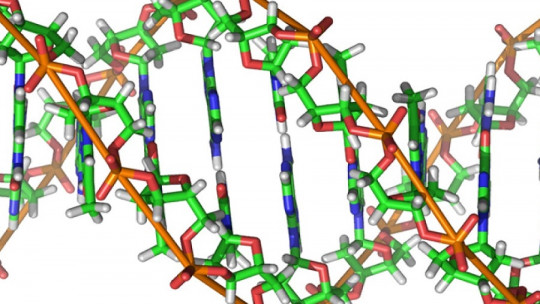
Within each chromosome, there are a series of ordered DNA sequences that have the information necessary to synthesize proteins or RNA: genes On the other hand, each gene can present various “forms” that depend on the nucleotide sequence, which are called alleles. Since we have two chromosomes of each type in our cell nuclei, we claim that we also have two alleles for each gene.
A particular allele, according to typical Mendelian genetics, can be dominant (A) or recessive (a). Dominant alleles are those that are expressed independently of their partner (AA or Aa), while recessive alleles require that both alleles are the same for the same gene (aa). For a given gene, an individual can be homozygous dominant (AA), homozygous recessive (aa), or heterozygous (Aa). In the latter case, the dominant trait (A) is expressed and the other is masked (a).
With these ideas in mind, we can only clarify that The genotype is the set of genetic information in the form of DNA that a specific living being carries while the phenotype is the part of that genome that is expressed at a visible level.
At this point, it should be emphasized that the phenotype is a product of the environment and genes, so the genome does not always fully explain external traits. Now, let’s look at Mendel’s laws.
Phenotype: genotype + environment
1. Uniformity principle (first generation)
Let’s give a fictitious example that is a little different from the typical Mendelian pea seeds Imagine with us, for a moment, that a species of bird has the COL1 gene in its genome, which encodes feather coloration.
In turn, this gene has two variants: COL1A and COL1a. The first allele (A) is dominant and manifests at the phenotype level with a red tone, while the second (a) is recessive and manifests with a yellow color.
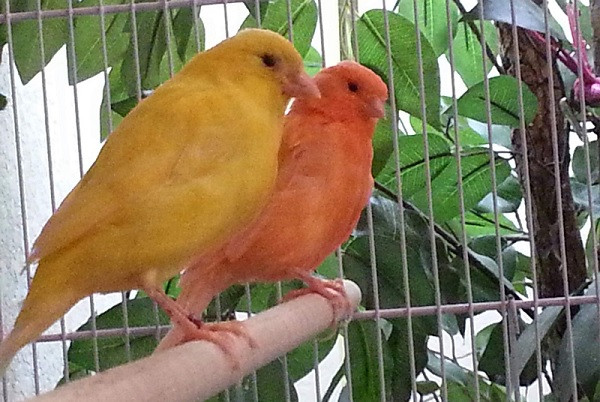
According to the principle of uniformity, If two homozygous parents come together (one has the two AA alleles and the other has the two aa alleles), all the children will be heterozygous (Aa) for that gene, without exception. Thus, one of the parents will be red (AA), the other will be yellow (aa) and all the offspring will also be red (Aa), since the red trait is superimposed on top of the yellow.
2. Principle of segregation (second generation)
Let’s now see what happens if this red generation (Aa) reproduces among itself. First we apply the formula and then explain the result:
Aa x Aa= ¼ AA, ¼ Aa, ¼ Aa, ¼ aa
According to these values, if two heterozygotes for a given gene are crossed, 1 in 4 offspring will be homozygous dominant, 2 in 4 will be heterozygous and 1 in 4 will be homozygous recessive
If we return to our example, we will see that from two paired red parents three out of four red children also emerge (the Aa and AA), but one of them recovers the yellow phenotype (aa), which was masked in the previous generation.
Thus, the frequency of the red trait is distributed in the population at a ratio of 3:1. With this very basic statistical inference, it is shown that The parental alleles are segregated during gamete production through meiotic cell division
3. Principle of independent transmission (third generation)
To see how the alleles are distributed if we cross members of the third generation with each other, we would need a table with a total of 16 spaces, since each variant (AA, Aa, Aa and aa) can reproduce with any of the others (4×4: 16).
We are not going to focus on these results, since it has been clear to us with the previous example that the dominant red trait is the one that will prevail in the color of our birds’ feathers.
In any case, we are interested in rescuing an idea of the principle of independent transmission: different traits encoded by different genes are inherited independently, that is, the inheritance pattern of the “feather color” trait that we have shown you does not have to affect the “beak size” trait. This is only applicable for genes that are on different chromosomes, or at considerable distances within the same chromosome.
The limitations of genetic segregation postulations
Although these laws laid the foundations for what we know today as genetic inheritance (and therefore, molecular genetics and all aspects of the discipline), it is necessary to recognize that they fall a little short after obtaining certain knowledge.
For example, These postulations do not take into account the effect of the environment on the phenotype (external appearance of the specimen) and the genotype (its genome) If the feathers of our birds fade due to the action of the Sun’s rays (something without any basis, just to give an example), it is possible that the phenotype of red birds turns orange, not red. Despite being specimens with AA or Aa alleles for the COL1 gene, the environment modifies what is external and visible.
It is also possible that feather color is encoded by the interaction between several genes, such as COL1, COL2, COL3 and COL4. Imagine, furthermore, that one of them has greater predominance over the rest and is more decisive for the final phenotype. Here 8 different alleles come into play and very complex genetic issues that cannot be explained solely with Mendel’s laws, so it would be necessary to enter the realms of quantitative genetics.
As a final clarification, we want to make it clear that all the examples cited here are fictitious, since we have no knowledge of whether there really is a COL1 gene that encodes one shade or another in a species of bird in nature. The human being has about 25,000 genes in its genome so imagine having to categorically affirm or deny the existence of phenotypes and genotypes in many other wild species that have not even been sequenced.
What we want to make clear is that, with these laws of genetic segregation that we have shown you through examples, the separation of alleles during the production of gametes is explained by a meiotic cell division in reproductive events. Although many traits are not governed by these mechanisms, they are always a good starting point to begin the study of genes, whether at an informative or professional level.
Use this citation format to reference the article clearly and help readers find the original source.
PsychologyFor. (2024). Genetic Segregation: What it Is, Characteristics and Examples. PsychologyFor. https://psychologyfor.com/genetic-segregation-what-it-is-characteristics-and-examples/