

See more of our articles in your search results.
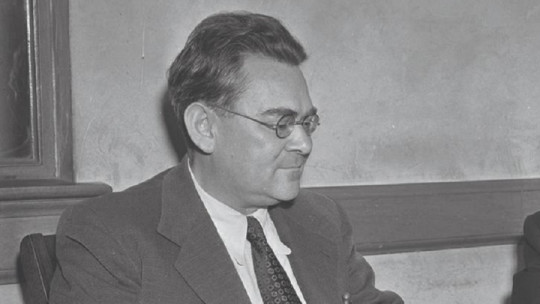
Within the different philosophical movements that emerged in Europe throughout the 20th century, Reichenbach is one of the prominent authors.
Below we will be able to better understand all the episodes in the life of this philosopher and thus better understand what were the great contributions that he was able to make in that discipline thanks to the extensive training he received and which allowed him to combine different knowledge. Here you will find a biography of Hans Reichenbach in summary format.
Brief biography of Hans Reichenbach
Hans Reichenbach was born in 1891 in the city of Hamburg, at that time belonging to the German Empire His family was of Jewish descent, although they had converted to Protestant Christianity. His upbringing took place in his hometown. Once he completed primary and secondary education, he decided to begin his higher education.
His university life was intense. On the one hand, he studied engineering at the Stuttgart University of Technology of Applied Sciences, but also He decided to continue his studies, this time in the field of mathematics and physics on the one hand, and philosophy on the other To do this, he successively enrolled in different German universities, such as Berlin, Munich, Göttingen or Erlangen.
All of Hans Reichenbach’s academic experience was also nourished by the experience of having had some professors who were true eminences in their respective fields. Some examples could be Ernst Alfred Cassirer in philosophy, Max Bon and David Hilbert in mathematics, or Arnold Johannes Wilhelm Sommerfeld and Max Karl Ernst Ludwig Planck himself, who would win the Nobel Prize.
How many of these have you been "meaning to read" for months?


But university life was not only useful for his training, since he was also a very active component in different student movements. He joined the Freistudentenschaft, one of the most important groups. Likewise, he was present when the Freideutsche Jugend was created; He wrote different articles in this area, in which he talked about the reform of universities.
This activism progressively brought him closer to communist groups, also counting on the influence of his brother, who was a member of the left-wing communist movement. Hans Reichenbach joined the Communist Workers’ Party of Germany. He achieved a prominent position in it, and so much so that he participated on behalf of the party in the Executive Committee of the Communist International.
He became increasingly involved in the political side of student organizations, to the point of founding and presiding over the Berlin Student Socialist Party. The germ of this group already existed in a veiled form, due to the vetoes that existed on these movements, but it was with Hans Reichenbach when it definitively crystallized into a visible organization.
During this time he had the opportunity to interact with some of the most important activists of the time in Germany, such as Alexander Schwab and Karl August Wittfogel, although both abandoned their communist position later, and even Wittfogel renounced this ideology after the events of the Second World War.
However, despite these intense years of involvement in political and protest activities, Hans Reichenbach completely abandoned this facet of his life around the year 1920. It was as a result of attending a series of conferences by one of the most important scientists. important in the history of humanity, Albert Einstein, in which learned about the theory of relativity, which would revolutionize the world of physics
Development of your career
After obtaining the degrees listed above, Hans Reichenbach earned his doctorate, publishing a thesis in which he talked about the concept of probability to mathematically represent reality. In these years the First World War broke out, in which his country, Germany, was involved, so he was forced to serve in the army, although in 1917 he would return home for health reasons.
Come the year 1920, He began his time as an academic, working for the Technische Hochschule at the University of Stuttgart In addition, he also published his work, “The theory of relativity and a priori knowledge”, where he united two of his fields of knowledge, which were physics and philosophy. In this volume, he confronted some of Kant’s approaches.
This was the beginning of a prolific era in which he published a succession of books of this type, such as Axiomatization of the Theory of Relativity, in 1924, From Copernicus to Einstein, in 1927, or The Philosophy of Space and Time, in 1928. Hans Reichenbach tried to propose approaches between positivist logical philosophy and the theory of relativity of physics.
His good relationship with Planck, von Laue and Albert Einstein himself made it easier for him to join the physics department at the University of Berlin, as an assistant professor. His way of teaching classes represented a small revolution, as he left the rigid academic schemes and promoted an atmosphere of debate which was not common at that time.
Come 1928, Hans Reichenbach created the Berlin Circle, an association whose backdrop was the philosophy of logical empiricism This group was joined by personalities of the stature of David Hilbert, Richard Edler von Mises, Carl Gustav “Peter” Hempel and Kurt Grelling. He also launched a philosophy magazine, in partnership with author Rudolf Carnap. The publication was named Erkenntnis, a term that means knowledge.

Exile to Türkiye and the United States
When the year 1933 arrived, With the rise of Nazism to power in Germany, reprisals against people of Jewish origin began, as was the case of Hans Reichenbach even though his family had converted to Protestantism and he himself had married Selma Menzel under this faith.
Therefore, because of the new racial laws that were imposed in Germany, Reichenbach lost his position at the University of Berlin. He knew that this was just the beginning, so he decided to leave the country immediately. His first destination, outside the German borders, was Türkiye.
In this country he was well received and He soon resumed his career as a teacher, this time at Istanbul University, where he headed the philosophy department Over the next few years, he taught classes at this institution, while also organizing seminars and courses on other disciplines in which he was also an expert. In 1935 he published another of his famous works, “The Theory of Probability.”
Thanks to his contacts with authors such as Charles William Morris, he was able to agree to join the University of California, Los Angeles, as a professor of philosophy, so In 1938 he moved to the United States to take a new step in his career Thanks to the work of Hans Reichenbach, the philosophy department of this university became a reference in the United States.
Throughout this stage, he trained students who would end up excelling in this field. Some of the most notable could be Wesley Charles Salmon, Hilary Whitehall Putnam and Carl Hempel, who had previously dealt with Hans Reichenbach and belonged to the Berlin Circle. During these years, he also continued to publish works, including some of the most important volumes he created.
Among them are, for example, “Philosophical Foundations of Quantum Mechanics”, from 1944, “Elements of Symbolic Logic”, from 1947 and probably his most influential book, “The Rise of Scientific Philosophy”, which published in 1951.
Final years and death
Hans Reichenbach was at the peak of his career. He taught classes at a prestigious university, was a reference in his field and had just published some of his best works. Some of his most recent works dealt with such exciting topics as the philosophy of time and other questions about the scientific laws of nature
In his research on time, he studied this concept in language and established three different typologies, which would be the time of speech, the time of the event and the time of reference. This differentiation was later collected by language experts to make the distinction between different verbal tenses.
In fact, this work crystallized in his last two works, which were “The direction of time” and “Nomological declarations and admissible operations.” Unfortunately, both were published posthumously, since Hans Reichenbach died suddenly due to a heart attack. It was 1953 and he was 61 years old when this tragic event happened.
In any case, his career was already successful enough to leave a legacy that survives to this day.
Use this citation format to reference the article clearly and help readers find the original source.
PsychologyFor. (2024). Hans Reichenbach: Biography of This German Physicist and Philosopher. PsychologyFor. https://psychologyfor.com/hans-reichenbach-biography-of-this-german-physicist-and-philosopher/