


See more of our articles in your search results.
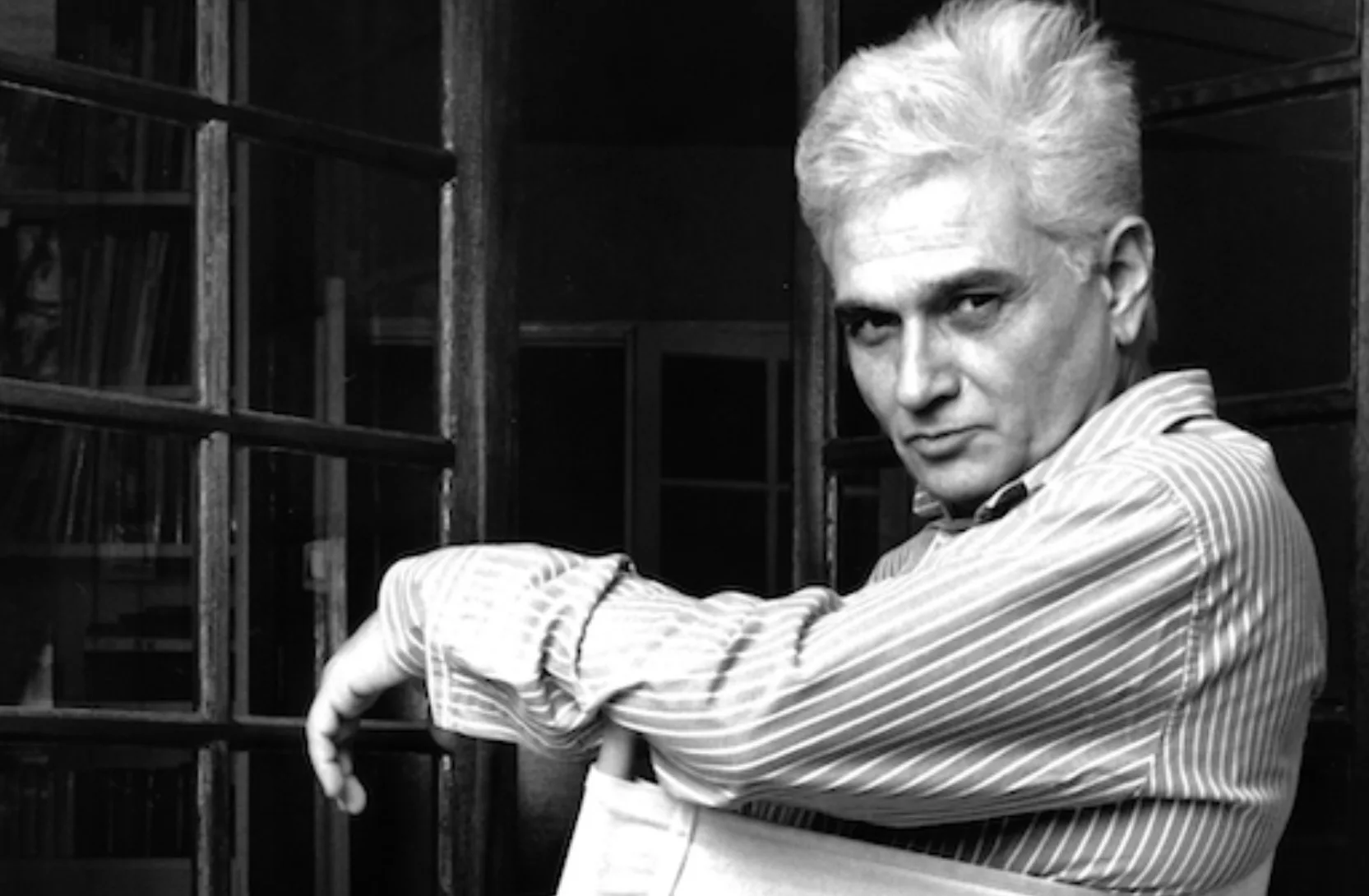
Jacques Derrida (1930–2004) was one of the most influential, prolific, and controversial philosophers of the twentieth century—a Algerian-born French thinker who upended the foundations of Western philosophy with a single, deceptively simple question: What if the texts, concepts, and categories we use to make sense of the world contain hidden contradictions that undermine their own claims to stable meaning? The answer he spent a lifetime elaborating became known as deconstruction—a method of close, critical reading that exposed the internal tensions and unacknowledged assumptions running through philosophy, literature, linguistics, law, psychoanalysis, and virtually every domain of Western thought. From his earliest publications in 1967 to his death from pancreatic cancer in 2004, Derrida produced nearly fifty books and countless essays that transformed intellectual life across multiple continents, sparked fierce debates in academic departments, shaped the development of literary theory and cultural studies, influenced feminist and queer theory, and left an indelible mark on how educated people in the late twentieth century thought about language, meaning, identity, and power.
He was not an easy philosopher. That’s worth acknowledging upfront. Derrida’s prose is notoriously demanding—labyrinthine, digressive, full of neologisms and punning wordplay that is sometimes brilliant and occasionally maddening. Academics have spent decades arguing about whether his difficulty is the necessary price of genuine philosophical depth or a kind of elaborate performance. The debate itself says something interesting about Derrida, who was fascinated, throughout his career, by the way meaning resists simple transmission—the way every text, every speech act, every communication contains more than its author intends and says something other than what it appears to say.
But before the philosopher, there was the person: a Jewish child in colonial Algeria who was expelled from school because of his ethnicity; a young man who moved to Paris alone at nineteen and failed his entrance examinations twice before succeeding; a thinker who spent the rest of his life questioning the very structures of authority and inclusion that had once excluded him. To understand Derrida’s philosophy, it helps enormously to understand his biography—because his intellectual project was never entirely separable from his personal experience of being on the margins, of being the other, of being named by systems that didn’t recognize him as fully belonging.
This is the story of that life—and the ideas it produced.
Early Life: Algeria and the Experience of Exclusion
Jackie Derrida—he wouldn’t change his name to the more formal “Jacques” until adulthood—was born on July 15, 1930, in El Biar, a town near Algiers in what was then French Algeria. He was the third child of Haïm Aron Prosper Charles Derrida and Georgette Sultana Esther Safar, a Sephardic Jewish family that had lived in North Africa for generations. He would later describe his family as “small, colonized colonials”—Algerian Jews who held French citizenship and aspired to French culture, occupying an ambiguous position between the European colonial population and the Arab and Berber majority.
How many of these have you been "meaning to read" for months?


This ambiguity—belonging fully to neither group, recognized completely by neither identity—would become one of the defining themes of Derrida’s life and thought. He was French but not quite French, Jewish but not observant, Algerian but shaped by a European education. He was, from early childhood, acquainted with the experience of the threshold—of occupying a space between categories rather than being firmly inside any of them.
In 1942, when Derrida was twelve years old, that ambiguity became concrete and traumatic. Under the anti-Semitic laws of the Vichy regime—which applied to French Algeria despite its distance from occupied France—Jewish children were expelled from French public schools. Derrida was removed from his lycée and briefly enrolled in a Jewish school before largely withdrawing from formal education. The experience left marks he would discuss late in his life in terms both of psychological devastation and intellectual consequence: being excluded from the institution that was supposed to welcome you, defined as other by the very structures claiming to be universal, is perhaps the most vivid possible introduction to questions of inclusion, identity, and the violence of categorization.
After the war, Derrida returned to formal schooling. He was a bright, ambitious student, fascinated by literature and philosophy, drawn to writers like Rousseau, Gide, and Nietzsche. His adolescence in postwar Algeria was marked by the tensions that would culminate, in the 1950s, in the Algerian War of Independence—a conflict whose political and ethical dimensions he would grapple with throughout his career, even when he appeared to be writing about ancient Greek texts or Romantic literature.
Paris: The Formation of a Philosopher
In 1949, at nineteen, Derrida moved to Paris to pursue the education that the French academic system demanded of anyone with serious intellectual ambitions. He enrolled as a preparatory student at the prestigious Lycée Louis-le-Grand, where he would spend three years preparing for the entrance examination to the École Normale Supérieure—the grande école that has produced more distinguished French intellectuals than any other institution in the country.
The transition was difficult. Derrida was an Algerian Jew in a world that was very specifically Parisian, very specifically bourgeois, and very specifically French in ways that didn’t map neatly onto his background. He suffered from depression and felt profoundly out of place. He failed the entrance examination to the ENS twice before passing on his third attempt—a failure that, he would later reflect, was partly the result of deliberate self-sabotage, a refusal to fully capitulate to the institutional demands that admission required.
At the ENS, however, he found his footing. He immersed himself in philosophy—in the phenomenology of Edmund Husserl and Martin Heidegger, in the structuralist linguistics of Ferdinand de Saussure, in the psychoanalytic thought of Sigmund Freud. These were the intellectual materials from which deconstruction would eventually be forged. He passed the agrégation de philosophie—the rigorous examination required to teach philosophy in France—in 1956, and immediately began working on Husserl’s text The Origin of Geometry, producing a translation and a long introduction that would be his first major publication.
The Husserl work was significant because it established the characteristic gesture of Derrida’s entire subsequent project: reading a major philosophical text with extreme care and discovering that it contains problems it cannot solve—tensions between what it intends to say and what it actually says, between its explicit claims and the logic that underlies them. With Husserl, Derrida found that the attempt to ground meaning in pure conscious presence—the phenomenological project at its most ambitious—encounters internal obstacles that cannot be overcome on its own terms. That discovery, refined and extended over decades, became deconstruction.
The Algerian War and Early Academic Career
When the Algerian War of Independence erupted in 1954, Derrida faced the prospect of military service. He successfully negotiated an alternative arrangement: rather than serving in the army, he would teach French and English to the children of soldiers from 1957 to 1959. It was a compromise that reflected both his practical ingenuity and the deep ambivalence he felt about a war in which his own identity—as an Algerian, as a Jew, as a French citizen—placed him in an almost impossibly complicated position.
Following this interlude, Derrida began his formal academic career. From 1960 to 1964, he taught philosophy at the Sorbonne as a junior assistant, working alongside some of the most distinguished philosophers in France: Suzanne Bachelard, Georges Canguilhem, Paul Ricœur, and Jean Wahl. These were years of intellectual formation and increasing confidence. He was developing the ideas that would eventually appear in his landmark publications, reading widely across philosophy, literature, and linguistics, and beginning to find a distinctive voice.
In 1964, he received a position at the École Normale Supérieure, where he would teach for the next twenty years. The ENS appointment gave him a stable platform and access to the best students in France. Among his students during this period were figures who would go on to significant careers of their own. The intellectual atmosphere of the ENS in the 1960s—charged with the legacy of Sartrean existentialism, the rise of structuralism, the political ferment that would culminate in May 1968—was the perfect environment for the kind of ambitious, transgressive philosophical project Derrida was developing.
The Year of Three Books: 1967 and the Emergence of Deconstruction
If there is a single year in Derrida’s biography that changed intellectual history, it is 1967. In that year, he published three books simultaneously—a feat that would be remarkable under any circumstances, but that in this case represented the coordinated emergence of an entirely new philosophical framework. The three books were Of Grammatology, Writing and Difference, and Speech and Phenomena.
Of Grammatology is perhaps the most foundational of the three. Its central argument concerns the relationship between speech and writing in Western philosophy—and in Western culture more broadly. Derrida observed that the entire philosophical tradition, from Plato to Rousseau to Lévi-Strauss, had consistently privileged speech over writing: oral language was understood as immediate, present, alive, authentic, while writing was treated as secondary, derivative, a mere transcription of the real thing. Derrida called this privileging logocentrism—the centering of meaning on the logos, the Word, understood as a form of living presence.
His argument was that this hierarchy was not a neutral observation about how language works but a philosophical construction with profound consequences—and that it was internally contradictory. Writing, Derrida argued, is not secondary to speech; rather, the features that philosophy had attributed exclusively to writing—iterability, absence, the possibility of meaning without a present speaker—are actually features of all language, including speech. The clean distinction between presence and absence, speech and writing, cannot be maintained under close examination. This argument, which sounds technical when summarized, had implications that ranged from the philosophy of language to ethics, politics, and the understanding of identity itself.
Speech and Phenomena conducted a sustained critical reading of Husserl’s theory of signs, showing how the phenomenological project, despite its aspirations to absolute self-evidence and pure presence to consciousness, relies on precisely the temporal and linguistic structures it claims to transcend. Writing and Difference collected essays on figures including Freud, Artaud, Levinas, and Foucault, demonstrating the range of texts and disciplines to which deconstructive reading could be applied.
Together, these three books established Derrida as one of the most significant philosophers of his generation—and sparked a controversy that would continue for the rest of his life and beyond. Some readers recognized in his work a genuinely new way of thinking about language, meaning, and the history of philosophy. Others accused him of nihilism, of undermining the possibility of truth and rational inquiry, of philosophical irresponsibility dressed up in elaborate prose. The debate was real, productive, and sometimes bitter. It defined the intellectual landscape of the humanities for decades.

Key Philosophical Concepts
Understanding Derrida’s biography requires at least a passing familiarity with the key concepts he developed, because his intellectual project was not a series of separate inquiries but a sustained elaboration of interconnected ideas that built on each other across decades of writing.
Deconstruction is the concept most associated with Derrida’s name, and the most frequently misunderstood. It is not a method of destruction or demolition, not a claim that texts mean nothing, not a license for arbitrary interpretation. Derrida described it as a way of reading that attends to the tensions, contradictions, and unstated assumptions within a text—the way a text undermines its own explicit claims, the hierarchies it constructs and then quietly destabilizes. Deconstruction is a practice of slow, careful, responsible reading, not a shortcut to saying that everything is relative.
Différance is perhaps Derrida’s most original and influential neologism—a word he coined by combining two senses of the French verb différer: to differ and to defer. In Derrida’s account, meaning in language is never fully present; it is always produced through a process of differentiation from other terms and is always deferred, never arriving at a final, stable resting place. The word différance (with an ‘a’ rather than an ‘e’) cannot be heard in spoken French—the pronunciation is identical to différence—which means the neologism only becomes visible in writing, a point Derrida was making deliberately about the relationship between speech and writing.
The trace refers to the way every element of language carries within it the marks of what it is not—the other terms it differs from, the history of its usage, the absences that make its presence possible. Meaning is never pure or self-contained; it always bears the trace of its others. The supplement is a concept Derrida derived from his reading of Rousseau, referring to something that is supposed to be merely additional, secondary, extra—but which turns out to be necessary to the thing it supplements, thus destabilizing the hierarchy between original and supplement, nature and culture, speech and writing.
International Fame and the “French Theory” Phenomenon
Derrida’s international reputation grew rapidly from 1968 onward, fueled particularly by his influence in American academic circles. In 1966, he had attended a famous conference at Johns Hopkins University titled “The Languages of Criticism and the Sciences of Man”—an event designed to introduce French structuralism to American academics. Derrida’s paper, “Structure, Sign and Play in the Discourse of the Human Sciences,” was a sensation: he essentially argued that structuralism itself was caught in the same metaphysical assumptions it claimed to have overcome. The paper announced the arrival of post-structuralism to an American audience, and it announced Derrida as one of its defining figures.
From 1975, Derrida taught regularly at Yale University, becoming associated with the Yale School of deconstruction—a group that included literary critics Paul de Man, Geoffrey Hartman, Harold Bloom, and J. Hillis Miller, who were applying deconstructive reading strategies to literary texts. This American connection was crucial to Derrida’s global impact. In the United States, his work became the foundation of what came to be called “French Theory”—a body of thought associated with Derrida, Foucault, Lacan, Deleuze, and others, which transformed humanities departments at major American universities throughout the 1970s, 1980s, and 1990s.
Not everyone welcomed this transformation. In 1992, when Cambridge University proposed awarding Derrida an honorary doctorate, a group of philosophers—including Willard Van Orman Quine—published a letter of protest in the press, arguing that Derrida’s work did not meet the standards of genuine philosophical rigor. Cambridge proceeded with the award, but the controversy illustrated the depth of opposition his work generated among philosophers trained in the Anglo-American analytic tradition.
Derrida was not silent in these debates. He engaged his critics directly, sometimes acerbically, and he was as capable of polemical combat as of patient philosophical exposition. But he also consistently resisted the reductive readings of his work—the idea that deconstruction was a form of nihilism, or that questioning the foundations of Western metaphysics meant abandoning the commitments to reason, justice, and responsibility.
Later Work: Ethics, Politics, and Justice
A significant development in Derrida’s later career was the increasing prominence of explicitly ethical and political concerns in his writing. This surprised some readers who had associated deconstruction primarily with questions of textuality and linguistic structure. But Derrida had always maintained that the political implications of his work were substantial, and from the 1980s onward he made those implications explicit.
He addressed questions of justice, hospitality, friendship, democracy, mourning, the gift, forgiveness, and the relationship between law and justice. His 1994 book Specters of Marx—written just after the fall of the Berlin Wall and the triumphalist declarations of capitalism’s final victory—argued for the continuing relevance of a certain spirit of Marxist critique even in the absence of the institutional structures of communist ideology. The book was controversial, characteristically, but it demonstrated that Derrida’s engagement with political philosophy was neither superficial nor merely rhetorical.
He was also politically active in concrete ways. He campaigned against apartheid in South Africa at a time when many Western intellectuals were reluctant to engage. He helped found the Jan Hus Association in 1981, which provided support and solidarity to dissident intellectuals in Czechoslovakia. He was a consistent and vocal opponent of the death penalty. He engaged with questions of immigration, asylum, and the obligations of nations toward those who cross their borders. These weren’t marginal concerns—they were connected to the deepest preoccupations of his philosophical work, and to the biography of a man who had experienced, from childhood, what it meant to be excluded, classified, and refused full belonging.
In 1983, with François Châtelet and others, he co-founded the Collège International de Philosophie in Paris—an institution dedicated to philosophical research that could not be conducted within the constraints of the official academic system. The Collège was a direct expression of Derrida’s commitment to democratizing intellectual life, to creating spaces where questions could be asked that existing institutions were structured to avoid. In 1984, he was elected to a permanent position at the École des Hautes Études en Sciences Sociales, where he remained until his death.
Personal Life and Human Dimensions
Derrida married Marguerite Aucouturier in 1957, and they had two sons, Pierre and Jean. A third son, Daniel, was born from a relationship with philosopher Sylviane Agacinski, though Derrida did not publicly acknowledge his paternity for many years—a biographical fact that generated controversy and that sits in uncomfortable tension with his philosophical commitments to responsibility and the other.
Those who knew Derrida personally describe a man quite different from the arcane academic of popular caricature. He was warm, generous with students, genuinely curious, given to humor, and deeply emotional. His seminars at the EHESS were legendary in Paris academic circles—attended by students, academics, and intellectuals from across disciplines who came to witness a mind working through problems in real time, often without a completed text in front of him. He was a demanding but attentive intellectual presence, one who took his interlocutors seriously precisely because he believed that genuine thought happened in encounter with others, in the friction of dialogue and disagreement.
He was also, particularly in his later years, profoundly concerned with themes of mortality, memory, and what survives after death. His seminars on the death penalty, his extended meditations on mourning and friendship (including his essays on friends and colleagues who predeceased him), and his autobiographical writings all circle around the question of what it means to live toward death—a preoccupation that the psychologically minded reader will recognize as deeply human, however philosophical the idiom in which he expressed it.
Final Years and Death
In 2003, Derrida was diagnosed with pancreatic cancer. He continued working with remarkable intensity in the time remaining to him—giving seminars, completing manuscripts, granting interviews in which he reflected on his life and legacy with striking candor. He declined to offer false reassurances about what awaited him, and he declined equally to perform acceptance. In a 2004 interview with Le Monde, conducted just months before his death, he said: “I have not learned to accept death… I remain uneducatable on this subject.”
He died on October 8 or 9, 2004 (sources differ on the precise date) in Paris, at the age of seventy-four. One of his last written texts concerned the South African Truth and Reconciliation Commission—justice and forgiveness, characteristically, remaining his preoccupations to the end. His death was mourned across the intellectual world and greeted, in some quarters, with shocking displays of contempt by old adversaries who had evidently been waiting. The range of responses—grief, celebration, dismissal, defiant insistence on his importance—was itself a kind of testament to the degree to which his work had mattered, had provoked, had changed things.
Legacy and Continuing Influence
Derrida’s legacy is both enormous and contested, which is perhaps exactly as it should be for a philosopher who spent his career interrogating the way authority, tradition, and institutional power shape what counts as legitimate thought. He wrote nearly fifty books, translated into more than twenty languages. His concepts—deconstruction, différance, logocentrism, the trace, the supplement—have entered the working vocabulary of scholars in literary studies, cultural studies, legal theory, feminist theory, queer theory, postcolonial studies, architecture, and numerous other fields.
In psychology, his influence has been felt primarily through the theoretical frameworks of postmodern psychology, narrative therapy, and critical psychology—all of which engage, in different ways, with the deconstructive insight that the categories we use to understand human beings (including diagnostic categories, developmental stages, and personality typologies) are historical constructions rather than natural facts, and that attending to what those constructions exclude or suppress is essential to an adequate understanding of human experience.
His work continues to generate both enthusiastic application and vigorous critique. Critics argue that deconstruction, despite its stated commitments to justice and responsibility, provides no clear grounds for ethical or political action. Defenders respond that Derrida was doing something prior to and necessary for ethical action: exposing the concealed assumptions that allow injustice to present itself as natural, inevitable, or rational. Whether you find that response adequate depends on what you think philosophy is for—which means that reading Derrida inevitably draws you into the deepest questions about the relationship between thought and action, knowledge and responsibility, theory and life.
Those are not bad questions to be drawn into. That, perhaps, is Derrida’s most enduring gift.
FAQs About Jacques Derrida
What is deconstruction, in simple terms?
Deconstruction is a way of reading texts—philosophical, literary, legal, or otherwise—that pays close attention to their internal tensions and contradictions. Most texts claim to offer a coherent, unified argument or perspective. Deconstruction asks: what has been excluded or suppressed to make that coherence possible? What hidden hierarchies structure the text—between, say, speech and writing, reason and emotion, man and woman, presence and absence? And what happens when you examine those hierarchies closely?
What Derrida consistently found is that the “secondary” or “inferior” term in these pairs—writing, emotion, absence—is actually necessary to define the “primary” term, which means the hierarchy is unstable, built on foundations it cannot acknowledge. Deconstruction doesn’t destroy texts or argue they mean nothing; it reads them more carefully than they typically read themselves, discovering in that careful reading the complexity, ambiguity, and internal resistance that simpler readings overlook. It’s worth emphasizing that deconstruction is not a license for saying that all interpretations are equally valid—it’s a demand for more rigorous, more honest reading.
Why was Derrida so controversial among analytic philosophers?
The controversy between Derrida and the Anglo-American analytic philosophical tradition is one of the most significant and enduring fault lines in twentieth-century intellectual life. It reflects genuine disagreements about what philosophy is, what it should do, and what standards of clarity and argumentative rigor it should meet.
Analytic philosophers—trained in a tradition that prizes logical precision, clear argumentation, and verifiable claims—found Derrida’s prose illegibly obscure and his arguments frustratingly resistant to the kind of step-by-step evaluation their methods demanded. The 1992 Cambridge controversy crystallized these objections. For his critics, difficulty without illumination was not philosophical depth but philosophical failure.
Defenders of Derrida countered that his prose difficulty was not accidental but deliberate and philosophically motivated—that the complexity of his subject matter (the nature of language, meaning, and consciousness) genuinely required a mode of writing that didn’t falsely simplify. They also pointed out that analytic philosophy’s standards of clarity were themselves philosophical choices with unacknowledged assumptions about what counts as legitimate thought. The debate has not been resolved and arguably cannot be, because it is itself a dispute about the very foundations of philosophical practice.
How did Derrida’s Algerian-Jewish background shape his philosophy?
Profoundly, though the connections are subtle rather than direct. Growing up as a Sephardic Jew in colonial Algeria placed Derrida in a position of constitutive ambiguity: he was French but not fully accepted as French; Algerian but shaped by a French colonial education; Jewish but distant from religious observance; located at the intersection of European, Arab, and Jewish cultures without fully belonging to any of them.
This biographical experience of being on the threshold—between categories, recognized fully by none—resonates throughout his philosophical work. His sustained attention to what gets excluded by systems of classification, his focus on margins and borders rather than centers, his insistence on attending to what texts suppress as much as what they assert, all bear the marks of someone who knew from personal experience what it means to be defined as marginal, as other, as not quite belonging.
He addressed this directly in late autobiographical writings, reflecting on what he called his “triple marginality”—as a Jew, as an Algerian, as someone whose mother tongue was French but who was taught that his French was impure compared to metropolitan French. That experience of being at once inside and outside a tradition is, in a deep sense, what deconstruction is about.
What are Derrida’s most important books for a first-time reader?
Starting Derrida requires some strategic thinking, because no single text serves as an easy introduction to his thought, and the difficulty of his writing varies significantly across his career.
Many readers find Writing and Difference (1967) the most accessible of his major early works because it consists of essays on specific thinkers and texts, allowing you to follow the deconstructive reading of particular arguments rather than confronting a sustained philosophical treatise. The essays on Freud (“Freud and the Scene of Writing”) and on Emmanuel Levinas (“Violence and Metaphysics”) are particularly rewarding.
Of Grammatology (1967) is the foundational text for understanding deconstruction’s core arguments about language and writing, but it is challenging and benefits from being read with a secondary introduction. Limited Inc (1988), which collects his exchanges with the philosopher John Searle over speech act theory, is genuinely engaging and offers clear insight into both his method and his polemical intelligence. His later works—including Specters of Marx (1994) and The Gift of Death (1992)—are somewhat more accessible stylistically and address themes (politics, ethics, mortality) that non-specialist readers often find more immediately engaging.
What is Derrida’s relationship to psychology and psychoanalysis?
Derrida’s engagement with psychoanalysis—particularly the work of Sigmund Freud and Jacques Lacan—was sustained, complex, and philosophically significant. He was deeply influenced by Freud’s writings, finding in psychoanalytic thought a sophisticated model of the way meaning operates beneath or alongside conscious intention, and the way the human subject is not fully present to itself—not fully transparent to its own understanding.
His essay “Freud and the Scene of Writing,” collected in Writing and Difference, examines Freud’s models of memory and the psychic apparatus, arguing that Freud’s own metaphors—particularly the image of a “mystic writing pad”—reveal an implicit theory of writing and inscription at the heart of psychoanalytic thinking about mind and memory. Derrida saw in Freud a thinker who, despite his explicit commitments, was constantly moving toward insights about the non-presence, the deferral, and the essential writtenness of psychological life.
His relationship with Lacan was more complicated—a combination of deep intellectual engagement and strategic distance. Derrida was critical of what he saw as Lacan’s residual logocentrism, his privileging of the spoken word and the present voice, even within a psychoanalytic framework that ostensibly decentered the subject. His book The Post Card (1980) includes extended reflections on Lacan and on the relationship between psychoanalysis, literature, and truth. For psychologists and psychoanalysts, Derrida’s work offers a challenging but genuinely enriching perspective on the nature of the psyche, the limits of self-knowledge, and the complex relationship between language and inner life.
Use this citation format to reference the article clearly and help readers find the original source.
PsychologyFor. (2026). Jacques Derrida: Biography of This French Philosopher. PsychologyFor. https://psychologyfor.com/jacques-derrida-biography-of-this-french-philosopher/