

See more of our articles in your search results.
The journalistic caricature is one of the most powerful elements of current communication: A few images can express a lot, even starting from very abstract ideas. This mix between topicality, emotional charge and (normally) humor and sarcasm make these pieces very attractive in the eyes of readers, and that makes many newspapers, magazines and websites opt to include several graphic works of this type in their publications.
Throughout this article we will see what journalistic caricatures are, what are the characteristics that define them, and we will also review several examples of these.
What is a journalistic cartoon?
A journalistic caricature is understood to be a piece of journalism in which, Through drawings or other forms of graphic representation, an idea is expressed by posing fictitious situations that exaggerate some aspect of current events from a critical and, in most cases, ironic and humorous point of view.
These pieces can be presented as a single image that contains a story in itself, or using a “comic strip” format, several vignettes in which a narrative development is created. On the other hand, the characters that appear in journalistic cartoons do not have to be representations of people who exist in real life, but there are always references to phenomena that are happening today and which in fact constitute the main theme of these pieces.
If famous people appear drawn in these cartoons, they are usually captured with emphasis on their distinctive features to make them recognizable, but it should be noted that it is not called “journalistic caricature” because it contains graphic representations of caricatured physical features, but because of the use of exaggeration. and the humor in the topics discussed.
How many of these have you been "meaning to read" for months?
- 1
 TarcherThe Artist's Way30th Anniversary EditionListen Free On Audible
 - 2
 New Harbinger PublicationsThe Dialectical Behavior Therapy Skills WorkbookPractical DBT Exercises for Learning Mindfulness, Interpersonal Effectiveness, Emotion Regulation...Listen Free On Audible
 - 3
 Simon & SchusterThe Green WitchYour Complete Guide to the Natural Magic of Herbs, Flowers, Essential Oils, and More (Green Witch...Listen Free On Audible
Where is it published?
The journalistic caricature It is usually published daily or weekly in newspapers, in the format of a single vignette or short series of vignettes that occupy a strip of modules on the page, often on the apron (so as not to downplay the importance of the titles of adjacent articles. However, they are also common in monthly magazines and on web pages.
Unlike other forms of graphic expression in cartoons, such as Japanese manga or Western graphic novels, journalistic cartoons are not usually attributed their own entity, so they are almost always considered a complement to textual pieces in which Current events are explained on topics of general interest or on topics in which the publication in question specializes. Sometimes it is possible to acquire pieces of journalistic cartoons bound in book format, but in these cases they are usually compilations of pieces made and published during previous years.
Characteristics
These are the main characteristics of journalistic cartoons, although it must be taken into account that As pieces of artistic expression that they are, they do not always comply with definitions nor to formats excessively planned in advance.
1. Periodicity
Journalistic cartoons are usually series of pieces in which current events are monitored, so In practice they usually have a continuity Newspapers, magazines, fanzines and other publications that use them regularly collaborate with the authors of these works to create a loyal audience.
2. News
As has been mentioned, journalistic cartoons address topics that are being discussed in the present and that are part of the news for the majority of people in a region or for the niche of readers targeted by the publication for which they are intended. it works. These topics are usually related to politics, society, and other areas of interest that provoke debate and positions for and against certain ideas.
3. Exaggerates characteristics of people and entities
The use of stereotypes is another of the constants of journalistic caricature, which tries to offer an extreme version to the point of absurdity of those physical and behavioral characteristics of people, organizations, etc. This has led to controversy over whether it is appropriate to take advantage of these stereotypes to represent discriminated minorities.
4. Indicates who the author is
The journalistic caricature always has an indication about who created that work; The author may use his or her real name or a pseudonym.
5. It is used in the context of opinion content
Neither the authors of the journalistic cartoons nor the editors of the publications in which they are included intend to pass off these pieces as purely informative and descriptive elements of what is happening currently. It is evident that there is opinion and ideological positioning in them, and that It is normal to disagree with the message of what is expressed For this reason, in newspapers, journalistic caricatures are usually in the opinion columns section.
6. The position in which it is published is fixed
In periodic publication works, such as magazines, websites and newspapers, The position in which the journalistic cartoon appears is almost always the same This is due to the very operation of these publications, which start from a distribution of content (layout) already planned in advance, and thanks to which readers already know where to go to find what interests them most.
Functions of this form of journalism
Among the main functions of the journalistic caricature we find the following:
Examples
These are some examples of journalistic cartoons that help to understand what they consist of.
eneko piece
The caricaturist and illustrator Eneko las Heras thus represents the so-called “media cavern”, a derogatory term by which a group of media associated with right-wing ideology is known in Spain.

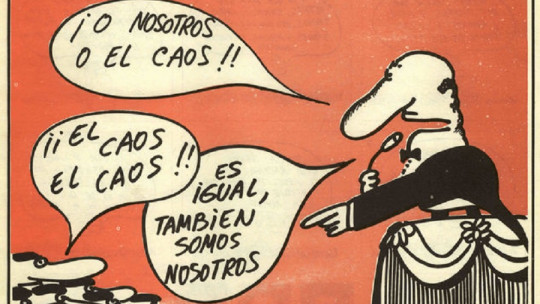
Piece of El Roto
In this piece by El Roto, nationalism is criticized, pointing out a tendency to pass off personal interests as the essence of a group with a history that legitimizes it.

Use this citation format to reference the article clearly and help readers find the original source.
PsychologyFor. (2024). Journalistic Cartoons: What They Are, Characteristics, and Examples. PsychologyFor. https://psychologyfor.com/journalistic-cartoons-what-they-are-characteristics-and-examples/