


See more of our articles in your search results.
Every time you resist a second slice of cake, push through a workout when motivation is low, or manage to stay calm during a difficult conversation instead of reacting impulsively, you are engaging in a psychological process that behavioral scientist Frederick Kanfer spent decades trying to explain. Kanfer’s self-regulation model offers one of the most influential and clinically useful frameworks in behavioral psychology for understanding exactly how people manage their own actions, emotions, and impulses in the absence of external control.
Self-regulation is not a vague personality trait that some people simply “have” and others lack. It is a describable, learnable psychological process — one that Kanfer broke down into distinct, sequential stages that explain how self-control actually operates moment to moment. Understanding this model matters well beyond academic psychology: it has direct, practical applications in therapy for depression, anxiety, addiction, weight management, and virtually any situation where a person is working to change an established pattern of behavior.
What makes Kanfer’s contribution particularly valuable is that it demystifies willpower. Rather than treating self-control as a fixed inner resource that some people possess in abundance and others lack, the model describes self-regulation as a skill built from specific, teachable components: observing your own behavior, evaluating it against a meaningful standard, and responding to that evaluation in ways that either reinforce or discourage the behavior going forward.
This article explores the origins of Kanfer’s self-regulation model, its three core stages, the distinction between different types of self-control it identifies, and its practical applications in therapeutic and everyday contexts.
Who Was Frederick Kanfer and Why Did He Develop This Model?
Frederick H. Kanfer (1925–2002) was a clinical psychologist whose work sits at the intersection of behaviorism and cognitive psychology, and whose research fundamentally shaped how the field understands self-control, behavior modification, and psychotherapy process. Over a prolific career that produced more than 150 scientific publications and several influential books, Kanfer worked to answer a deceptively simple question: how do people control their own behavior when no external authority is present to reward or punish them?
How many of these have you been "meaning to read" for months?
- 1
 TarcherThe Artist's Way30th Anniversary EditionListen Free On Audible
 - 2
 New Harbinger PublicationsThe Dialectical Behavior Therapy Skills WorkbookPractical DBT Exercises for Learning Mindfulness, Interpersonal Effectiveness, Emotion Regulation...Listen Free On Audible
 - 3
 New Harbinger PublicationsAdult Children of Emotionally Immature ParentsHow to Heal from Distant, Rejecting, or Self-Involved ParentsListen Free On Audible
This question emerged directly from the limitations of strict behaviorism, the dominant psychological paradigm through much of the twentieth century, which explained behavior primarily through external reinforcement — rewards and punishments delivered by the environment. Strict behaviorist frameworks struggled to explain a common human experience: people frequently regulate their own behavior even when no one is watching and no external consequence is immediately at stake. Someone sticks to a diet alone in their kitchen. Someone resists the urge to send an angry text message even though no one would know if they sent it. Kanfer recognized that explaining this kind of behavior required a model of internal, self-administered regulation — a bridge between behaviorist principles and the cognitive processes that make self-directed behavior change possible.
Working alongside collaborators including Paul Karoly, Kanfer developed and refined his self-regulation model throughout the 1970s and 1980s, publishing foundational papers that described self-control as an active, structured psychological process rather than a mysterious character trait. His work directly influenced the development of behavior therapy and, subsequently, cognitive-behavioral approaches, and it remains a foundational reference point in clinical psychology’s understanding of self-management, particularly in the treatment of depression, addictive behaviors, and difficulties with emotional regulation.
Practical takeaway: Kanfer’s central insight — that self-control is built from specific, describable processes rather than raw willpower — is itself clinically empowering. If self-regulation is a skill made of component parts, each part can be strengthened individually, which is a far more actionable starting point than treating self-discipline as an innate, fixed quality.
What Are the Three Stages of Kanfer’s Self-Regulation Model?
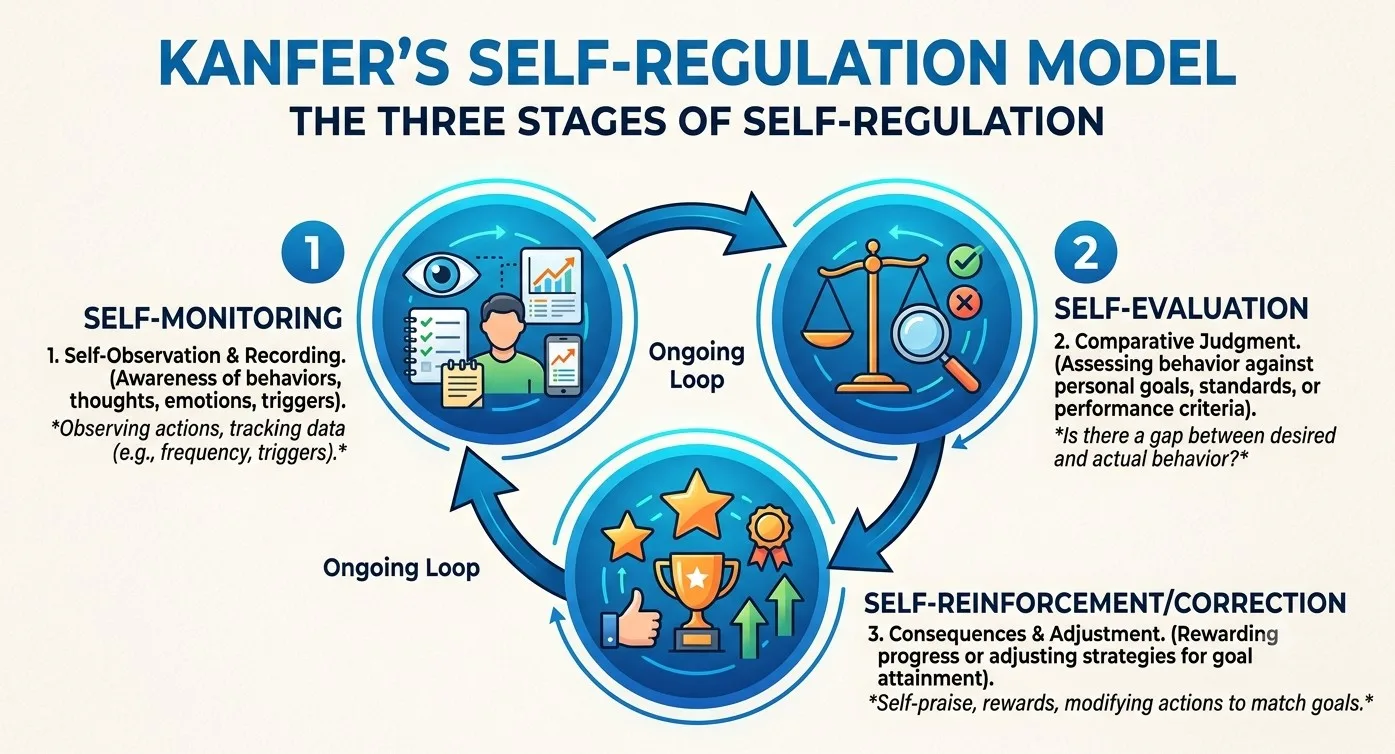
Kanfer’s self-regulation model describes self-control as a cyclical process unfolding across three sequential stages: self-monitoring, self-evaluation, and self-reinforcement. These stages typically activate when a person’s automatic or habitual behavior is interrupted — often because the situation demands attention, because an old pattern has stopped working, or because the person has consciously decided to pursue change.
According to Kanfer, self-regulation is not constantly active in every moment of daily life. Much of our behavior runs on relatively automatic pathways that do not require deliberate self-monitoring. Self-regulation switches on specifically when this automatic behavior is disrupted — a habit fails to produce the expected outcome, a new or unfamiliar situation arises, or a person deliberately sets out to change an established pattern. It is precisely in these moments of disruption that the three-stage cycle becomes active.
- Self-monitoring (self-observation): The person deliberately attends to and observes their own behavior, thoughts, or emotional responses, gathering accurate information about what they are actually doing rather than relying on assumption or memory.
- Self-evaluation: The person compares the observed behavior against an internal standard, goal, or expectation, determining whether their actual behavior matches, falls short of, or exceeds what they intended or value.
- Self-reinforcement: The person responds to the outcome of that comparison by administering a consequence to themselves — a form of self-reward when the standard is met, or self-criticism or corrective action when it is not.
These three stages do not operate as an isolated, one-time event but as a continuous feedback loop. The outcome of self-reinforcement feeds back into future self-monitoring, shaping what the person pays attention to and how they interpret it going forward. This cyclical structure closely parallels cybernetic control theory — the same conceptual framework used to describe how thermostats regulate temperature through continuous feedback — applied to human psychological self-management.
Practical takeaway: When you notice yourself struggling to change a behavior, it can help to explicitly separate these three stages in your own mind: Am I accurately observing what I’m doing? Is my standard for evaluation realistic and fair? And is my response to falling short constructive rather than harshly punitive? Difficulty at any one of these three stages can derail the entire self-regulation process.
What Happens During the Self-Monitoring Stage?
Self-monitoring is the foundational first stage of Kanfer’s model, involving the deliberate, attentive observation of one’s own behavior, thoughts, or physiological states as they occur. Without accurate self-monitoring, the entire self-regulation process is compromised from the start, because a person cannot evaluate or adjust behavior they are not actually perceiving clearly.
Kanfer identified that self-monitoring is influenced by several important factors that determine how accurate and useful it will be. The salience of the behavior — how noticeable or attention-grabbing it is — affects whether a person registers it at all; subtle behaviors like small avoidance patterns or brief negative self-talk are easily missed without deliberate effort. The timing of monitoring also matters significantly: observing a behavior immediately as it happens produces more accurate self-knowledge than trying to reconstruct it from memory afterward, which is vulnerable to distortion, minimization, or selective recall.
This stage has significant real-world applications in clinical psychology and everyday behavior change. Structured self-monitoring tools — including mood tracking journals, food diaries, thought records used in Cognitive Behavioral Therapy (CBT), and habit-tracking apps — are essentially formalized systems for supporting this first stage of Kanfer’s model. Research on behavior change consistently demonstrates that the simple act of monitoring a behavior, even before any explicit effort to change it, tends to shift that behavior in a healthier direction — a phenomenon sometimes referred to as the reactivity effect of self-monitoring.
Difficulties at the self-monitoring stage are common and clinically significant. People experiencing depression, for example, often show biased self-monitoring, disproportionately noticing failures and negative experiences while overlooking successes or positive moments — a pattern consistent with Aaron Beck’s cognitive model of depression and its concept of negative attentional bias. Similarly, people with limited insight into their own emotional or behavioral patterns may struggle with self-monitoring simply due to unfamiliarity with the practice of turning attention inward in a structured way.
Practical takeaway: Building accurate self-monitoring is often the most valuable first step toward any behavior change goal. A brief, consistent daily practice of noting a specific target behavior — even in a simple notebook or phone note — creates the foundational data needed for the rest of the self-regulation process to function well.
How Does Self-Evaluation Shape the Self-Regulation Process?
Self-evaluation is the stage at which a person compares their self-monitored behavior against a personal standard, goal, or expectation, generating a judgment about whether that behavior is adequate, falls short, or exceeds what was intended. This comparative process is where Kanfer’s model becomes deeply relevant to psychological wellbeing, because the standards people use — and how they apply them — vary enormously and carry substantial emotional consequences.
Kanfer emphasized that the standards used in self-evaluation are not universal or objectively fixed; they are shaped by a person’s history, values, social comparisons, and — significantly — by modeling and past reinforcement, echoing themes central to Albert Bandura’s social learning theory and his later, closely related concept of self-efficacy. A person who was raised with rigid, perfectionistic standards for achievement is likely to bring those same exacting standards into their self-evaluation of adult behaviors, often producing chronic feelings of falling short even when their actual performance is objectively reasonable.
The self-evaluation stage highlights a critical clinical distinction between adaptive and maladaptive self-evaluation standards. Adaptive standards are specific, realistic, achievable, and tied to meaningful values, allowing for a fair and motivating assessment of behavior. Maladaptive standards tend to be vague, excessively rigid, disconnected from actual capability, or centered on all-or-nothing thinking — patterns that closely resemble the cognitive distortions described in Beck’s cognitive therapy framework, including dichotomous thinking and unrealistic personal rules.
This is precisely why self-evaluation is a major clinical target in psychotherapy. Cognitive Behavioral Therapy techniques frequently work directly at this stage, helping clients examine and recalibrate the standards they hold for their own behavior — not by lowering standards indiscriminately, but by making them more accurate, achievable, and genuinely aligned with the person’s actual values and circumstances, rather than with internalized criticism or unrealistic comparison.
Practical takeaway: When you notice persistent frustration or shame connected to a behavior change goal, examine the standard you are using to evaluate yourself. Ask whether that standard is specific, realistic given your actual circumstances, and genuinely your own — rather than an inherited expectation you have never consciously examined.

What Role Does Self-Reinforcement Play in Behavior Change?
Self-reinforcement is the third and final stage of Kanfer’s cycle, referring to the self-administration of a reward or corrective consequence based on the outcome of self-evaluation. This stage is where the self-regulation cycle produces its lasting effect on future behavior, because the consequences a person delivers to themselves — whether encouraging or punitive — shape the likelihood that the behavior will recur.
Kanfer, drawing on operant conditioning principles central to behaviorist theory, conceptualized self-reinforcement as functioning through the same basic learning mechanisms as external reinforcement, but administered internally by the individual rather than by an outside source. When a person meets a self-set standard and responds with a genuine sense of accomplishment, satisfaction, or a concrete self-reward, that positive internal consequence strengthens the likelihood of repeating the behavior. When a person falls short and responds with harsh self-criticism rather than constructive correction, the resulting negative emotional state can paradoxically undermine future motivation rather than support genuine change.
This is one of the most clinically significant insights within Kanfer’s model: the manner of self-reinforcement matters as much as its presence. Excessively punitive self-reinforcement — harsh self-criticism, all-or-nothing judgments, disproportionate self-blame following a single lapse — is strongly associated with poorer psychological outcomes, including symptoms of depression and reduced motivation for continued effort. This connects directly to later research on self-compassion, developed extensively by Kristin Neff, which demonstrates that a kinder, more balanced internal response to personal setbacks supports more resilient and sustained behavior change than harsh self-punishment.
Effective self-reinforcement, by contrast, tends to be proportionate, specific, and tied closely to the actual behavior rather than to global self-judgment. Rewarding oneself for a specific, well-defined accomplishment — completing a planned exercise session, resisting a specific unhealthy impulse — builds a much stronger and more durable connection between behavior and consequence than vague, global self-praise or self-criticism about one’s character as a whole.
Practical takeaway: When evaluating your own progress toward a goal, practice separating the specific behavior from your overall self-worth. “I didn’t follow through on my plan today” is a workable, correctable observation; “I have no self-discipline” is a global judgment that undermines the very self-reinforcement process needed to support future change.
What Is the Difference Between Decisional and Protracted Self-Control?
Kanfer’s broader theoretical framework distinguishes between two meaningfully different forms of self-control, a distinction that has significant practical implications for understanding why some behavior changes feel manageable while others require sustained, effortful commitment over time.
| Decisional Self-Control | Protracted Self-Control |
|---|---|
| Involves a discrete choice between competing behavioral options at a specific moment | Requires sustained effort and continuous self-regulation over an extended period toward a goal |
| Example: choosing not to eat a dessert offered at a single dinner | Example: maintaining a long-term dietary change over many months |
| Typically requires a single act of resistance to an immediate temptation | Requires the full self-monitoring, self-evaluation, self-reinforcement cycle repeated consistently over time |
Decisional self-control involves choosing, at a specific decision point, between two or more competing courses of action — often between an immediately gratifying option and one more consistent with longer-term goals or values. This form of self-control is generally less demanding, because it requires only a single act of resistance or choice at one particular moment.
Protracted self-control, by contrast, describes the far more demanding process of sustaining self-regulated behavior across an extended period, often in the face of repeated temptation, fluctuating motivation, and the absence of immediate reward for continued effort. Recovering from addiction, maintaining long-term weight management, or persisting with an extended course of therapy all require protracted self-control, and each depends on the full three-stage self-regulation cycle operating consistently, sometimes for months or years, rather than in a single decisive moment.
This distinction helps explain why some behavior changes that seem conceptually simple — “just stop doing X” — are, in practice, extraordinarily difficult to sustain. The initial decisional moment of choosing to change is genuinely different, psychologically, from the protracted process of maintaining that choice against ongoing temptation, fatigue, and setbacks over an extended timeframe. Clinical interventions that fail to account for this difference often set people up for short-term success followed by relapse, because they address the decisional moment without building the sustained self-regulatory infrastructure that protracted change requires.
Practical takeaway: If you are working toward a long-term behavior change, recognize explicitly that you are engaging in protracted rather than decisional self-control. This means building in structured support — regular self-monitoring routines, realistic evaluation standards, and sustainable self-reinforcement practices — rather than relying on a single moment of willpower to carry you through weeks or months of effort.
How Is Kanfer’s Model Applied in Psychotherapy and Behavior Change?
Kanfer’s self-regulation model has been translated into concrete, structured therapeutic applications across a range of clinical presentations, most notably in the treatment of depression, addictive behaviors, and difficulties with emotional and behavioral self-management.
One of the most direct clinical applications is Rehm’s self-management model of depression, developed by psychologist Lynn Rehm, which applies Kanfer’s three-stage framework specifically to depressive symptoms. Rehm’s model proposes that depressed individuals frequently show characteristic difficulties at each stage: biased self-monitoring that selectively attends to negative events and personal failures while minimizing successes; self-evaluation against excessively harsh, perfectionistic, or unrealistic standards; and a pattern of insufficient self-reward paired with excessive self-punishment. Therapeutic interventions based on this model teach clients to monitor their behavior more accurately and comprehensively, adjust unrealistic evaluative standards, and practice more balanced, proportionate self-reinforcement — directly targeting each stage of Kanfer’s original cycle.
In the treatment of addictive behaviors, self-regulation frameworks derived from Kanfer’s work inform structured self-monitoring practices — tracking triggers, cravings, and behavioral responses — combined with the development of more realistic evaluative standards for progress (recognizing gradual improvement rather than demanding immediate, perfect abstinence) and reinforcement strategies that reward incremental progress rather than only complete success.
Kanfer’s framework has also informed broader self-management training programs used across health psychology, including interventions for chronic disease management, weight control, and habit formation. These programs typically structure intervention explicitly around the three stages: teaching self-monitoring skills (tracking relevant behaviors systematically), building self-evaluation skills (setting specific, achievable, and meaningful goals), and establishing self-reinforcement systems (identifying and delivering appropriate rewards contingent on meeting those goals).
Practical takeaway: If you are working with a therapist on a behavior change goal, ask explicitly how your treatment plan addresses each of the three self-regulation stages — how you will track relevant behavior, what standard you will use to evaluate your progress, and how you will respond constructively to both successes and setbacks along the way.

What Are the Practical Applications of Self-Regulation in Daily Life?
Beyond formal clinical treatment, Kanfer’s self-regulation model offers a genuinely useful framework for approaching everyday goals — from establishing healthier habits to managing emotional reactions in challenging interpersonal situations.
- Habit formation and behavior change: Structuring a new habit around explicit self-monitoring (tracking whether you performed the behavior), realistic self-evaluation (comparing progress to an achievable standard rather than an idealized one), and proportionate self-reinforcement (acknowledging progress meaningfully) builds a more durable habit than relying on motivation alone.
- Emotional regulation: Applying the three-stage cycle to emotional responses — noticing an emotional reaction as it arises, evaluating whether the intensity or expression fits the actual situation, and responding to yourself with curiosity rather than harsh judgment — supports healthier emotional self-management over time.
- Academic and professional performance: Students and professionals can apply self-monitoring (tracking actual work completed against a plan), self-evaluation (assessing progress against specific, realistic milestones), and self-reinforcement (building in genuine rewards for meeting targets) to improve consistency and reduce procrastination.
- Recovery from setbacks: Kanfer’s model highlights that a single lapse in a behavior change effort is not itself the primary problem — the response to that lapse, particularly at the self-evaluation and self-reinforcement stages, often determines whether the lapse becomes a full relapse or remains a manageable, temporary setback.
What unites all these applications is the underlying reframe that Kanfer’s work offers: self-control is not a fixed trait you either have or lack. It is an ongoing process built from identifiable, improvable components — and struggling with self-regulation in one or more of these specific stages is a genuinely normal, addressable part of behavior change, not a sign of fundamental personal failure.
FAQs about Kanfer’s Self-Regulation Model
What are the three stages of Kanfer’s self-regulation model?
Kanfer’s model describes three sequential stages: self-monitoring, in which a person deliberately observes their own behavior, thoughts, or emotional responses; self-evaluation, in which that observed behavior is compared against a personal standard or goal; and self-reinforcement, in which the person delivers a consequence to themselves — a reward or a corrective response — based on the outcome of that comparison. These stages function as a continuous cycle rather than a one-time event, with the outcome of self-reinforcement feeding back into future self-monitoring and shaping the ongoing self-regulation process. Difficulty at any one stage, such as biased self-monitoring or excessively harsh self-evaluation standards, can disrupt the entire cycle and contribute to persistent difficulty with behavior change.
Why did Frederick Kanfer develop this model of self-regulation?
Kanfer developed his self-regulation model to address a gap in strict behaviorist theory, which explained behavior primarily through external reinforcement but struggled to account for how people regulate their own behavior in the absence of any outside reward or punishment. Working through the 1970s and 1980s alongside collaborators including Paul Karoly, Kanfer proposed that self-control operates through internal, self-administered processes that parallel external reinforcement but are generated and delivered by the individual. This work helped bridge behaviorist and cognitive psychology, contributing directly to the development of behavior therapy and, later, cognitive-behavioral approaches that remain widely used in clinical psychology today.
How does Kanfer’s model relate to depression and its treatment?
Psychologist Lynn Rehm applied Kanfer’s three-stage framework specifically to depression in a model that identifies characteristic self-regulatory difficulties associated with depressive symptoms: biased self-monitoring that overemphasizes failures and negative events while minimizing successes; self-evaluation against unrealistically harsh or perfectionistic standards; and a pattern combining insufficient self-reward with excessive self-punishment. Therapeutic approaches based on this model work directly with each stage, helping people build more accurate and balanced self-monitoring habits, adjust unrealistic personal standards, and develop healthier, more proportionate self-reinforcement patterns. This structured approach offers a concrete, skill-based pathway for addressing depressive symptoms related to self-management difficulties, complementing other evidence-based depression treatments.
What is the difference between self-control and self-regulation in Kanfer’s theory?
In Kanfer’s framework, self-regulation refers to the broader, ongoing three-stage cyclical process — self-monitoring, self-evaluation, and self-reinforcement — through which people manage their own behavior over time. Self-control is often used to describe the specific behavioral outcome of that process: the capacity to resist an immediate impulse or sustain effort toward a goal despite competing pressures. Kanfer further distinguished between decisional self-control, involving a single choice at one particular moment between competing behavioral options, and protracted self-control, which requires the full self-regulation cycle to operate consistently over an extended period to sustain a longer-term behavior change. This distinction helps clarify why certain behavior changes feel considerably more demanding to sustain than others.
Can self-regulation skills be learned, or are they a fixed personality trait?
According to Kanfer’s model and the extensive body of research it has generated, self-regulation is best understood as a learnable, improvable skill set rather than a fixed personality trait that some people simply possess in greater quantity than others. Each of the three component stages — accurate self-monitoring, realistic self-evaluation, and proportionate self-reinforcement — can be practiced and strengthened through deliberate effort, structured tools such as behavior tracking, and, when needed, therapeutic support. This reframing carries genuine clinical and personal significance: struggling with self-control in a particular area of life reflects difficulty with specific, addressable processes rather than an unchangeable deficiency in character, which opens a much more constructive and hopeful path toward meaningful change.
How can I apply Kanfer’s self-regulation model to my own goals?
Applying Kanfer’s model practically involves structuring your approach to a goal around its three stages. Begin with deliberate self-monitoring — tracking the specific behavior you want to change through a journal, app, or simple daily note, focusing on immediate observation rather than relying on memory. Next, establish a realistic self-evaluation standard — a specific, achievable goal tied to your actual values and circumstances rather than an idealized or inherited expectation. Finally, build in proportionate self-reinforcement — genuine, specific acknowledgment of progress when you meet your standard, and a constructive, non-punitive response when you fall short. Applying this structure consistently, especially for goals requiring protracted rather than decisional self-control, tends to produce more durable behavior change than relying on motivation or willpower alone.
Bibliography
- Kanfer, F. H., & Karoly, P. (1972). Self-control: A behavioristic excursion into the lion’s den. Behavior Therapy, 3(3), 398–416.
- Kanfer, F. H. (1970). Self-regulation: Research, issues, and speculations. In C. Neuringer & J. L. Michael (Eds.), Behavior Modification in Clinical Psychology. Appleton-Century-Crofts.
- Kanfer, F. H., & Hagerman, S. (1981). The role of self-regulation. In L. P. Rehm (Ed.), Behavior Therapy for Depression: Present Status and Future Directions. Academic Press.
- Rehm, L. P. (1977). A self-control model of depression. Behavior Therapy, 8(5), 787–804.
- Bandura, A. (1986). Social Foundations of Thought and Action: A Social Cognitive Theory. Prentice-Hall.
- Bandura, A. (1991). Social cognitive theory of self-regulation. Organizational Behavior and Human Decision Processes, 50(2), 248–287.
- Beck, A. T. (1979). Cognitive Therapy of Depression. Guilford Press.
- Neff, K. D. (2011). Self-Compassion: The Proven Power of Being Kind to Yourself. William Morrow.
- Karoly, P. (1993). Mechanisms of self-regulation: A systems view. Annual Review of Psychology, 44(1), 23–52.
- Carver, C. S., & Scheier, M. F. (1998). On the Self-Regulation of Behavior. Cambridge University Press.
Use this citation format to reference the article clearly and help readers find the original source.
PsychologyFor. (2026). Kanfer Self-regulation Model: What it is and What it is for. PsychologyFor. https://psychologyfor.com/kanfer-self-regulation-model-what-it-is-and-what-it-is-for/