

See more of our articles in your search results.
Two students sit down to study the same chapter. One is in a library carrel with a lamp, a closed door and a friend working quietly two seats away. The other is at a kitchen table at 9 p.m., with a dishwasher mid-cycle, a phone lighting up with group-chat banter and a half-finished mug of tea going cold. Same book. Same brain, roughly speaking. Entirely different afternoon. By the end of the hour, one has retained a handful of key ideas and the other has read the same paragraph four times. Nobody in either room would call it a fair fight.
We tend to blame the learner when learning goes badly: lazy, distractible, “not a math person.” Researchers and good teachers look first at the setting. A learning environment is far more than a room with desks; it’s the physical space, the social atmosphere, the emotional tone, the tools and the unwritten rules that together shape what a person can absorb and how safe it feels to try. Change those, and performance often changes with them, sometimes dramatically. The effects are measurable, and they’re usually larger than people expect. Teachers feel it, managers feel it, and parents watching a child melt down over homework feel it too.
Context is not a side issue.
This guide explains what learning environments are, the main types of learning environments, and the characteristics that separate spaces where people grow from spaces where they merely sit.
A short tour first: where the idea came from, then the evidence. You’ll see what the research says, where it’s thin, and how to adjust your own classroom, office or kitchen table.
How many of these have you been "meaning to read" for months?
- 1
 MajostaLearning To Love MyselfListen Free On Audible
 - 2
 THOUGHT CATALOGThe Mountain Is YouTransforming Self-Sabotage Into Self-MasteryListen Free On Audible
 - 3
 Spiegel & GrauCodependent No MoreHow to Stop Controlling Others and Start Caring for Yourself (Revised and Updated)Listen Free On Audible
What is a learning environment?
A learning environment is the sum of the physical, social, psychological and instructional conditions in which learning happens. It includes where you learn, who you learn with, how you’re treated when you get things wrong, and what tools and methods are available.
That definition is deliberately wide, because the term is used in several overlapping ways. Educators may mean a classroom. Psychologists often mean the social and emotional climate of that classroom. Technologists may mean a platform such as a learning management system. A workplace trainer may mean the culture of a team. All of these are legitimate, and they interact.
It helps to think in layers. The physical layer covers light, noise, temperature, seating, layout and materials. The social layer covers relationships with teachers, peers and managers, and the norms about participation. The psychological layer covers feelings of safety, belonging, autonomy and challenge. The pedagogical layer covers how tasks are designed, how feedback arrives and how success is defined. A digital layer sits across all of them when technology is involved.
Take Maya, an illustrative composite, a first-year university student. Her dorm room is quiet enough, but her roommate practices guitar at night, her seminar leader makes her feel stupid when she asks questions, and her course platform is a maze of unlabeled folders. Her physical, social and digital layers are all quietly working against her, and none of that has anything to do with how bright she is.
Why does the distinction matter? Because it changes where you intervene. If a student is struggling, the instinct is to tutor harder. Sometimes the faster fix is to change seating, reduce noise, clarify expectations or make mistakes feel survivable.
It also matters because environments are not neutral. A space designed around one kind of learner can quietly exclude another. A noisy, open-plan classroom can overwhelm a child with sensory sensitivities; a rigid, silent room can stifle a child who learns by talking.
The rest of this article walks through where the idea came from, the main types, the evidence on what matters most, and practical changes you can make. One caution up front: research on environments is often correlational and context-bound, so treat headline numbers as indications, not guarantees.
Where does the idea of a learning environment come from?
It grew out of a century of thinking that learners are shaped by their surroundings as much as by their own effort. Three figures stand behind much of it: a philosopher, a physician-educator and a developmental psychologist.
The American philosopher John Dewey, in Experience and Education (1938), argued that learning arises from the interaction between a person and the conditions around them. He criticized both rigid traditional classrooms and unstructured “free” ones, and held that a teacher’s central job is to arrange the environment so that experiences are educative, meaning they lead to further growth. His principles of continuity (experiences build on one another) and interaction (internal and external conditions combine) remain a basic grammar of the field.
Next came Maria Montessori, an Italian physician who developed the idea of the prepared environment. In her view, adults should design the space so that children can act independently: child-sized furniture, materials arranged within reach, a sense of order, freedom to choose within clear limits. The teacher guides and observes more than lectures. Whatever you think of the full method, the principle that a room should make independence possible is widely borrowed, even by schools that don’t use her name.
Then Urie Bronfenbrenner widened the lens. His ecological systems theory, laid out in The Ecology of Human Development (1979), pictured a child nested in layers of influence. The microsystem is the immediate setting, such as a classroom or home. The mesosystem is the set of connections among those settings, such as how well parents and teachers communicate. The exosystem includes settings the child doesn’t directly enter but that affect them, like a parent’s workplace or school board decisions. The macrosystem covers cultural values, laws and economic conditions.
That last idea explains something practical. A classroom is never an island. A teacher who is perfectly attuned can be undermined by a chaotic school schedule, a funding cut or a community that doesn’t value the subject.
Think of Mr. Okafor, an illustrative composite teacher who builds a warm, well-organized classroom. His pupils flourish until a staffing change moves half of them to a different school mid-year. His microsystem was strong; the exosystem pulled it apart.
Modern work has added tools. Researchers now measure classroom climate with scales, track the effect of building design on test progress and study online platforms. But the central claim hasn’t changed since Dewey: environments teach.
Which of the three, Dewey’s interaction, Montessori’s preparation or Bronfenbrenner’s nested layers, best describes the place where you learn or teach right now?

What are the main types of learning environments?
There are five common types: physical classrooms, outdoor settings, virtual or online environments, blended or hybrid environments, and informal settings such as home, workplace or community. Each can be described by the same social and psychological layers, which is why a “type” is better seen as a setting than a fixed category.
| Type | What it looks like | Typical strengths | Typical risks |
|---|---|---|---|
| Physical classroom | Teacher and learners in a shared room, in person | Immediate feedback, social presence, shared routines | Noise, fixed layouts, one-pace instruction |
| Outdoor and place-based | Gardens, field sites, nature trails, museums, workplaces | Hands-on experience, engagement, real-world context | Weather, logistics, uneven access, supervision demands |
| Virtual or online | Fully remote teaching through video, platforms and recorded content | Flexibility, access, self-pacing | Isolation, distraction, technology barriers |
| Blended or hybrid | Mix of online and face-to-face components | Combines flexibility with human contact | Poor integration, double workload, uneven access |
| Informal and self-directed | Home study, workplace learning, hobby groups, community programs | Autonomy, relevance, low pressure | No structure, no feedback, inconsistent quality |
Other classifications cut across these. Educators sometimes distinguish teacher-centered environments, where the instructor controls content and pace, from learner-centered ones, where students have more say over goals and methods. They also describe collaborative environments built around group work and competitive ones built around ranking. Another distinction is formal (structured curriculum and assessment) versus non-formal and informal learning.
Consider three composite learners. Priya takes an evening certificate course online while working full time; her environment is virtual, self-paced and informal in feel. Leo attends a community woodworking class on Saturday mornings; it is non-formal, hands-on and social. Sofia sits in a traditional lecture hall with two hundred others; it is formal, teacher-centered and large. Each can be excellent or poor depending on how the layers are handled.
A word on outdoor learning. Interest in nature-based and place-based approaches has grown, but the evidence base is mixed. Studies often report better engagement and well-being, while academic effects are less consistent, partly because programs vary so much. It’s promising, not proven for every goal.
Most real environments mix types. A university course might use lectures, online quizzes, lab sessions and study groups. The useful question isn’t “which type is best” but “which combination fits this learner, this content and this goal?”
Fit matters more than fashion.
How much does the physical space affect learning?
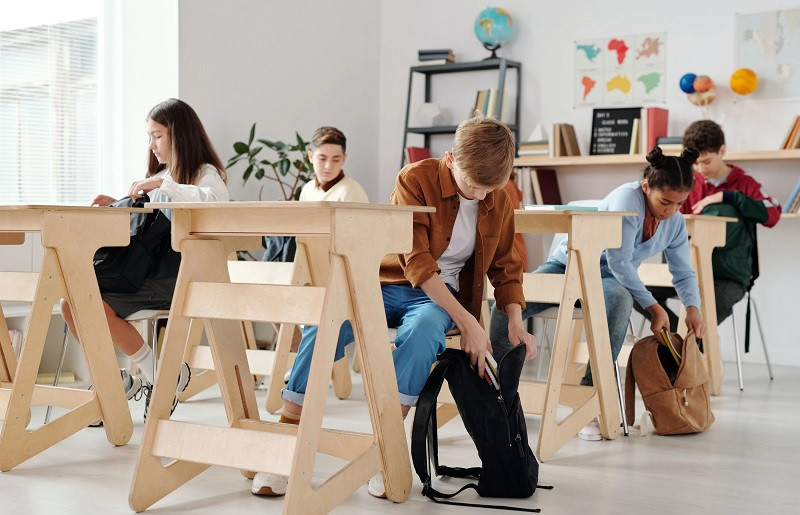
More than most people assume, though less than teaching quality. A large study of English primary schools found that the physical features of classrooms explained about 16 percent of the variation in pupils’ academic progress over a year. That’s a substantial slice from things like light, air and layout.
The study, led by Peter Barrett and colleagues at the University of Salford, assessed 153 classrooms in 27 schools and followed 3,766 pupils. The team organized the physical factors into three design principles, memorably abbreviated as SIN: Stimulation, Individualization and Naturalness. Naturalness, covering light, temperature and air quality, accounted for roughly half of the effect. Individualization, meaning a sense of ownership, flexibility of layout and connection, accounted for about a quarter. Stimulation, meaning the level of visual complexity and color, made up the remaining quarter.
One finding is easy to remember and easy to act on: moderate stimulation works best. A bare, blank room under-stimulates. A wall covered in posters, mobiles and clutter overwhelms. A middle level of visual complexity, with some displays and some calm space, tended to support learning.
Seven design parameters together explained the 16 percent: light, temperature, air quality, ownership, flexibility, complexity and color. No single factor dominated, which means there’s no magic fix. Many small things add up.
Imagine Dana, an illustrative composite fourth-grade teacher who inherits a room that is stuffy by afternoon, lit by flickering fluorescent tubes and covered in last year’s decorations. She opens windows at lunch, swaps bulbs, clears two walls, and lets pupils arrange their own reading corner. None of this costs much. It’s the Naturalness, Stimulation and Individualization story in miniature.
Practical features that research and practice suggest matter:
- Daylight and good lighting, avoiding glare and flicker.
- Comfortable temperature and fresh air, since stuffy rooms dull attention.
- Flexible seating that supports both individual work and group conversation.
- Quiet zones and acoustic control, particularly for learners sensitive to noise.
- Personalization, such as space to display work and make the room one’s own.
Now the caveats. The Salford study is observational: classrooms with better features may also have better teachers or more advantaged pupils, though the researchers used multilevel modeling to account for background factors. It focused on primary schools in one country, so results may not transfer to universities or workplaces. And 16 percent leaves 84 percent to other things, including teaching, relationships and the learner’s own history.
Think of the physical space as a foundation, not the house. It rarely makes learning great alone. It can make it noticeably harder.
What does the social climate of a classroom involve?
Social climate is the felt quality of relationships and expectations in a learning group. It includes how involved students are, how supported they feel, how clear the rules are and how much the setting emphasizes competition versus growth.
The most influential measurement approach comes from psychologist Rudolf Moos, who argued in Evaluating Educational Environments (1979) that every setting has a “personality” that can be assessed. His Classroom Environment Scale asks students to rate their class on nine subscales grouped into three dimensions. The scale has been used for decades in research and school improvement.
Here is how the three dimensions break down:
- Relationship: involvement (attention and interest), affiliation (friendship among students) and teacher support.
- Personal growth and goal orientation: task orientation (staying on subject) and competition (emphasis on grades and recognition).
- System maintenance and change: order and organization, rule clarity, teacher control and innovation.
The value of this framework is that it names things people usually feel but can’t pin down. A class can be friendly but chaotic, orderly but cold, innovative but unclear about expectations. Measuring each dimension helps teachers see where the imbalance lies.
Students and teachers often perceive the same classroom differently. A teacher may believe expectations are crystal clear while students experience them as arbitrary. Collecting student perceptions, anonymously, is one of the cheapest and most useful steps a teacher can take.
Picture a secondary-school class where the teacher believes she runs a lively, collaborative room. Student ratings show high involvement but low rule clarity and high competition. Pupils enjoy the discussions yet feel anxious about unspoken grading standards. Small adjustments, like publishing a rubric and shifting some marks to team work, shift the climate.
The same ideas apply beyond school. Workplaces, sports teams and online communities have climates: how supportive, how clear, how competitive. A new hire’s first month is largely a climate experience.
A limit worth noting: Moos’s scales rely on self-report, so they capture perception, and perception is influenced by mood, culture and recent events. Still, perception is the thing that drives behavior. A student who experiences a class as hostile will act accordingly, whatever the teacher intended.
If you only measure one thing, ask how supported people feel. Almost everything else grows from that.
Why do psychological safety and motivation matter so much?
Because people can’t learn well while they’re busy protecting themselves. When asking a question feels risky, mistakes feel dangerous or effort feels pointless, learners go quiet. Safety and motivation are the emotional engine of any learning environment.
Amy Edmondson introduced the concept of psychological safety to organizational research, defining it as a shared belief that a team is safe for interpersonal risk taking. In a 1999 study of 51 work teams at a manufacturing company, she found that team psychological safety was associated with learning behavior, such as asking for help, seeking feedback and discussing errors, and that learning behavior in turn related to team performance. The finding has been replicated and extended in many settings, including schools and hospitals, though most studies are correlational and rely on surveys.
Consider what this looks like in practice. A student who thinks “if I ask this, they’ll laugh” stays silent and confused. A junior nurse who fears blame hides a near-miss. A new engineer who worries about looking incompetent doesn’t say the spec looks wrong. In each case, information that could improve learning never surfaces.
Then there’s motivation. Richard M. Ryan and Edward L. Deci developed self-determination theory, which proposes three basic psychological needs: autonomy (a sense of choice and ownership), competence (a sense of effectiveness and growth) and relatedness (a sense of connection to others). Environments that support these needs tend to foster more intrinsic motivation, meaning engagement for its own sake, and better well-being; environments that thwart them, through heavy control, impossible tasks or isolation, tend to undermine motivation. Their 2000 review in American Psychologist is a standard citation.
Translate the theory into everyday terms:
Autonomy shows up as choices about topics, formats or order of work. Competence shows up as tasks pitched just beyond comfort, with clear feedback about progress. Relatedness shows up as being known by name, being listened to and belonging to a group that matters.
Take Jun, an illustrative composite who struggles in a coding bootcamp. The course is fast and graded on a curve; mistakes are announced to the class. He stops asking questions. When he moves to a smaller study group where errors are treated as puzzles, his progress jumps. The content didn’t change. The emotional conditions did.
A caution on over-simplifying. Safety isn’t the same as comfort or absence of challenge. The best environments combine high safety with high standards. Safety without challenge breeds complacency; challenge without safety breeds anxiety and hiding.
It’s an easy test to run: what happens in your setting when someone admits they don’t understand? The answer tells you almost everything.
How does social interaction shape what we can learn?
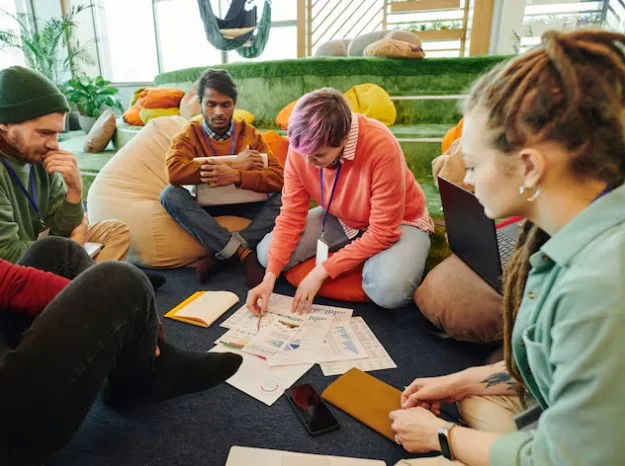
Much of what we learn, we learn with and from other people. In the work of Lev Vygotsky, learning is social before it is individual: we first manage tasks with support, then gradually take over. A good learning environment is built to provide that support and then step back.
Vygotsky’s best-known idea is the zone of proximal development, usually shortened to ZPD. In Mind in Society (1978), a collection of his writings, he described it as the gap between what a learner can do alone and what they can do with guidance from a more capable person. Tasks within the zone are challenging but achievable with help. Tasks well below it bore the learner; tasks well above it overwhelm.
That picture has direct design implications. An environment that rewards only independent performance may miss the zone entirely. One that provides well-timed hints, models, questions and peer collaboration can stretch learners farther than they’d reach alone.
Researchers have built on his ideas with the concept of scaffolding, temporary support that is gradually withdrawn as the learner gains skill. Scaffolds can be a worked example, a checklist, a sentence starter, a partner or a short conversation with a teacher. The key feature is that they fade. Support that never fades creates dependence.
What about peers? Group work can be powerful, particularly when tasks require everyone’s contribution. It can also fail spectacularly: one student does the work while the others coast, or a confident voice dominates. Environments that structure collaboration, with clear roles and individual accountability, do better than ones that simply say “work together.”
Take Amira, an illustrative composite learning to write persuasive essays. At first her teacher gives her a sentence-by-sentence outline. Then a paragraph template. Then a list of questions to consider. Finally she writes alone. The support was always just a little ahead of her ability, then it vanished.
Several features of environments support this kind of learning: opportunities to talk, because language is the main tool for thinking together; access to people who know more, whether teachers, mentors or advanced peers; tasks that are authentic enough to matter; and feedback that arrives while it’s still useful.
Limits are worth stating. Vygotsky’s writing is dense and partly unfinished, since he died young in 1934, and the ZPD is notoriously hard to measure precisely. Teachers use it as a guiding image more than a diagnostic tool, and that’s fine.
The practical takeaway might be a single question to ask in every lesson: what help does this learner need right now, and when can I take it away?
Are online and blended learning environments as effective as classrooms?
On average, yes, and blended formats often do somewhat better. A large meta-analysis found that purely online learning performed about the same as face-to-face teaching, while blended approaches modestly outperformed it. Averages hide a lot, though, and quality varies enormously.
Barbara Means and colleagues reviewed controlled studies for the U.S. Department of Education and published a version in Teachers College Record in 2013. Across 50 effect-size comparisons, the mean advantage of online learning (combining purely online and blended) over face-to-face instruction was +0.20, a small positive effect. Looking at purely online versus face-to-face, the difference was not statistically significant (+0.05). For blended versus face-to-face, it was significant (+0.35), a small-to-moderate benefit.
It’s important to read the fine print. The studies were mostly from before 2008, when technology looked very different. Many involved college or adult learners, and many were small. Blended conditions often gave students extra time on task and additional materials, which may explain part of the advantage, so the benefit may reflect the extra support more than the format itself. The authors cautioned against concluding that online delivery is inherently better.
Real-world experience since then has added caution. The emergency shift to remote schooling at the start of the 2020s showed that online learning works much better for motivated, well-resourced, older learners with reliable devices and quiet space than for young children or students without those supports. Equity matters: if the home environment is the classroom, then differences in homes become differences in learning.
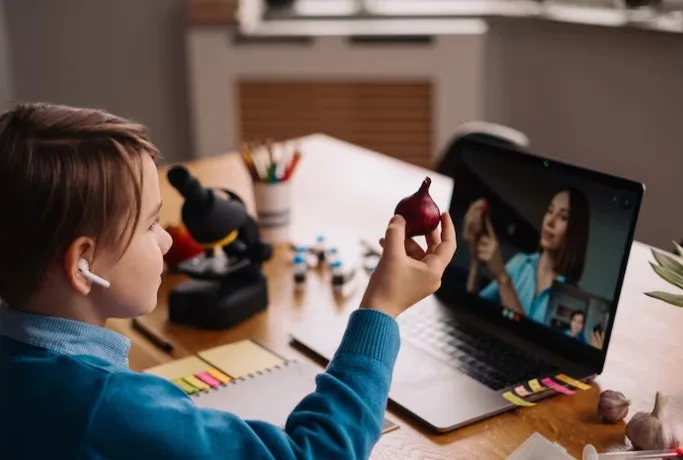
What makes an online environment good? Features that parallel good classrooms: clear structure, regular interaction with instructors and peers, timely feedback, manageable chunks of content, and ways to feel connected. What makes one bad? Walls of text, silent forums, unclear expectations and unreliable technology.
Imagine Rosa, an illustrative composite who works nights and enrolls in an online degree. When the course includes weekly live check-ins, short videos and a discussion group, she thrives. When a different course is only a list of readings and a final exam, she drifts away within a month. Same learner, same platform, different design.
Digital tools bring their own distractions. Notifications, multitasking and endless tabs compete for attention, and research on multitasking generally finds costs to comprehension. A good online environment helps learners limit those distractions, not just deliver content.
The sensible conclusion is not “online good” or “online bad.” It’s that design and support matter more than the delivery channel.
What characteristics define an effective learning environment?
Effective learning environments tend to share a handful of traits: they feel safe, they set clear expectations, they challenge learners at the right level, they give timely feedback, they support autonomy and they’re physically comfortable. No single trait guarantees success, but their absence is usually noticeable.
The following list pulls together the research from earlier sections:
- Psychological safety. Learners can ask questions, admit confusion and make mistakes without humiliation.
- Clear structure and expectations. People know what is expected, how work will be judged and what to do next. Moos’s rule clarity and order subscales capture this.
- Appropriate challenge. Tasks sit within the learner’s zone of proximal development, hard enough to stretch and supported enough to be doable.
- Timely, specific feedback. Learners learn what worked, what didn’t and what to try next, soon enough to use it.
- Autonomy and choice. Learners have some say in how, when or what they learn, which supports intrinsic motivation.
- Strong relationships. Teachers and peers know and respect each other. Involvement, affiliation and teacher support are the heart of Moos’s relationship dimension.
- A comfortable, flexible physical space. Good light, air, reasonable noise and layouts that can change for different tasks.
Notice what’s absent: expensive technology, fancy buildings, branded programs. These help only when they serve the traits above. A rundown room with a skilled, warm teacher often beats a gleaming one with a distant one.
Other characteristics deserve mention. Inclusion matters: environments should be accessible to learners with different abilities, languages and backgrounds, which includes physical access, flexible formats and respectful norms. Relevance matters: people learn more readily when they see why the content matters. And consistency matters: routines that are predictable free up attention for the actual material.
Some traits pull against each other, and good environments manage tensions. Structure versus autonomy. Challenge versus safety. Collaboration versus individual accountability. Competition versus cooperation. There isn’t a single right balance; it shifts with age, content and culture.
Take two composite teachers. Ms. Reyes sets crystal-clear rules but lets students choose their projects. Mr. Lindqvist allows endless choice but never says what a good project looks like. The first environment has structure and autonomy; the second has autonomy and confusion. Students in the first know where to put their energy.
How many of the seven describe the place where you learn or teach? Even a rough count tells you where to start.
How can you improve your own learning environment?
Start with the cheapest changes: noise, light, interruptions, clarity and support. You rarely need a new building or a budget. A few targeted adjustments often matter more than any gadget, whether you’re studying at home, running a classroom or training a team.
A short sequence works for most settings:
- Audit the basics. Check light, temperature, noise, seating and clutter. Fix whatever is easy, such as moving to a window, adding a lamp or clearing a table.
- Cut interruptions. Silence notifications, set a start and stop time, and tell housemates or colleagues when you’re unavailable.
- Clarify the target. Write down what “done” looks like for this session. Vague goals invite wandering.
- Add the right people. A study partner, a mentor or a regular check-in provides the relatedness and feedback that solo work lacks.
- Adjust the challenge. If everything is easy, add stretch. If everything is overwhelming, break tasks down and get support.
Teachers and managers have extra levers. Ask learners anonymously how safe, clear and supported they feel, using a few short questions based on Moos’s dimensions. Publish expectations and examples of good work. Respond to mistakes with curiosity. Offer some choices. Rearrange the room for different tasks. Then ask again in a month.
For parents, the equivalent is a consistent homework spot, a predictable routine, a calm adult nearby and a rule that mistakes are normal. Many families discover that the biggest improvement comes from removing a phone from the table, not adding a tutor.
For remote workers and online learners, mimic what a good classroom provides. Pick a dedicated spot, even a corner. Schedule live contact. Break content into short sessions. Build in movement. Join a group.
Take Elena, an illustrative composite who works from home and takes evening courses. She stops studying in bed, moves to a small desk by a window, sets a nightly 45-minute block with her phone in another room, and arranges a Friday call with a classmate. Within weeks she notices she’s finishing material she used to abandon.
When should you look for more help? If a learner struggles despite supportive conditions, or shows persistent distress, avoidance or sharp changes in behavior, it may be worth talking to a teacher, school counselor or doctor. Learning difficulties, attention problems, anxiety and sensory sensitivities can all interact with environments, and a professional assessment can open options that environmental tweaks alone can’t.
Change one thing this week and see what happens to the next hour of work.
FAQs about Learning Environments
What is a learning environment in simple terms?
A learning environment is everything around a learner that shapes how well they can learn: the physical space, the people, the emotional atmosphere, the tools and the rules or routines. It can be a classroom, an online course, a workplace training room, a museum, a park or a kitchen table. The same person may learn very differently in different environments because light, noise, support, expectations and feelings of safety all vary. Researchers often divide it into physical, social, psychological and instructional layers, plus a digital layer when technology is involved. Researchers often describe it in layers, which is a handy way to check what’s missing in any setting you care about.
What are the main types of learning environments?
The main types are physical classrooms, outdoor or place-based settings, virtual or online environments, blended or hybrid environments, and informal settings such as home study, workplace learning or community groups. Educators also distinguish teacher-centered from learner-centered environments, and collaborative from competitive ones. Most real settings combine several types: a university course may include lectures, online quizzes, lab work and study groups. Rather than asking which type is best, it helps to ask which combination suits this learner, this content and this goal, since fit matters more than format. In practice the categories overlap, which is why a good designer thinks about the combination for each learner and each goal rather than hunting for a single best format for everyone.
How much does classroom design affect learning?
It affects learning noticeably, but it is only one factor. A large study of 153 classrooms in 27 English primary schools, involving 3,766 pupils, found that physical design features explained about 16 percent of the variation in pupils’ progress over a year. Naturalness factors such as light, temperature and air quality accounted for roughly half of that effect, with individualization and stimulation making up the rest. The study was observational and focused on primary schools, so it can’t prove that any specific change will produce a specific gain, and teaching quality and relationships still matter a great deal. It’s a good example of how small, inexpensive changes can add up.
What is the difference between a learning environment and a learning style?
A learning environment is the setting and conditions around the learner. A learning style is a supposed preference for how a person takes in information, such as visual, auditory or kinesthetic. The environment is something you can observe and change. Learning styles are more controversial: many studies have failed to show that matching teaching to a preferred style improves outcomes. People do have preferences, and comfort can affect motivation, but the stronger evidence supports good design, clear explanations, practice and feedback for everyone. Improving the environment is usually a more reliable lever than trying to match a style. For that reason, many educators recommend focusing on clear explanations, practice and feedback for all learners, and adjusting the setting around them.
Is online learning as effective as in-person learning?
On average, studies find it can be. A major meta-analysis by Barbara Means and colleagues found no significant difference between purely online and face-to-face instruction, and a modest advantage for blended approaches that mix both. But the studies were mostly older, often involved adult or college learners, and blended courses sometimes gave students extra time and materials. Results vary widely with design: courses with regular interaction, clear structure and feedback do far better than ones that simply post content. Younger children and learners without good devices or quiet space tend to struggle more online. Studies since then have mostly supported the broad picture, but they also stress that design, support and the learner’s circumstances shape the outcome as much as the format does.
What is psychological safety in a classroom?
Psychological safety is the shared belief that it is safe to take interpersonal risks, such as asking a question, admitting confusion or disagreeing, without being embarrassed or punished. Amy Edmondson’s research in work teams linked it to learning behaviors like seeking feedback and discussing mistakes. In a classroom it shows up when students ask for help without fear of mockery, when errors are treated as information and when the teacher responds with curiosity. It doesn’t mean lowering standards. The strongest environments combine high safety with high expectations, so people feel both supported and challenged. It’s a useful test of any classroom or team.
How can I make my home a better place to study?
Begin with a consistent spot with good light and a comfortable chair, away from the TV and the busiest part of the house. Reduce interruptions by putting your phone in another room and setting a fixed start and stop time. Write down what you plan to finish in the session so the goal is clear. Take short breaks and move around. If you live with others, agree on quiet times. Adding a study partner or a regular check-in helps with motivation and feedback. If you still can’t focus despite these changes, consider whether attention, anxiety or sleep problems might be playing a part. It’s also worth involving the learner in the choices, since a space someone helped set up tends to feel more like theirs.
Does the learning environment matter for adults and workplaces?
Yes. Adults learn in offices, training rooms, online platforms and on the job, and the same factors apply: psychological safety, clear expectations, appropriate challenge, timely feedback and a comfortable space. Edmondson’s studies found that teams where people felt safe to speak up engaged in more learning behaviors, which relates to performance. Autonomy and relevance matter especially for adults, who often want to know why a skill matters to their work. Managers can improve a workplace learning environment by responding to mistakes with curiosity, offering choice in how to learn, and making time for practice and reflection. The common thread across settings is that people learn better when they feel capable, connected and free to say they’re lost.
Bibliography
- Barrett, P., Davies, F., Zhang, Y., & Barrett, L. (2015). The impact of classroom design on pupils’ learning: Final results of a holistic, multi-level analysis. Building and Environment, 89, 118-133.
- Bronfenbrenner, U. (1979). The ecology of human development: Experiments by nature and design. Harvard University Press.
- Dewey, J. (1938). Experience and education. Kappa Delta Pi.
- Edmondson, A. (1999). Psychological safety and learning behavior in work teams. Administrative Science Quarterly, 44(2), 350-383.
- Means, B., Toyama, Y., Murphy, R., & Baki, M. (2013). The effectiveness of online and blended learning: A meta-analysis of the empirical literature. Teachers College Record, 115(3), 1-47.
- Montessori, M. (1967). The absorbent mind (C. A. Claremont, Trans.). Holt, Rinehart and Winston.
- Moos, R. H. (1979). Evaluating educational environments. Jossey-Bass.
- Ryan, R. M., & Deci, E. L. (2000). Self-determination theory and the facilitation of intrinsic motivation, social development, and well-being. American Psychologist, 55(1), 68-78.
- Vygotsky, L. S. (1978). Mind in society: The development of higher psychological processes (M. Cole, V. John-Steiner, S. Scribner, & E. Souberman, Eds.). Harvard University Press.
Use this citation format to reference the article clearly and help readers find the original source.
PsychologyFor. (2026). Learning Environments: What They Are, Types, and Characteristics. PsychologyFor. https://psychologyfor.com/learning-environments-what-they-are-types-and-characteristics/