

See more of our articles in your search results.
Your brain right now is doing something extraordinary that you probably take completely for granted. You’re looking at these words, and somehow—almost instantly—you’re recognizing them as letters, assembling them into words, attaching meaning to those words, all while potentially glancing at an image on your screen and immediately knowing whether it’s a face, an object, or a scene. This seamless, automatic recognition of the visual world around you involves a remarkable brain structure tucked away on the underside of your temporal lobe: the lower temporal gyrus, more formally known as the inferior temporal gyrus (ITG). This relatively small strip of cortical tissue plays an absolutely crucial role in how you perceive and make sense of everything you see.
The inferior temporal gyrus sits at what neuroscientists call the “higher levels of the ventral visual stream”—essentially the final processing station where raw visual information transforms into meaningful recognition. When you instantly recognize your friend’s face in a crowd, remember what a coffee cup looks like, read a street sign, or distinguish between a dog and a cat, your inferior temporal gyrus is working overtime. It’s part of the brain’s sophisticated system for categorizing, identifying, and storing visual information about the world. Located on both the lateral (side) surface and the basal (bottom) surface of the temporal lobe, this structure occupies prime neurological real estate, positioned perfectly to integrate information from earlier visual processing areas and send refined, meaningful output to memory and decision-making centers.
What makes the inferior temporal gyrus particularly fascinating to neuroscientists is its apparent specialization. Different regions within this gyrus seem to preferentially respond to specific categories of visual stimuli—some neurons fire enthusiastically for faces, others for places, still others for written words or numbers. This isn’t just academic curiosity. Understanding how this region works has profound implications for treating brain injuries, developing artificial intelligence systems that recognize objects like humans do, understanding reading disorders like dyslexia, and even explaining conditions like prosopagnosia (face blindness) where people can see perfectly well but can’t recognize faces. Whether you’re a student studying neuroanatomy, a psychology enthusiast curious about how perception works, or someone who’s experienced visual recognition difficulties and wants to understand the neuroscience behind it, exploring the inferior temporal gyrus offers a window into one of the brain’s most elegant solutions to an incredibly complex problem: making sense of the constant visual chaos bombarding our eyes every waking moment.
Anatomy and Location: Where Exactly Is the Lower Temporal Gyrus?
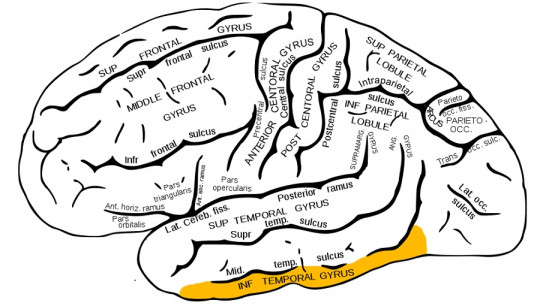
Let’s get oriented. Your brain’s temporal lobe sits roughly behind your temples (hence the name), underneath the large lateral sulcus—also called the Sylvian fissure—that separates the temporal lobe from the frontal and parietal lobes above it. If you could view your brain from the side, you’d see the temporal lobe’s lateral surface divided into three parallel ridges running roughly front to back. These are gyri (singular: gyrus), the characteristic bumps and folds that pack maximum brain tissue into limited skull space.
The inferior temporal gyrus is the lowest of these three parallel gyri on the lateral surface of the temporal lobe. Above it sits the middle temporal gyrus, and above that, the superior temporal gyrus closest to the Sylvian fissure. The inferior temporal sulcus—a groove or valley in the brain’s surface—separates the inferior temporal gyrus from the middle temporal gyrus above it.
How many of these have you been "meaning to read" for months?
- 1
 TarcherThe Artist's Way30th Anniversary EditionListen Free On Audible
 - 2
 Atria BooksThe Courage to Be DislikedThe Japanese Phenomenon That Shows You How to Change Your Life and Achieve Real HappinessListen Free On Audible
 - 3
 Hay HouseBecoming SupernaturalHow Common People Are Doing the UncommonListen Free On Audible
Here’s where it gets interesting anatomically. The inferior temporal gyrus doesn’t just stay on the lateral surface. It wraps around the bottom edge of the temporal lobe and continues onto the basal (inferior) surface of the brain—the part you’d see if you were looking at the brain from underneath. On this basal surface, the inferior temporal gyrus is bounded medially (toward the middle of the brain) by the occipitotemporal sulcus, which separates it from the fusiform gyrus (also called the occipitotemporal gyrus).
Key Anatomical Boundaries:
- Superior border (above): Inferior temporal sulcus, which separates it from the middle temporal gyrus
- Inferior border (below): On the basal surface, the occipitotemporal sulcus separates it from the fusiform gyrus
- Anterior extent (front): Extends forward to the temporal pole, the very front tip of the temporal lobe
- Posterior extent (back): Connects posteriorly with the inferior occipital gyrus, where temporal and occipital lobes meet
- Medial relationships: Deep to the inferior temporal gyrus lie important structures including the temporal horn of the lateral ventricle, the hippocampus, and various white matter tracts
In terms of Brodmann areas—a classic neuroanatomical mapping system based on cellular architecture—the inferior temporal gyrus corresponds primarily to Brodmann area 20, though portions may include area 37 posteriorly where temporal and occipital regions blend together. These Brodmann designations aren’t just historical curiosities; they reflect real differences in the microscopic cellular organization of the cortex in different regions.
The inferior temporal gyrus extends approximately 10-12 centimeters from front to back in the average adult brain, though individual variation exists. It occupies a substantial portion of the temporal lobe’s real estate, reflecting its important functional role. The gyrus shows slight asymmetry between left and right hemispheres in many people, with functional differences we’ll explore later—particularly regarding language-related visual processing in the dominant (usually left) hemisphere.
Understanding this anatomy matters clinically. Neurosurgeons operating in the temporal lobe need to know exactly where the inferior temporal gyrus sits relative to critical structures. The temporal horn of the lateral ventricle lies just deep to it, and medially you find the hippocampus—critical for memory formation. Damage to different portions of the inferior temporal gyrus produces different deficits, so precise anatomical localization helps predict and understand the consequences of strokes, tumors, or surgical interventions in this region.
The Ventral Visual Stream: Understanding the ITG’s Role in Vision
To understand what the inferior temporal gyrus actually does, you need to know about the two main pathways that process visual information in your brain. This elegant organization, discovered through decades of neuroscience research, divides visual processing into two broad streams.
The dorsal stream—sometimes called the “where” or “how” pathway—projects from primary visual cortex in the occipital lobe upward and forward into the parietal lobe. It processes spatial information, motion, and visually-guided action. It helps you reach for objects, track moving targets, and navigate through space.
The ventral stream—the “what” pathway—projects from primary visual cortex downward and forward into the temporal lobe, with the inferior temporal gyrus representing one of the highest levels of this processing hierarchy. While dorsal stream asks “where is it and how do I interact with it,” the ventral stream asks “what is it?”
Here’s how the ventral stream works in simplified form:
- V1 (Primary Visual Cortex): Located in the occipital lobe, V1 receives raw visual input from your eyes via the thalamus. At this early stage, neurons respond to simple features—edges, orientations, contrast, basic colors.
- V2 and V4: These extrastriate visual areas process increasingly complex features—contours, texture, more sophisticated color processing, some shape information.
- Posterior Inferior Temporal Cortex: As information flows into the temporal lobe, neurons begin responding to more complex visual patterns—combinations of features that might represent parts of objects.
- Inferior Temporal Gyrus (the endpoint): Here, neurons respond to complete, integrated representations of objects, faces, places, and other complex visual categories. This is where visual features become recognizable things.
What makes the inferior temporal gyrus special is this transformation from features to meaning. Early visual areas respond to lines, edges, colors—the building blocks. The ITG responds to the finished product: “that’s a face,” “that’s a chair,” “that’s the letter A.” This is called invariant object recognition—the ability to recognize something as the same object regardless of viewing angle, lighting, size, or position in your visual field.
Think about recognizing your friend’s face. You can recognize them from the side, from the front, in bright sunlight, in dim lighting, when they’re close or far away, even with different hairstyles or glasses. Your inferior temporal gyrus achieves this invariance by integrating information across all these variations and extracting the essential pattern that defines “your friend’s face.” This is computationally extremely difficult—it’s why computers struggled for decades to do what your ITG does effortlessly.
The ventral stream, culminating in the inferior temporal gyrus, doesn’t work in isolation. It sends processed information to numerous other brain regions:
- To the hippocampus and medial temporal lobe: Enabling you to form memories of what you’ve seen
- To prefrontal cortex: Supporting decision-making based on visual identification
- To language areas (in the dominant hemisphere): Connecting visual recognition with naming and linguistic processing
- Back to earlier visual areas: Feedback connections that may support attention and predictive processing
Damage to the ventral stream at the level of the inferior temporal gyrus produces visual agnosias—strange conditions where people can see perfectly well in terms of basic visual function but can’t recognize what they’re looking at. They might describe the features of an object accurately but can’t tell you what it is. This dissociation between seeing and recognizing demonstrates that these are genuinely separate brain processes, with recognition depending critically on the intact inferior temporal gyrus.

Core Functions: What Does the Inferior Temporal Gyrus Actually Do?
Now let’s get specific about the inferior temporal gyrus’s functions. Research using brain imaging, single-neuron recordings, and observations of brain damage has revealed that this region supports several distinct but related cognitive abilities.
Object Recognition and Categorization
The most fundamental function of the inferior temporal gyrus is recognizing and categorizing objects. When you look around your environment right now, you’re instantly identifying countless objects—furniture, devices, containers, tools, decorations. You’re not laboriously analyzing features and consciously deducing what things are; recognition happens automatically and immediately. That’s your inferior temporal gyrus at work.
Neuroimaging studies show that different parts of the ITG respond preferentially to different object categories. Some regions show stronger activation for tools and manipulable objects, others for natural items like animals and plants, others for buildings and scenes. This categorical organization suggests the brain organizes object knowledge not randomly but according to meaningful groupings—possibly reflecting evolutionary importance, shared perceptual features, or common patterns of use.
Face Recognition and Processing
Face recognition is so important for social primates like us that dedicated neural machinery has evolved to support it. While the fusiform gyrus (just medial to the inferior temporal gyrus) contains the famous fusiform face area (FFA), portions of the inferior temporal gyrus also participate heavily in face processing.
The ITG appears particularly involved in processing facial identity—recognizing whose face you’re looking at rather than just detecting that something is a face. It also contributes to processing facial expressions and extracting social information from faces. Damage to this region can contribute to prosopagnosia (face blindness), where people can see faces perfectly well but can’t recognize even highly familiar faces, sometimes even their own reflection.
Interestingly, the right hemisphere’s inferior temporal gyrus tends to show stronger involvement in face processing than the left, representing one of the functional asymmetries between the hemispheres.
Visual Word Recognition and Reading
Here’s where hemisphere differences become particularly striking. In the left hemisphere (for most right-handed people and many left-handers), a specific region in the posterior inferior temporal gyrus has become specialized for recognizing written words and letters. This region, called the visual word form area (VWFA), responds preferentially to strings of letters, particularly those forming actual words in your language.
The VWFA is essential for fluent reading. When you read, you’re not laboriously identifying individual letters; skilled reading involves recognizing whole words or even phrases at a glance. The VWFA supports this rapid, automatic word recognition. Damage to this region can cause pure alexia (also called alexia without agraphia)—a condition where people lose the ability to read despite intact language abilities, intact speech, and even intact ability to write. They can write a sentence perfectly but then can’t read back what they just wrote. This demonstrates that reading—a relatively recent cultural invention—has co-opted pre-existing object recognition machinery in the inferior temporal gyrus.
Color Processing and Knowledge
The inferior temporal gyrus, particularly in its posterior portions, also participates in higher-order color processing. This goes beyond simply seeing colors (which earlier visual areas handle) to knowing what colors objects typically have and using color information for recognition. You know bananas are yellow, grass is green, stop signs are red—even though you might encounter them in black-and-white photos or under strange lighting. This color knowledge appears to be partially stored in the inferior temporal gyrus.
Damage here can sometimes produce unusual deficits where people lose knowledge about objects’ characteristic colors while still perceiving colors normally, or conversely, lose color perception while retaining color knowledge. These dissociations reveal that color perception and color knowledge are separable brain functions.
Visual Memory Formation
The inferior temporal gyrus sits immediately lateral to the hippocampus and related medial temporal lobe memory structures. This anatomical proximity reflects functional connectivity—the ITG works closely with memory systems to help form lasting visual memories.
When you remember what someone looks like, recall the appearance of a place you’ve visited, or remember what your childhood home looked like, you’re retrieving visual information that was originally processed and partially stored through inferior temporal cortex. The ITG essentially serves as a visual knowledge repository, storing representations of objects, faces, places, and words you’ve encountered.
Number Processing
Emerging research suggests the inferior temporal gyrus may also participate in processing numerals and numerical symbols. The ability to quickly recognize numerical digits (1, 2, 3, etc.) as distinct from letters involves some of the same ventral stream machinery used for word recognition, and the ITG appears to contribute to this function, particularly in the left hemisphere.

Lateralization and Hemisphere Differences
The human brain shows functional asymmetries—the two hemispheres aren’t mirror images functionally, even though they look similar anatomically. The inferior temporal gyrus demonstrates several important lateralization patterns worth understanding.
Left Hemisphere Specialization:
- Visual word recognition: The visual word form area in the left posterior ITG is crucial for reading, and this specialization is much more pronounced in the left hemisphere
- Object naming: Connecting visual recognition to linguistic labels appears more left-lateralized
- Tool recognition: Some research suggests the left ITG shows preferential responses to tools and manipulable objects
- Sequential processing: The left hemisphere may be somewhat better at processing temporal sequences of visual information
Right Hemisphere Specialization:
- Face recognition: The right ITG and adjacent regions show stronger involvement in face processing and facial identity recognition
- Spatial relationships: Processing the spatial configuration of object parts may be right-lateralized
- Holistic processing: The right hemisphere may favor processing objects as integrated wholes rather than collections of parts
- Unfamiliar faces and objects: Some evidence suggests the right ITG is particularly important for processing novel or unfamiliar visual stimuli
These lateralizations aren’t absolute—both hemispheres contribute to most visual recognition tasks. But they’re statistically reliable and clinically important. Damage to the left posterior ITG produces different deficits (particularly reading problems) than damage to the corresponding right hemisphere region (more face recognition difficulties).
The origins of these asymmetries remain debated. Language lateralization to the left hemisphere may have driven left ITG specialization for visually presented words. Face recognition’s right lateralization might reflect the right hemisphere’s general preference for holistic processing, which suits the integrated nature of facial recognition.
Clinical Significance: What Happens When the ITG Is Damaged?
Understanding what can go wrong with the inferior temporal gyrus helps clarify what it does and why it matters clinically.
Visual Agnosias
Visual agnosia refers to impaired object recognition despite adequate vision. People with agnosia can see—they can describe visual features, navigate obstacles, reach for objects—but they can’t identify what they’re looking at. This deficit, often called “perception without recognition,” typically results from bilateral damage to ventral stream regions including the inferior temporal gyrus.
Specific types include:
- Associative agnosia: Can perceive the shape and features of objects but can’t access their meaning or identity. Might accurately draw an object they can’t recognize.
- Object agnosia: Specific difficulty recognizing objects, sometimes with preserved face and word recognition if damage is limited.
- Color agnosia: Impaired ability to recognize, name, or retrieve knowledge about colors despite intact color perception.
Prosopagnosia (Face Blindness)
Damage to the right inferior temporal gyrus and adjacent fusiform regions can cause prosopagnosia—severe difficulty recognizing faces. People with acquired prosopagnosia (from stroke or injury) suddenly lose the ability to recognize even highly familiar faces, including family members, celebrities, or their own reflection. They can still recognize people by voice, gait, clothing, or context, demonstrating the deficit is specifically about facial recognition.
Interestingly, some people have developmental prosopagnosia—lifelong face recognition difficulties without any obvious brain damage. Research suggests subtle differences in inferior temporal and fusiform gyrus structure or function in these individuals.
Pure Alexia
Damage to the left posterior inferior temporal gyrus, particularly affecting the visual word form area, can cause pure alexia—inability to read despite intact writing, speaking, and comprehension. This striking dissociation shows that reading is a distinct brain function that can be selectively impaired. People with pure alexia sometimes develop compensatory strategies, like laboriously tracing letters with their finger to identify them through motor feedback, but rapid visual word recognition remains impossible.
Semantic Dementia
This form of frontotemporal dementia involves progressive degeneration of anterior temporal lobe structures including the anterior inferior temporal gyrus. People with semantic dementia lose conceptual knowledge about objects, words, faces, and facts. They might look at a dog and describe it accurately—”four legs, fur, tail”—but not know it’s called a dog, what dogs do, or that they owned one for years. The anterior ITG’s involvement in storing semantic (meaning-based) knowledge about visual concepts explains its vulnerability in this condition.
Temporal Lobe Epilepsy
Seizures originating in the temporal lobe can involve the inferior temporal gyrus, sometimes producing unusual visual phenomena—distorted perception of objects, faces appearing strange or unfamiliar (even loved ones), visual hallucinations, or brief moments where visual recognition fails. Surgical treatment of medication-resistant temporal lobe epilepsy sometimes requires removing portions of temporal cortex, and neurosurgeons must carefully consider the functional importance of inferior temporal regions when planning resections.
Strokes and Tumors
Strokes affecting the posterior cerebral artery territory can damage inferior temporal regions, producing combinations of visual field defects and higher-order visual recognition impairments. Tumors in or near the inferior temporal gyrus require careful surgical approach—the basal location makes access challenging, and preserving function while removing pathological tissue requires detailed anatomical knowledge and often functional brain mapping during surgery.

Research Methods: How We Study the Inferior Temporal Gyrus
Our knowledge about the inferior temporal gyrus comes from multiple complementary research approaches, each offering different insights.
Functional MRI (fMRI)
This non-invasive technique measures brain activity by detecting blood flow changes. Researchers show participants various visual stimuli—faces, objects, words, scenes—while scanning their brains. By comparing activity patterns, they can map which ITG regions respond most strongly to which categories. fMRI has revealed the categorical organization of ventral temporal cortex and identified specialized regions like the visual word form area.
Single-Neuron Recording
In rare cases when epilepsy patients have electrodes implanted for clinical purposes, researchers can record from individual neurons in the inferior temporal gyrus. These remarkable studies have found neurons that respond highly selectively—some firing strongly to one particular face but barely responding to other faces, objects, or visual patterns. These “grandmother cells” suggest remarkable specificity in how visual information is represented.
Lesion Studies
Studying patients with brain damage remains crucial. When specific ITG regions are damaged by stroke or injury, observing which functions are lost provides direct evidence about what those regions normally do. Classic neuropsychology cases—like pure alexia or prosopagnosia—were discovered this way and continue informing theories about ventral stream organization.
Transcranial Magnetic Stimulation (TMS)
TMS uses magnetic pulses to temporarily disrupt activity in targeted brain regions. Applying TMS to the inferior temporal gyrus while people perform recognition tasks creates a “temporary lesion,” allowing researchers to test whether that region is necessary for specific functions. This provides causal evidence that complements correlational techniques like fMRI.
Electrocorticography (ECoG)
Like single-neuron recording, this technique uses electrodes placed directly on the brain surface in epilepsy patients. It provides excellent temporal and spatial resolution, revealing precisely when different ITG regions activate during visual processing—typically within 200-300 milliseconds after stimulus presentation.
Computational Modeling
Neuroscientists develop artificial neural networks that attempt to replicate inferior temporal gyrus function. These models help test theories about how hierarchical processing achieves invariant object recognition and generate predictions for biological experiments. The success of deep learning in computer vision—partly inspired by ventral stream architecture—validates many neuroscience insights about hierarchical visual processing.
Connections to Modern Neuroscience Questions
The inferior temporal gyrus sits at the intersection of several exciting current questions in neuroscience.
How Does the Brain Implement Conceptual Knowledge?
The ITG is crucial for visual semantics—the conceptual knowledge associated with visual appearance. How does neural activity in this region represent “chairness” or “face-ness”? Current theories propose distributed representations where patterns of activity across many neurons encode conceptual information, but the exact neural code remains an active research area.
What Is the Role of Feedback in Perception?
The inferior temporal gyrus doesn’t just receive input from earlier visual areas—it sends massive feedback projections back to them. These feedback connections may support predictive processing, where high-level expectations influence early sensory processing. You might “see” ambiguous stimuli as faces because your ITG predictions influence earlier processing stages. This challenges traditional bottom-up views of perception.
How Does Learning Shape Neural Representations?
We’re not born recognizing letters or many specific objects. Learning creates new representations in the inferior temporal gyrus. Understanding neural plasticity in this region—how experience molds its response properties—has implications for education, rehabilitation after brain injury, and understanding developmental disorders affecting visual recognition.
What Is the Neural Code for Object Identity?
How exactly do neurons in the ITG represent specific objects or faces? Is it sparse coding (few neurons respond to each object) or distributed coding (patterns across many neurons)? Research suggests mixed representations with some specificity but substantial overlap, allowing efficient encoding of vast numbers of possible objects.
Can We Decode Visual Experience From Brain Activity?
Emerging work in “brain reading” attempts to decode what someone is seeing based on ITG activity patterns. This isn’t science fiction—researchers can classify which category of object someone is viewing with impressive accuracy by analyzing inferior temporal activity. Future applications might include communication devices for paralyzed individuals or understanding perception in non-communicative patients.
FAQs About the Lower Temporal Gyrus
Is the lower temporal gyrus the same as the inferior temporal gyrus?
Yes, these are exactly the same structure. “Inferior” is the formal anatomical term meaning “below” or “lower,” so inferior temporal gyrus and lower temporal gyrus refer to the same brain region—the lowest of the three main gyri on the lateral surface of the temporal lobe. You might also see it abbreviated as ITG in scientific literature. The formal medical and scientific name is inferior temporal gyrus, but “lower temporal gyrus” is a perfectly accurate descriptive alternative.
What happens if you damage the inferior temporal gyrus?
The effects depend on which hemisphere is damaged, how extensive the damage is, and the specific location within the ITG. Damage to the left posterior ITG often impairs reading (pure alexia) because this region contains the visual word form area crucial for recognizing written words. Damage to the right ITG frequently impairs face recognition (prosopagnosia), making it difficult or impossible to recognize even highly familiar faces. Bilateral damage affecting both inferior temporal gyri can cause broader visual recognition problems called visual agnosias, where people can see objects clearly but can’t identify what they’re looking at. The specific pattern of deficits helps neurologists locate brain damage. Some people partially recover function over time as other brain regions compensate, but recovery is often incomplete for higher-level visual recognition abilities.
How does the inferior temporal gyrus differ from the fusiform gyrus?
These are adjacent but distinct brain structures, both important for high-level visual processing. The inferior temporal gyrus is located more laterally (toward the side of the brain), on both the lateral surface and the basal surface of the temporal lobe. The fusiform gyrus (also called occipitotemporal gyrus) lies more medially (toward the middle), exclusively on the basal surface of the temporal lobe. They’re separated by the occipitotemporal sulcus. Functionally, they work together as part of the ventral visual stream, but they show some specialization. The fusiform gyrus contains the famous fusiform face area particularly important for face detection and recognition, while the inferior temporal gyrus has broader involvement in object recognition, reading (visual word form area in the left ITG), and various other visual recognition processes. They’re heavily interconnected and often work together, but damage to each produces somewhat different patterns of impairment.
Can the inferior temporal gyrus change or adapt with experience and learning?
Absolutely. The inferior temporal gyrus shows remarkable plasticity—its neural organization changes based on experience. The most striking example is reading. Humans haven’t been reading long enough for evolution to create reading-specific brain structures, yet skilled readers develop a highly specialized visual word form area in the left posterior ITG that responds preferentially to written words. This specialization emerges through learning and practice. Similarly, people with extensive expertise in particular domains (like bird watchers or car enthusiasts) show altered ITG responses to objects in their area of expertise. Studies of people learning new categories or visual discriminations show corresponding changes in inferior temporal representations. This plasticity has clinical implications—it means that with appropriate rehabilitation, some recovery of function may be possible after injury, and it explains why early visual experience is so important for normal development of ventral stream function. However, there appear to be sensitive periods—some aspects of ITG organization are more plastic during childhood than adulthood.
Is the inferior temporal gyrus involved in memory?
Yes, but in a specific way. The ITG isn’t primarily a memory storage region in the way the hippocampus is. However, it plays crucial roles in visual memory. The ITG stores perceptual knowledge and visual representations—what objects look like, what faces you’ve seen, what words look like—essentially serving as a visual knowledge repository. When you remember what your friend’s face looks like or recall the visual appearance of your childhood home, you’re retrieving representations partially stored in inferior temporal cortex. The ITG works closely with the hippocampus and medial temporal lobe memory systems. During memory encoding, visual information processed in the ITG is bound into episodic memories by the hippocampus. During retrieval, reactivation of ITG representations contributes to visual aspects of remembering. Damage to the ITG can impair both recognizing currently visible objects and remembering what objects looked like previously. So while it’s not a “memory structure” in the traditional sense, it’s essential for the visual content of memories.
Does the inferior temporal gyrus process information from both eyes?
Yes, absolutely. By the time visual information reaches the inferior temporal gyrus, it has already been integrated across both eyes. Early in the visual pathway—at the retina and optic nerves—information from each eye is separate. But starting at the optic chiasm, information from the left and right visual fields (not left and right eyes) is sent to opposite brain hemispheres. Then, as information flows through the visual system from V1 through ventral stream areas to the inferior temporal gyrus, binocular integration occurs. By the ITG, neurons respond to visual stimuli presented to either eye or both eyes—they’re processing integrated visual information regardless of which eye it came from. This integration is crucial for the ITG’s function in object recognition. Whether you close one eye or the other, you can still recognize objects, faces, and words because the ITG is working with integrated visual information, not separate inputs from each eye. This is why people who lose vision in one eye can still recognize objects normally—higher-level ventral stream processing in the ITG doesn’t depend on binocular input.
What is the visual word form area and why is it important?
The visual word form area (VWFA) is a specialized region in the left posterior inferior temporal gyrus that responds preferentially to written words and letter strings. Discovered through functional imaging studies in the 1990s and 2000s, it’s remarkably consistent in location across individuals—typically in the left fusiform/inferior temporal region. The VWFA is crucial for fluent reading because it enables rapid, automatic recognition of whole words or familiar letter combinations without laboriously identifying individual letters. When you’re a skilled reader, you don’t consciously process each letter—you instantly recognize entire words, and that automatic word recognition depends on the VWFA. What makes it particularly interesting is that reading is a recent cultural invention (only a few thousand years old), so we couldn’t have evolved brain regions specifically for reading. Instead, the VWFA represents recycling of existing visual object recognition machinery in the inferior temporal gyrus for the cultural purpose of reading. Learning to read appears to repurpose part of the ITG’s object recognition capacity for recognizing letter combinations. Damage to the VWFA causes pure alexia—complete inability to read despite intact vision, language, and writing ability. Understanding the VWFA has implications for teaching reading and understanding dyslexia.
How is the inferior temporal gyrus studied in living humans?
Researchers use several non-invasive and minimally invasive techniques to study the inferior temporal gyrus in living people. Functional MRI (fMRI) is the most common—participants view various visual stimuli while brain activity is measured, revealing which ITG regions respond to faces, objects, words, or other categories. Magnetoencephalography (MEG) and electroencephalography (EEG) measure brain electrical activity with excellent temporal resolution, showing the precise timing of ITG activation. Transcranial magnetic stimulation (TMS) temporarily disrupts ITG function to test whether specific regions are necessary for particular visual recognition tasks. In epilepsy patients with surgically implanted electrodes for clinical reasons, researchers sometimes have opportunities for intracranial recordings—electrocorticography or even single-neuron recordings—providing unprecedented detail about ITG function. Neuropsychological studies of patients with brain damage affecting the ITG reveal what functions are lost, providing causal evidence about the region’s roles. Finally, newer techniques like high-resolution structural imaging and diffusion tensor imaging map ITG anatomy and its connections to other brain regions. Together, these methods have built our comprehensive understanding of inferior temporal gyrus structure and function without requiring invasive procedures in healthy volunteers.
Use this citation format to reference the article clearly and help readers find the original source.
PsychologyFor. (2025). Lower Temporal Gyrus: Features and Functions. PsychologyFor. https://psychologyfor.com/lower-temporal-gyrus-features-and-functions/