

See more of our articles in your search results.
Few ideas in the history of neuroscience have captured the popular imagination as powerfully — or sparked as much scientific debate — as Paul MacLean’s triune brain theory. First developed in the 1960s and elaborated across several decades of research, the theory proposed something elegantly simple and intuitively compelling: that the human brain is not a unified organ but an evolutionary composite of three distinct neural systems, each inherited from a different stage of vertebrate evolution, each operating according to its own logic, and each capable of generating behavioral and psychological responses that can come into conflict with the others.
The three layers MacLean described — the reptilian complex, the paleomammalian complex (which he named the limbic system), and the neomammalian complex — mapped onto a hierarchy of evolutionary antiquity, emotional complexity, and cognitive sophistication that seemed to explain, in a single compelling framework, some of the most puzzling aspects of human behavior: why we sometimes act on impulse despite knowing better, why emotion so often overrides reason, why we share basic behavioral drives with creatures vastly different from us in every other respect.
The theory was taken up enthusiastically far beyond neuroscience — in psychology, education, management, therapy, and popular culture — and it continues to shape how many people intuitively think about the relationship between instinct, emotion, and rational thought, even decades after its core claims were substantially revised by modern neuroscience. Understanding the triune brain theory — what MacLean actually proposed, why it became so influential, what evidence has challenged it, and what genuine insights it preserves — is a genuinely valuable exercise in the history of scientific ideas and in the psychology of how theories shape our self-understanding.
This article provides a comprehensive, psychologically and neuroscientifically grounded account of MacLean’s triune brain theory: its origins, its three components, its influence, its limitations, and what a more accurate contemporary understanding of brain evolution and function looks like.
Who Was Paul MacLean? The Scientist Behind the Theory
Paul D. MacLean (1913–2007) was an American physician and neuroscientist who spent the majority of his career at the National Institute of Mental Health (NIMH), where he served as chief of the Laboratory of Brain Evolution and Behavior. He was, by any measure, a serious and productive scientist — a careful empirical researcher who published extensively on the neuroanatomy and function of the limbic system and related structures over a career spanning more than five decades.
How many of these have you been "meaning to read" for months?
- 1
 MajostaLearning To Love MyselfListen Free On Audible
 - 2
 THOUGHT CATALOGThe Mountain Is YouTransforming Self-Sabotage Into Self-MasteryListen Free On Audible
 - 3
 Spiegel & GrauCodependent No MoreHow to Stop Controlling Others and Start Caring for Yourself (Revised and Updated)Listen Free On Audible
MacLean’s intellectual project was ambitious: he wanted to understand the evolutionary origins of human emotion and behavior by tracing the neural structures underlying them through the vertebrate lineage. His work built on the earlier contributions of James Papez, whose 1937 paper proposed a specific circuit of brain structures (the Papez circuit) as the anatomical substrate of emotion — and which MacLean significantly expanded and reconceptualized into the broader concept of the limbic system.
The triune brain framework was not introduced as a single theory in a single paper. It developed across MacLean’s career, finding its fullest expression in his 1990 book The Triune Brain in Evolution: Role in Paleocerebral Functions — a dense, comprehensive, and deeply personal scientific statement that synthesized decades of research into a unified evolutionary account of brain structure and behavior. The book arrived, somewhat ironically, at approximately the same time that neuroscientific methods and comparative anatomy were beginning to generate findings that would significantly challenge its core claims.
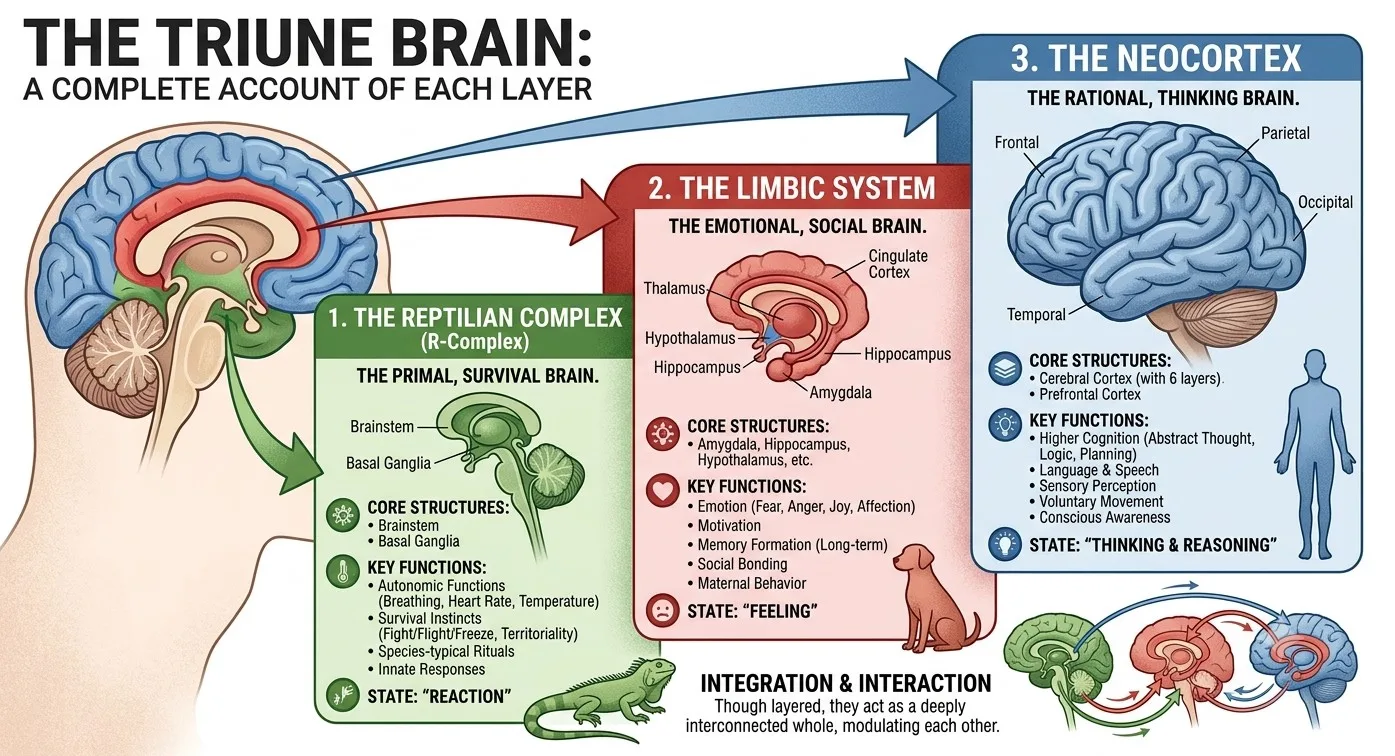
The Three Brains: A Complete Account of Each Layer
The triune brain theory proposes that the human brain contains three functionally and evolutionarily distinct systems, organized hierarchically from the most ancient and deepest to the most recent and most superficial. MacLean believed these systems were not merely anatomical regions but genuinely distinct “brains” — each with its own subjectivity, its own memory, its own motor functions, and its own sense of time and space.
1. The Reptilian Complex (R-Complex)
The most ancient layer in MacLean’s model, the reptilian complex — also called the protorepilian brain or R-complex — encompasses the brainstem and basal ganglia: structures including the striatum (caudate nucleus and putamen), the globus pallidus, and related regions. MacLean proposed that these structures, shared in evolutionary heritage with reptiles and earlier vertebrates, are responsible for the most fundamental, stereotyped behavioral repertoires: territoriality, dominance hierarchies, ritual display, aggression, mating behavior, the establishment of home sites, and the basic routines of daily life.
The behaviors attributed to the reptilian complex are, in MacLean’s account, inflexible, compulsive, and resistant to change — driven by inherited programs rather than flexible learning. They are performed with a characteristic automaticity, triggered by specific environmental stimuli, and relatively immune to the modifying influence of learning or reflection. MacLean pointed to behaviors like following daily routines, defending territory, and engaging in dominance displays as expressions of this ancient layer — behaviors that persist in humans despite our vastly expanded cortex.
2. The Paleomammalian Complex (Limbic System)
The middle layer in MacLean’s model — the one to which he devoted the most sustained research attention — is the paleomammalian complex, which he identified with the limbic system: a ring of cortical and subcortical structures including the hippocampus, amygdala, hypothalamus, cingulate cortex, septum, and related regions. MacLean proposed that these structures evolved with early mammals and are responsible for the emotional life that distinguishes mammals from reptiles: the capacity for subjective feeling states, mother-infant attachment and nurturing behavior, play, and the social bonds that characterize mammalian life.
This is the layer most directly associated with emotion in MacLean’s framework — and it is the layer whose influence on human behavior he found most clinically and psychologically interesting. The limbic system, in his account, generates emotional states that are experienced as immediate and compelling — fear, joy, rage, grief, tenderness — and that can override the rational deliberations of the neocortex. The visceral conviction of gut feelings, the intensity of emotional memories, and the apparent irrationality of emotional responses to otherwise neutral stimuli all reflect, in MacLean’s view, the ancient wisdom and ancient limitations of this middle brain.
MacLean’s specific identification of the limbic system as a unified functional system is one of the aspects of his theory most significantly challenged by subsequent research — but his intuition that specific brain structures play central roles in emotional processing has been substantially confirmed, even if the details have been substantially revised.
3. The Neomammalian Complex (Neocortex)
The outermost and most recently evolved layer in MacLean’s model is the neomammalian complex — the greatly expanded neocortex that reaches its most elaborate development in humans and other large-brained mammals. This is the seat of higher cognitive functions: language, abstract reasoning, planning, intentional problem-solving, creative thought, and the capacity for self-reflection. It is the brain that reads and writes, constructs theories, makes deliberate choices, and maintains the complex social and cultural life that distinguishes humans from other species.
In MacLean’s framework, the neocortex is the newest arrival — powerful, flexible, and capable of extraordinary complexity — but also, in important respects, dependent on and constrained by the older systems beneath it. The neocortex can reflect on emotional responses, plan around instinctive impulses, and deliberate about competing options; but it cannot simply override the older systems, which retain their own functional integrity and their own behavioral outputs. This is the neurological basis, in MacLean’s account, for the perennial human experience of internal conflict: the rational self that knows what is wise and the emotional, instinctive self that pulls in another direction.
Why MacLean’s Theory Became So Culturally Influential
The triune brain theory achieved a cultural reach that far exceeded what most scientific theories accomplish — and understanding why illuminates something important about how scientific ideas travel through culture and take root in popular understanding.
The most obvious reason is its narrative simplicity and explanatory elegance. The idea that we each carry three brains — a reptile, an emotional mammal, and a rational human — inside our skulls provides an immediately graspable framework for experiences that would otherwise require complex neurobiological explanation. Why do I know I shouldn’t eat the entire cake and eat it anyway? Why does intense emotion make clear thinking so difficult? Why do I feel territorial about my space, attached to my routines, and drawn to dominance signals in social hierarchies? MacLean’s framework offered answers in plain language.
Its adoption in therapeutic and educational contexts was rapid and widespread. Carl Sagan’s enormously influential 1977 book The Dragons of Eden — which won the Pulitzer Prize and introduced MacLean’s ideas to a vast general readership — cemented the triune brain in popular consciousness. Psychotherapy approaches, particularly those addressing trauma, drew on the framework to explain the relationship between somatic, emotional, and cognitive experience. The concept of the “emotional brain” versus the “thinking brain” — a direct translation of MacLean’s model — remains standard currency in many therapeutic and self-help contexts today.
The theory also resonated with a broader cultural preoccupation with the tension between reason and emotion, civilization and nature, conscious intention and unconscious impulse — tensions that have philosophical and literary histories stretching back millennia. MacLean gave these ancient intuitions a neuroscientific address, which made them feel simultaneously more legitimate and more concrete.
What Modern Neuroscience Says: The Evidence Against the Triune Brain
For all its cultural influence, the triune brain theory has been substantially challenged by modern comparative neuroscience — and the challenges go to the heart of its core claims. Understanding these challenges does not diminish MacLean’s genuine contributions; it places them in an accurate scientific context.
The most fundamental challenge comes from comparative neuroanatomy and evolutionary neuroscience. MacLean’s model assumed a particular view of brain evolution — that evolution added new layers on top of older ones, producing a hierarchically organized composite in which older structures were preserved intact beneath newer ones. This view — sometimes called the “scala naturae” or chain of being model of evolution — has been significantly revised by modern research.
Neuroscientist Georg Striedter, in his comprehensive work Principles of Brain Evolution (2005), demonstrated that brain evolution is not simply additive — it does not work by stacking new layers on top of preserved old ones. All vertebrate brains share the same basic organizational plan and the same fundamental components; what differs between species is the relative size and elaboration of different components, not the presence or absence of distinct “layers.” Reptiles do not lack a limbic system, as MacLean’s model implied — they have homologous structures serving related functions. And the human basal ganglia are not simply an inherited “reptilian” structure preserved unchanged; they have been significantly modified throughout mammalian evolution.
Neuroscientist and psychologist Lisa Feldman Barrett has offered one of the most thorough and accessible contemporary critiques of the triune brain in her book Seven and a Half Lessons About the Brain (2020). Barrett argues that the idea of three distinct brains in one is fundamentally inconsistent with what neuroscience now knows about brain architecture. There are no sharp anatomical boundaries between the structures MacLean assigned to different “brains.” The amygdala — central to MacLean’s limbic system and popularly conceived as an ancient emotional structure — is itself a complex, evolutionarily diverse structure with components of varying antiquity. And the behavior attributed to the “reptilian complex” — rigidity, territoriality, routine-following — is in fact mediated by basal ganglia circuits that are tightly integrated with the cortex in ways that make functional separation impossible.
The concept of the limbic system as a unified functional system has also been substantially questioned. While the structures MacLean grouped under this label do play important roles in emotional processing and memory, they do not form a functionally unified system — they are anatomically and functionally interconnected with the cortex in ways that prevent clean separation, and many of them are involved in non-emotional functions that MacLean’s framework does not readily accommodate.

What the Triune Brain Theory Gets Right: The Insights That Survive
The scientific critique of the triune brain does not mean that everything MacLean proposed was wrong — and identifying what survives scrutiny is as important as identifying what does not.
MacLean was fundamentally correct that understanding human behavior requires an evolutionary perspective. The brain is the product of evolutionary history, and that history shapes its architecture in ways that cannot be ignored. The behavioral patterns we share with other mammals — attachment, nurturing, play, social bonding — are not coincidences; they reflect shared neural heritage and shared adaptive pressures. MacLean’s insistence on taking this evolutionary continuity seriously was, and remains, important.
He was also correct that different brain systems can generate competing behavioral outputs — that there is something genuinely real about the experience of internal conflict between impulse, emotion, and deliberate reasoning. What modern neuroscience disputes is the specific anatomical mapping and the clean separation between systems, not the reality of the functional tensions that MacLean was trying to explain. The experience of emotion overriding reason, of habit competing with intention, of visceral responses preceding conscious awareness — these are real phenomena, robustly supported by modern neuroscience, even if the mechanisms are more distributed and integrated than MacLean’s clean three-layer model suggested.
His work on the limbic system — whatever its subsequent limitations — was genuinely foundational in directing scientific attention toward the neural substrates of emotion and social behavior at a time when these were understudied relative to purely cognitive functions. The vast research literature on the amygdala, hippocampus, cingulate cortex, and related structures that now characterizes affective neuroscience owes a real intellectual debt to MacLean’s insistence that emotion had a neuroscience worth pursuing.
The Triune Brain in Psychology and Therapy: Applied Uses and Limitations
The triune brain framework has been applied extensively in psychology, psychotherapy, and education — with results that are clinically useful in some respects and potentially misleading in others.
In trauma therapy, the language of the triune brain has been widely adopted — particularly in the work of clinicians like Peter Levine (somatic experiencing) and Bessel van der Kolk (The Body Keeps the Score), who have used the framework to explain why trauma responses involve the body and emotion in ways that resist purely cognitive intervention. The idea that trauma activates lower brain systems in ways that the cortex cannot simply override is clinically useful — it validates the somatic dimension of trauma experience and explains why talking alone is often insufficient for trauma resolution.
Dan Siegel’s “hand model of the brain” — a widely used pedagogical tool in mindfulness and parenting education — draws directly on the triune brain framework to explain the relationship between the brainstem, limbic system, and prefrontal cortex. The concept of “flipping your lid” — losing prefrontal regulation under emotional activation — has proven genuinely useful for helping people understand and work with their own emotional responses.
The limitation of these applied uses is the risk of oversimplification that becomes inaccuracy. When clients or students understand themselves as having a “reptile brain” or an “emotional brain” that is architecturally separate from their “rational brain,” they may develop a fragmented self-concept that does not accurately reflect the integrated nature of neural function. The reality — that all complex behavior involves the integrated activity of distributed neural systems that cannot be cleanly divided into ancient and modern, emotional and rational — is somewhat harder to communicate but ultimately more accurate and more empowering.
Beyond the Triune Brain: What Contemporary Neuroscience Offers Instead
Modern neuroscience offers a more complex but ultimately more accurate account of how the brain generates behavior, emotion, and experience — one that preserves what was genuinely insightful in MacLean’s framework while replacing its oversimplifications with more accurate models.
Several contemporary frameworks deserve attention:
- Predictive processing models — associated with theorists including Karl Friston and Andy Clark — propose that the brain is fundamentally a prediction machine, continuously generating models of the world and updating them based on incoming sensory data. In this framework, emotion is not a product of a separate “emotional brain” but an integral component of the brain’s predictive modeling — a system for tracking and communicating interoceptive states that are relevant to survival and wellbeing. Lisa Feldman Barrett’s theory of constructed emotion builds on this framework.
- Affective neuroscience — the field developed by Jaak Panksepp — identifies specific subcortical emotional systems (SEEKING, RAGE, FEAR, LUST, CARE, PANIC/GRIEF, and PLAY) that are conserved across mammals and that provide a more empirically grounded account of emotional evolution than MacLean’s reptilian/mammalian distinction.
- Polyvagal theory — developed by Stephen Porges — offers an evolutionary account of the autonomic nervous system that has significant parallels with MacLean’s hierarchical model, proposing three evolutionarily distinct response systems (dorsal vagal immobilization, sympathetic mobilization, and ventral vagal social engagement) that are organized hierarchically and that shape behavioral and psychological responses to perceived safety and threat.
Each of these frameworks is more consistent with current neuroanatomical knowledge than MacLean’s original model — and each preserves the core evolutionary and hierarchical insights that made the triune brain so intuitively appealing, while grounding them in more accurate neuroscience.
FAQs About MacLean’s Triune Brain Theory
What is MacLean’s triune brain theory in simple terms?
Paul MacLean’s triune brain theory proposes that the human brain is composed of three evolutionarily distinct systems layered on top of one another: the reptilian complex (brainstem and basal ganglia), responsible for basic survival behaviors and routines; the paleomammalian complex or limbic system (including the hippocampus, amygdala, and cingulate cortex), responsible for emotion, memory, and social bonding; and the neomammalian complex (the neocortex), responsible for higher cognitive functions like language, reasoning, and planning. MacLean proposed that these three systems can operate semi-independently and sometimes in conflict — explaining why humans sometimes act on impulse or emotion despite knowing better. While influential, the theory has been substantially challenged by modern neuroscience, which emphasizes the integrated rather than separate functioning of these brain regions.
Is the triune brain theory still accepted by neuroscientists?
In its original form, the triune brain theory is no longer accepted as an accurate account of brain evolution or function by the mainstream neuroscience community. The core claims — that the brain consists of three anatomically and functionally distinct layers inherited from reptiles, early mammals, and later mammals respectively — have been challenged by modern comparative neuroanatomy, evolutionary neuroscience, and neuroimaging research. Critics including neuroscientist Georg Striedter and psychologist Lisa Feldman Barrett have argued that brain evolution does not work by adding intact new layers on top of preserved old ones, that the brain regions MacLean separated are actually tightly integrated, and that the behaviors attributed to distinct “brains” are mediated by distributed neural systems rather than discrete anatomical modules. The theory retains influence in popular and clinical contexts but is not the framework that guides contemporary neuroscientific research.
What did MacLean mean by the limbic system?
MacLean used the term “limbic system” to describe a ring of cortical and subcortical structures surrounding the brainstem — including the hippocampus, amygdala, hypothalamus, cingulate cortex, and septum — that he proposed functioned as an integrated emotional brain inherited from early mammals. The term “limbic” (from the Latin limbus, meaning border or rim) had been used before MacLean, but it was his work that defined it as a coherent functional system and established its central role in emotion. While the individual structures MacLean included in the limbic system — particularly the amygdala and hippocampus — are indeed centrally important in emotion and memory, the concept of the limbic system as a unified functional system has been substantially questioned. Modern neuroscience tends to discuss the roles of specific structures rather than treating the limbic system as a coherent unit.
How has the triune brain theory influenced psychology and therapy?
The triune brain theory has had enormous influence in psychology, psychotherapy, and education — disproportionate to its current scientific status. In trauma therapy, clinicians including Peter Levine and Bessel van der Kolk have drawn on the framework to explain why trauma involves the body and emotion in ways that resist purely cognitive approaches, and why treatment must address somatic and emotional dimensions alongside cognitive ones. Dan Siegel’s hand model of the brain — widely used in mindfulness and parenting contexts — translates the triune brain into a pedagogical tool for understanding emotional regulation. The theory has been influential in explaining to clients and students why emotional responses can feel difficult to control through reasoning alone. These clinical applications remain useful as metaphors and educational tools, even as the underlying neuroscience has been refined.
What is the main criticism of the triune brain theory?
The main scientific criticism is that the triune brain theory presents an inaccurate account of how the brain evolved and how it is organized. Modern comparative neuroanatomy has established that evolution does not produce brains by adding intact new layers on top of preserved old ones — all vertebrate brains share the same basic organizational plan, and the differences between species reflect modifications and elaborations of shared structures rather than the layering of distinct brains. Additionally, the brain regions MacLean treated as functionally separate are in fact tightly integrated through dense reciprocal connections — the basal ganglia, limbic structures, and neocortex operate as part of distributed, integrated networks rather than as independent systems. The concept of a “reptilian brain” that operates separately from the “emotional” and “rational” brains does not accurately reflect neural architecture.
What theories have replaced or updated the triune brain model?
Several contemporary frameworks offer more empirically grounded accounts of the relationships between evolution, emotion, and cognition that MacLean was exploring. Lisa Feldman Barrett’s theory of constructed emotion proposes that emotions are not products of a separate limbic system but are constructed by the entire brain through predictive modeling of interoceptive and exteroceptive states. Jaak Panksepp’s affective neuroscience identifies conserved subcortical emotional systems shared across mammals, providing an empirically grounded account of emotional evolution. Stephen Porges’ polyvagal theory offers an evolutionary hierarchy of autonomic nervous system response systems that has genuine parallels with MacLean’s hierarchical intuitions. Karl Friston’s predictive processing framework provides a unified account of brain function in which emotional and cognitive processes are integrated rather than separate. Each of these frameworks is more consistent with current neuroanatomical and neuroscientific evidence than MacLean’s original model.
Bibliography
- MacLean, P. D. (1990). The Triune Brain in Evolution: Role in Paleocerebral Functions. Plenum Press.
- MacLean, P. D. (1952). Some psychiatric implications of physiological studies on frontotemporal portion of limbic system (visceral brain). Electroencephalography and Clinical Neurophysiology, 4(4), 407–418.
- Papez, J. W. (1937). A proposed mechanism of emotion. Archives of Neurology and Psychiatry, 38(4), 725–743.
- Striedter, G. F. (2005). Principles of Brain Evolution. Sinauer Associates.
- Barrett, L. F. (2020). Seven and a Half Lessons About the Brain. Houghton Mifflin Harcourt.
- Panksepp, J. (1998). Affective Neuroscience: The Foundations of Human and Animal Emotions. Oxford University Press.
- Porges, S. W. (2011). The Polyvagal Theory: Neurophysiological Foundations of Emotions, Attachment, Communication, and Self-Regulation. W. W. Norton.
- Sagan, C. (1977). The Dragons of Eden: Speculations on the Evolution of Human Intelligence. Random House.
- van der Kolk, B. A. (2014). The Body Keeps the Score: Brain, Mind, and Body in the Healing of Trauma. Viking.
- Siegel, D. J. (2010). Mindsight: The New Science of Personal Transformation. Bantam Books.
- LeDoux, J. E. (2015). Anxious: Using the Brain to Understand and Treat Fear and Anxiety. Viking.
Use this citation format to reference the article clearly and help readers find the original source.
PsychologyFor. (2026). MacLean’s Triune Brain Theory. PsychologyFor. https://psychologyfor.com/macleans-triune-brain-theory/