

See more of our articles in your search results.
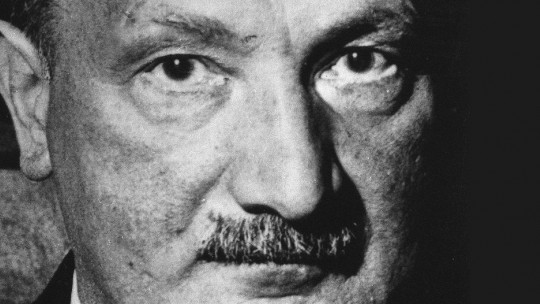
Martin Heidegger’s existentialist theory She is considered one of the main exponents of this philosophical movement, associated above all with authors from the late 19th and early 20th centuries. In turn, existentialism has been a movement that has greatly influenced the current of Humanistic Psychology, whose main representatives were Abraham Maslow and Carl Rogers and which during the last decades has been transformed into Positive Psychology.
In this article we will analyze the main approaches of the controversial German philosopher Martin Heidegger in his contributions to existentialist philosophy, including his own understanding of his work as part of existentialism. Let’s start by seeing what exactly this philosophical current is.
What is existentialism?
Existentialism is a philosophical current in which thinkers as diverse as Søren Kierkegaard, Friedrich Nietzsche, Martin Heidegger, Jean-Paul Sartre, Simone de Beauvoir, Albert Camus, Miguel de Unamuno, Gabriel Marcel, the psychologist Karl Jaspers, have been categorized. the writer Fiódor Dostoevsky or the film director Ingmar Bergman.
All these authors have in common their focus on the nature of human existence. In particular, they focused on the search for meaning as the driving force of an authentic life, for which they highlighted the importance of individual freedom. They were also united by their criticism of abstraction and the conception of thought as a central aspect.
Martin Heidegger, the philosopher in question, He denied his connection with existentialist philosophy; In fact, two periods have been distinguished in his work, and the second of them cannot be classified within this current of thought. However, the proposals and objects of study of his first stage have an evident existentialist character.
How many of these have you been "meaning to read" for months?
- 1
 CrosswayDust to DustAging Wisely in an Anti-Aging WorldListen Free On Audible
- 2
 THOUGHT CATALOGThe Mountain Is YouTransforming Self-Sabotage Into Self-MasteryListen Free On Audible
- 3
 Thomas NelsonBreath as PrayerCalm Your Anxiety, Focus Your Mind, and Renew Your Soul (80+ Breath Prayers and Devotional Medita...Listen Free On Audible
Martin Heidegger Biography
Martin Heidegger was born in 1889 in Messkirch, a town in Germany. His parents were devout Roman Catholics; This led Heidegger to study theology at the University of Freiburg, although he ultimately decided to devote himself to philosophy. In 1914 he received his doctorate with a thesis on psychologism, a current that highlights the role of mental processes.
In the 1920s he worked as professor of philosophy at the University of Marburg and later at Freiburg, where he would practice for the rest of his career. During this time he began to give talks focused on his ideas about human existence and the meaning of it, which he would develop in his book “Ser y tiempo”, published in 1927.
In 1933 Heidegger was appointed rector of the University of Freiburg, a position he left 12 years later. It is worth noting the affiliation of him and his active participation in the National Socialist German Workers Party – better known as the “Nazi Party”; In fact, Heidegger tried without success to become the reference philosopher of this movement.
Heidegger died in 1976 in the city of Freiburg im Breisgau; At that time he was 86 years old. Despite the criticism he has received for his collaboration with the Nazis, for the contradictions between his works and for his ignorance of other authors of his time, today this philosopher is considered one of the most important of the 20th century.
Heidegger’s existentialist theory
Heidegger’s main work is “Being and Time”. In it the author tries to answer a key question: what exactly does “being” mean? What does existence consist of, and what is its fundamental characteristic, if there is one? In this way he recovered a question that, in his opinion, had been neglected by philosophy since the classical period.
In this book Heidegger proposes that this question must be reformulated in search of the meaning of being, rather than this in itself. Regarding this, he affirms that it is not possible to separate the meaning of being from a specific spatial and temporal context (with death as a structuring element); So he talks about human existence as “Dasein” or “being-in-the-world”
Unlike what Descartes and other previous authors proposed, Heidegger considered that people are not thinking entities isolated from the world around us, but rather that our own interaction with the environment is a nuclear aspect of being. This is why it is not possible to master the self and trying to do so leads to a life lacking authenticity.
Consequently, The human ability to think has a secondary character and it should not be understood as that which defines our being. We discover the world through being-in-the-world, that is, existence in itself; For Heidegger, cognition is just a reflection of it, and therefore so are reflection and other similar processes.
Existence does not depend on will, but We are “thrown” into the world and know that it is inevitable that our lives will end. The acceptance of these facts, as well as the understanding that we are just another part of the world, allows us to give meaning to life, which Heidegger conceptualizes as the project of being-in-the-world.
Later Heidegger’s interests moved to other topics. He highlighted the relevance of language as a fundamental tool for understanding the world, explored the relationship between art and the search for “the truth” and criticized the dismissive and irresponsible attitude of Western countries towards nature.
Use this citation format to reference the article clearly and help readers find the original source.
PsychologyFor. (2024). Martin Heidegger’s Existentialist Theory. PsychologyFor. https://psychologyfor.com/martin-heideggers-existentialist-theory/