

See more of our articles in your search results.
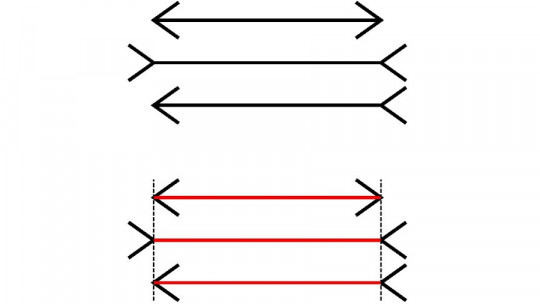
Stare at two lines of identical length, one capped with outward-facing arrowheads, the other with inward-facing ones, and something strange happens: your brain refuses to believe they’re the same size. They genuinely look different. You can measure them with a ruler, confirm they match perfectly, and your visual system will still insist otherwise the moment you look away and back again. That stubborn mismatch between measurement and perception is the Müller-Lyer illusion, one of the oldest and most studied optical illusions in psychology.
What makes this particular illusion so compelling to researchers isn’t just that it fools people. It’s that it fools nearly everyone, consistently, across repeated viewings, even once you know the trick. Understanding why your visual system does this reveals something genuinely important about how perception actually works: it’s not a passive camera recording the world exactly as it is, but an active, interpretive process constantly making assumptions about depth, distance, and context based on visual cues that aren’t always trustworthy. The illusion isn’t a flaw in your vision. It’s a byproduct of a system built for a three-dimensional world, tricked by a flat page.
So what’s actually happening inside the brain to produce this stubborn misjudgment?
This article explains what the Müller-Lyer illusion is, how it works, and the leading psychological theories behind why it occurs.
What Is the Müller-Lyer Illusion?
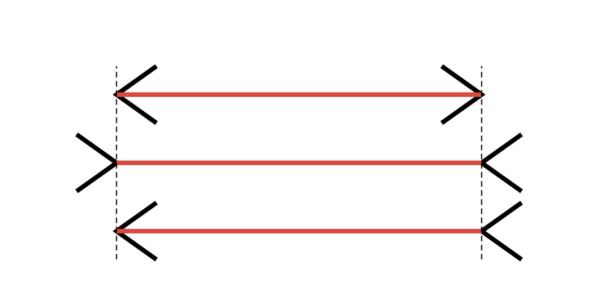
The Müller-Lyer illusion is a visual illusion in which two lines of equal length appear to be different lengths because of arrow-like fins attached to their ends, one set pointing outward and the other pointing inward. The line with outward-pointing fins consistently appears longer than the line with inward-pointing fins, even though both are objectively identical.
How many of these have you been "meaning to read" for months?
- 1
 TarcherThe Artist's Way30th Anniversary EditionListen Free On Audible
 - 2
 New Harbinger PublicationsThe Dialectical Behavior Therapy Skills WorkbookPractical DBT Exercises for Learning Mindfulness, Interpersonal Effectiveness, Emotion Regulation...Listen Free On Audible
 - 3
 New Harbinger PublicationsAdult Children of Emotionally Immature ParentsHow to Heal from Distant, Rejecting, or Self-Involved ParentsListen Free On Audible
The illusion is named after Franz Carl Müller-Lyer, a German sociologist and psychiatrist who first published the effect in 1889 in a German psychology journal. Remarkably, over a century of subsequent research hasn’t fully settled the question of exactly why it happens, even though the effect itself has been replicated thousands of times across countless studies.
A few essential facts define the illusion:
- It’s classified as a geometric optical illusion, relying on line configuration rather than color or shading.
- The perceived length difference typically ranges between ten and thirty percent, depending on fin angle and length.
- It remains one of the most frequently used illusions in introductory psychology courses worldwide, given its simplicity and reliability.
Despite its age, the Müller-Lyer illusion continues generating genuine research interest, particularly around questions of cross-cultural variation and the underlying neural mechanisms responsible for the effect.
What Does the Müller-Lyer Illusion Look Like? Key Characteristics
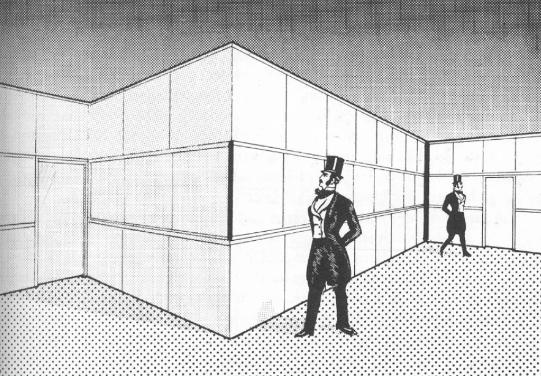
The illusion’s classic form involves two horizontal lines of identical length, each terminated by angled fins. One line’s fins point outward, forming shapes resembling arrowheads or the outer corner of a wall. The other line’s fins point inward, resembling the inner corner of a room, like the corner where two walls and a ceiling meet.
The outward-fin line consistently looks longer, while the inward-fin line looks shorter, despite both being drawn to precisely equal measurements. Researcher Richard Gregory, whose extensive work on visual perception shaped much of modern understanding of illusions, noted that the strength of the effect depends heavily on the specific angle of the fins, generally growing stronger as the angle becomes more acute.
A few characteristics affect how strongly someone perceives the illusion:
- Fin angle — sharper angles tend to intensify the perceived length difference.
- Fin length — longer fins relative to the central line generally produce a stronger effect.
- Viewing distance — the illusion can weaken somewhat at very close viewing ranges.
Interestingly, the illusion persists even when viewers are explicitly told the lines are equal length beforehand. Knowing the trick doesn’t undo it. That resistance to conscious correction is part of what makes this particular illusion so scientifically interesting.
Why Does the Müller-Lyer Illusion Occur? Leading Theories
Several competing theories attempt to explain the underlying mechanism, and no single explanation has achieved full consensus among researchers. Understanding the main candidates helps clarify just how genuinely puzzling this simple-looking illusion still is.
The most influential explanation, often called the misapplied size constancy theory, was developed extensively by Richard Gregory. This theory argues that outward-facing fins resemble the corners of a room viewed from inside, cues the brain typically associates with a nearer surface, while inward-facing fins resemble a convex corner viewed from outside, associated with a farther surface. The brain, applying real-world depth-processing habits to a flat image, unconsciously “corrects” for perceived distance, inflating the apparent length of what it interprets as farther away.
Other proposed explanations include:
- Confusion theory, suggesting the fins simply make it harder to accurately judge where the line actually begins and ends.
- Attentional theories, proposing that fins draw visual attention outward or inward, subtly biasing length judgment.
- Eye movement theories, which suggest saccadic eye movements toward the fins influence perceived line length directly.
None of these theories fully explains every observed variation of the illusion on their own. Most contemporary researchers suspect the true explanation likely involves some combination of these mechanisms working together, rather than one single, tidy cause.
The Carpentered World Hypothesis: Does Culture Shape the Illusion?
One of the most fascinating findings about the Müller-Lyer illusion is that its strength varies measurably across different cultural groups. This single observation sparked decades of cross-cultural perception research.
Psychologists Marshall Segall, Donald Campbell, and Melville Herskovits conducted a landmark cross-cultural study in the 1960s, comparing susceptibility to the Müller-Lyer illusion across numerous populations, including groups living in environments with few or no rectangular, “carpentered” structures. Their findings showed that people raised in environments rich with straight lines, right angles, and rectangular architecture, like most industrialized Western cities, experienced the illusion more strongly than people raised in environments with fewer such structures.
This became known as the carpentered world hypothesis, suggesting that repeated visual exposure to rectangular architecture trains the visual system to apply certain depth-interpretation habits automatically, habits that then get misapplied when viewing the illusion’s flat fin configurations.
Key implications of this cross-cultural research include:
- Perception isn’t purely hardwired biology; environment and visual experience genuinely shape how illusions are processed.
- Populations with less exposure to rectangular architecture showed measurably reduced susceptibility to the effect.
- The findings challenged assumptions that visual perception operates identically across all human populations regardless of environment.
How the Brain Processes Depth Cues and Size Constancy
Understanding the Müller-Lyer illusion requires understanding size constancy, the brain’s remarkable ability to perceive an object as maintaining a consistent size even as its distance from the viewer changes. This mechanism usually serves us extremely well in everyday life.
When a car drives away from you, it casts a progressively smaller image on your retina, yet you don’t perceive it as literally shrinking. Your brain automatically compensates, using depth cues, to maintain a stable perception of the car’s actual size. Richard Gregory’s core insight was that the Müller-Lyer illusion essentially hijacks this exact mechanism, triggering it inappropriately in response to flat, two-dimensional line drawings that merely resemble depth cues without any actual depth present.
This depth-processing system relies on several visual cues in ordinary life:
- Linear perspective, where converging lines suggest increasing distance.
- Relative size comparisons between familiar objects and their surroundings.
- Corner and edge configurations, exactly the kind mimicked by the illusion’s fins.
The fins in the Müller-Lyer figure essentially borrow visual shorthand normally reserved for genuine three-dimensional corners, and the brain, doing what it does reliably in real environments, applies its usual depth-correction logic anyway. The correction is appropriate in the real world. Here, applied to flat lines, it simply misfires.
Who Is Most Susceptible to the Müller-Lyer Illusion?
Susceptibility to the illusion varies measurably across age, culture, and even individual visual processing differences. It isn’t a uniform experience for everyone.
Researcher Ross Day, whose work on perceptual constancy examined how illusion susceptibility changes across development, found that young children often show weaker Müller-Lyer effects than adults, suggesting the illusion strengthens as visual systems mature and accumulate more experience interpreting depth cues from carpentered environments. This finding supports the broader idea that the illusion is, at least partly, a learned perceptual habit rather than a purely innate reflex.
Several factors correlate with illusion susceptibility:
- Age — susceptibility tends to increase through childhood before stabilizing in adulthood.
- Cultural and architectural environment, as demonstrated by the carpentered world research.
- Certain neurological or visual conditions, which can alter the strength of the perceived effect.
Interestingly, some research has also found individuals with autism spectrum traits sometimes show reduced susceptibility to certain visual illusions, including this one, suggesting differences in how context influences perceptual judgment. That finding remains an active area of ongoing investigation rather than a settled conclusion.

Müller-Lyer Illusion vs Other Classic Visual Illusions
The Müller-Lyer illusion belongs to a broader family of geometric illusions, each revealing slightly different aspects of how perception can be manipulated. Comparing it to related illusions clarifies what makes it distinct.
| Illusion | Core Mechanism |
|---|---|
| Müller-Lyer illusion | Fin-based depth cues misapplying size constancy |
| Ponzo illusion | Converging lines create false perspective-based size distortion |
| Ebbinghaus illusion | Surrounding circle size affects relative size judgment of a central circle |
| Zöllner illusion | Crossing diagonal lines create a false sense of angular distortion |
Researcher John Ninio, whose extensive work cataloguing and analyzing visual illusions has helped systematize the field, has noted that many geometric illusions, including the Müller-Lyer effect and the Ponzo illusion, likely share overlapping neural mechanisms related to context-dependent size and distance judgment. They’re not identical illusions, though. Each highlights a slightly different visual assumption the brain makes automatically.
What the Müller-Lyer Illusion Reveals About Human Perception
Beyond its role as a classroom demonstration, the Müller-Lyer illusion offers genuine insight into how perception fundamentally works. It’s a small trick with big implications.
Perhaps the most important lesson is that human vision isn’t a neutral, passive recording device. It’s an active interpretive process, constantly making probabilistic guesses about the world based on prior experience and contextual cues, guesses that are usually accurate but occasionally, predictably wrong. The illusion demonstrates this vulnerability with unusual clarity, precisely because the “mistake” is so consistent and so resistant to conscious override.
This has broader implications worth sitting with:
- Perception is shaped by learned visual habits, not just raw sensory input.
- Conscious knowledge doesn’t automatically override lower-level perceptual processing.
- Studying illusions offers a genuine window into otherwise invisible cognitive and neural mechanisms.
If anything, the persistence of the illusion despite full conscious awareness is oddly reassuring. It confirms that perception operates through dedicated, largely automatic systems, ones that generally serve us remarkably well outside of carefully constructed laboratory tricks designed specifically to expose their limits.
Practical Applications and Everyday Examples of the Illusion
Beyond psychology textbooks, principles behind the Müller-Lyer illusion show up in surprisingly practical contexts. Understanding the underlying mechanism has genuine real-world value.
Designers and architects sometimes apply similar visual principles deliberately, using angled lines or fin-like elements to make spaces feel larger or smaller than their actual dimensions. Clothing designers occasionally use analogous visual tricks, arranging patterns or seams to create the perception of different body proportions, drawing on the same underlying depth-cue misapplication.
A few practical examples worth noting:
- Interior design sometimes uses angled trim or molding to make rooms feel more spacious than their actual footprint.
- Fashion design occasionally applies similar line-angle principles to visually alter perceived body proportions.
- User interface design can leverage related size-perception principles to draw attention toward or away from specific elements.
None of these applications require deep technical knowledge of the underlying psychology to use effectively. Still, understanding why they work adds a layer of appreciation for just how much of everyday visual experience rests on assumptions the brain makes without ever asking permission first.
FAQs about the Müller-Lyer Illusion
Can you train yourself to stop seeing the Müller-Lyer illusion?
Not entirely, and that’s part of what makes it such a compelling illusion to study. Even people who fully understand the mechanism and have seen the illusion hundreds of times still perceive the length difference, though the effect can weaken slightly with repeated, deliberate exposure in some individuals. This resistance to conscious correction suggests the illusion operates at a fairly automatic, low-level stage of visual processing that isn’t easily overridden by explicit knowledge alone.
Does the Müller-Lyer illusion affect everyone equally?
No, susceptibility varies based on factors including age, cultural background, and individual visual processing differences. Cross-cultural research has shown that people raised in environments with less rectangular architecture, sometimes called less “carpentered” environments, tend to experience a weaker version of the illusion than those raised amid heavily rectangular urban environments. Age also plays a role, with the effect generally strengthening somewhat through childhood development before stabilizing in adulthood.
Is the Müller-Lyer illusion caused by eye movement alone?
Eye movement theories propose that saccadic movements toward the fins contribute to the perceived length difference, but this doesn’t appear to be the complete explanation. Studies using brief exposure times too short for meaningful eye movement still produce the illusion, suggesting cognitive and neural interpretation processes play a significant role beyond simple eye tracking behavior. Most researchers currently believe the effect likely results from multiple contributing mechanisms rather than any single cause acting alone.
What’s the difference between the Müller-Lyer illusion and an optical illusion in general?
The Müller-Lyer illusion is one specific type within the broader category of optical illusions, which includes many different visual effects caused by various mechanisms. While all optical illusions involve a mismatch between physical reality and perceived experience, the Müller-Lyer illusion specifically involves misjudged line length caused by attached angled fins, distinguishing it from illusions based on color, motion, or ambiguous figures that can be seen multiple ways.
Why do psychology courses use the Müller-Lyer illusion so often as an example?
It’s simple to reproduce, requires no special equipment, and reliably demonstrates a clear, measurable gap between objective reality and subjective perception in a way students can experience firsthand. Because the illusion has been studied extensively since the late 1800s, it also comes with a rich body of supporting research covering theory, cross-cultural variation, and developmental changes, making it a particularly well-documented teaching example for introducing core concepts in visual perception.
Can the Müller-Lyer illusion be used to measure something meaningful about a person’s brain?
To some extent, yes, though it’s used more in research contexts than as a standalone diagnostic tool. Researchers have used variations in illusion susceptibility to explore differences in visual processing across populations, including studies examining potential differences related to autism spectrum traits or specific neurological conditions. That said, illusion susceptibility alone isn’t considered a reliable diagnostic measure on its own, and any meaningful interpretation typically requires it to be considered alongside other, more comprehensive assessments.
Bibliography
- Müller-Lyer, F. C. (1889). Optische Urteilstäuschungen. Archiv für Physiologie.
- Gregory, R. L. (1997). Eye and Brain: The Psychology of Seeing. Princeton University Press.
- Segall, M. H., Campbell, D. T., & Herskovits, M. J. (1966). The Influence of Culture on Visual Perception. Bobbs-Merrill.
- Day, R. H. (1972). Visual Spatial Illusions: A General Explanation. Science.
- Ninio, J. (2001). The Science of Illusions. Cornell University Press.
- American Psychological Association. Resources on visual perception and cognitive processing.
- National Eye Institute. Understanding how the brain processes visual information.
Use this citation format to reference the article clearly and help readers find the original source.
PsychologyFor. (2026). Müller-Lyer Illusion: What it is and Why it Occurs. PsychologyFor. https://psychologyfor.com/muller-lyer-illusion-what-it-is-and-why-it-occurs/