

See more of our articles in your search results.
Your father calls twice in one afternoon, both times asking the same question he already asked yesterday, and something in your stomach tightens in a way it never used to. Is this just aging, or something more? That uncertainty is exhausting, because normal forgetfulness and genuine cognitive decline can look almost identical from the outside, especially in the early stages.
Families facing this uncertainty often feel caught between overreacting and dismissing something real. Waiting too long to investigate cognitive changes can delay treatment for reversible causes, while jumping straight to alarming assumptions can create unnecessary distress. What families actually need is a quick, structured way to gauge whether cognitive function has genuinely shifted, something more reliable than a gut feeling but less intimidating than a full neuropsychological workup. That’s precisely the gap a brief, standardized cognitive screening tool like the Pfeiffer Scale was designed to fill.
So what exactly does this tool measure, and what does a concerning score actually mean?
This guide explains what the Pfeiffer Scale is, what it’s used for, and how its results are typically interpreted.
What Is the Pfeiffer Scale?
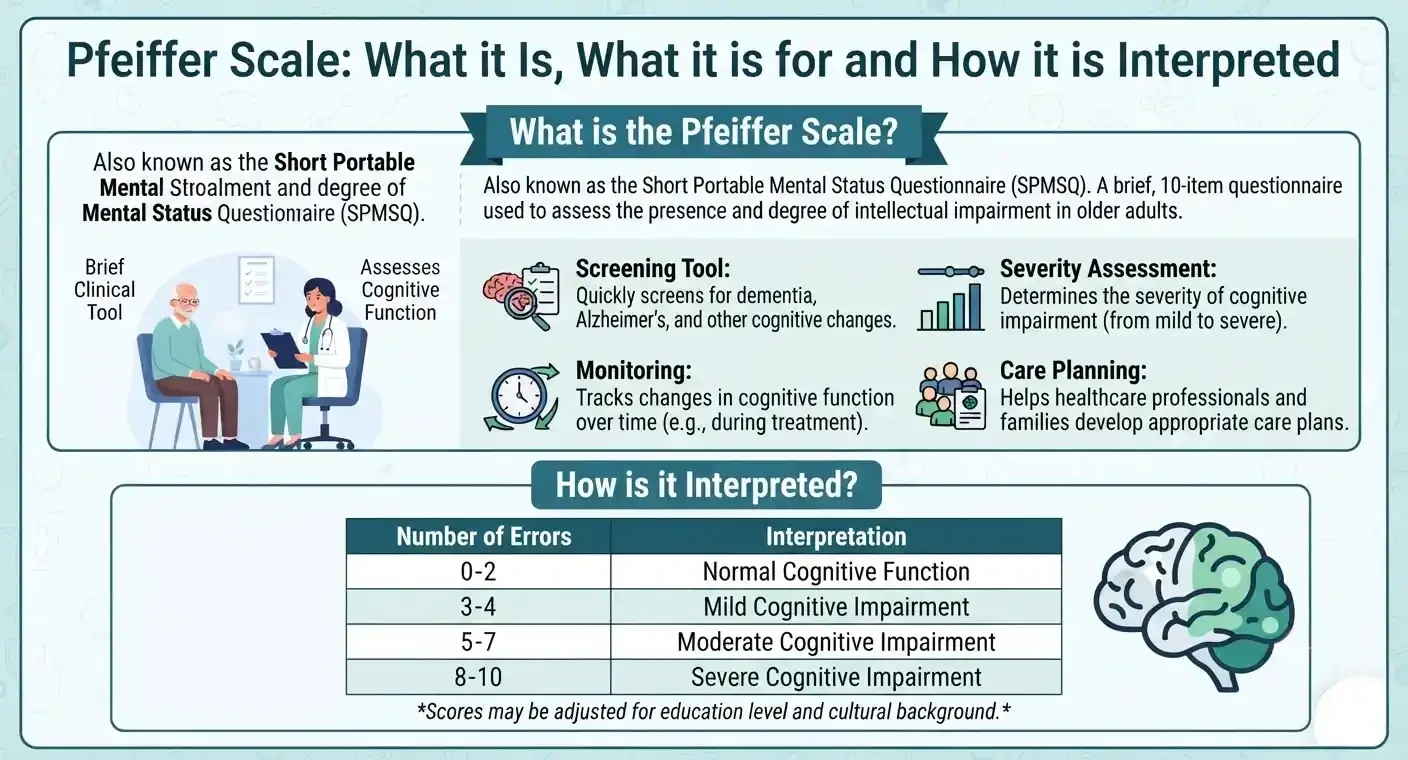
The Pfeiffer Scale, formally known as the Short Portable Mental Status Questionnaire, is a brief, ten-item cognitive screening tool used to quickly assess the presence and severity of cognitive impairment, particularly in older adults. It takes only a few minutes to administer.
How many of these have you been "meaning to read" for months?


Psychiatrist Eric Pfeiffer, who developed this instrument in 1975 specifically for use in geriatric assessment settings, designed it to be simple enough for non-specialist staff to administer reliably, without requiring extensive training or specialized equipment. That accessibility remains one of its defining strengths decades later.
A few core facts define the tool:
- It consists of ten brief questions covering orientation, memory, and basic calculation.
- It’s designed as a quick screening tool, not a comprehensive diagnostic instrument.
- Scoring adjusts based on education level, accounting for baseline differences in test performance.
Understanding the Pfeiffer Scale this way clarifies its actual purpose. It flags potential concern efficiently. It doesn’t, on its own, deliver a definitive diagnosis.

Who Created the Pfeiffer Scale and Why?
Eric Pfeiffer developed this screening tool while working in geriatric medicine, aiming to create something clinicians and even trained laypeople could administer quickly during routine visits. The healthcare need was genuinely pressing at the time.
Before instruments like this existed, cognitive impairment in older adults often went unnoticed until it became severe enough to be obvious, since lengthy, specialized testing wasn’t practical for routine screening across large elderly populations. Pfeiffer’s tool built directly on earlier work, including the Mental Status Questionnaire developed by researcher Leo Kahn in the 1960s, refining and shortening it into something considerably more efficient for widespread use.
The tool’s development addressed a few specific practical needs:
- The need for a brief, reliable screening method usable across busy clinical and community settings.
- A tool simple enough for non-specialist administration, expanding access beyond specialized memory clinics.
- A scoring system accounting for educational background, reducing bias against less formally educated patients.
Researcher Robert Katzman, whose subsequent validation studies helped establish the tool’s reliability across diverse populations, contributed significantly to confirming its practical clinical value beyond Pfeiffer’s original development work.
What Is the Pfeiffer Scale Used For?
The Pfeiffer Scale is primarily used to screen for cognitive impairment in older adults, helping identify individuals who may need further, more comprehensive evaluation. It’s a first step, not a final answer.
Clinicians commonly use it in primary care visits, nursing home admissions, and general geriatric assessments, situations where a quick, standardized check on cognitive status helps guide next steps without requiring extensive time or specialized resources. It’s also occasionally used to track changes in cognitive status over time, comparing scores across multiple visits.
Common applications include:
- Routine geriatric screening during primary care visits or annual wellness checks.
- Nursing home or care facility admissions, establishing a baseline cognitive status.
- Monitoring changes in cognitive function over time, particularly following illness or hospitalization.
- Identifying patients who need referral for comprehensive neuropsychological testing.
It’s worth being clear about scope here. This tool identifies who might need a closer look. It doesn’t replace that closer look when the situation genuinely calls for it.

What Questions Does the Pfeiffer Scale Include?
The Pfeiffer Scale consists of ten specific questions assessing orientation, memory, and basic calculation ability, each contributing to an overall error count that determines the final score. The questions themselves are intentionally simple and direct.
Typical items include asking the person to state today’s date, their age, their birthdate, the current president or head of state, and to perform a simple subtraction task, like counting backward from twenty by threes. These questions target different cognitive domains simultaneously, orientation to time and place, personal memory, and basic executive function.
The ten standard questions generally cover:
- Current date, testing orientation to time.
- Day of the week, another orientation check.
- Current location, testing spatial orientation.
- Personal phone number or address, testing basic memory recall.
- Current age, assessing personal factual memory.
- Birthdate, another personal memory check.
- Current head of state, testing general knowledge and orientation.
- Previous head of state, testing retained historical knowledge.
- Mother’s maiden name, testing long-term personal memory.
- Serial subtraction, testing basic calculation and attention.
How Is the Pfeiffer Scale Scored and Interpreted?
Scoring is based on the total number of incorrect answers, with higher error counts indicating greater likely cognitive impairment. The interpretation adjusts slightly based on the person’s educational background, a thoughtful design detail that improves fairness across different populations.
| Error Count | Interpretation |
|---|---|
| 0-2 errors | Normal cognitive functioning for most educational backgrounds |
| 3-4 errors | Mild cognitive impairment, warranting further observation |
| 5-7 errors | Moderate cognitive impairment, typically warranting further evaluation |
| 8-10 errors | Severe cognitive impairment, requiring comprehensive assessment |
The scoring criteria shift slightly for individuals with less formal education, allowing one additional error before a result is flagged as concerning, and shift in the opposite direction for those with more extensive education, requiring somewhat stricter accuracy. This adjustment reflects a genuine effort to avoid unfairly flagging people whose test performance might be influenced by educational background rather than actual cognitive decline.

Pfeiffer Scale vs Mini-Mental State Examination (MMSE)
The Pfeiffer Scale is often compared to the more widely known Mini-Mental State Examination, and understanding their differences clarifies when each tool makes more practical sense. Both serve similar screening purposes but differ meaningfully in structure and depth.
Psychiatrist Marshal Folstein, who developed the Mini-Mental State Examination in 1975, created a more comprehensive thirty-point assessment covering a broader range of cognitive domains, including language, visuospatial skills, and more detailed memory testing, compared to the Pfeiffer Scale’s more streamlined ten-question format.
Key comparative differences include:
- The Pfeiffer Scale takes only a few minutes and requires minimal training to administer.
- The MMSE takes longer and assesses a broader range of cognitive functions in more detail.
- The Pfeiffer Scale is often preferred for rapid initial screening, while the MMSE suits more detailed follow-up assessment.
Neither tool is universally “better.” They serve different points along the same general screening pathway, with the Pfeiffer Scale often functioning as the faster first step.
Who Should Be Assessed With the Pfeiffer Scale?
The Pfeiffer Scale is most commonly used with older adults, particularly those showing possible signs of cognitive change or entering care settings where baseline assessment matters. It’s not typically used for younger populations, where different tools apply.
Reasonable candidates for this screening include:
- Older adults showing noticeable memory changes reported by themselves or family members.
- Individuals being admitted to nursing homes or assisted living facilities, establishing a documented baseline.
- Patients recovering from significant illness or hospitalization, where cognitive changes sometimes emerge.
- Anyone undergoing routine geriatric health assessment, even without specific concerns yet raised.
A single concerning score doesn’t automatically confirm dementia or any specific diagnosis. It simply flags something worth exploring further with a qualified healthcare professional.

Limitations and Criticisms of the Pfeiffer Scale
Despite its practical usefulness, the Pfeiffer Scale carries genuine limitations worth understanding before relying on it too heavily. No brief screening tool captures the full complexity of cognitive functioning.
The tool’s brevity, while practical, means it can miss subtler forms of cognitive impairment that a more comprehensive assessment would catch. It also doesn’t assess certain cognitive domains, like executive function or complex reasoning, as thoroughly as longer instruments. Cultural and language factors can additionally affect performance in ways the educational adjustment alone doesn’t fully address.
Documented limitations include:
- Limited sensitivity to mild or early-stage cognitive changes compared to more detailed assessments.
- Potential cultural or linguistic bias in specific question content, like knowledge of national leadership.
- The tool cannot diagnose any specific condition on its own, only flag potential concern.
None of this makes the Pfeiffer Scale useless. It just means results should always be interpreted within a broader clinical context, not treated as a standalone verdict.
What Happens After an Abnormal Pfeiffer Scale Result?
An elevated error count on the Pfeiffer Scale typically prompts referral for more comprehensive cognitive and medical evaluation, rather than an immediate diagnosis. This next step matters considerably for getting an accurate picture.
A concerning score usually leads to further investigation, including a detailed medical history, blood tests ruling out reversible causes like thyroid dysfunction or vitamin deficiencies, and often referral to a neurologist or geriatric specialist for more extensive neuropsychological testing. Many causes of cognitive change are treatable, which is exactly why timely follow-up matters so much.
A typical follow-up pathway includes:
- A comprehensive medical workup, ruling out reversible causes of cognitive change.
- Referral for detailed neuropsychological testing, providing a more complete cognitive profile.
- Discussion of findings with the patient and family, framed with compassion and clear next steps.
Receiving a concerning score can feel frightening, understandably. Reaching out for that next evaluation step, though, reflects genuine proactive care, not confirmation of the worst-case scenario.
FAQs about the Pfeiffer Scale
Is the Pfeiffer Scale the same thing as a dementia diagnosis?
No, the Pfeiffer Scale is a screening tool, not a diagnostic instrument. A concerning score suggests the need for further evaluation, but an actual dementia diagnosis requires a comprehensive assessment involving detailed medical history, neuropsychological testing, and often brain imaging conducted by a qualified specialist. Many conditions besides dementia, including depression, medication side effects, or vitamin deficiencies, can also produce a low score on this kind of brief cognitive screening.
How long does the Pfeiffer Scale take to administer?
The test itself typically takes only a few minutes to complete, since it consists of just ten brief questions requiring simple, direct answers. This efficiency is actually one of its main advantages, making it practical for busy clinical settings like primary care visits or nursing home admissions where lengthy testing isn’t always feasible. The brief format does mean it provides less detailed information than longer cognitive assessments, which is a tradeoff worth understanding.
Can family members administer the Pfeiffer Scale at home?
While the questions themselves are simple enough that a family member could technically ask them, proper interpretation of results really benefits from professional context, since scoring accounts for educational background and results should be considered alongside broader clinical information. If a family member notices concerning memory changes, discussing those observations directly with a healthcare provider, who can administer the test properly and interpret it within a full clinical picture, generally produces more reliable and actionable results than informal home testing alone.
Does a low score always mean something is seriously wrong?
Not necessarily. A concerning score indicates that further evaluation is warranted, but it doesn’t automatically confirm a serious or permanent condition. Temporary factors like acute illness, medication side effects, severe stress, or even significant fatigue during testing can all affect performance without reflecting a genuine underlying cognitive disorder. This is exactly why an abnormal result typically leads to additional testing rather than an immediate, final conclusion.
How is the Pfeiffer Scale different from a simple memory test?
The Pfeiffer Scale assesses several distinct cognitive domains beyond memory alone, including orientation to time and place, basic calculation ability, and retained general knowledge. A simple memory test might only check recall of a short list of words, while this instrument provides a slightly broader, though still brief, snapshot of overall cognitive functioning. That said, it remains considerably less comprehensive than longer, more detailed assessments like the Mini-Mental State Examination.
Is the Pfeiffer Scale used outside of elderly care settings?
It’s primarily designed and used within geriatric and elderly care contexts, since it specifically addresses cognitive concerns common in older populations, like age-related cognitive decline or dementia risk. It’s not typically the appropriate tool for assessing cognitive concerns in younger adults or children, where different, more specialized instruments are generally used instead. Its scoring and question content are specifically calibrated for the kinds of cognitive changes most relevant to older adult populations.
Bibliography
- Pfeiffer, E. (1975). A Short Portable Mental Status Questionnaire for the Assessment of Organic Brain Deficit in Elderly Patients. Journal of the American Geriatrics Society.
- Folstein, M. F., Folstein, S. E., & McHugh, P. R. (1975). Mini-Mental State: A Practical Method for Grading the Cognitive State of Patients. Journal of Psychiatric Research.
- Katzman, R., et al. (1983). Validation of a Short Orientation-Memory-Concentration Test of Cognitive Impairment. American Journal of Psychiatry.
- National Institute on Aging. Cognitive Health and Older Adults: Screening and Assessment Resources.
- Alzheimer’s Association. Diagnostic Criteria and Cognitive Screening Tools.
Use this citation format to reference the article clearly and help readers find the original source.
PsychologyFor. (2026). Pfeiffer Scale: What it Is, What it is for and How it is Interpreted. PsychologyFor. https://psychologyfor.com/pfeiffer-scale-what-it-is-what-it-is-for-and-how-it-is-interpreted/