

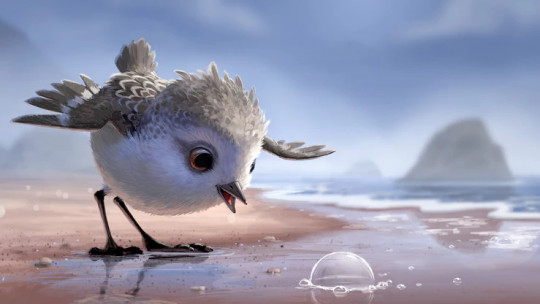
Some moments of fear feel impossibly large. A small bird standing at the edge of a crashing wave, trembling, unsure whether to step forward or retreat, captures something many people recognize: the paralyzing gap between knowing what you need to do and actually doing it. Piper, the Pixar short film, turns that inner struggle into a visual story that is both tender and precise. It is not a lecture. It is a moment.
The emotional weight of the film comes from how simply it portrays overcoming fear. The chick does not suddenly become brave. She experiments, fails, observes, adapts, and tries again. That process mirrors how people actually learn to face anxiety, uncertainty, or new challenges in their own lives. The short does not promise instant courage. It shows a gradual shift from avoidance to exploration, which is far more relatable and far more useful for anyone trying to understand their own hesitation.
What makes Piper an endearing short film about the ability to overcome so emotionally resonant?
This article explores the psychological themes in Piper, including fear, resilience, learning through experience, parental support, and the quiet courage required to try again after failure. It offers a framework for using the film as a tool for reflection, discussion, and emotional growth in families, classrooms, or personal journaling.

Why Piper Resonates as a Story About Fear and Courage
Piper resonates because it translates an internal emotional experience into external action without relying on dialogue. The chick’s fear is visible in her body language, her hesitation, and her retreat from the water. Her eventual courage is visible in her willingness to return to the same place that previously frightened her. That visual clarity makes the emotional arc easy to follow even for young viewers.
How many of these have you been "meaning to read" for months?
- 1
 Summer, JadeStress ReliefAdult Coloring Book with Animals, Flowers, Fantasy, and More for Mindfulness and RelaxationListen Free On Audible
 - 2
 HarperOneMere Christianity (Deluxe Edition)Listen Free On Audible
 - 3
 MajostaDon't Believe Everything You ThinkWhy Your Thinking Is The Beginning & End Of Suffering (Beyond Suffering)Listen Free On Audible
The film avoids the common trap of portraying courage as the absence of fear. Instead, it shows courage as a behavior that emerges alongside fear. Fear and courage coexist in the story. The chick does not stop being afraid of the waves. She learns a new way of interacting with them. That distinction matters because it reframes bravery not as a personality trait but as a learned response.
Psychologist Albert Bandura emphasized that people learn through observation, experience, and mastery. Piper’s journey reflects this. She watches other birds, experiences failure, discovers a new strategy, and then succeeds. Observational learning and experiential mastery combine to create a believable emotional transformation that feels earned rather than imposed.
The Psychology of Fear in Piper
Fear in Piper is not presented as irrational or childish. It is a reasonable response to a genuinely overwhelming stimulus. A large wave knocks the chick down, fills her with water, and leaves her shaken. From a psychological perspective, this is a classic conditioning event: a neutral stimulus, the ocean, becomes associated with a frightening outcome.
After the incident, the chick avoids the water. Avoidance is a common response to fear. It provides immediate relief but prevents learning. Fear avoidance maintains anxiety over time because the person never discovers that the situation might be manageable with a different approach. The film captures this accurately by showing the chick staying on the shore while others feed.
The turning point arrives when the chick observes a different strategy. She watches a small crab dig into the sand and withstand the wave safely. This moment introduces adaptive coping. Instead of retreating, she experiments with a new behavior, and that shift from avoidance to adaptation is central to how people overcome anxiety in real life. The fear does not disappear. It simply stops running the show.
Resilience and the Process of Trying Again
Resilience in Piper is not a single heroic moment. It is a sequence of small attempts, failures, observations, and adjustments. The chick falls, shakes off the water, watches, tries again, and eventually succeeds. This process mirrors how resilience actually develops in human experience, and it is iterative, not instantaneous.
Psychologist Ann Masten described resilience as ordinary magic: the result of everyday protective factors rather than extraordinary traits. In the film, those protective factors include a safe environment, a supportive parent, and the opportunity to explore. Ordinary magic appears in the chick’s ability to try again because the cost of failure is low and the possibility of success remains open.
The film also shows that resilience does not require verbal encouragement. The parent bird does not lecture the chick about bravery. She allows space for failure and returns to encourage feeding. Non-verbal support can be powerful because it communicates trust in the learner’s capacity to adapt without pressure to perform immediately.
Parental Support and the Space to Fail
The parent bird in Piper plays a crucial role without dominating the story. She pushes the chick toward the food, allows her to experience the wave, and then returns to encourage her again. This balance between encouragement and autonomy is central to healthy development. Parental support does not mean removing all obstacles. It means providing a secure base from which to explore.
Psychologist John Bowlby described attachment as a secure base that allows a child to explore the world while knowing support is available. The parent bird embodies this. She does not carry the chick to the food. She does not shield her from the wave. She remains present, responsive, and encouraging, which is the essence of secure attachment in practice rather than theory.
The film also shows that support can be gentle and non-intrusive. The parent does not force the chick into the water after the frightening experience. She allows time for recovery. Emotional pacing matters because pushing too quickly can reinforce fear rather than reduce it.
Learning Through Observation and Imitation
A pivotal moment in Piper occurs when the chick watches the crab withstand the wave by digging into the sand. This is not a random event. It is a clear example of learning through observation. The chick does not invent the strategy alone. She sees it, imitates it, and adapts it to her own body.
Bandura’s social learning theory emphasizes that people learn by watching others. Observational learning allows individuals to acquire new behaviors without direct trial and error. In the film, the crab serves as a model, and the chick’s imitation is not blind copying. She modifies the behavior to fit her own needs, which shows cognitive flexibility.
This process has practical implications for how people overcome fear in real life. Observing someone else manage a similar challenge can reduce anxiety and provide a concrete strategy. Modeling behavior is used in therapy, education, and parenting to help individuals learn new responses to difficult situations.
Overcoming Fear Through Adaptation, Not Elimination
Piper does not end with the chick becoming fearless. It ends with her returning to the water confidently, using the strategy she learned. The fear is not eliminated. It is managed. This distinction is important because it reflects how people actually overcome anxiety: they do not become immune to fear, they develop tools to navigate it.
Psychologist Susan David emphasizes emotional agility: the ability to move through difficult emotions with awareness and flexibility. The chick demonstrates this. She does not deny her fear. She acknowledges it, adapts her behavior, and moves forward, and that combination is what emotional agility looks like outside a textbook.
The film also shows that adaptation can be creative. The chick does not simply copy the crab. She integrates the strategy into her own way of moving and feeding. Creative adaptation is a hallmark of resilience because it allows individuals to find solutions that fit their unique circumstances rather than following a rigid formula.
Using Piper as a Tool for Emotional Discussion
Piper can be used in classrooms, families, or therapy settings to open conversations about fear, failure, and courage. The lack of dialogue makes it accessible across ages and languages. The emotional arc is clear enough that viewers can project their own experiences onto the story without needing explicit explanation.
Parents and educators can ask questions such as: What was the chick afraid of? Why did she avoid the water? What did she learn from the crab? How did her behavior change? These questions encourage reflective discussion without requiring viewers to disclose personal details immediately.
- Ask what moment in the film felt most like a real-life fear the viewer has experienced.
- Discuss how the chick’s avoidance behavior changed once she observed a new strategy.
- Explore what parental support looked like without a single spoken word.
- Invite viewers to name one small step they could try after watching the short.
The short can also be used to normalize struggle. Many children and adults feel shame when they hesitate or fail. Normalizing difficulty helps reduce that shame by showing that fear and failure are part of learning, not signs of weakness.
Practical Takeaways from Piper for Everyday Life
The lessons in Piper can be applied to real-life challenges involving anxiety, new skills, or unfamiliar situations. The film suggests that courage is not about eliminating fear but about finding a way forward despite it. This reframing can reduce pressure and make difficult tasks feel more manageable.
Viewers can reflect on their own experiences using a short, practical sequence rather than trying to solve everything at once.
- Notice the specific fear attached to the situation instead of labeling the whole task as scary.
- Identify one small, low-risk step that resembles the chick’s first cautious movement toward the shoreline.
- Observe someone who has faced a similar challenge and borrow a piece of their adaptive strategy.
- Allow room for failure without treating it as proof that the goal is impossible.
The film also highlights the value of patience. The chick does not succeed immediately. She takes time. Patience and persistence are essential for overcoming fear because they allow space for learning and adaptation. Rushing the process often reinforces anxiety rather than reducing it.
FAQs about Piper and Overcoming Fear
What is the main message of Piper?
The main message of Piper is that courage is not the absence of fear but the ability to move forward despite it. The chick learns to face the ocean not by becoming fearless but by discovering a new strategy that allows her to interact with the waves safely. This reflects how people overcome anxiety in real life, through adaptation, observation, and repeated attempts rather than sudden transformation.
How does Piper show resilience?
Piper shows resilience through the chick’s repeated attempts to feed despite initial failure. She falls, recovers, observes, adapts, and tries again. This iterative process mirrors how resilience develops in humans, through small steps, supportive environments, and the freedom to fail without permanent consequence. The film avoids portraying resilience as a single heroic act, which is part of why it feels so believable.
Can Piper be used to teach children about fear?
Yes, Piper can be used to teach children about fear because it visualizes an emotional experience without relying on complex dialogue. Parents and educators can use the film to discuss what fear feels like, why avoidance happens, and how new strategies can help. The chick’s journey provides a safe, relatable story that normalizes struggle and encourages problem-solving in a way that feels playful rather than instructive.
What psychological concepts does Piper illustrate?
Piper illustrates several psychological concepts, including observational learning, fear conditioning, avoidance behavior, resilience, secure attachment, and emotional agility. The chick’s experience reflects how fear is learned, maintained, and overcome through adaptation. The parent bird’s behavior also models supportive attachment that encourages exploration without forcing immediate success.
Is Piper suitable for all ages?
Yes, Piper is suitable for all ages because it contains no dialogue, violence, or complex themes that would be inappropriate for young viewers. The emotional content is universal and accessible. Adults may appreciate the psychological depth, while children can engage with the story on a simpler level. Its short length also makes it easy to use in educational or family settings without demanding a long attention span.
How can adults use Piper for personal reflection?
Adults can use Piper for personal reflection by identifying situations in their own lives where they feel like the chick, hesitant, afraid, or unsure how to proceed. They can ask themselves what strategies they might observe or adapt, what support they need, and what small step they could try next. The film encourages viewing fear as a signal worth paying attention to rather than a wall that cannot be crossed.
Bibliography
- Bandura, A. (1977). Social Learning Theory. Prentice Hall.
- Bowlby, J. (1988). A Secure Base: Parent-Child Attachment and Healthy Human Development. Basic Books.
- David, S. (2017). Emotional Agility: Get Unstuck, Embrace Change, and Thrive in Work and Life. Penguin Random House.
- Masten, A. S. (2001). Ordinary magic: Resilience processes in development. American Psychologist, 56(3), 227-238.
- Pixar Animation Studios. (2016). Piper [Short film]. Walt Disney Pictures.
- American Psychological Association. (2020). Understanding resilience and how to build it. APA.org.
- National Institute of Mental Health. (2021). Anxiety disorders: Overview and treatment options. NIMH.gov.
- World Health Organization. (2022). Mental health: Strengthening our response. WHO.int.
Use this citation format to reference the article clearly and help readers find the original source.
PsychologyFor. (2026). Piper: an Endearing Short Film About the Ability to Overcome. PsychologyFor. https://psychologyfor.com/piper-an-endearing-short-film-about-the-ability-to-overcome/