

See more of our articles in your search results.
The settlement of the continents occurred through the migrations carried out by the human species, gradually produced until they inhabited all possible regions on planet Earth.
The most accepted theory is the one that states that the first Australopithecus lived in Africa, as well as Homo Sapiens, and from that continent they left for the rest of the continents until they were all populated.
In this article it will be done a brief review of the settlement of the continents by the different human species that have evolved until only the Homo sapiens.
Dispersion throughout the contents of human species
The settlement of the continents began more than 2.5 million years ago, when beings belonging to a species very similar to modern humans, better known as Australopithecus (southern ape), inhabited Africa, whose physical characteristics were very similar to those of the apes we know today.
However, Australopithecus were differentiated by their ability to walk with a more upright posture, becoming a bipedal species, and they also developed a notable growth in the size of their brain (approximately 600 cubic centimeters, which could be up to 3 times larger). than that of an ape), which made it easier for them to acquire the ability to make small stone tools which despite being very rudimentary facilitated its evolution.
How many of these have you been "meaning to read" for months?
- 1
 Irvin D. YalomLove's ExecutionerRadically honest case studies on existential dread and changeListen Free On Audible
- 2
 Irvin D. YalomThe Gift of Therapy85 practical, warm clinical insights from a master therapistListen Free On Audible
- 3
 Oliver SacksThe Man Who Mistook His Wife for a HatUnforgettable clinical case studies on perception and identityListen Free On Audible
The australopithecus, after acquiring a series of skills, went on to become a more evolved species, the Homo habilisbeing considered the first species of human beings.
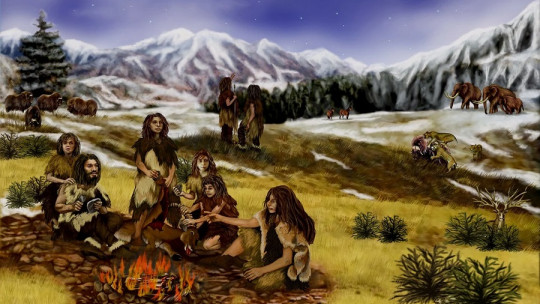
He Homo habilis It was the first human species to leave Africa, reaching territories in Asia and Europe, and it is on the European continent where it evolves into a new species, Neanderthal men; while in Asia they evolved into the species of Homo erectus (upright man).
On the other hand, the Homo habilis that lived in Africa also managed to evolve and, according to various research in this regard, it is on the African continent where the first beings with an anatomy similar to that of modern human beings emerged, said species being baptized with the name Homo. Sapiens. This is the one that has managed to survive to this day and to which we belong, and whose brain has an average of 1200 to 1400 cubic centimeters, more than double that of an Australopithecus.

The Homo neanderthalensisalso known as Neanderthals, were shorter than the Homo sapiens, but more robust. On the other hand the Homo sapiens He developed a slightly larger brain, which allowed him to acquire more sophisticated skills, thanks to which he was able to better adapt to the environment and its changes.
More than 100,000 years ago there was a period known as the “last ice age” during which the Homo sapiens left the African continent The peopling of the continents by Homo sapiens It continued when it moved to Asia and then colonized territories until it inhabited 5 continents, as we will explain in greater detail below. At the same time that it colonized territories, sapiens coexisted with other species of Homo that had arrived previously; However, the other species ended up becoming extinct and, therefore, only the Homo sapiens managed to survive.
The peopling of the continents by Homo sapiens
Although the species ancestors of Homo Sapiens had managed to reach various areas of the planet, only Homo Sapiens has managed to settle the continents in their entirety.
1. Africa
Although the Australopithecus spread to other continents, in Africa, in addition to occupying the entire continent, those who lived there also evolved. The human species that existed on this continent shortly before the Homo sapiens were the following: Homo Rudolfensis (Rudolph Lake Man), and Homo Ergaster (working man).
There are many theories that consider that there was a direct line of descent in evolution. However, there are others who claim that during the 2 million years since the first humans appeared until just over 10,000 years ago, when only the Homo sapiensdifferent human species came to coexist for many years.
Scientists who are experts in the field mostly agree on the hypotheses that state that 150,000 years ago, the eastern part of Africa was mostly populated by sapiens who looked very similar to those we live in today Likewise, it states that 70,000 years ago these sapiens from the African continent spread throughout the Eurasian territory.
2. Expansion through Asia
In the easternmost regions of the Asian continent, the species of Homo erectus managed to continue the settlement of the continents and also, managed to survive for 2 million years on this continent being the longest lasting human species that has ever existed.
In Indonesia, more specifically on the island of Java, another hominid species lived, known as Homo soloensis (man from the Solo Valley), which was the species that managed to adapt to the climate and life in the tropics. Studies carried out with remains of this species provided data about its antiquity (between 40,000 and 60,000 years).
The humans They managed to reach the island of Flores for the first time, taking advantage of a time in which the sea level had dropped significantly, which made access to the island easier. But when the sea level rose again, many were trapped on the island due to the scarcity of resources there, with the largest members dying first because they needed more food.
For this reason, on that island the inhabitants who managed to survive were the smallest and the members of the following generations were even smaller (it is estimated that they were 1 meter tall and weighed less than 25 kg), forming a species called by scientists as Homo floresiensis This species, despite being small, had a great ability to create stone tools that they could use for hunting; However, they disappeared more than 50,000 years ago. On the other hand, the first Homo sapiens arrived in Southeast Asia between 50,000 and 70,000 years ago, so perhaps they came into contact with floresiensis.
Regarding the western territory of Asia, there are two theories about its settlement. One of them states that there was an interbreeding between the species that had recently arrived from Africa and the one that lived there. The other theory says that the sapiens did not have offspring with the species that lived in that territory when they arrived (the Neanderthals), so that according to this theory the sapiens ended up replacing all the ancestor human species without mixing with them. There are investigations that have revealed data in favor of both, so there is no one that is absolutely right.
Notably In the southern area of Siberia and also in China, remains of Homo sapiens appeared that are about 40,000 years old
3. Expansion across Europe
Neanderthals lived in Europe before the Homo sapiens, expanding the settlement of the continents more than 500,000 years ago. However, they did not survive as long as the Homo erectus who lived in Asia.
The remains of Homo sapiens oldest that have appeared in Europe are about 45,000 years old Furthermore, remains that are 43,000 and 40,000 years old respectively appeared in England and Romania. Curiously, our species arrived earlier to the islands of Southeast Asia than to the Iberian Peninsula, since the latter was only populated by sapiens 44,000 years ago.
4. Expansion through Australia
It is estimated that 45,000 years ago, humans managed to cross the open sea until they managed to land in the territory that is now known as Australia, a territory that until then had never been trodden by the human species, thus continuing with the settlement of the continents. And in the period that elapsed from 70,000 years ago to 30,000 years ago, man made great discoveries (invention of the boat, bows and arrows, oil lamps and needles with which they could sew warm clothes). The first jewelry and also the first drawings also date from this time.
That stage constituted a cognitive revolution where new ways of communicating and thinking emerged. There is a highly validated theory that states that it is at this stage that the human brain developed numerous internal connections that facilitated a way of thinking more complex than any to date, allowing humans to communicate through a type of language that was completely innovative, despite the fact that a type of language already existed among humans.
This language not only allowed other members to be warned when they saw a “dangerous” animal approaching, but also made it easier to share information about other humans and in this way transmit to other members that someone in the group could become dangerous, this hypothesis being known under the name “gossip theory.”
Other great advances produced thanks to the cognitive revolution were the following: the ability to transmit to other humans a greater amount of information about the environment that surrounds them, plan and carry out actions of greater complexity, form groups with a greater number of members and which at the same time are more cohesive.
- You may be interested: “Hunter-gatherers: what characteristics do these cultures present?”
5. Expansion through America
Among the scientific community, the hypothesis has been widely accepted according to which Humans accessed the American continent through the Bering Strait with a length of 82 km, which united in winter, through an ice sheet that formed, Asia and America, so that humans were able to cross it and thus access a new continent for the first time in their history about 12,000 years ago. (late settlement theory), thus completing the settlement of the habitable continents.
However, there is another theory that states that humans had managed to reach the American continent earlier based on a series of archaeological finds (early settlement theory).
Use this citation format to reference the article clearly and help readers find the original source.
PsychologyFor. (2024). Population of the Continents: the 5 Stages of Human Dispersion. PsychologyFor. https://psychologyfor.com/population-of-the-continents-the-5-stages-of-human-dispersion/