


See more of our articles in your search results.
Every cabinet in the kitchen is ajar. The bedroom door yawns open, the bathroom door too, and the drawer under the microwave sticks out like a tongue. You come home, walk the apartment closing things one by one, and the person you live with looks up from the sofa with real surprise. “Oh. Was that open?” You’ve had a version of this conversation for years. It always ends the same way: a sigh, a joke, a quiet suspicion that this tiny habit must mean something larger. Somebody in the house always has a theory.
The internet is happy to tell you what. Commitment issues, unfinished business, anxiety, ADHD, a messy mind, a fear of endings. Some of those guesses have a kernel of research behind them. Many are pop-psychology decoration, confidently delivered and quietly unsupported. The theories are entertaining, and the people who offer them are usually sure, which should be your first reason for caution. Here’s the honest starting point: no study has tested what leaving doors open means, so anyone offering a single answer is guessing.
But you can reason well from adjacent science.
This article explains the psychological meaning of not closing doors by sorting the plausible explanations from the weak ones, with the evidence on habit, attention, “open loops,” options, closure, anxiety and upbringing.
It also covers when the habit is just a habit, when it’s a clue worth following and how to change it, or live with it, peacefully. You’ll also see what each explanation predicts, so you can test them against your own life instead of taking anyone’s word.
How many of these have you been "meaning to read" for months?
- 1
 TarcherThe Artist's Way30th Anniversary EditionListen Free On Audible
 - 2
 New Harbinger PublicationsThe Dialectical Behavior Therapy Skills WorkbookPractical DBT Exercises for Learning Mindfulness, Interpersonal Effectiveness, Emotion Regulation...Listen Free On Audible
 - 3
 New Harbinger PublicationsAdult Children of Emotionally Immature ParentsHow to Heal from Distant, Rejecting, or Self-Involved ParentsListen Free On Audible
What does it mean psychologically when someone doesn’t close doors?
Usually it means very little. Most of the time, leaving doors and drawers open is an automatic habit that nobody ever interrupted. It can also reflect attention and memory differences, a preference for openness, anxiety about enclosed spaces or the way someone was raised.
That’s the dull answer, and it’s probably the right one for most people. Closing a door is a tiny, effortless action that happens at the end of another action (getting something out, walking through a room). It’s not tied to any strong reward or consequence, so it’s easy to skip and easy to never learn. When nobody objects, it can last a lifetime.
The more interesting question is when it’s not just a habit. Researchers have not examined door-closing directly, but several established ideas offer reasonable hypotheses:
- Habit and automaticity: the behavior was never built, or was built in a household where open was normal.
- Attention and executive function: the closing step slips because working memory is occupied, a pattern common in ADHD.
- Open loops: the mind is carrying unfinished tasks, and the physical environment mirrors that.
- Keeping options open: a general preference to avoid commitment and finality.
- Low need for closure: comfort with ambiguity and unresolved things.
- Anxiety or threat sensitivity: open doors mean visibility and escape routes.
- Upbringing and context: norms learned at home about privacy, tidiness and doors.
Notice that those explanations point in different directions. Some suggest a mind that’s overloaded; others suggest a mind that’s relaxed; others suggest one that’s vigilant. The same visible behavior can come from opposite inner states. That’s why door-reading is unreliable, and why I’d treat any online claim of “this means you are X” with suspicion.
Take Hollis, an illustrative composite whose partner says he’s “commitment-phobic” because he leaves every cupboard open. Hollis has been in the same relationship for nine years, owns his home and has never changed jobs. His open doors have nothing to do with commitment. They have a lot to do with the fact that his mother never closed hers either.
This is the first rule of interpreting small habits: look at the whole person. A single behavior is a poor clue. A cluster of behaviors, together with how someone feels and functions, is much better.
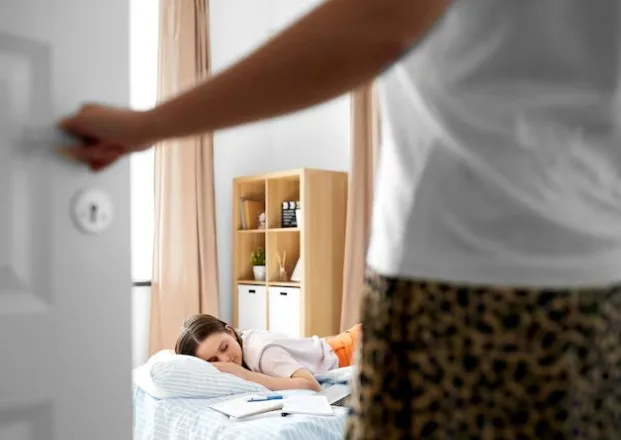
Is leaving doors open just a habit?
Often, yes. A habit is an automatic response triggered by a context, performed with little thought. Closing doors is a habit most people acquire by repetition and feedback; leaving them open is what happens when that learning never took place or was never reinforced.
The psychologists Wendy Wood and David T. Neal, in a 2007 review in Psychological Review, described habits as learned associations between contexts and responses. With repetition, the context itself (a cabinet, a kitchen, the moment you finish taking out a mug) starts to cue the action without much conscious intention. Habits are fast and efficient, which is also why they’re so stubborn: they persist even when your goals change.
What does that imply for doors? If you grew up in a house where doors were always closed, the end of “take something out” cues “push it shut” without any thought. If you grew up in a house where nobody bothered, no such link formed. Neither person is more disciplined; they’ve simply practiced different things.
How long does it take to change? The best-known estimate comes from a study by Phillippa Lally and colleagues, published in 2010 in the European Journal of Social Psychology. They followed 96 volunteers who chose a new daily behavior, and found that the time to reach automaticity varied widely, with a median of 66 days and a range from 18 to 254 days. Missing a single day did not seem to derail the process. The popular claim that habits take 21 days has no solid basis in that research.
Several features make door-closing an unusually easy habit to miss:
It has no payoff. Nothing good happens when you close a cabinet, and nothing bad happens when you don’t, at least not immediately. It happens at the tail end of another task, when your attention has already moved on. It is invisible to you, since you’re not looking at the door when you walk away. And it often has an audience that gets annoyed, while you don’t.
Imagine Anika, an illustrative composite who works long hospital shifts. She comes home, grabs a mug, a snack, her phone charger and a hoodie, and leaves a trail of open doors behind her. When she’s asked about it, she genuinely has no memory of leaving any of them open. That’s what automatic behavior feels like from inside: nothing.
So if your door-leaving is a long-standing habit with no other symptoms, it almost certainly is just a habit. The fix is behavioral, not psychological: attach the new action to a clear cue, repeat it, and give it time.
No deep meaning required.
Could leaving doors open be a sign of ADHD or executive function differences?
It can be one small piece of the picture, though it isn’t a symptom you can diagnose from. Difficulties finishing the last step of a task, losing track of what you were doing and forgetting small closing actions are common in ADHD, but they’re common in tired and stressed people too.
The psychologist Russell A. Barkley proposed in a 1997 paper in Psychological Bulletin that ADHD is fundamentally a problem of behavioral inhibition, with downstream effects on executive functions such as working memory, self-regulation of emotion and motivation, and the internalization of speech. In practice, that means difficulty holding a goal in mind while handling interruptions, and trouble with the small, boring steps that don’t carry much motivation. Closing a drawer is exactly that kind of step.
The same executive skills support prospective memory, remembering to do something in the future or at the right moment. “Close the door when I’ve got the milk” is a miniature prospective memory task. When working memory is already full, the intention evaporates. That’s why people with ADHD describe leaving doors, cupboards, car doors and the fridge open as a familiar daily annoyance.
But precision matters. Leaving doors open is not a diagnostic sign of ADHD. It’s a non-specific behavior shared by many people for many reasons. Researchers diagnose ADHD by looking at a pattern of inattention and/or hyperactivity-impulsivity that started in childhood, appears in more than one setting and impairs functioning. A habit with doors doesn’t meet that bar.
If you suspect ADHD, look for a broader cluster rather than one quirk:
- Chronic difficulty finishing tasks or following through on multi-step plans.
- Frequently losing keys, phone, wallet and documents.
- Time blindness: running late, underestimating how long things take.
- Starting many projects and leaving them unfinished.
- Trouble sustaining attention in boring tasks, along with restlessness or an inner sense of constant motion.
Other conditions can also affect attention and the small closing steps of tasks. Sleep deprivation, depression, anxiety, burnout, perimenopause, thyroid problems and certain medications can each impair concentration and memory. A sudden change, such as someone who always closed doors and now doesn’t, deserves a medical check, especially in older adults, since new forgetfulness can have several causes.
Think of Tariq, an illustrative composite who is thirty-four and suddenly noticing that he leaves doors, taps and the front door unlocked. He’s working eighty-hour weeks and sleeping five hours. The habit reflects exhaustion, not a lifelong disorder, and it fades when he gets sleep back.

Do open doors mirror open loops in the mind?
It’s a tempting metaphor, and psychology has a related idea: unfinished tasks tend to linger in the mind. Whether a physically open door reflects a mentally open loop is unproven, but the research on unfinished goals is worth knowing about either way.
The idea goes back to Bluma Zeigarnik, a Soviet psychologist who, in a 1927 study, found that people tended to remember interrupted tasks better than completed ones. The finding became known as the Zeigarnik effect. It suggested that an unfinished task keeps a kind of tension in memory until it’s resolved. A popular story has it that Zeigarnik was inspired by a waiter who could recall unpaid orders in detail but forgot them once the bills were settled, though that anecdote is more folklore than documented fact.
The evidence is more mixed than the legend. Replications of the original memory effect have been inconsistent, and many researchers regard it as less robust than textbooks suggest. What has held up better is a related idea: unfulfilled goals can intrude into thought and consume attention.
Work by E. J. Masicampo and Roy F. Baumeister supports that. In a 2011 paper in the Journal of Personality and Social Psychology, they found that unfulfilled goals produced intrusive thoughts and interfered with performance on other tasks, but that making a specific plan for the goal reduced the interference, even without completing it. In other words, the mind doesn’t need the task finished; it needs a believable plan for finishing it.
What might that mean for doors? If your head is crowded with unfinished obligations, your capacity to attend to small, automatic closing actions may shrink. The door isn’t a symbol of the open loops; it’s a casualty of the attention they use up. That is a plausible mechanism, but nobody has tested it for doors.
Consider Rhea, an illustrative composite who is a freelance designer juggling six client projects. Her apartment is a landscape of open drawers, half-read books and mugs in odd places. When she spends twenty minutes on Sunday writing down the next step for each project, she’s surprised to find she feels calmer and, a bit later, that she’s closing cupboards without trying. The doors didn’t cause the stress, and closing them didn’t fix it. The plan did.
Practical takeaway: if you suspect open loops, try a short “capture and plan” session. Write down every unfinished item and a concrete next step for each. It’s cheap and often calming, whatever it does for your cabinets.
And if your doors are the only thing that’s open, the metaphor may be overreaching. Sometimes a door is just a door.
Is leaving doors open a way of keeping options open?
As a literal explanation, probably not. As a metaphor, it connects to strong research: people really do hate closing doors, in the sense of losing options, even when keeping them costs more than it’s worth. But that research is about decisions, not about cupboards.
The classic experiments are by Jiwoong Shin and Dan Ariely, published in 2004 in Management Science under the title Keeping Doors Open. In their “door games,” participants clicked on three doors on a computer screen to earn money, and any door left unvisited gradually shrank and vanished. Participants invested effort and money to keep doors from disappearing, even when those doors had lower payoffs, and kept doing so despite experience and information. The researchers’ last experiment suggested the driver was loss aversion, a dislike of watching options vanish, rather than a genuine desire for flexibility.
The cost of that instinct is clear from work by Daniel Gilbert and Jane Ebert. In their 2002 paper in the Journal of Personality and Social Psychology, photography students who could change their minds about which print to keep liked their chosen print less than students who had to decide once and for all. Yet most people said they’d prefer the changeable option. In other words, we want reversible decisions and are happier with irreversible ones, and we don’t predict it.
A related line of work concerns maximizers. Barry Schwartz and colleagues reported in 2002 that people who always seek the best possible option, as opposed to “good enough,” tended to report lower happiness, optimism and self-esteem and more regret and depression. They’re the people for whom closing any door feels risky.
So the psychology of keeping options open is real and consequential. The question is whether it shows up as literal open doors, and I’d say there’s no good evidence it does. The mechanisms are about choices with real stakes: majors, partners, jobs, houses. An open pantry is a different kind of thing.
Still, the metaphor can be useful for self-reflection. If you notice that you leave many “doors” open in life, such as unanswered invitations, tentative plans, unresolved relationships or a long list of “maybe” commitments, that’s worth examining separately from the cabinets.
Imagine Owen, an illustrative composite who has been “kind of seeing” three people for a year and hasn’t signed a lease in a decade. His open cupboards are incidental. His open life is not. The first is a habit; the second is a pattern worth discussing with a therapist if it’s making him unhappy.
The useful question isn’t “what do my open doors mean?” It’s “where in my life am I avoiding a decision because closing it feels like loss?”
What does the need for closure have to do with it?
The need for cognitive closure is a person’s desire for a firm answer instead of ambiguity. People low in this need tolerate open questions comfortably, and might also live comfortably amid physical open-endedness, though that link is speculative.
The concept was developed by Arie W. Kruglanski and Donna M. Webster, who described it in a 1996 paper in Psychological Review called Motivated Closing of the Mind. They proposed that people differ in how strongly they want definite knowledge, and that this motivation can be triggered by situations such as time pressure, noise and fatigue. When the need is high, people tend to “seize” on early information and “freeze” on it, resisting new evidence. When it’s low, they remain open to alternatives and take longer to commit to a conclusion.
Closure is also the language we use for endings: closing a chapter, closing a deal, getting closure after a loss. Language makes it easy to treat a closed door as a symbol of finality. Someone who feels uneasy about endings might unconsciously avoid the small ritual of closing, or might not. The metaphor is attractive and nobody has measured it.
There’s an interesting asymmetry. People with a high need for closure usually like order: closed cupboards, tidy surfaces, clear categories. People with a low need for closure are comfortable with a bit of mess and ambiguity. That would predict that low-closure people leave more doors open, but I’m not aware of data on this, so treat it as a hypothesis, not a finding.
Different contexts raise or lower the need. Stress, deadlines and noise push people toward wanting quick answers. Calm, slow settings let people stay open. A person who leaves doors open at home and is meticulous at work isn’t contradictory. It may reflect different demands.
Consider Meg, an illustrative composite who is a researcher. At work, she’s a stickler for precise definitions. At home, she lives in what her husband calls “a house of unfinished sentences”: open doors, half-read books, projects in progress. She says home is where she gets to leave things open. The doors mark a boundary between her tight work mind and her loose home mind.
That illustrates something important about interpretation. The same behavior can be an expression of relaxation instead of dysfunction. Not everything unclosed is a problem.
For most people, though, the closure story is a mild personality flavor, not a clinical sign.
Can anxiety or past trauma explain keeping doors open?
Sometimes, yes. For some people, open doors feel safer: they provide visibility, an escape route and a sense that nothing is hiding. This is more likely when someone has a history of threat or confinement, or when anxiety about enclosed spaces is part of the picture.
Here the research is about hypervigilance. The psychiatrist Judith Herman, in her 1992 book Trauma and Recovery, described how people who have lived through prolonged trauma often remain in a state of heightened arousal: easily startled, constantly scanning for danger, uneasy in situations where they feel unable to leave. Everyday choices, such as where to sit in a restaurant, whether to face the entrance or whether to close the bedroom door, can be shaped by that readiness.
For someone with that history, a closed door may feel like a trap or a blind spot. An open door means they can see and hear what is happening and leave quickly. It isn’t irrational. It’s a learned safety strategy that once made sense.
Other anxiety-related patterns can produce similar behavior. Claustrophobia, a fear of enclosed spaces, can make closed doors uncomfortable. People with panic disorder sometimes avoid situations from which escape feels difficult. Some people with generalized anxiety keep doors open to hear what’s going on in the house, particularly parents of young children or people living with a vulnerable relative.
Warning signs that open doors are linked to something that deserves attention:
- You feel panicky, tight in the chest or trapped when a door is closed.
- You can’t sleep unless doors are open or you can see the exit.
- The habit began after a frightening event, such as an assault, break-in, accident or period of confinement.
- You startle easily, scan rooms on entering and avoid enclosed spaces generally.
- Other people closing doors, or being asked to close them, brings a spike of distress.
If several of those apply, the pattern may be a trauma-related or anxiety-related response, and a psychologist or licensed counselor who works with trauma can help. Effective treatments exist, and people often find that these responses ease when the sense of safety is rebuilt.
Imagine Jonah, an illustrative composite who never closes the bathroom or bedroom door at home. After a stressful event years ago, he finds that being enclosed sets his heart racing. He assumed it was a quirk until a therapist asked what happens in his body when he closes a door. That question changed how he understood the habit.
A cautious note: not everyone who keeps doors open has trauma, and nobody should assume it. This is a possibility to consider if the behavior is accompanied by fear, not a default reading.
If any of this sounds like you, a gentle first step is to notice when and why. If the answer includes the word “safe,” that’s a clue worth sharing with a professional.
How do upbringing, culture and relationships shape door habits?
Strongly, though invisibly. Families have unspoken rules about doors, privacy and tidiness, and children absorb them without being taught. Many “meanings” of door-leaving are really inherited norms, which become visible only when two households meet.
Consider how much a door can signify in different homes. In some families, a closed bedroom door means privacy and respect. In others it signals secrecy or rejection, and parents may insist on open doors. In some homes doors stay shut to keep heat in or bugs out; in warm climates, open doors might be the default for airflow. In a home with lots of people, closing a door can be a rare act of retreat.
That means people may bring very different instincts into the same house. One partner learned that closing doors is polite and tidy. The other learned that doors are for when you want to be left alone, and closing one is a sign something is wrong. Neither is “right.” The conflict arises when each interprets the other’s behavior as a message.
Door disputes are among the most common minor friction points in shared living, and they’re rarely about doors. A partner who keeps closing cupboards may be reading open ones as carelessness or disrespect. A partner who leaves them open may feel nagged and controlled. The meaning each assigns is what stings.
Take Priya and Dev, illustrative composites who share an apartment. She grew up in a household where closed doors meant someone was in trouble. He grew up where doors were closed to keep the dog out. When she leaves the bathroom door open, he feels she is being careless; when he closes the bedroom door, she feels shut out. Once they discuss it, both laugh. The doors had stood in for entirely different childhoods.
Practical steps for couples and households: talk about what doors mean to each of you before treating them as a moral issue. Agree on a few “rules that matter,” such as the front door and the fridge, and let the rest be negotiable. Use a light tone. And separate the habit from the relationship, since a cupboard left open isn’t evidence of how someone feels about you.
Often, understanding where a habit came from makes it far easier to tolerate or to change.
When is leaving doors open worth paying attention to?
Pay attention when it’s new, when it comes with other changes, when it causes distress or conflict, or when it’s linked to fear. Otherwise, it’s a harmless quirk. The table below sets out the main explanations, what supports them and how to tell them apart.
| Possible explanation | Evidence level | Clues it fits | What tends to help |
|---|---|---|---|
| Simple habit | Strong general evidence on habit formation | Lifelong, no other symptoms, family did the same | Cue, repetition, patience (weeks to months) |
| Attention or executive differences (including ADHD) | Strong for ADHD itself; none for doors specifically | Many unfinished tasks, lost items, time blindness since childhood | Reminders, routines; evaluation if broader pattern |
| Fatigue, stress or overload | Well supported for attention lapses | Recent onset, poor sleep, heavy workload | Rest, reducing load, planning |
| Open loops and unfinished goals | Moderate for goal intrusion; doors untested | Mind full of pending tasks, relief after planning | Capture and plan sessions |
| Keeping options open or avoiding commitment | Strong for decisions; none for doors | Wider pattern of avoiding decisions in life | Reflection, therapy if distressing |
| Low need for closure | Moderate; link to doors untested | Comfortable with mess and ambiguity | Usually none needed |
| Anxiety or trauma response | Strong for hypervigilance; doors anecdotal | Panic when enclosed, onset after a frightening event | Trauma-informed therapy, safety work |
| Upbringing and household norms | Plausible, little direct research | Family and culture did the same | Conversation, negotiated rules |
A few red flags are worth acting on. A sudden change in a longstanding habit, particularly in an older adult, may warrant a medical check, since new forgetfulness has many possible causes including medication effects, infection, thyroid problems, depression and early cognitive changes. Leaving doors unlocked or appliances on in addition to leaving doors open raises safety concerns. Distress or panic around closed doors suggests anxiety or trauma. And significant conflict in a relationship over the issue may deserve a conversation or couples counseling, not because of the doors but because of what they’ve come to stand for.
When should you see a professional? If the pattern is part of a broader difficulty with attention or organization that affects work, school or relationships; if you feel fear, panic or distress about enclosed spaces; if the change is sudden and unexplained; or if you’re worried about safety. A primary care doctor (a GP in the UK, Ireland, Australia and New Zealand) can rule out medical causes and refer you to a psychologist or psychiatrist.
Imagine Ben, an illustrative composite who is seventy-one. His family notices that he has started leaving the front door open and the stove on, which he never did. That’s not a quirky habit. It’s a reason for a prompt conversation with his doctor.
In the end, the best question is a simple one: has this changed, and does it hurt anyone?
If the answer is no and no, relax.
How can you change the habit, or live with someone who leaves doors open?
Anchor the new behavior to an existing cue, make it easy, repeat it and be patient. And if you live with a door-leaver, shift from nagging to agreements. Habits change through design and repetition, not through guilt.
For the person who wants to change, here are six steps grounded in habit research:
- Pick one door. Start with the cabinet or door that bothers people most, not all of them at once.
- Attach it to a cue. Decide on a trigger such as “when I take my hand off the handle, I push it shut.” The context cues the action once it’s practiced.
- Make it effortless. Fit soft-close hinges, magnetic catches or door closers so the closing is nearly automatic.
- Add a visible reminder. A small sticker or note at eye level works well for the first few weeks.
- Repeat, and don’t panic about misses. Lally’s study suggested that one missed day didn’t derail habit formation, and that automaticity often takes around two months or more.
- Do an end-of-task sweep. After cooking or getting ready, take ten seconds to look around and close what’s open. It converts a forgotten step into a ritual.
For the person living with someone who leaves doors open, the hard part is emotional. It feels like disrespect, and it’s almost never intended that way. Try these shifts: ask rather than accuse (“could we try to close the cupboards after cooking?”), choose a small number of non-negotiables, offer practical aids such as soft-close hardware, and acknowledge their efforts. Avoid diagnosing (“you must have ADHD”) or reading the behavior as a message about the relationship.
Take Priya and Dev again. They agree that the fridge and the front door must always be closed, and the rest is flexible. Dev installs soft-close hinges on the cabinets. The arguments fade within weeks. The doors weren’t the issue; the unspoken rules were.
Some people simply will not change this habit, and that’s fine. Many couples and households live well with a few open cupboards. The relationship matters more than the hinge.
What would happen if, for the next two weeks, you treated open doors as information instead of insult?
FAQs about the Psychological Meaning of Not Closing Doors
Does leaving doors open mean something psychologically?
Not on its own. Most of the time it’s an automatic habit that nobody interrupted, and no research has directly tested what door-leaving means. Plausible contributors include attention and memory differences, a mind busy with unfinished tasks, comfort with ambiguity, anxiety about enclosed spaces and the norms of the household you grew up in. Because the same behavior can come from opposite inner states, one door can’t tell you much. A cluster of behaviors, along with how someone feels and functions, is a far better clue than a single quirk. People who study habits would add that a quirk with no distress and no change over time rarely needs any explanation at all.
Is leaving cabinet doors and drawers open a sign of ADHD?
It can be one small part of a larger picture, but it isn’t diagnostic. In ADHD, differences in working memory and behavioral inhibition make small closing steps easy to forget, and many people with ADHD describe leaving doors and cupboards open. But tired, stressed and distracted people do it too. ADHD is diagnosed from a longstanding pattern of inattention and impulsivity or hyperactivity across settings that impairs functioning. If you recognize many other signs, such as lost items, unfinished projects and time blindness, a clinical evaluation is worth considering. Because ADHD and ordinary overload overlap so much, it’s the pattern across many areas of life, not any single behavior, that matters.
Is not closing doors a sign of commitment issues?
There’s no evidence for that link. The research on keeping options open, such as the door games by Jiwoong Shin and Dan Ariely, concerns decisions about real options, not cupboards. People leave doors open for ordinary reasons like habit and distraction. If you notice a wider pattern of avoiding decisions in life, such as leaving relationships or plans permanently tentative, that’s worth exploring separately, perhaps with a therapist. But don’t treat an open pantry as a window into someone’s capacity to commit. Another way to put it is that a behavior that is ambiguous in meaning shouldn’t be treated as a symptom, particularly in a partner or family member you care about.
Why do I leave doors open when I’m stressed?
Stress and fatigue reduce working memory and attention, which makes small automatic steps like closing a door easier to skip. A mind full of unfinished tasks can also use up the attention you’d need for those tiny actions. Research by E. J. Masicampo and Roy Baumeister found that unfulfilled goals can interfere with other tasks and that making a concrete plan reduces the interference. If your door habit worsens when you’re overloaded and eases when you rest or plan, that’s a useful clue that stress is the main driver. Rest, a brief planning session and a more forgiving schedule often reduce lapses of this kind more than any attempt to try harder.
Can leaving doors open be related to anxiety or trauma?
Yes, for some people. Those who have experienced threat or confinement can feel safer with open doors, because they offer visibility and an escape route, a pattern linked to hypervigilance. Claustrophobia and panic can also make closed doors uncomfortable. Clues include panic or tightness when a door is closed, trouble sleeping with doors shut and a habit that began after a frightening event. This is not the explanation for most people who leave doors open, but if it fits, a trauma-informed therapist can help. These responses often ease as safety is rebuilt. If you suspect this pattern, it helps to tell a clinician what happens in your body when a door closes, because that detail often points toward the right kind of help.
How long does it take to build the habit of closing doors?
It varies widely. In a 2010 study led by Phillippa Lally, people took a median of about 66 days to make a new daily behavior feel automatic, with a range from 18 to 254 days. Missing one day didn’t seem to derail progress. Simple, easy behaviors tend to become automatic faster than complex ones, and tying the new action to a clear cue helps. Expect a couple of months of practice, and consider soft-close hardware or a visible reminder to make the early weeks easier. Patience matters more than willpower here, and the habit tends to stick once the cue, the action and the repetition have lined up.
My partner never closes doors and it drives me crazy. What can I do?
Start by treating it as a habit, not a message about how they feel about you. Ask calmly and specifically instead of accusing, agree on a short list of non-negotiables such as the front door and the fridge, and let the rest go. Practical aids like soft-close hinges and magnetic catches can reduce friction. Avoid armchair diagnosis and sarcasm, which tend to escalate. If the issue keeps resurfacing as a symbol for deeper resentment, a couples counselor can help you talk about what the doors have come to represent. A shared agreement tends to work better than ongoing reminders, because it replaces a chronic small conflict with a clear arrangement that both people chose.
When should I worry about someone leaving doors open?
Worry when the change is sudden, when it comes with other new problems like forgetfulness, confusion, leaving the stove on or the front door unlocked, or when it’s tied to fear or panic. A sudden change in an older adult deserves a prompt medical check, since memory and attention changes have several causes, many treatable. Persistent difficulty with attention and organization that affects work or relationships, or distress about closed spaces, is worth discussing with a doctor or psychologist. A lifelong quirk with no other symptoms and no distress generally isn’t a cause for concern. It’s also worth asking whether the person themselves is bothered; many people with this habit are not, and the concern may belong mostly to those around them.
Bibliography
- Barkley, R. A. (1997). Behavioral inhibition, sustained attention, and executive functions: Constructing a unifying theory of ADHD. Psychological Bulletin, 121(1), 65-94.
- Gilbert, D. T., & Ebert, J. E. J. (2002). Decisions and revisions: The affective forecasting of changeable outcomes. Journal of Personality and Social Psychology, 82(4), 503-514.
- Herman, J. L. (1992). Trauma and recovery. Basic Books.
- Kruglanski, A. W., & Webster, D. M. (1996). Motivated closing of the mind: “Seizing” and “freezing.” Psychological Review, 103(2), 263-283.
- Lally, P., van Jaarsveld, C. H. M., Potts, H. W. W., & Wardle, J. (2010). How are habits formed: Modelling habit formation in the real world. European Journal of Social Psychology, 40(6), 998-1009.
- Masicampo, E. J., & Baumeister, R. F. (2011). Consider it done! Plan making can eliminate the cognitive effects of unfulfilled goals. Journal of Personality and Social Psychology, 101(4), 667-683.
- Schwartz, B., Ward, A., Monterosso, J., Lyubomirsky, S., White, K., & Lehman, D. R. (2002). Maximizing versus satisficing: Happiness is a matter of choice. Journal of Personality and Social Psychology, 83(5), 1178-1197.
- Shin, J., & Ariely, D. (2004). Keeping doors open: The effect of unavailability on incentives to keep options viable. Management Science, 50(5), 575-586.
- Wood, W., & Neal, D. T. (2007). A new look at habits and the habit-goal interface. Psychological Review, 114(4), 843-863.
- Zeigarnik, B. (1927). Das Behalten erledigter und unerledigter Handlungen [The retention of completed and uncompleted actions]. Psychologische Forschung, 9, 1-85.
Use this citation format to reference the article clearly and help readers find the original source.
PsychologyFor. (2026). Psychological Meaning of Not Closing the Doors. PsychologyFor. https://psychologyfor.com/psychological-meaning-of-not-closing-the-doors/