

See more of our articles in your search results.
You reach for your morning coffee cup without a second thought, your fingers curling around the handle with perfect precision, while at the same time you can feel the exact temperature of the ceramic against your skin. It’s such an ordinary moment that it barely registers, yet underneath it lies an extraordinarily fast, coordinated exchange between your brain and body. Now imagine that same simple action becoming difficult or unreliable, as it does for people recovering from a nerve injury, a stroke, or a condition like Guillain-Barré syndrome, and suddenly this invisible system demands your full attention. That system, quietly running nearly every deliberate movement and sensation you experience, is the somatic nervous system.
It’s genuinely disorienting when voluntary movement or basic sensation stops working the way it always has, especially since most people have never been taught the biological mechanics behind reaching, walking, or feeling a light touch on the skin. This gap in understanding can leave people feeling frightened and confused after an injury or diagnosis, unsure whether their symptoms are serious, temporary, or something else entirely. Because the somatic nervous system handles both the sensory information coming into the brain and the motor commands going back out to muscles, disruptions here can affect movement, coordination, and touch sensation all at once, sometimes in ways that feel bewildering to describe to a doctor. Understanding how this system actually works can replace that confusion with a grounded, practical sense of what’s happening and why.
So what exactly allows you to consciously control your body while also feeling everything it touches, all through one interconnected system?
This article explains what the somatic nervous system is, how it’s structured, and the essential functions it performs every time you move, touch, or sense the world around you.
What Is the Somatic Nervous System and What Does It Do?
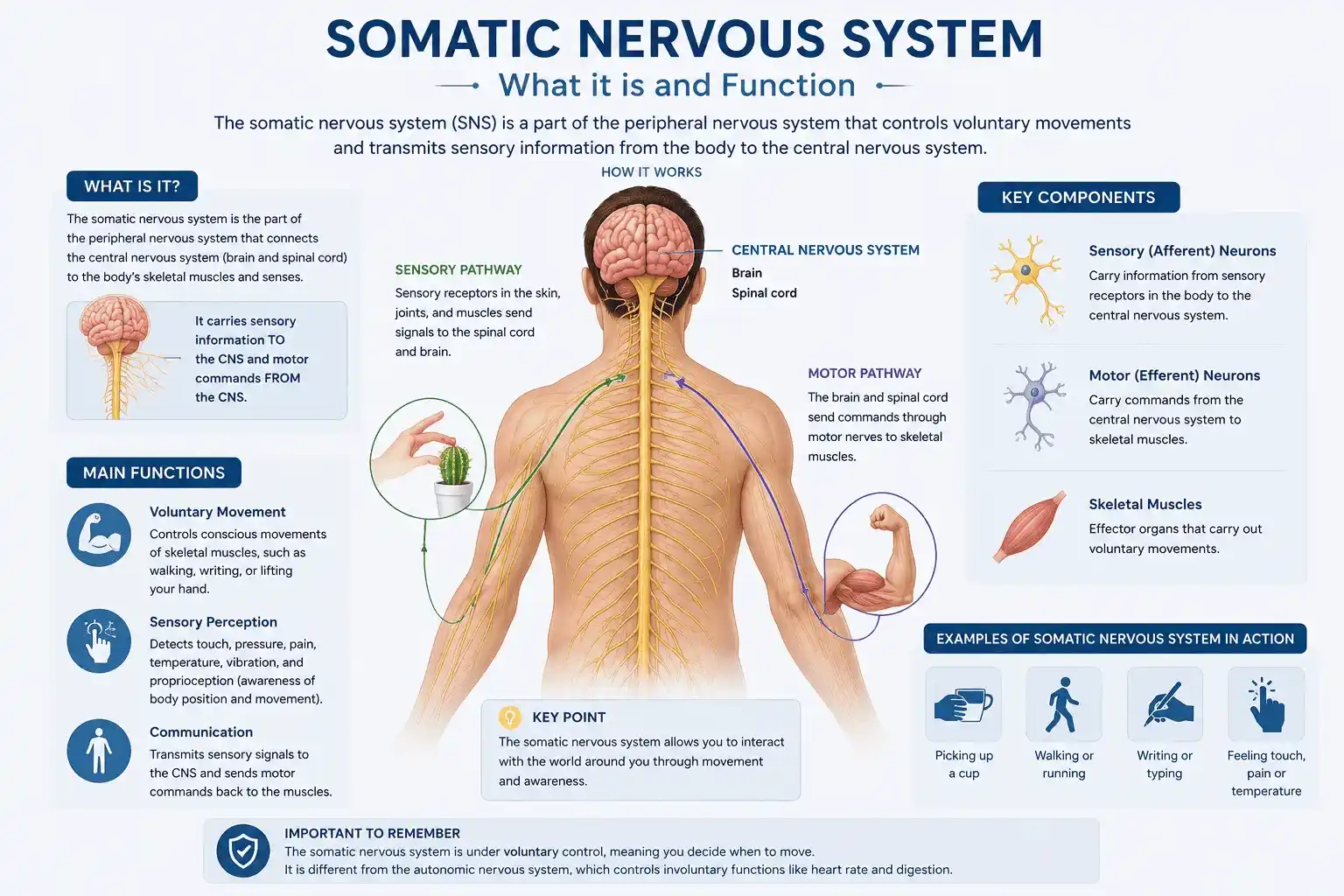
The somatic nervous system is the division of the peripheral nervous system responsible for voluntary movement and conscious sensory processing. Unlike the automatic, background functions managed by the autonomic nervous system, everything the somatic nervous system controls is something you can consciously initiate or become aware of.
How many of these have you been "meaning to read" for months?


This system carries out two core jobs continuously throughout the day. First, it handles sensory input, carrying information from receptors in the skin, muscles, and joints toward the central nervous system, allowing conscious awareness of touch, pressure, temperature, and pain. Second, it manages voluntary movement, carrying motor commands from the brain out to the skeletal muscles, enabling deliberate, controlled actions like walking, speaking, or picking up an object.
Structurally, the somatic nervous system is part of the broader peripheral nervous system, meaning it lies entirely outside the brain and spinal cord, though its signals originate from and terminate within these central structures. Neuroscientist Santiago Ramón y Cajal’s foundational nineteenth-century research established that individual nerve cells communicate across small gaps rather than existing as one fused, continuous structure, a discovery that shaped the modern understanding of how somatic signals travel with such speed and precision between the brain and body.
Because this system governs everything from typing a message to feeling a light breeze on your arm, even small disruptions here can meaningfully affect daily independence, which is exactly why understanding its basic function matters for anyone navigating an injury, chronic condition, or unexplained sensory change.
How Is the Somatic Nervous System Structured?
The somatic nervous system is built from two functionally distinct types of nerve fibers working in opposite directions. This dual structure allows for the constant, two-way communication needed to both sense the environment and respond to it purposefully.
Sensory, or afferent, nerve fibers carry information from receptors throughout the body toward the central nervous system, relaying signals related to touch, temperature, pain, and proprioception, the sense of where your body is positioned in space without needing to look at it directly. Motor, or efferent, nerve fibers carry the opposite direction of traffic, transmitting commands from the brain and spinal cord out to skeletal muscles, triggering the specific, coordinated contractions needed to produce deliberate movement.
- Afferent nerve fibers carry sensory information from the body toward the central nervous system.
- Efferent nerve fibers carry motor commands from the central nervous system out to skeletal muscles.
- The system includes both cranial nerves, serving the head and neck, and spinal nerves, serving the rest of the body.
- A single motor neuron and the muscle fibers it controls together form a motor unit, the basic functional building block of voluntary movement.
Physiologist Charles Sherrington’s extensive research on the nervous system introduced the very concept of the motor unit, demonstrating that a single motor neuron can control anywhere from a handful to hundreds of individual muscle fibers depending on how fine or powerful the required movement needs to be. This structural insight helps explain why some movements, like the precise motions of the fingers, are remarkably delicate and controlled, while others, like the large muscles of the thigh, prioritize raw power over fine detail.
How Does the Somatic Nervous System Control Voluntary Movement?
Voluntary movement begins in the brain and travels through a carefully organized pathway before ever reaching a muscle. This process depends on precise coordination between multiple regions of the central and peripheral nervous systems working together.
When you decide to move, the primary motor cortex in the frontal lobe generates the initial signal, which travels down through the spinal cord and out along efferent somatic nerve fibers to the appropriate skeletal muscle. Neurosurgeon Wilder Penfield’s pioneering intraoperative stimulation studies produced the famous motor homunculus, a map showing how different body parts are represented across the motor cortex in proportion to how finely controlled that body part needs to be, rather than its actual physical size, which is why the hands and face occupy such a disproportionately large area of this map compared to the trunk or legs.
This entire process, from conscious intention to actual muscle contraction, happens remarkably quickly, often within a fraction of a second, though the exact speed depends on the specific pathway and the complexity of the movement involved. More complex, multi-step movements, such as those involved in playing a musical instrument or performing a new physical skill, require additional planning and refinement from the supplementary motor area and cerebellum, working alongside the primary motor cortex to smooth out timing and coordination.
A practical takeaway: because voluntary movement depends on this entire chain functioning correctly, physical rehabilitation exercises following a somatic nerve or brain injury often focus on repetitive, purposeful movement, since this kind of practice genuinely helps strengthen and refine the remaining functional pathways.
How Does the Somatic Nervous System Process Sensory Information?
Sensory processing within the somatic nervous system begins the moment a specialized receptor detects a physical change in the environment or within the body itself. This raw information must then travel a specific pathway before it becomes a conscious sensation.
Specialized sensory receptors throughout the skin, muscles, and joints detect distinct types of stimuli, including light touch, deep pressure, temperature, pain, and body position. Physiologist Edgar Adrian’s Nobel Prize-winning research on how sensory neurons encode information demonstrated that the intensity of a stimulus is represented by how frequently a neuron fires rather than by the strength of any single signal, a foundational insight into how the nervous system translates physical stimuli into meaningful neural information. This sensory information travels through afferent somatic nerve fibers into the spinal cord and up toward the thalamus, which relays it to the primary somatosensory cortex in the parietal lobe for conscious interpretation.
Neurophysiologist Vernon Mountcastle’s influential research on the columnar organization of the somatosensory cortex helped establish that this brain region processes sensory information through vertically arranged functional columns, each dedicated to a specific type of input from a highly localized part of the body, which explains why sensory deficits following nerve or brain damage can be so precisely mapped to a specific body region.
Recognizing that sensations like numbness or tingling reflect a real, traceable disruption somewhere along this specific pathway, rather than something vague or difficult to explain, can help patients communicate more effectively with healthcare providers about exactly what they’re experiencing.

What Is the Reflex Arc and How Does It Work Within the Somatic System?
The reflex arc is a rapid, automatic response pathway that allows the somatic nervous system to react to certain stimuli without waiting for input from the brain. This built-in shortcut can be genuinely protective in situations requiring an immediate response.
A classic example is the withdrawal reflex, where touching something painfully hot triggers a signal that travels to the spinal cord, gets processed there by an interneuron, and immediately sends a motor command back to the muscle, pulling the hand away before the pain sensation has even reached the brain for conscious awareness. This circuit involves a sensory neuron detecting the stimulus, an interneuron within the spinal cord integrating the information, and a motor neuron carrying the resulting response back to the muscle, entirely bypassing higher brain centers in the interest of speed.
Because reflexes are a built-in, hardwired feature of the somatic nervous system, physicians routinely test them, such as the well-known knee-jerk reflex, specifically because a reflex that is too weak, too strong, or entirely absent can point toward a specific type of nervous system dysfunction, from nerve damage to spinal cord injury.
- The reflex arc allows an immediate protective response without requiring conscious brain processing.
- A sensory neuron detects the initial stimulus and carries the signal toward the spinal cord.
- An interneuron within the spinal cord integrates the incoming signal and generates an appropriate response.
- A motor neuron carries the resulting command back out to the muscle, completing the reflex.
How Does the Somatic Nervous System Differ From the Autonomic Nervous System?
The somatic and autonomic nervous systems represent two fundamentally different modes of bodily control: one voluntary and conscious, the other automatic and largely outside awareness. Understanding this distinction clarifies why some bodily functions respond to conscious effort while others operate entirely on their own.
| Feature | Somatic vs Autonomic Nervous System |
| Control type | Somatic: voluntary and conscious; Autonomic: involuntary and automatic |
| Primary targets | Somatic: skeletal muscles; Autonomic: internal organs, glands, smooth muscle |
| Example function | Somatic: reaching for an object; Autonomic: regulating heart rate |
The somatic nervous system governs skeletal muscles and conscious sensation, while the autonomic nervous system manages internal organs, blood vessels, and glands, adjusting functions like heart rate, digestion, and pupil size without requiring any deliberate decision-making. This division matters clinically because damage to each system tends to present quite differently: somatic nervous system damage often produces immediately noticeable symptoms, like muscle weakness or numbness in a specific area, while autonomic dysfunction can cause more subtle, harder-to-trace symptoms, such as unexplained blood pressure changes.
Understanding which system is involved in a particular set of symptoms can genuinely help guide the diagnostic process, since somatic symptoms typically point toward a specific, localized nerve or muscle problem, while autonomic symptoms often suggest a more diffuse or systemic underlying cause.

What Happens When the Somatic Nervous System Is Damaged?
Somatic nervous system damage produces symptoms that are usually noticeable and specific, since this system governs both conscious sensation and voluntary movement. The exact presentation depends on which specific nerve or nerve pathway is affected.
Common causes of somatic nerve damage include physical trauma, nerve compression, diabetes, autoimmune conditions, and certain infections. When a single nerve is affected, the resulting condition is called a mononeuropathy, producing weakness or numbness confined to a specific, traceable area, such as carpal tunnel syndrome affecting sensation and movement in the hand. When damage affects the pathway more broadly or symmetrically, it can produce widespread symptoms resembling those seen in conditions like Guillain-Barré syndrome, an autoimmune condition that attacks peripheral nerve fibers and can produce progressive weakness starting in the legs.
- Localized weakness or numbness often points toward damage affecting a specific somatic nerve.
- Widespread, symmetrical symptoms can indicate a broader nerve condition affecting multiple pathways at once.
- Abnormal reflexes, whether exaggerated or absent, help clinicians localize somatic nervous system dysfunction.
- Loss of proprioception can cause balance difficulties and clumsy, poorly coordinated movement.
Because these symptoms are usually noticeable relatively quickly, prompt medical evaluation is genuinely important, since certain causes of somatic nerve damage, particularly autoimmune or compressive conditions, respond significantly better to treatment when addressed early.
How Are Somatic Nervous System Conditions Diagnosed and Treated?
Diagnosing somatic nervous system disorders typically combines a detailed physical and neurological examination with specialized nerve testing. This structured process helps pinpoint the exact nerve or pathway responsible for a person’s specific symptoms.
Nerve conduction studies and electromyography remain the primary diagnostic tools for assessing somatic nerve and muscle function, measuring how efficiently electrical signals travel along specific nerves and how effectively muscles respond. A thorough reflex and sensory examination, assessing strength, sensation, and coordination across different body regions, often provides valuable localizing information even before specialized testing is performed. Imaging studies, such as MRI, may be used when a structural cause, like nerve compression from a herniated disc, is suspected.
Treatment depends heavily on the specific underlying cause. Physical therapy focused on strength and coordination often supports recovery following a somatic nerve injury, while conditions like carpal tunnel syndrome may respond well to targeted splinting, activity modification, or, in more severe cases, surgical decompression. For autoimmune-related nerve conditions, treatments aimed at reducing immune system activity can help limit ongoing nerve damage and support recovery over time.
- Seek prompt evaluation for any new weakness, numbness, or coordination difficulty, since early diagnosis often improves outcomes.
- Request nerve conduction testing when symptoms suggest a specific, localized somatic nerve problem.
- Engage consistently in physical therapy following a nerve injury, since repetitive, purposeful movement supports meaningful functional recovery.
- Monitor for progressive or spreading weakness, since this pattern requires urgent medical evaluation to rule out serious underlying causes.

How Does the Somatic Nervous System Change Across the Lifespan?
The somatic nervous system develops rapidly in early childhood and can show measurable, predictable changes in older adulthood. Recognizing this trajectory helps distinguish typical development and aging from patterns that warrant closer medical attention.
In infancy and early childhood, ongoing myelination of somatic nerve fibers continues to improve the speed and precision of both movement and sensory processing, which is part of why fine motor skills like handwriting, drawing, and buttoning clothing continue developing gradually well beyond the toddler years. This developmental refinement continues into adolescence, as increasingly complex, coordinated movements become possible through ongoing maturation of both the somatic nervous system and the brain regions that direct it. In older adulthood, gradual, natural declines in nerve conduction speed and sensory receptor sensitivity can contribute to slower reflexes and a somewhat diminished sense of touch, distinct from any specific underlying disease process.
Chronic health conditions that become more common with age, particularly diabetes, substantially raise the risk of somatic nerve damage affecting both sensation and movement, making consistent management of blood sugar and cardiovascular risk factors an important preventive strategy throughout adulthood. Regular physical activity, balance training, and prompt attention to new sensory or motor changes all support healthier somatic nervous system function across the lifespan.
Recognizing that some degree of somatic nervous system change is a normal part of aging, distinct from a more serious progressive condition, can help ease unnecessary worry while still supporting timely evaluation for any sudden or rapidly worsening symptoms.
FAQs about the Somatic Nervous System
What is the main function of the somatic nervous system?
The somatic nervous system’s primary role is enabling voluntary movement and conscious sensory processing. It carries motor commands from the brain to skeletal muscles, allowing deliberate actions like walking or reaching, while also relaying sensory information about touch, temperature, and pain back to the brain for conscious awareness. Unlike the autonomic nervous system, everything the somatic nervous system controls is something a person can consciously initiate or perceive. This combination of movement control and sensory input makes it essential for nearly every intentional interaction with the physical world.
How is the somatic nervous system different from the autonomic nervous system?
The somatic nervous system controls voluntary movement and conscious sensation through skeletal muscles, while the autonomic nervous system manages involuntary functions like heart rate, digestion, and pupil size without requiring conscious effort. Damage to the somatic nervous system typically produces noticeable symptoms, such as muscle weakness or numbness in a specific area, while autonomic dysfunction often causes subtler, harder-to-trace symptoms like unexplained blood pressure changes. Both systems are part of the broader peripheral nervous system and work together continuously, even though they operate through very different mechanisms. Understanding which system is involved can help guide diagnosis and treatment for specific symptoms.
What are examples of the somatic nervous system in action?
Everyday examples of the somatic nervous system include reaching for an object, walking across a room, typing on a keyboard, and feeling the texture of a fabric between your fingers. It also governs reflexive actions, like the automatic knee-jerk response tested during a physical exam, and protective reflexes, like quickly pulling a hand away from a hot surface. Speech production, facial expressions, and even the fine coordination required to write by hand all depend on somatic nervous system function. Essentially, any action you consciously initiate, or any sensation you consciously feel through touch, involves this system.
What happens if the somatic nervous system is damaged?
Damage to the somatic nervous system typically produces noticeable symptoms like weakness, numbness, or tingling in a specific, traceable area corresponding to the affected nerve or pathway. Common causes include physical injury, nerve compression, diabetes, and autoimmune conditions like Guillain-Barré syndrome, which can cause more widespread, symmetrical weakness. Reflex testing often reveals abnormalities, whether exaggerated or absent, that help clinicians pinpoint the location and severity of the underlying problem. Prompt medical evaluation is important, since certain causes respond significantly better to treatment when identified and addressed early.
How does the brain communicate with muscles through the somatic nervous system?
When the brain generates a signal for voluntary movement, it travels from the primary motor cortex down through the spinal cord and out along motor, or efferent, somatic nerve fibers to the target skeletal muscle. This entire process typically happens within a fraction of a second for simple movements, though more complex, multi-step actions require additional coordination from brain regions like the cerebellum and supplementary motor area. A single motor neuron, along with the muscle fibers it controls, forms what’s called a motor unit, the basic functional building block of voluntary movement. This tightly coordinated system allows for both powerful, large-scale movements and remarkably precise, fine motor control.
Can somatic nervous system damage be reversed?
Recovery from somatic nervous system damage depends heavily on the cause, severity, and location of the injury. Peripheral somatic nerves generally have a greater capacity for repair than central nervous system tissue, and mild to moderate nerve injuries sometimes improve meaningfully over weeks to months with appropriate treatment and rehabilitation. Conditions like carpal tunnel syndrome often respond well to targeted treatment, while more severe or autoimmune-related nerve damage may require more extensive intervention and a longer recovery timeline. Consistent engagement in physical therapy generally supports the best possible functional outcome, regardless of the underlying cause.
Bibliography
- StatPearls Publishing. (2022). Neuroanatomy, Somatic Nervous System. National Center for Biotechnology Information Bookshelf.
- Cleveland Clinic. (2022). Somatic Nervous System: What It Is & Function.
- Queensland Brain Institute. (2018). Somatic Nervous System.
- Ramón y Cajal, S. (1899). Textura del Sistema Nervioso del Hombre y de los Vertebrados. Nicolás Moya.
- Sherrington, C. S. (1906). The Integrative Action of the Nervous System. Yale University Press.
- Penfield, W., & Rasmussen, T. (1950). The Cerebral Cortex of Man: A Clinical Study of Localization of Function. Macmillan.
- Adrian, E. D. (1932). The Mechanism of Nervous Action: Electrical Studies of the Neurone. University of Pennsylvania Press.
- Mountcastle, V. B. (1957). Modality and topographic properties of single neurons of cat’s somatic sensory cortex. Journal of Neurophysiology.
Use this citation format to reference the article clearly and help readers find the original source.
PsychologyFor. (2026). Somatic Nervous System: What it is and Function. PsychologyFor. https://psychologyfor.com/somatic-nervous-system-what-it-is-and-function/