

See more of our articles in your search results.
Maybe the ability to think through abstract ideas It differentiates us from the rest of the animals and allows us to act in very intelligent ways, but it also places us in a position of vulnerability. Being self-aware causes us to face existential questions without a clear answer, and that uncertainty can leave us immobile, trapped in our own lives without knowing what to do.
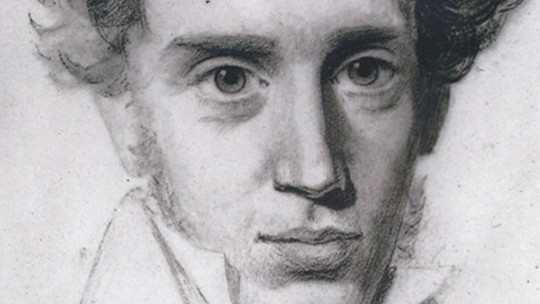
Søren Kierkegaard’s thought is an attempt to offer a philosophical framework through which to address questions such as “who am I?” “What do I live for?” or “what should I do?” It is a form of philosophy that focuses on human subjectivity.
In this article we will review the fundamentals of Kierkegaard’s existentialist theory.
Who was Søren Kierkegaard?
The philosopher Søren Kierkegaard was born in Copenhagen on May 5, 1813 into a wealthy family. He studied theology in his hometown, and also trained in philosophy, a field to which he ended up dedicating his life.
Melancholy was one of the elements that marked the history of Søren Kierkegaard, a highly emotional person who, in turn, imbued his philosophy with this characteristic. He, in turn, harshly criticized both the Church and Hegelian philosophy, which was hegemonic in Europe during much of the 19th century, given that the latter spoke about absolutes and left subjectivity aside.
How many of these have you been "meaning to read" for months?
- 1
 New Harbinger PublicationsThe Untethered SoulThe Journey Beyond YourselfListen Free On Audible
- 2
 Sourcebooks, Inc.My Calm Down BookA Sensory Book to Help Kids Calm Their BodiesListen Free On Audible
- 3
 FINGERPRINT with FP logoMeditations (Deluxe Hardbound Edition)FINGERPRINT with FP logoListen Free On Audible
Kierkegaard died in Copenhagen in 1855 after suffering a crisis and spending several weeks in the hospital.
Kierkegaard’s existentialist theory
Next we will see what were the most notable aspects of Kierkegaard’s philosophy, in its most existentialist facet.
1. Freedom of choice defines life
Kierkegaard believed that life is fundamentally about choosing. It is through elections that we develop our existence, what speaks about who we are and what stories we have left behind us.
2. Elections are inevitable
Whatever we do, we must constantly decide, since doing nothing is also an option that we have chosen when we find ourselves at a crossroads of possible actions to take.
3. Morality also starts from freedom
Decisions are not limited to observable actions; there are also some that They have a strong moral character. That is why we must choose between what is fair and what gives us pleasure.
However, for Søren Kierkegaard the conditions under which we choose depend solely on us, and not on anyone else or the context. Everything is our responsibility, since for this philosopher we must assume that we choose from scratch.
The above implies, for example, that neither our past nor the history of our family or neighborhood has any influence.
4. Anguish fills us
As we constantly move from one choice to another, we experience distress to a greater or lesser extent. We would prefer to live without having to constantly choose, and past times, which we see through the illusion that they were not based on decisions, seem more attractive to us than the present.
5. Vertigo
We constantly feel the weight of freedom, which makes us let’s feel existential vertigo to the idea that there is nothing that separates us from the void. Uncertainty makes it seem like everything can be ruined.
Criticisms of Kierkegaard’s philosophy
The ideas of this Danish thinker are not exempt from criticism. For example, it is common accuse Kierkegaard of being too individualistic, since it is based on philosophical questions that have to do with the person alone and not with the person in society. It is as if the outside world did not exist and social phenomena had a negligible impact on our lives.
On the other hand, it is also criticized for not taking into account history, what makes a culture what it is. In this way, he makes it clear that decisions depend on us, and that neither our past nor the past of our family line influences any of that. This is something that later existentialists tried to correct to get out of that individualism, the price of adopting a philosophy focused on the subjective.
Use this citation format to reference the article clearly and help readers find the original source.
PsychologyFor. (2024). Søren Kierkegaard’s Existentialist Theory. PsychologyFor. https://psychologyfor.com/soren-kierkegaards-existentialist-theory/