

See more of our articles in your search results.
Your heart slams against your ribs before you’ve even processed what scared you, your breath goes shallow, and your whole body feels primed to run, even though you’re just sitting at your desk staring at an email. Then, hours later, after the crisis has passed, you finally exhale, your shoulders drop, and you realize how exhausted the whole ordeal left you feeling. Maybe you’ve also noticed the opposite struggle: a nagging inability to fully relax, even on vacation, as though some part of you is still braced for the next demand. These shifts, from tension to release and back again, are governed by two opposing yet deeply connected systems: the sympathetic and parasympathetic nervous systems.
It’s genuinely exhausting to feel like your body reacts more intensely than a situation seems to warrant, or to struggle to unwind even when nothing is actively threatening you. This disconnect between what you consciously know and what your body automatically does can leave people feeling confused, or even ashamed, as though they should simply be able to will themselves calm. That expectation misunderstands how deeply automatic this system truly is; these physical shifts are not a matter of willpower but of two specific, well-documented branches of the autonomic nervous system working in constant, dynamic balance. Understanding exactly how these two systems differ and cooperate can transform a frustrating, confusing bodily experience into something concrete, explainable, and ultimately more manageable.
So what actually separates the system that revs you up from the one that calms you down, and how do they manage to work together so seamlessly?
This article breaks down the key differences and functions of the sympathetic and parasympathetic nervous systems, along with practical ways to support healthier balance between them.
What Are the Sympathetic and Parasympathetic Nervous Systems?
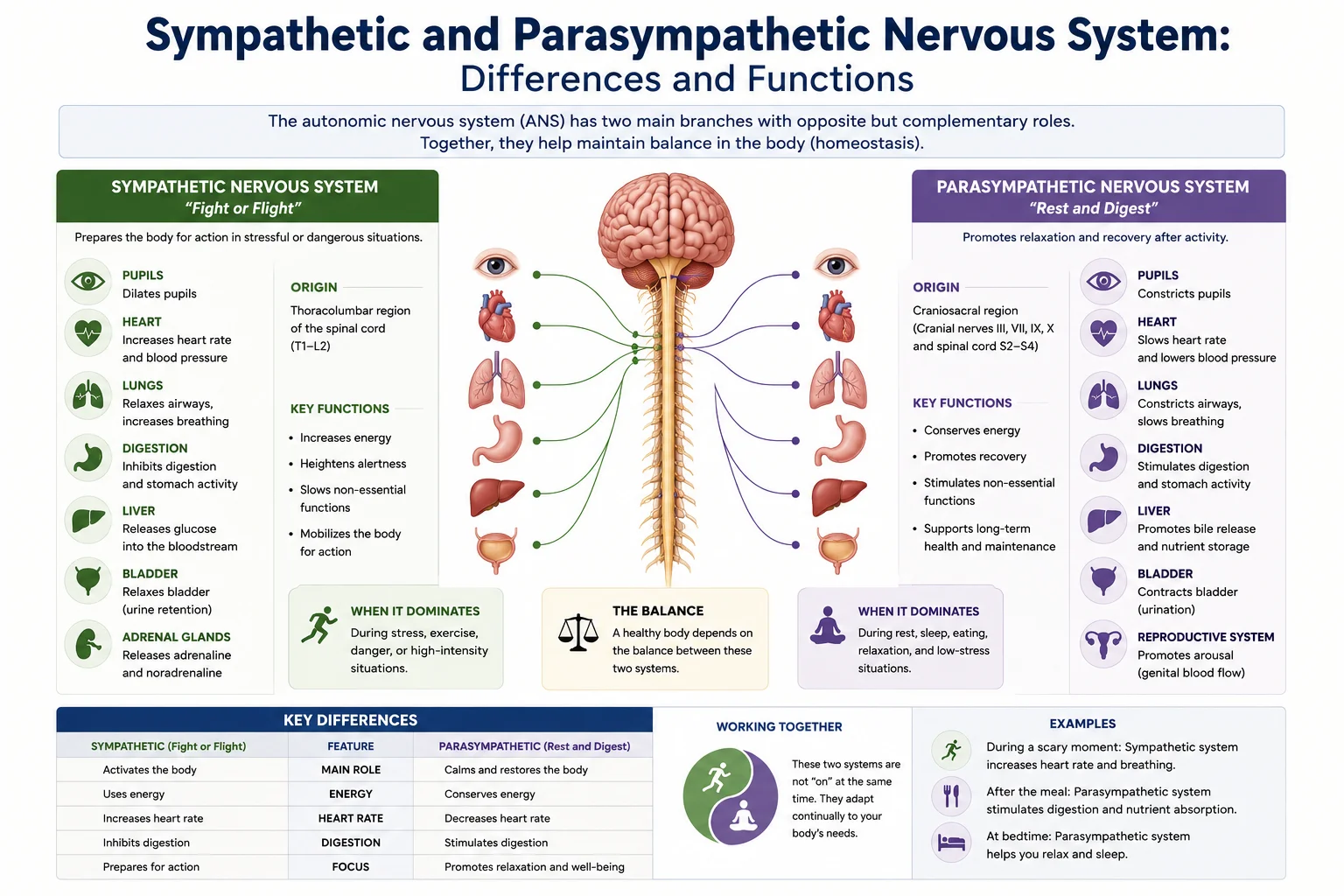
The sympathetic and parasympathetic nervous systems are the two primary branches of the autonomic nervous system, each responsible for regulating the body’s involuntary functions in opposite directions. Together, they form a finely tuned regulatory system that adjusts heart rate, digestion, breathing, and countless other automatic processes based on the body’s immediate needs.
How many of these have you been "meaning to read" for months?
- 1
 TarcherThe Artist's Way30th Anniversary EditionListen Free On Audible
 - 2
 Atria BooksThe Courage to Be DislikedThe Japanese Phenomenon That Shows You How to Change Your Life and Achieve Real HappinessListen Free On Audible
 - 3
 Hay HouseBecoming SupernaturalHow Common People Are Doing the UncommonListen Free On Audible
Physiologist John Newport Langley, who coined the term autonomic nervous system in the early twentieth century, established the framework still used today for classifying these two branches based on their distinct anatomical origins and largely opposing physiological effects. The sympathetic nervous system generally mobilizes the body for action, while the parasympathetic nervous system generally promotes rest, digestion, and recovery, though both systems remain continuously active to some degree, adjusting their relative influence rather than switching on and off like a simple light switch.
These two systems innervate many of the same organs, including the heart, lungs, digestive tract, and eyes, but produce opposite effects on each, a structural arrangement physiologists call dual innervation. This design allows for remarkably fine-tuned control, since the body can adjust an organ’s activity level along a continuous spectrum rather than being limited to a simple binary “on or off” state.
Understanding that these two systems work in constant, shifting balance, rather than operating as strictly separate or opposing forces, offers a genuinely useful framework for making sense of physical stress responses and the process of calming back down afterward.
How Is Each System Structured Anatomically?
The sympathetic and parasympathetic nervous systems originate from different regions of the central nervous system and follow distinct anatomical pathways to reach their target organs. This structural difference is part of what allows them to be activated somewhat independently of one another.
The sympathetic nervous system originates from the thoracic and lumbar regions of the spinal cord, a pattern anatomists describe as thoracolumbar outflow. From there, sympathetic nerve fibers travel to a chain of ganglia running alongside the spinal column before extending outward to target organs throughout the body, allowing for widespread, coordinated activation across many organs simultaneously. The parasympathetic nervous system, by contrast, originates from the brainstem and the sacral region of the spinal cord, a pattern known as craniosacral outflow, with the vagus nerve alone responsible for carrying a substantial portion of all parasympathetic signaling to the heart, lungs, and digestive organs.
- The sympathetic nervous system originates from the thoracic and lumbar spinal cord, allowing widespread, simultaneous organ activation.
- The parasympathetic nervous system originates from the brainstem and sacral spinal cord, largely through the vagus nerve.
- Sympathetic ganglia form a chain alongside the spinal column, while parasympathetic ganglia sit closer to or within the target organs themselves.
- This structural difference allows for more localized, specific activation of the parasympathetic nervous system compared to the sympathetic branch.
This anatomical distinction has real functional consequences: because sympathetic ganglia sit close to the spinal cord while parasympathetic ganglia sit near their target organs, sympathetic activation tends to spread more broadly and simultaneously across multiple organs, while parasympathetic activation can be more precisely targeted to a specific organ or region as needed.
What Does the Sympathetic Nervous System Do During Stress?
The sympathetic nervous system activates the body’s rapid, energizing response to perceived threats or physical demands. It functions much like an accelerator, quickly mobilizing the resources needed for immediate action.
Physiologist Walter Cannon’s influential early twentieth-century research described this activation pattern in detail, coining the now-famous term fight-or-flight response to capture how the sympathetic nervous system prepares the body to either confront a threat or flee from it. When activated, this system increases heart rate and blood pressure, redirects blood flow away from digestion and toward large muscle groups, dilates the pupils to sharpen vision, and triggers the release of stress hormones like adrenaline from the adrenal glands.
This response evolved as a genuinely protective mechanism for responding to immediate physical danger, but in modern daily life, it frequently activates in response to psychological stressors that don’t actually require a physical fight-or-flight reaction, such as a demanding email or a tense conversation. Endocrinologist Hans Selye’s extensive research on stress physiology, which he termed the general adaptation syndrome, demonstrated that repeated or prolonged sympathetic activation without adequate recovery time can contribute meaningfully to long-term health problems, since the body was never designed to remain in this heightened state indefinitely.
A practical takeaway: recognizing physical sensations like a racing heart or shallow breathing as sympathetic nervous system activation, rather than a personal failing, can help you respond with self-compassion and more quickly employ effective calming strategies.
What Does the Parasympathetic Nervous System Do During Rest?
The parasympathetic nervous system counterbalances the sympathetic response, promoting relaxation, digestion, and recovery once a perceived threat has passed. It functions like a brake, gradually slowing the body’s systems back down to a calmer baseline.
Often summarized by the phrase “rest and digest,” the parasympathetic nervous system slows heart rate, stimulates digestive activity, constricts the pupils, and supports the body’s repair and recovery processes. A substantial portion of parasympathetic activity travels through the vagus nerve, the longest cranial nerve in the body, connecting the brainstem to the heart, lungs, and digestive organs, making it a central player in the body’s relaxation response.
Psychiatrist and researcher Stephen Porges’s influential polyvagal theory expanded scientific understanding of this system, proposing that vagal nerve activity contributes not only to physical relaxation but also to social engagement and emotional regulation, suggesting that vagal tone, the vagus nerve’s overall activity level, plays a meaningful role in how effectively a person can shift between states of stress and calm. Cardiologist Herbert Benson’s well-known research on what he termed the relaxation response further demonstrated that deliberately engaging the parasympathetic nervous system through specific techniques could produce measurable physiological changes, including reduced heart rate, blood pressure, and stress hormone levels.
A genuinely practical takeaway: activities that stimulate the vagus nerve, such as slow, deep breathing with an extended exhale, can help actively engage the parasympathetic nervous system, offering a concrete, evidence-supported tool for calming the body during periods of stress.

Sympathetic vs Parasympathetic: What Are the Key Differences at a Glance?
The sympathetic and parasympathetic nervous systems differ across nearly every measurable physiological function, despite governing many of the same organs. Comparing them directly makes these opposing roles easy to understand at a glance.
| Feature | Sympathetic vs Parasympathetic Nervous System |
|---|---|
| Overall role | Sympathetic: mobilizes energy for action; Parasympathetic: conserves energy and supports recovery |
| Heart rate | Sympathetic: increases; Parasympathetic: decreases |
| Digestion | Sympathetic: inhibits; Parasympathetic: stimulates |
| Pupils | Sympathetic: dilate; Parasympathetic: constrict |
| Primary neurotransmitter | Sympathetic: norepinephrine; Parasympathetic: acetylcholine |
| Spinal origin | Sympathetic: thoracolumbar; Parasympathetic: craniosacral |
This side-by-side comparison highlights just how thoroughly these two systems oppose one another across nearly every organ they jointly regulate, from the eyes to the digestive tract to the cardiovascular system. Recognizing this antagonistic relationship helps explain why symptoms of chronic stress, like digestive upset alongside a persistently elevated heart rate, so often cluster together rather than appearing as isolated, unrelated complaints.
How Do Neurotransmitters Differ Between the Two Systems?
The sympathetic and parasympathetic nervous systems rely on distinct chemical messengers to produce their opposing effects. This chemical difference is what allows medications and the body itself to selectively influence one branch without necessarily affecting the other.
Pharmacologist Otto Loewi’s classic 1920s experiments provided the first direct evidence that nervous system communication involves chemical signaling, identifying acetylcholine as the primary neurotransmitter released by parasympathetic nerve fibers at their target organs. Sympathetic nerve fibers, by contrast, primarily release norepinephrine at their target organs, a chemical closely related to adrenaline that produces the excitatory, energizing effects characteristic of the fight-or-flight response. Interestingly, both systems actually use acetylcholine at an earlier stage in their signaling pathway, within the ganglia themselves, with the key difference emerging only at the final connection to the target organ.
This distinct chemical signaling explains why certain medications can selectively target one branch of the autonomic nervous system over the other; beta-blockers, for instance, work by blocking the effects of norepinephrine on the heart, reducing heart rate and blood pressure in people managing cardiovascular conditions or significant anxiety-related symptoms.
Recognizing that these two systems operate through genuinely distinct chemical pathways underscores why interventions aimed at calming the sympathetic nervous system, such as certain medications or breathing techniques, work through very different biological mechanisms than those aimed at directly stimulating parasympathetic activity.
How Do These Systems Work Together to Maintain Balance?
The sympathetic and parasympathetic nervous systems rarely operate in complete isolation from one another; instead, they exist in constant, dynamic balance, with one typically dominating depending on the immediate situation. This ongoing interplay is what allows the body to respond appropriately to an enormous range of circumstances throughout the day.
During a typical day, the parasympathetic nervous system generally maintains a baseline of calm regulation, supporting digestion and recovery during quiet, low-demand periods, while the sympathetic nervous system activates temporarily and appropriately in response to genuine physical or psychological demands, such as exercise or a sudden startle. This natural rhythm of activation and recovery is a normal, healthy pattern, and problems tend to arise specifically when this balance becomes chronically skewed toward sympathetic dominance without adequate parasympathetic recovery time.
Heart rate variability, the natural variation in time between heartbeats, offers a measurable window into this balance, with higher variability generally reflecting healthier, more flexible autonomic regulation and a greater capacity to shift smoothly between sympathetic and parasympathetic dominance as circumstances require. This measure has become an increasingly popular tool in both clinical and wellness settings for tracking stress resilience over time.
A practical takeaway: because this balance depends on regular opportunities for parasympathetic recovery, deliberately building brief periods of genuine rest and relaxation into a busy day, rather than waiting for exhaustion to force a break, supports healthier long-term autonomic balance.

What Happens When This Balance Is Disrupted?
Chronic imbalance between the sympathetic and parasympathetic nervous systems, typically involving excessive or prolonged sympathetic dominance, can produce a wide range of physical and emotional symptoms over time. This imbalance rarely announces itself clearly, often building gradually until symptoms become difficult to ignore.
Persistent sympathetic overactivation has been linked to symptoms including chronic muscle tension, digestive irregularities, disrupted sleep, elevated blood pressure, and a persistent sense of being “on edge” even in objectively safe situations. Conditions involving dysautonomia, or broader autonomic nervous system dysfunction, can produce more specific and sometimes dramatic symptoms, such as an abnormally rapid heart rate upon standing, seen in postural orthostatic tachycardia syndrome, reflecting a genuine breakdown in the normal balance and coordination between these two systems.
- Chronic sympathetic dominance can contribute to persistent muscle tension, elevated blood pressure, and disrupted sleep.
- Reduced vagal tone may reflect a diminished capacity for effective parasympathetic recovery after stress.
- Digestive irregularities often accompany prolonged sympathetic activation, since digestion is actively suppressed during stress.
- Autonomic dysfunction can produce more specific symptoms, like orthostatic intolerance, reflecting deeper imbalance.
Because these symptoms can appear gradually and are sometimes dismissed as ordinary stress, recognizing persistent sympathetic overactivation as a genuine physiological pattern, rather than simply “being busy” or “being anxious,” can encourage more proactive attention to recovery and, when appropriate, professional support.
How Can You Support Healthy Autonomic Balance?
Supporting healthy balance between the sympathetic and parasympathetic nervous systems involves deliberately incorporating practices that activate the parasympathetic branch, since modern life often provides abundant sympathetic activation but too little structured recovery. Fortunately, several well-studied strategies can meaningfully shift this balance.
Cardiologist Herbert Benson’s research on the relaxation response demonstrated that structured practices like slow, deep breathing, progressive muscle relaxation, and meditation can produce measurable reductions in heart rate, blood pressure, and stress hormone levels, directly supporting parasympathetic activity. Regular physical exercise, despite temporarily activating the sympathetic nervous system during the activity itself, has been consistently associated with improved long-term autonomic balance and increased vagal tone over time. Consistent, adequate sleep also plays an essential role, since sleep deprivation has been shown to shift autonomic balance toward greater sympathetic dominance even during waking hours.
- Practice slow diaphragmatic breathing with an extended exhale to directly stimulate parasympathetic activity.
- Engage in regular physical activity, since consistent exercise supports healthier long-term autonomic balance.
- Prioritize consistent, adequate sleep, since sleep deprivation shifts the body toward greater sympathetic dominance.
- Build brief recovery periods into daily routines rather than waiting for exhaustion to force genuine rest.
These strategies work precisely because they target the same physiological pathways involved in the body’s natural stress and recovery cycle, offering genuinely evidence-supported tools rather than vague wellness advice.

How Does This Balance Change Across the Lifespan?
Sympathetic and parasympathetic nervous system balance shifts naturally across different life stages, reflecting both developmental changes and cumulative life experience. Recognizing this trajectory helps set realistic expectations for how stress responses and recovery capacity change over time.
In infancy and early childhood, autonomic regulation is still maturing, which is part of why young children can shift rapidly and intensely between states of distress and calm compared to older children and adults; this capacity for smooth autonomic regulation continues developing well into adolescence. In older adulthood, natural declines in vagal tone and heart rate variability are common, contributing to a somewhat reduced capacity for rapid autonomic adjustment, such as slower blood pressure recovery after standing up. Chronic health conditions that become more common with age, including diabetes and cardiovascular disease, can further affect this delicate balance, making consistent management of these conditions an important part of preserving healthy autonomic function.
Practical strategies for supporting healthy sympathetic and parasympathetic balance across the lifespan include managing chronic health conditions proactively, maintaining regular physical activity appropriate to one’s age and ability, prioritizing consistent sleep, and practicing stress-reduction techniques that actively engage the parasympathetic nervous system throughout every life stage.
FAQs about Sympathetic and Parasympathetic Nervous Systems
What is the main difference between the sympathetic and parasympathetic nervous systems?
The sympathetic nervous system activates the body’s fight-or-flight response, increasing heart rate and mobilizing energy during moments of stress or perceived danger, while the parasympathetic nervous system promotes rest, digestion, and recovery once that stress has passed. They also differ anatomically, with the sympathetic system originating from the thoracic and lumbar spinal cord and the parasympathetic system originating from the brainstem and sacral spinal cord. Additionally, they rely on different primary neurotransmitters at their target organs, with the sympathetic system using norepinephrine and the parasympathetic system using acetylcholine. Despite these differences, both systems work together continuously to maintain overall physiological balance.
Can you consciously control your sympathetic and parasympathetic nervous systems?
While these systems generally operate automatically, without direct conscious control, certain deliberate practices can meaningfully influence their relative balance. Slow, controlled breathing techniques, for example, can directly stimulate the vagus nerve and shift activity toward greater parasympathetic dominance, producing measurable reductions in heart rate and blood pressure. Regular exercise, meditation, and consistent sleep have all been shown to improve overall autonomic balance and increase vagal tone over time. While you cannot simply “decide” to activate the parasympathetic nervous system the way you might consciously move a muscle, these evidence-based practices offer a genuinely effective indirect pathway.
What happens when the sympathetic nervous system is overactive?
Chronic sympathetic nervous system overactivation, often resulting from prolonged or repeated stress, can contribute to a range of symptoms including persistent muscle tension, elevated blood pressure, digestive irregularities, and disrupted sleep. Over time, this sustained activation without adequate parasympathetic recovery has been linked to broader long-term health concerns, since the body was never designed to remain in this heightened state indefinitely. People experiencing chronic sympathetic overactivation often describe feeling persistently “on edge,” even in objectively safe situations. Structured relaxation techniques and, when appropriate, professional support can help restore healthier autonomic balance.
How does the vagus nerve relate to the parasympathetic nervous system?
The vagus nerve is the longest cranial nerve in the body and carries a substantial portion of all parasympathetic signaling, connecting the brainstem to the heart, lungs, and digestive organs. Its overall activity level, often called vagal tone, plays a significant role in how effectively a person can shift between states of stress and calm, according to research including the polyvagal theory. Because the vagus nerve carries far more sensory information from the body to the brain than in the opposite direction, it also plays an important role in the connection between physical sensations and emotional regulation. Practices like slow, deep breathing with an extended exhale are commonly used to help stimulate vagal activity and support parasympathetic recovery.
Are the sympathetic and parasympathetic nervous systems always working against each other?
While these systems generally produce opposing effects on the organs they jointly regulate, describing them as constantly “fighting” oversimplifies their relationship. In reality, both systems remain continuously active to some degree, with one typically dominating depending on the body’s immediate needs, creating a dynamic, shifting balance rather than a strict binary opposition. This ongoing interplay allows the body to respond appropriately to an enormous range of circumstances throughout the day, from sudden stress to quiet rest. Problems tend to arise specifically when this balance becomes chronically skewed, rather than from the systems simply opposing one another as part of their normal function.
What are some signs that your parasympathetic nervous system needs support?
Signs that the parasympathetic nervous system may need more support include difficulty relaxing even in calm situations, persistent muscle tension, disrupted sleep, digestive irregularities, and a general sense of being unable to unwind after stressful periods. Reduced heart rate variability, a measurable indicator of autonomic flexibility, can also suggest a diminished capacity for parasympathetic recovery. These signs often reflect chronic sympathetic dominance rather than a specific medical illness, though persistent or severe symptoms should still be evaluated by a healthcare provider. Incorporating deliberate relaxation practices, regular physical activity, and consistent sleep can help restore healthier autonomic balance over time.
Bibliography
- StatPearls Publishing. (2022). Neuroanatomy, Parasympathetic Nervous System. National Center for Biotechnology Information Bookshelf.
- StatPearls Publishing. (2025). Anatomy, Autonomic Nervous System. National Center for Biotechnology Information Bookshelf.
- Cleveland Clinic. (2022). Parasympathetic Nervous System (PSNS): What It Is & Function.
- Langley, J. N. (1921). The Autonomic Nervous System, Part 1. W. Heffer & Sons.
- Cannon, W. B. (1932). The Wisdom of the Body. W.W. Norton & Company.
- Loewi, O. (1921). Über humorale Übertragbarkeit der Herznervenwirkung. Pflügers Archiv für die gesamte Physiologie.
- Selye, H. (1956). The Stress of Life. McGraw-Hill.
- Porges, S. W. (2011). The Polyvagal Theory: Neurophysiological Foundations of Emotions, Attachment, Communication, and Self-Regulation. W.W. Norton & Company.
- Benson, H., & Klipper, M. Z. (1975). The Relaxation Response. William Morrow.
Use this citation format to reference the article clearly and help readers find the original source.
PsychologyFor. (2026). Sympathetic and Parasympathetic Nervous System: Differences and Functions. PsychologyFor. https://psychologyfor.com/sympathetic-and-parasympathetic-nervous-system-differences-and-functions/